Indiana Advances Bitcoin Rights Law as U.S. States Deepen Crypto Integration

bitcoinistОпубликовано 2026-02-26Обновлено 2026-02-26

Введение

Indiana lawmakers have passed House Bill 1042, known as the Bitcoin Rights Bill, which now awaits the governor's signature. If enacted, the law would allow state-managed investment funds—including retirement plans for public employees and education savings programs—to offer cryptocurrency ETFs as voluntary investment options. It also establishes legal protections for individuals using or holding digital assets, including the right to accept crypto payments and use self-custodied wallets, while prohibiting public agencies from restricting lawful crypto activities. The bill aligns with a broader trend of U.S. states integrating digital assets into public financial systems and is set to take effect in July 2026.

Indiana is moving closer to formally embedding crypto into its public financial system after lawmakers approved House Bill 1042, commonly referred to as the Bitcoin Rights Bill. The legislation has cleared both legislative chambers and now awaits the signature of Governor Mike Braun.

Related Reading: Binance Faces US Senate Inquiry Tied To $1.7 Billion In Sanctions-Related Transactions

If enacted, the law would allow certain public investment programs to provide exposure to crypto through regulated ETFs and establish legal protections for individuals who use or hold digital assets. The measure reflects a broader shift among U.S. states as they explore how crypto fits within traditional finance.

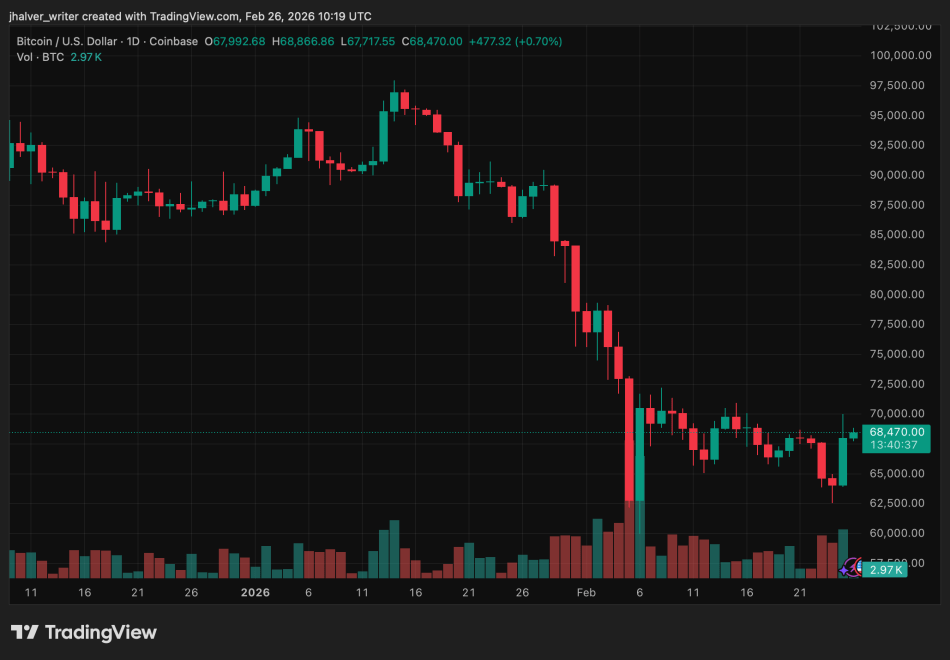
BTC's price trends to the downside with some sideways action on low timeframes as seen on the daily chart. Source: BTCUSD on Tradingview

Public Funds and Retirement Plans Open to Crypto ETFs

HB 1042 permits state-managed investment funds to include cryptocurrency ETFs as investment options rather than allowing direct token purchases. The approach aims to provide exposure through regulated financial products while maintaining oversight mechanisms.

Under the bill, several state-administered programs must offer self-directed brokerage accounts containing at least one digital asset investment option. These include retirement plans for teachers, public employees, and legislators, as well as the Hoosier START 529 education savings program.

Participation would remain voluntary, meaning individuals could choose whether to allocate funds toward crypto-related investments. Before rollout, the state must establish approved investment structures designed to manage compliance and risk oversight.

The legislation also allows eligible investment funds from outside Indiana to allocate assets into crypto ETFs under the state’s framework, potentially expanding institutional participation beyond state borders.

Legal Protections for Digital Asset Users

Beyond access to investment, the bill introduces protections for cryptocurrency users. Public agencies, with limited exceptions, would be restricted from banning or limiting lawful digital asset activities.

Residents would retain the right to accept crypto payments for legal goods and services and to store assets in self-custodied or hardware wallets. The proposal also prevents the state from imposing special taxes on crypto transactions and requires taxation rules to align with those applied to other financial activities.

Supporters argue that these provisions provide legal clarity for individuals and businesses operating in the digital asset space, while critics continue to highlight concerns about market volatility and retirement risk exposure.

Part of a Broader U.S. Policy Shift

Indiana’s move comes amid growing institutional interest in cryptos, following the expansion of crypto ETFs and evolving federal policy discussions on retirement portfolio diversification. Other states are considering similar measures, signaling a gradual shift toward incorporating digital assets into public finance structures.

HB 1042, introduced by State Representative Kyle Pierce, completed the legislative process after the House approved Senate amendments. If Governor Braun signs the bill, the law is scheduled to take effect on July 1, 2026, triggering implementation by state agencies and retirement administrators.

Related Reading: Netherlands To Amend Controversial 36% Tax On Unrealized Crypto, Stock Gains

As more states evaluate crypto-focused legislation, Indiana’s decision could serve as another trigger to the continued adoption of crypto in other states’ financial systems.

Cover image from ChatGPT, BTCUSD chart on Tradingview

Связанные с этим вопросы

QWhat is the main purpose of Indiana's House Bill 1042, also known as the Bitcoin Rights Bill?

AThe main purpose is to allow certain public investment programs to provide exposure to cryptocurrency through regulated ETFs and to establish legal protections for individuals who use or hold digital assets.

QWhich specific state-administered programs must offer a digital asset investment option under this bill?

AThe programs include retirement plans for teachers, public employees, and legislators, as well as the Hoosier START 529 education savings program.

QWhat are some of the key legal protections for cryptocurrency users provided by this legislation?

AThe bill prevents public agencies from banning lawful digital asset activities, allows residents to accept crypto payments and use self-custodied wallets, and prohibits special taxes on crypto transactions, requiring taxation to align with other financial activities.

QHow does the bill propose to provide crypto exposure to public funds without allowing direct token purchases?

AIt permits state-managed investment funds to include cryptocurrency ETFs as investment options, providing exposure through these regulated financial products.

QWhen is the Indiana Bitcoin Rights Bill scheduled to take effect if signed by the governor?

AThe law is scheduled to take effect on July 1, 2026, if signed by Governor Mike Braun.

Похожее

Popular Interaction Collection | Interstate Launches Points Event; Flip Early Waitlist Application (June 12)

**Interstate Launches Points Event, Flip Opens Early Waitlist Applications** *Originally published by Odaily Planet Daily, author Asher.* **Interstate**, an infrastructure platform integrating on-chain transactions for assets like Meme tokens, prediction markets, and xStocks, has launched a points event. Each trade on the platform now rewards users with points. The project has completed a $1.5 million seed round from investors including MH Ventures, Alchemy Ventures, and Marshland Capital. Users can visit the official website to connect their wallets and start earning points through trading tasks (note: the site may experience high traffic). **Flip**, an AI-powered financial assistant, has opened applications for its early waitlist. The platform allows users to manage finances via chat, helping with spending tracking, bill management, investment portfolio monitoring (including stocks and crypto), and more. Flip recently raised $1.4 million in a pre-seed round led by The House Fund and participated in a16z's Speedrun accelerator. Interested users can join the waitlist via the official website. **ArcNova**, an AI-native infrastructure platform for short-form video and entertainment, continues to offer tasks for earning points. Users can sign in daily, complete social and app tasks, and refer friends to accumulate points. The project announced a $15 million funding round in May, backed by Adaverse Ventures, Animoca Brands, and others. The task portal is accessible through the ArcNova website. These updates highlight ongoing opportunities for user engagement and potential rewards across emerging crypto and AI projects.

Odaily星球日报29 мин. назад

Popular Interaction Collection | Interstate Launches Points Event; Flip Early Waitlist Application (June 12)

Odaily星球日报29 мин. назад

MoneyGram: Why Did We Launch Our Own Stablecoin?

MoneyGram, a global leader in cross-border remittances for over 80 years, has launched its own stablecoin, MGUSD. The initiative aims to evolve from single-transaction services to becoming a more integral part of users' financial lives. By allowing customers to hold a stable US dollar balance within the MoneyGram app, MGUSD enables not only remittances but also everyday spending, currency exchange, cash access, and future financial services. Targeting the billions globally who face challenges like currency volatility or lack of bank accounts, MGUSD leverages Stellar blockchain technology with a self-custody wallet architecture. This gives users control over their assets while providing a secure, compliant experience through a trusted brand. The approach focuses on solving existing customer pain points within MoneyGram's established network, rather than competing for broad crypto market liquidity. A key advantage is MoneyGram's hybrid model, combining digital services with the world's largest physical network for crypto-to-cash conversions. The stablecoin also modernizes the company's internal infrastructure, streamlining treasury management and partner settlements, with annual forex volume via stablecoins already reaching $2 billion. The project was delivered in about a year, driven by a reorganization into agile, cross-functional teams that operate with startup-like speed while leveraging decades of institutional expertise. Partners include Stablecoin (issuance), Crossmint (wallet APIs), Fireblocks (enterprise treasury), m0 (smart contracts), and the Stellar network. MoneyGram emphasizes that enhancing direct consumer offerings strengthens its partner ecosystem. The future direction is clear: to provide users worldwide with stable value storage, better financial tools, and greater control over their funds through a trusted, existing network.

Foresight News1 ч. назад

MoneyGram: Why Did We Launch Our Own Stablecoin?

Foresight News1 ч. назад

Торговля

Спот
Фьючерсы
活动图片