In Just 70 Days, Polymarket Easily Rakes in Tens of Millions in Fees

Odaily星球日报Опубликовано 2026-03-16Обновлено 2026-03-16

Введение

Polymarket, a prediction market platform, has generated over $11.2 million in fees in just 70 days since introducing transaction fees on January 6. Initially applied only to "15-minute crypto up/down" markets, the fee structure charges more when odds are near 50% (up to 1.56%) and less when they approach 0% or 100%. By March 6, fees were expanded to all crypto-related markets, which now drive most of the revenue. Weekly fee income has shown consistent growth, reaching $1.84 million in a recent week. If current trading volume and structure continue, Polymarket’s annualized revenue is estimated at $58.4 million under a conservative model. A more aggressive projection—assuming fees are applied to all markets—could yield up to $360 million per year. The platform has also distributed $13.41 million in liquidity provider incentives, which March revenue is on track to cover entirely. Polymarket’s revenue potential hinges on two factors: continued growth in trading volume and further expansion of fee-based markets. The platform has effectively proven the profitability of the prediction market model, positioning it as a highly efficient revenue generator in the crypto ecosystem.

Original | Odaily Planet Daily (@OdailyChina)

Author | Azuma (@azuma_eth)

On January 6th of this year, Polymarket officially ended its "zero-fee" model, beginning a trial implementation of transaction fees starting with the "15-minute cryptocurrency up/down" markets. The specific fee rate varies with the market's real-time odds — the closer the odds are to 0% or 100%, the lower the fee; conversely, the closer the odds are to 50%, the higher the fee, up to a maximum of 1.56%.

Later, on January 28th, about three weeks after the fees were introduced, we published an article titled "Data Estimates Show Polymarket Could Easily Exceed $100 Million in Annual Revenue, Assuming...". The article provided a static estimate based on Polymarket's trading volume and activity structure at the time: in the most conservative scenario, if the scope of fee-charging markets remained unchanged, Polymarket was projected to generate approximately $38 million in annual income; in the most aggressive scenario, if Polymarket extended fees to all markets, it was projected to earn $418 million in annual fee revenue.

When we last estimated Polymarket's revenue, we were hampered by an overly short observation period and too few calculable samples. Now, nearly two months later, we have used richer data to re-estimate Polymarket's revenue expectations. The results show that the so-called "conservative" estimate was indeed too conservative, and the "aggressive" expectation isn't too exaggerated.

Changes in Revenue Data

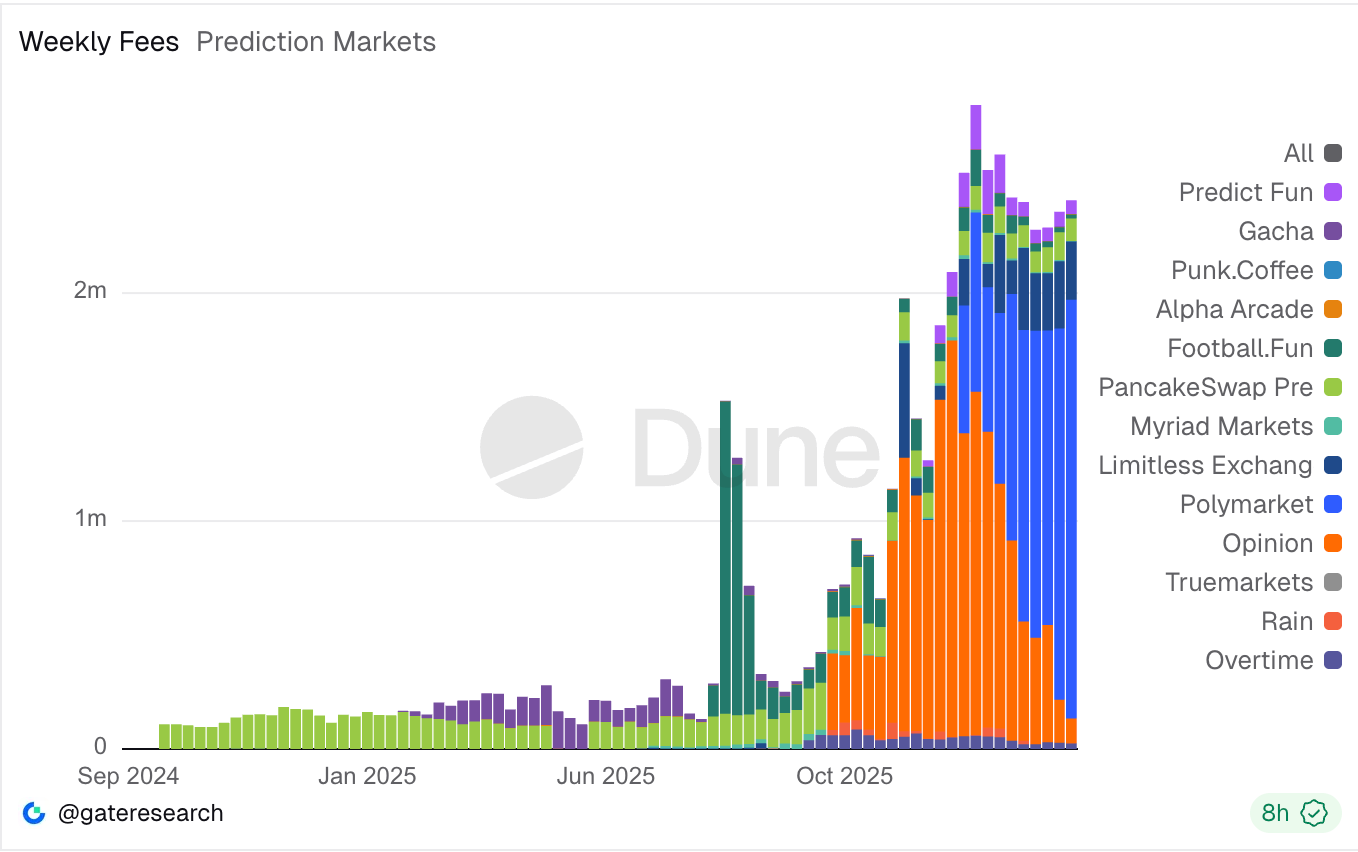
According to data compiled by Gate Research on Dune, since transaction fees were introduced on January 6th, Polymarket has accumulated over $11.2 million in fee revenue.

Using the most conservative method for another static estimate, assuming the trading volume and activity structure of the relevant markets remain unchanged, Polymarket is projected to generate approximately $58.4 million in annual revenue.
However, this estimation method does not accurately reflect Polymarket's revenue-generating capability.

The reason is that Polymarket's revenue data is clearly in a growth trend — over the past 10 weeks, the platform's weekly fee revenue has been $560,000, $786,000, $633,000, $749,000, $1.08 million, $1.28 million, $1.35 million, $1.29 million, $1.63 million, $1.84 million... showing almost weekly significant growth.

Reasons for Revenue Growth

There are two reasons for the growth in Polymarket's fee revenue. First, Polymarket has expanded the scope of fee-charging markets; second, Polymarket's overall trading volume and the trading volume in fee-charging markets have been growing continuously.

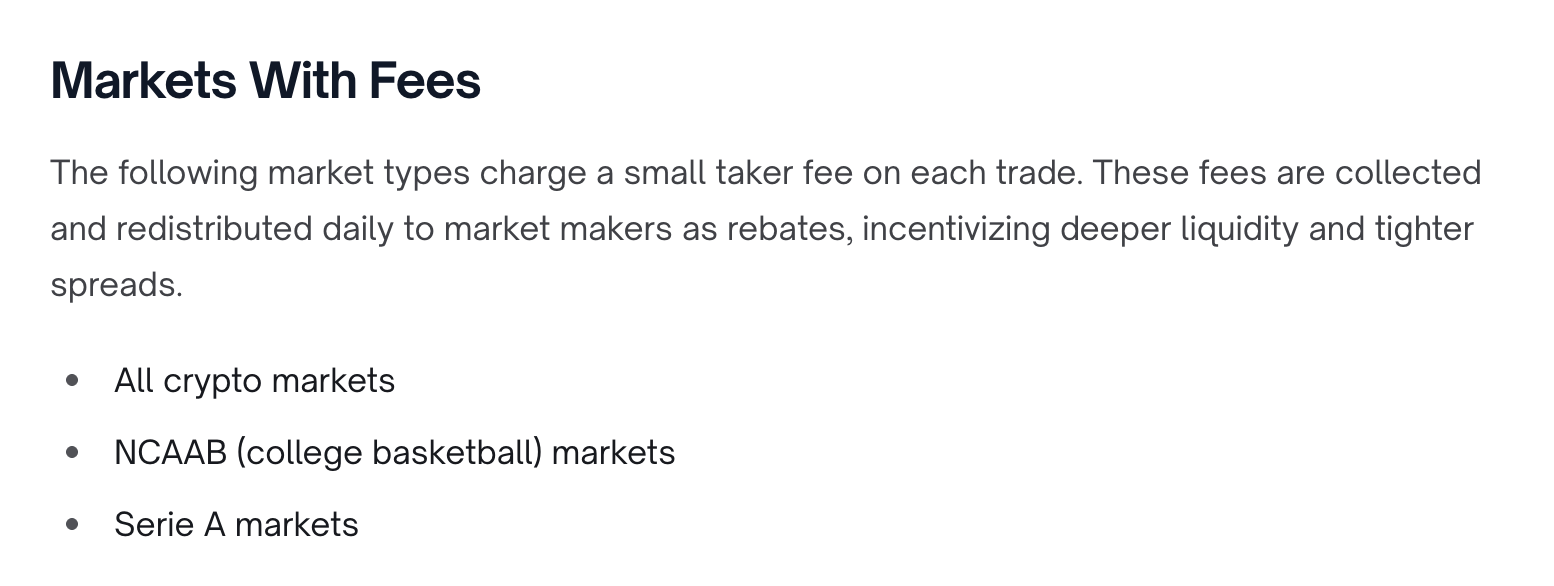
Regarding the scope of fee-charging markets, Polymarket extended the fee mechanism to all cryptocurrency-related markets on March 6th. Additionally, even earlier, it had begun trialing fee collection in sports markets like NCAA and Serie A. However, the former (cryptocurrency-related markets) currently remains the primary source of fee revenue.
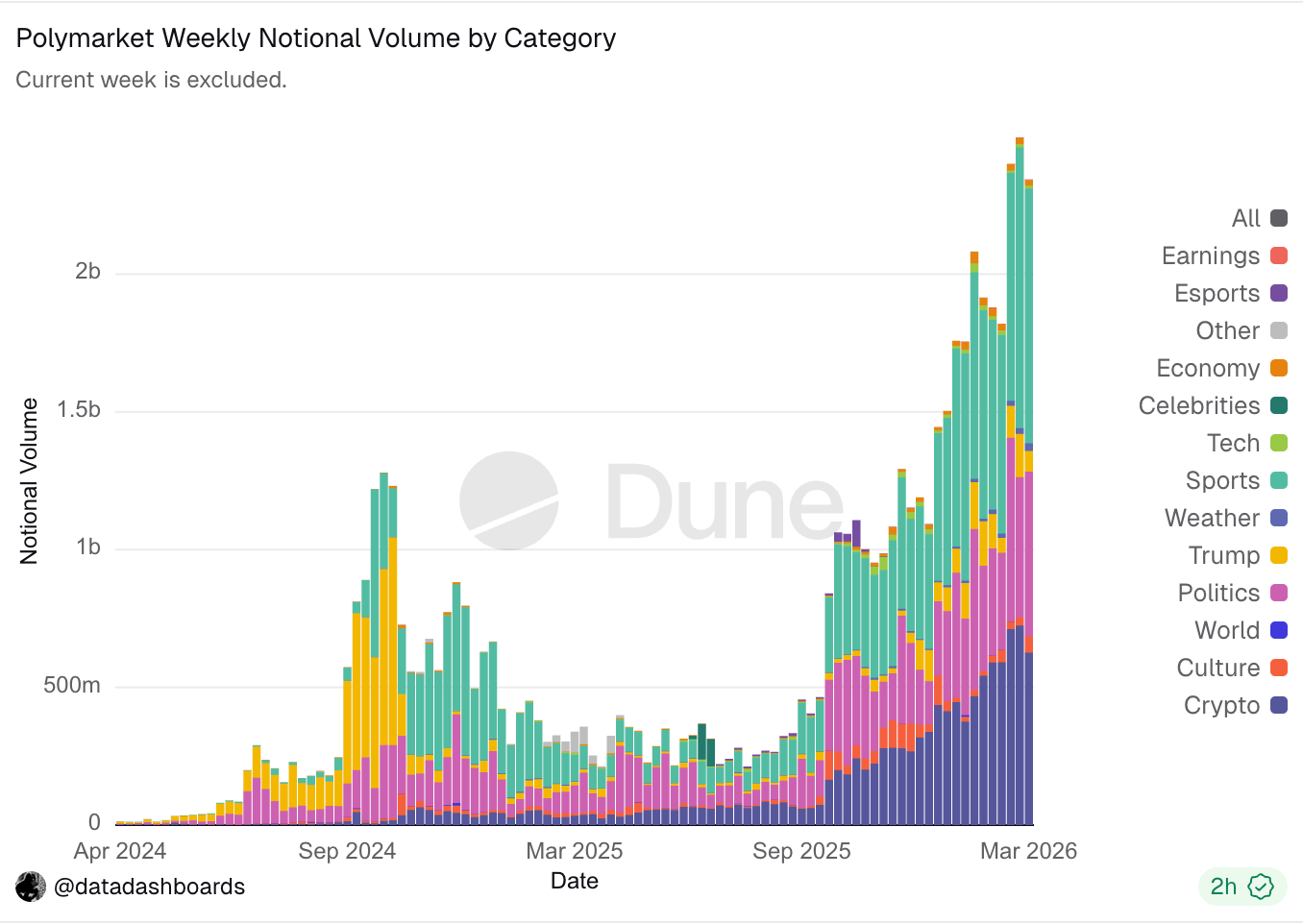
Regarding trading volume, the data dashboard compiled by Data Dashboards on Dune shows that Polymarket's weekly overall trading volume and cryptocurrency market volume (the bottom purple bars) have been growing steadily.
Future Revenue Projections

When we last projected Polymarket's revenue, we had to manually extract the trading volume proportion of "15-minute cryptocurrency up/down" related markets within all cryptocurrency-related markets. But now, since Polymarket extended fees to all cryptocurrency-related markets on March 6th, this estimation is much more straightforward. As for NCAA and Serie A, perhaps because the former hasn't entered the "March Madness" official tournament yet, and the latter has relatively low cultural attention in the US, the trading volume scale of these markets is significantly smaller compared to cryptocurrencies, so they are temporarily ignored here.

Taking data from the only full week after March 6th (March 9th-15th), the trading volume of cryptocurrency-related events accounted for 26.7% of the platform's total trading volume that week. In the same week, Polymarket's fee revenue was approximately $1.84 million. Based on this ratio for a static projection, under the current trading volume level and structure, if Polymarket introduces a similar fee model across all markets, it is projected to bring in $360 million in annual revenue for the platform.

The Money Printer is Already Running

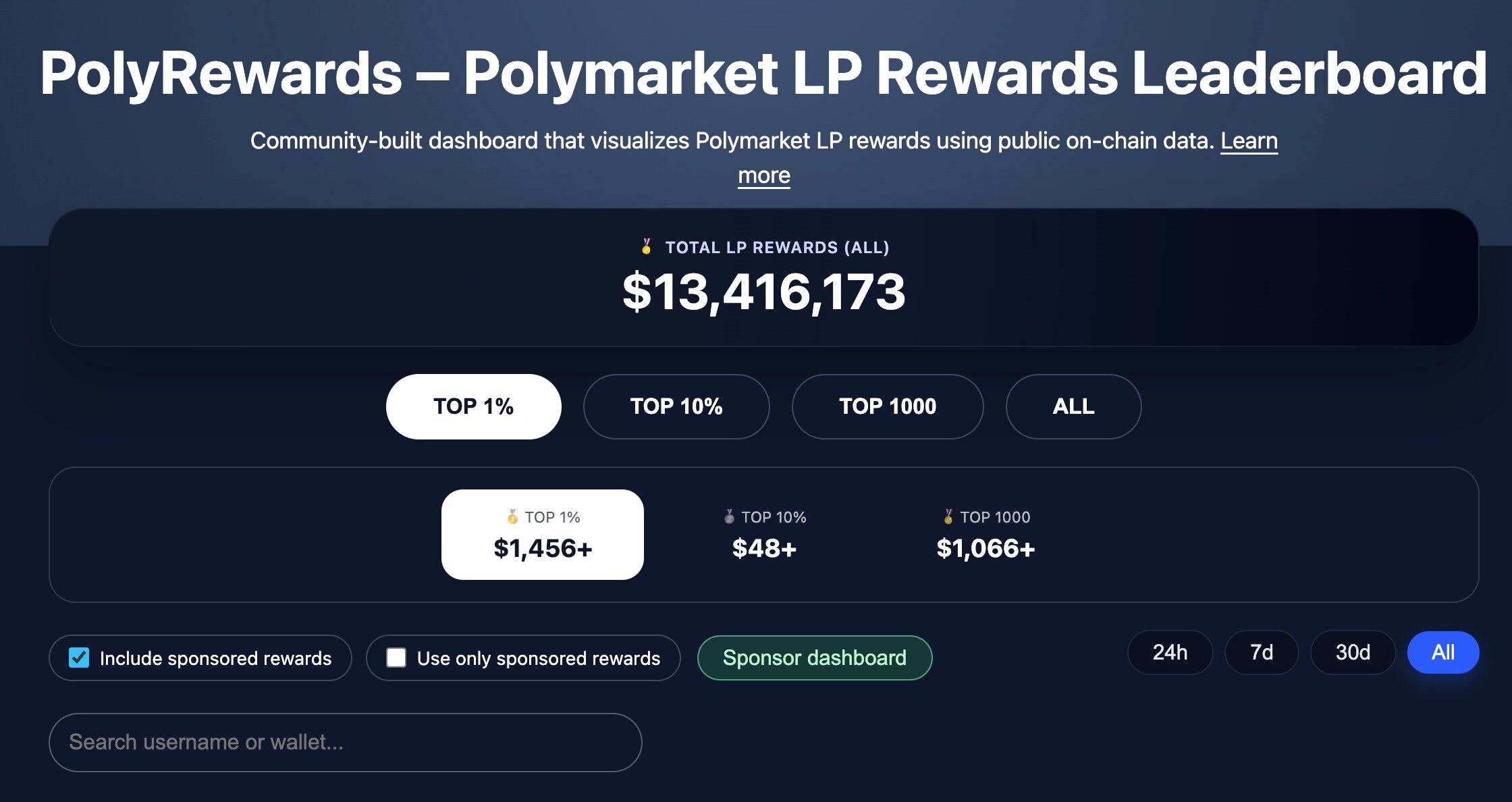
It is worth mentioning that, as a key measure for Polymarket to expand liquidity, the platform has so far distributed a total of $13.41 million in subsidies to liquidity providers (LPs). In contrast, if the data for the remainder of March can continue the performance of the first half, the fee revenue generated by Polymarket within this month alone could cover the total expenditure on liquidity subsidies.
Polymarket has largely proven the revenue-generating capability of this new form of prediction markets. Future revenue growth will mainly depend on two variables — how much more trading volume can grow, and whether fees can be further extended to more markets.

If these two variables continue to trend upwards, prediction markets might become the simplest and most direct "money printer" in the cryptocurrency industry.


Связанные с этим вопросы

QWhen did Polymarket start charging transaction fees, and what was the initial market targeted?

APolymarket started charging transaction fees on January 6, beginning with the '15-minute cryptocurrency up/down' markets.

QHow much fee revenue has Polymarket accumulated since it began charging fees?

APolymarket has accumulated over $11.2 million in fee revenue since it started charging transaction fees.

QWhat are the two main reasons for the growth in Polymarket's fee revenue?

AThe two main reasons are the expansion of fee-charging markets to include all crypto-related markets and the continuous growth in overall trading volume, particularly in cryptocurrency markets.

QWhat is the estimated annual revenue for Polymarket if fees are extended to all markets, according to the latest data?

AIf fees are extended to all markets, the estimated annual revenue for Polymarket is approximately $360 million, based on current trading volume and structure.

QHow does Polymarket's fee revenue compare to the subsidies it has provided to liquidity providers (LPs)?

APolymarket has provided a total of $13.41 million in subsidies to LPs. If the revenue trend from the first half of March continues, the fee income for the month alone could cover the total subsidies paid to LPs so far.

Похожее

2026 New Policy Interpretation: The "Mutual Pursuit" of Intelligent Agents and AI Terminals, and the Three Major Value Reconstructions in the AIoT Industry

In May 2026, China's national ministries released two pivotal policy documents that jointly establish a strategic "dual-track" framework for the AIoT industry. The "Intelligent Agent Standardized Application and Innovation Development Implementation Opinions" defines the "soul"—positioning intelligent agents as core AI products. The "Artificial Intelligence Terminal Intelligence Grading" national standard defines the "body"—establishing a four-tier capability ladder (L1 to L4) for AI hardware. This synchronized policy approach is globally unique, moving beyond market-led (US) or risk-focused (EU) models. It frames AIoT as a new type of "intelligent infrastructure," comparable to electricity or the internet in historical significance. The core analysis identifies a value evolution from IoT 1.0 (connection) to AIoT 4.0 (collaboration, represented by the forward-looking L4 level). This "L4" signifies a paradigm shift: from users operating tools to delegating tasks to agent-like devices ("Intelligent Action of All Things"). The article outlines three strategic paths for companies: becoming Standard Definers, Scenario Integrators (focusing on 19 specified application areas), or Infrastructure Builders. A critical 18-24 month window is identified for strategic positioning. A "Four Levers" strategy is proposed: leveraging Standards (L-level certification), leveraging Scenarios (deep vertical focus), leveraging Open Source (for cost reduction and ecosystem influence), and leveraging Momentum (engaging in global protocol ecosystems). In conclusion, these policies are a starting gun for a decade-long industrial transformation, shifting the industry narrative from "Intelligent Connection of All Things" to "Intelligent Action of All Things," with companies needing to choose their赛道and execution strategy decisively.

marsbit44 мин. назад

2026 New Policy Interpretation: The "Mutual Pursuit" of Intelligent Agents and AI Terminals, and the Three Major Value Reconstructions in the AIoT Industry

marsbit44 мин. назад

Splashing Out 27 Billion Yuan, OpenAI Establishes New Company to Accelerate AI Deployment

On May 11th, OpenAI announced the formation of a new company, "OpenAI Deployment Company," with an initial investment of over $4 billion (approximately 27.2 billion RMB). This venture aims to help businesses build and deploy AI solutions. OpenAI is also acquiring the AI consulting firm Toromo to rapidly scale the deployment company's capabilities. This new entity, majority-owned by OpenAI, brings together 19 investment, consulting, and system integration partners, led by TPG with co-lead founding partners including Advent International, Bain Capital, and Brookfield. OpenAI's Chief Revenue Officer, Denise Dresser, stated that while AI is becoming increasingly capable, the current challenge lies in integrating these systems into core business infrastructure and workflows. The deployment company is designed to bridge this gap and translate AI capabilities into operational impact. This move comes as OpenAI emphasizes the next competitive phase will depend on the efficiency of deploying AI in real business scenarios. The company reports over 1 million businesses already use its products and APIs. OpenAI is significantly increasing its investments in computing power, with co-founder Greg Brockman stating the company expects to spend $50 billion on compute this year, a dramatic increase from $3 million in 2017. The announcement follows OpenAI's recent completion of a record $122 billion funding round in late March, led by Amazon, Nvidia, and SoftBank, valuing the company at $852 billion post-money. Major strategic investors committed $110 billion as a base for this round. Concurrently, OpenAI is advancing its core model development. It has shifted focus from its Sora video generator to developing advanced robotics and AI models that interact with the physical world. It has also begun allowing select users access to a new model specialized in identifying software vulnerabilities and is reportedly preparing to launch an enhanced image generation model in the coming weeks. According to reports citing founder Sam Altman, OpenAI is considering an IPO as early as 2027, with a potential valuation around $1 trillion.

marsbit1 ч. назад

Splashing Out 27 Billion Yuan, OpenAI Establishes New Company to Accelerate AI Deployment

marsbit1 ч. назад

Торговля

Спот
Фьючерсы
活动图片




