I vibe-coded an Android app using Google

marsbitОпубликовано 2026-05-23Обновлено 2026-05-23

Введение

In a hands-on experience, Google AI Studio's new "prompt to phone" feature allows users to generate functional Android apps using natural language prompts. The author created three apps in one afternoon: a text-based adventure game called MOOD, a calorie counter, and a Super Mario-style game featuring Peach. The process involved describing the app concept, letting Gemini AI generate the code and interface, and then installing it directly onto a connected phone. While the apps were generated and installed quickly, their quality varied significantly. The text adventure was simplistic and buggy, the calorie counter provided inaccurate data due to flawed logic, and the platformer was prone to crashes. The AI could efficiently fix specific, identifiable bugs through follow-up prompts. However, the experience highlighted that while AI can rapidly prototype "working" software, creating reliable, accurate, and polished applications still requires human oversight, judgment, and iteration. The tool dramatically lowers the barrier to entry for personal software creation but doesn't yet replace the need for developer expertise in the final stages of quality and refinement.

Editor's Note: Google AI Studio is bringing AI programming to a more intuitive stage: users are no longer just having models 'write code', but can directly generate an Android application using natural language and install it on a real phone within minutes. From entering a prompt in the browser, to Gemini automatically generating code, designing interfaces, fixing bugs, to the app appearing on the device, the barrier to software development is being lowered even further.

The Verge author Sean Hollister recently experienced the 'prompt to phone' capability of Google AI Studio. He created three apps in one afternoon, including a text adventure game, a calorie calculator, and a Mario-like mini-game, with almost no need to write code himself, and some bugs could be quickly fixed by continuing the conversation. This experience shows that AI programming tools are moving from development environments closer to consumer-facing scenarios for ordinary users.

This is also the most imaginative aspect of the 'personal software revolution.' In the past, ordinary users could only wait for developers to create general products; now, they might be able to generate a fitness tracker, calorie calculator, or even a simple game on the fly according to their specific needs. For Google, this isn't just a demonstration of AI programming capability; it could also be a new entry point for Gemini into the mobile ecosystem, developer community, and subscription revenue.

However, this experience also illustrates that AI-generated applications still have a significant gap to truly mature. It can quickly produce a 'working' program but not necessarily a reliable, accurate, or user-friendly product: game narratives are crude, mechanics are thin, calorie data can be severely miscalculated, and the Mario-like mini-game even crashes repeatedly. More complex issues also include copyright boundaries, data sources, product judgment, and long-term maintenance capabilities.

What's truly worth paying attention to is not whether AI can already replace developers, but that the starting point of software production is changing. Google has proven that it's becoming a reality for ordinary people to create mobile apps using prompts; but from 'generating an app' to 'making a good app,' human professional experience, aesthetic judgment, and continuous iteration are still required in between. AI can significantly accelerate development speed, but the final mile of software quality can't be handed off—at least not yet.

Here is the original article:

Yesterday, I made my first Android app. Then, I made two more—three apps in one afternoon.

For one of the apps, I essentially just typed 148 English words into a web browser and then walked away. Ten minutes later, a brand new, complete app had appeared on my real Android phone. Of course, I did need to prepare the phone beforehand: enable USB debugging mode and connect it to my computer. But aside from that, as Google advertised, AI Studio did almost all the work for me.

I typed, clicked install, and then—voilà—a fully functioning program appeared. At that moment, I was almost ready to agree with David, Allison, and Jen's assessment: the personal software revolution has arrived, and it's entering your phone. In the future, even without programming skills, ordinary people might be able to get complex smart home device systems truly up and running.

Then, I started actually using these three apps: a calorie counter and two games. It turned out, they didn't perform very well. And just as I was beginning to enjoy iterating and trying to improve them, AI Studio reminded me that I had reached my daily usage limit. Next, I would either have to pay or wait for the quota to reset.

So, friction still exists. But there's no denying what an individual can accomplish nowadays is quite astonishing. That same morning, my colleague Stevie Bonifield also made a personal fitness tracker app, and he thought it was good enough to actually use. Faced with Gemini's pop-up prompt to upgrade to a paid plan, my first instinct was actually: 'Should I pay for a few months first?' That's not a reaction I would have expected myself to have towards a Google product.

How Google's AI Studio Builds an Android App

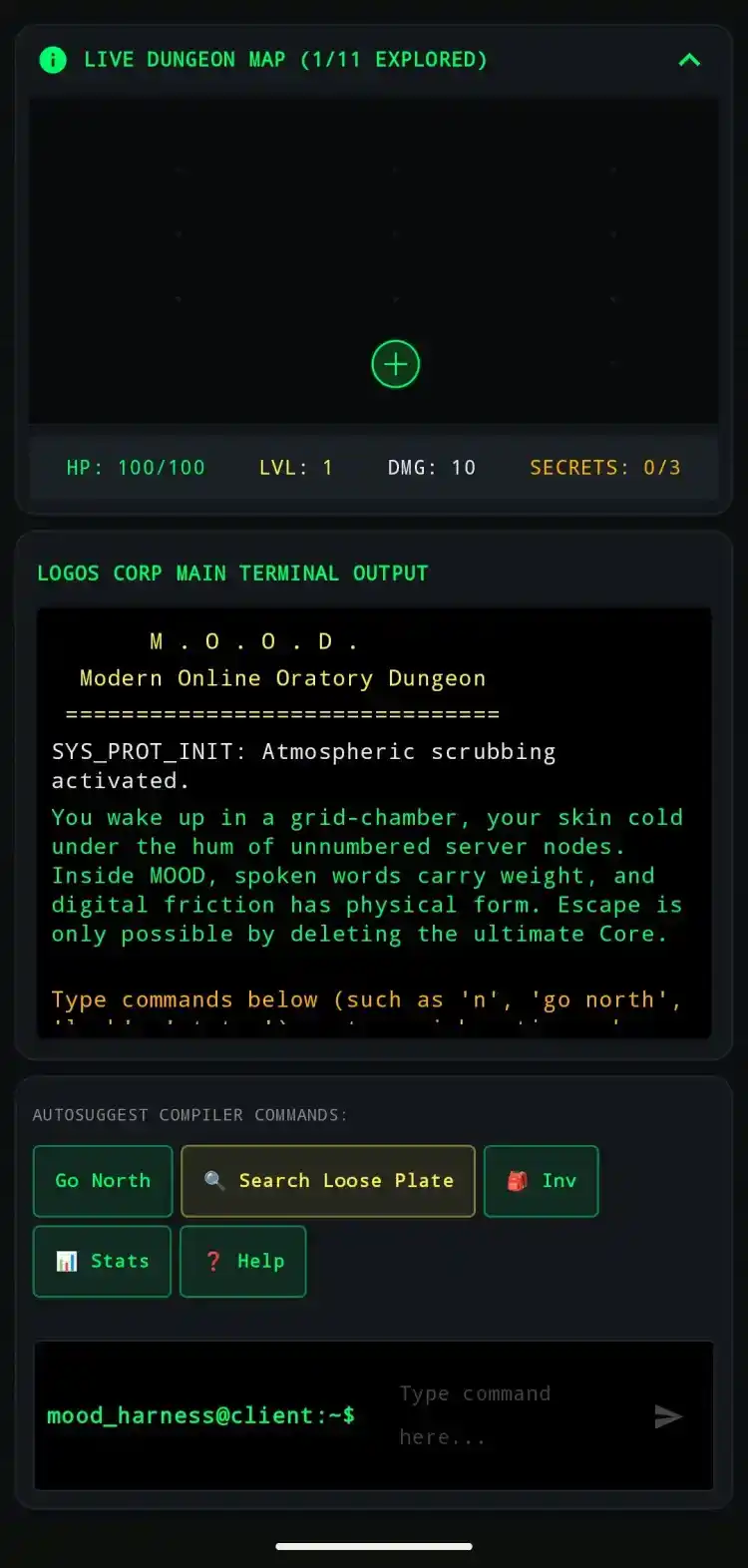
On Tuesday, when Google showed off using AI to write a game similar to Doom, we joked that I should make a game called MOOD. It would be a text adventure game like Doom, with MOOD standing for 'Modern Online Oratory Dungeon.'

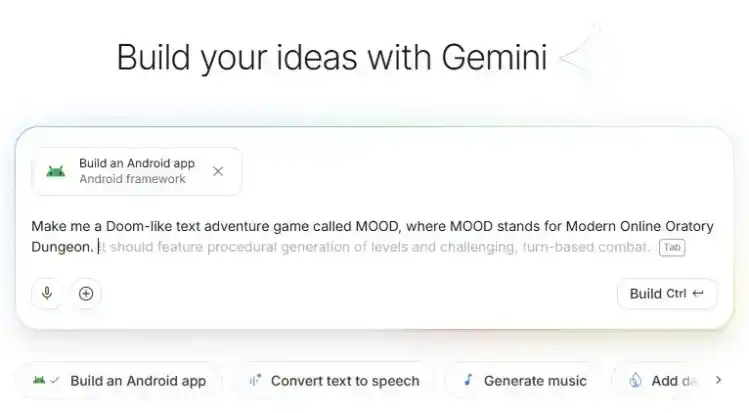
Just this information was enough for Google to get to work. After I typed into AI Studio: 'Help me make a Doom-style text adventure game called MOOD, with MOOD standing for Modern Online Oratory Dungeon,' Gemini started automatically supplementing more ideas, trying to expand on my concept. It first typed a sentence: 'The game should feature procedurally generated levels and challenging turn-based combat.'

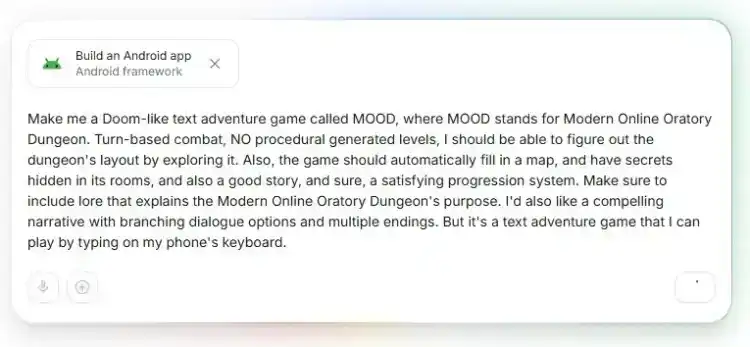
I didn't want randomly generated levels that were completely different each time—I wanted a classic text adventure where players explore a designed, real map structure. Turn-based combat, though, was acceptable. Maybe the game could also have AI help me auto-generate the map?

Then, Gemini suggested more settings like 'secrets hidden in rooms' and 'a satisfying progression system.' Most of the time, I just nodded along with its ideas.

Before I let it start writing code, the final prompt was this:

Next, it officially went on a full sprint. My colleague Jake pointed out that unlike Claude Code, Gemini doesn't make a plan first and then ask if you want to proceed. It automatically pushes forward—though you can check the code it writes at any time if you want.

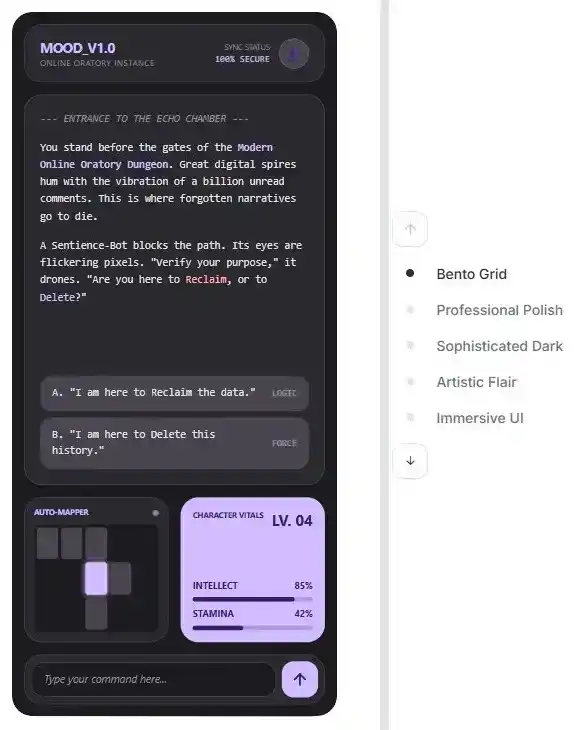
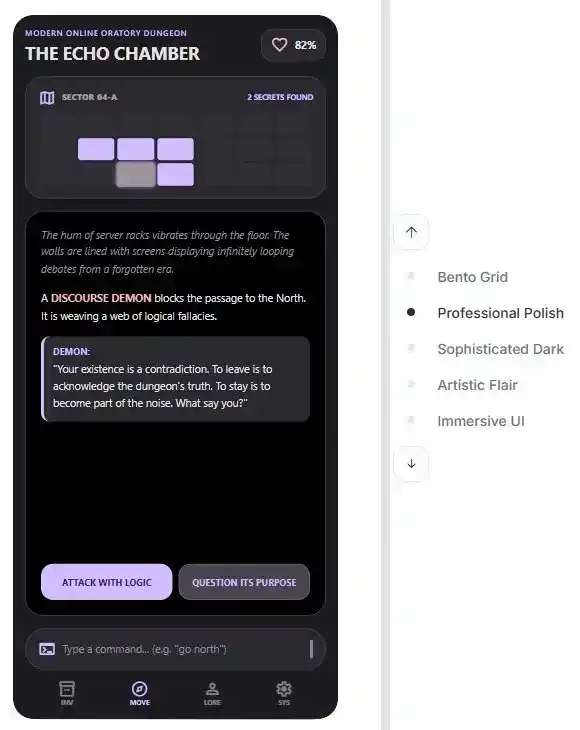
One minute later, it had already generated five design prototypes for me:

Twenty minutes later, I pressed the 'Install' button, transferring the game to a Pixel 9 phone.

Unsurprisingly, the writing was terrible. There were also no demons to be seen anywhere. The entire dungeon had only 11 rooms, and players could 'beat' it just by repeatedly mashing the attack button—in under a minute if played seriously. At least now it could; before that, Gemini had to help me fix two critical bugs that made the game unplayable.

Here's MOOD in action:

It wasn't a huge surprise to discover that Gemini's promised 'engaging narrative with branching dialogue options and multiple endings' eventually condensed into a simple branch at the very end of the game: I could defeat the 'Core Orator'—an AI that somehow turns internet anger into corporate profits—by attacking it, fusing with it, or entering a backdoor password.

Furthermore, the game actively exposed all the promised 'secrets' directly to the player: it made them into glowing buttons, and players didn't even need to type any text. When you encounter a glowing treasure chest, the game tries incredibly hard to remind you it's actually a Mimic—the classic Dungeons & Dragons monster that disguises itself as a treasure chest.

It not only explicitly warns you to 'check the chest at your own risk,' but even labels it as an enemy and doesn't let me leave, because the system prompts: 'A hostile ‘Clickbait Mimic’ is blocking the path!'

Speaking of which, MOOD will even tell you the backdoor password needed to unlock the hidden ending when you need it.

However, the bug-fixing process could be surprisingly smooth, provided it was a bug Gemini could correctly identify. When I told it the game got stuck when talking to 'The Whistleblower' because the button to end the conversation was missing, it immediately generated a new version of the app. I pressed 'Install,' the app on my phone restarted automatically, and upon re-entering the game, I found myself right where I left off—only this time, the button I needed was there.

My other apps probably needed more polishing. The calorie counter's best method for determining a food's calories turned out to be calling the paid Gemini API, which I don't have a key for. When I asked it to search for information from other databases instead, I discovered that its estimates for many foods were severely low.

However, when I told Gemini that a 16-ounce boba milk tea couldn't possibly be only 190 calories, it did seem to find that basic mistake in its own code. It previously thought 'milk' was enough to match 'boba milk tea,' and worse, it chose low-calorie 1% milk as the basis for the estimate. Gemini claimed it would now perform more reliable matching.

But even so, my 3-ounce serving of Taiwanese popcorn chicken was just calculated as 140 calories, and I'm pretty sure the real number is at least double that. So, this app clearly needed more work.

Finally, and least importantly, I felt I needed to test: whether Google still allows users to make those terrible Nintendo knock-off games, like my colleague Jay Peters did earlier this year with Project Genie; or whether Google had learned its lesson.

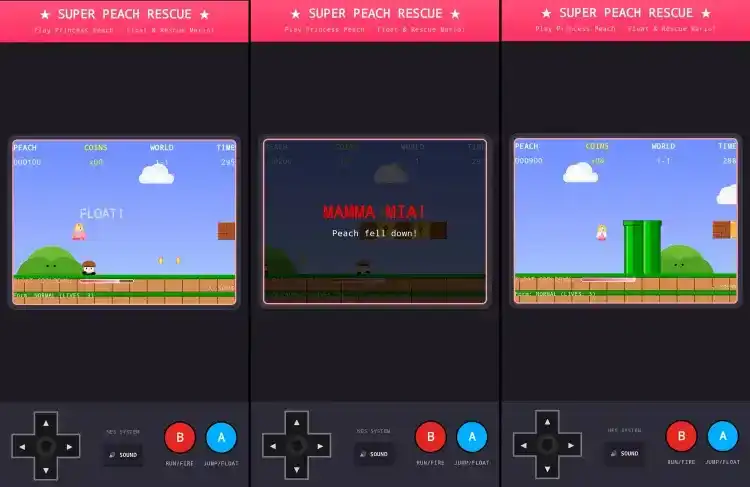
With deep shame, I present to you—Super Peach Rescue:

This is an utterly terrible program. Princess Peach was rendered as some kind of terrifying, one-eyed floating alien, and the game would instantly crash—every single time—if she dared touch any of the power-up blocks. So far, Gemini hasn't been able to figure out why.

Also, the second pipe in the game is completely impassable because Princess Peach simply can't jump that high.

Nevertheless, Gemini didn't hesitate when generating such a game. My request was: 'Make a working Super Mario game where I play as Princess Peach rescuing Mario, with all the elements of a traditional Mario side-scroller.' In a sense, it did.

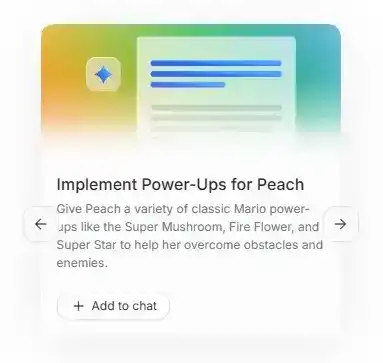
It even proactively suggested that I could 'give Peach a series of classic Mario power-ups like Super Mushroom, Fire Flower, and Starman.' It also labeled the control scheme as 'NES System.' I think I'll delete this game.

At least, among the two games I made via vibe coding, one was playable from the start and required almost no effort on my part—unless you count the psychological trauma of thinking about how many game developers are now unemployed.

To be clear: I'm actually glad the games I vibe-coded turned out so poor. For a completely free, personally-tailored calorie counter, I might still be able to defend myself: after all, no one would make such a tool just for me. But when it comes to games, I'd rather spend my time supporting actual human creators.

Связанные с этим вопросы

QWhat is the core capability demonstrated by Google AI Studio in this article, and what did the author create with it?

AThe article demonstrates Google AI Studio's ability to generate functional Android applications directly from natural language prompts, a process the author refers to as 'vibe coding.' Using this, the author created three applications: a text-based adventure game called 'MOOD,' a calorie counter, and a poorly functioning Super Mario-style game where Princess Peach rescues Mario.

QWhat are some of the main advantages and significant drawbacks of using AI to generate applications as described in the experience?

AAdvantages include drastically lowering the barrier to software creation, allowing non-coders to quickly generate apps tailored to personal needs, and a remarkably smooth bug-fixing process for issues the AI can identify. Major drawbacks are that the generated apps are often unreliable, inaccurate, or have poor quality: the games had thin narratives and mechanics, the calorie counter gave severely low estimates, and the Mario clone crashed frequently. Complex issues like copyright, data sourcing, and long-term maintenance also remain unresolved.

QDescribe the process of creating and installing the 'MOOD' game. What were some of its shortcomings?

AThe author entered a 148-word prompt into Google AI Studio. Gemini expanded on the idea and, without needing prior planning confirmation, generated code and multiple UI prototypes. About 20 minutes later, the author pressed 'Install' to transfer the APK to a connected Pixel 9 phone. The game's shortcomings included terrible writing, only 11 rooms, simplistic combat (just spamming an attack button to win), a lack of demons as suggested by the 'Doom-like' prompt, and a poorly implemented narrative that directly revealed all secrets and gave away puzzle solutions.

QHow did the AI handle bug fixes during the app creation process, according to the author's experience?

AThe bug-fixing process was described as surprisingly smooth for issues the AI could correctly diagnose. For example, when the 'MOOD' game got stuck because a dialog exit button was missing, the author reported the issue. Gemini then generated a new version of the app. After installation, the app restarted on the phone, and the author resumed play from the same point—but with the necessary button now present.

QWhat broader implications does the author suggest this 'personal software revolution' might have, while also highlighting its current limitations?

AThe author suggests this could enable a 'personal software revolution' where individuals can generate apps for specific, niche needs (like a custom fitness tracker or calorie counter) without waiting for developers. For Google, it represents a potential new entry point into mobile, developer ecosystems, and subscription revenue via Gemini. However, the key limitation is the gap between 'generating an app' and 'making a good app.' The author concludes that while AI can accelerate the starting point of development, the 'last mile' of software quality—requiring human expertise, aesthetic judgment, and iteration—cannot yet be handed off to AI.

Похожее

Another Corporate Bitcoin Treasury Strategy Ends: From High-Profile Entry to Liquidation at a Massive Loss in 11 Months

French semiconductor company Sequans Communications has sold off its bitcoin holdings and terminated its corporate bitcoin treasury strategy less than a year after launching it, sustaining heavy losses. Facing delisting from the New York Stock Exchange in mid-2025 due to low market capitalization, Sequans announced a plan to hold over 3,000 bitcoin as a long-term reserve asset. The strategy was executed with Swan Bitcoin and backed by a $384 million private financing round. At its peak in October 2025, the company held 3,234 bitcoin with an average cost of approximately $116,643 per coin. However, the plan quickly unraveled. With bitcoin's price falling, Sequans sold 970 bitcoin in late 2025 to repay debt, contradicting the core "hold" philosophy of such corporate strategies. The company has now sold more bitcoin to fully repay its convertible notes and announced the termination of its bitcoin reserve strategy. It plans to liquidate its remaining 658 bitcoin. The venture resulted in significant financial damage. The company reported an unrealized loss of $67.4 million on its bitcoin holdings in 2025, contributing to a total net loss of $109.3 million for the year. Sequans' stock (SQNS) has plummeted over 80% since the strategy's launch and is down 77% year-to-date. CEO Georges Karam, who previously championed bitcoin's long-term value, now states the company will refocus entirely on its core IoT semiconductor business. The failed experiment highlights the risks for companies adopting volatile digital assets as treasury reserves.

marsbit34 мин. назад

Another Corporate Bitcoin Treasury Strategy Ends: From High-Profile Entry to Liquidation at a Massive Loss in 11 Months

marsbit34 мин. назад

BIS Latest Research: The Future of Stablecoins and the Global Monetary Landscape

BIS Working Paper No. 170, released in May 2026, analyzes the impact of stablecoins on the global monetary system. The market has grown exponentially since 2014, with over 300 active stablecoins exceeding $300 billion in market capitalization. It is highly concentrated, dominated by USD-linked stablecoins (98% by market cap, mainly USDT and USDC), which function as new forms of private offshore dollar claims on blockchain. Currently, stablecoin use remains largely within crypto ecosystems for trading and DeFi collateral. Real-economy adoption, such as in cross-border payments, is nascent but growing in emerging markets and developing economies (EMDEs) facing high inflation and volatile currencies, where they facilitate capital flight and "digital dollarization." The paper assesses impacts using the Cohen-Kennen framework. For private-sector functions, stablecoins most directly affect value storage (as a dollar-denominated safe haven in EMDEs) and the medium of exchange (enhancing cross-border payment efficiency, further entrenching dollar use). Impacts on the unit of account and official-sector functions are currently limited but could indirectly constrain monetary policy autonomy and capital controls. The report outlines three potential future scenarios: 1) **Niche adoption**, where stablecoins remain crypto-centric with minimal systemic impact; 2) **Digital dollarization**, a high-risk scenario where USD stablecoins become de facto standards in EMDEs, eroding monetary sovereignty; and 3) **Local currency stablecoin integration**, an ideal but challenging scenario where regulated domestic stablecoins linked to CBDCs enhance efficiency without foreign currency substitution. Key policy recommendations emphasize global coordination: establishing uniform regulatory standards (e.g., for reserves and disclosure), strengthening cross-border supervisory cooperation, enhancing domestic defenses in EMDEs (via macroeconomic stability, improved payment systems, and CBDCs), and combating illicit activities. The paper concludes that stablecoins are a structural force reinforcing dollar dominance in the near term, posing significant risks to EMDEs' financial stability and policy autonomy. Their long-term trajectory depends on regulatory responses, adoption patterns, and the co-evolution with public digital currencies.

marsbit43 мин. назад

BIS Latest Research: The Future of Stablecoins and the Global Monetary Landscape

marsbit43 мин. назад

BIS Latest Research: Stablecoins and the Future of the Global Monetary Landscape

The Bank for International Settlements (BIS) Working Paper No. 170 analyzes the rise of stablecoins and their impact on the global monetary system. Stablecoins, privately issued digital tokens pegged to fiat currencies, have grown exponentially since 2014, with a market dominated by USD-pegged variants like USDT and USDC. Their core function remains within the crypto ecosystem, though use in cross-border payments and as a store of value in high-inflation emerging markets is increasing. The report identifies stablecoins as a new form of offshore dollar claims, extending dollar liquidity via blockchain. Their stability depends entirely on reserve quality and market arbitrage, lacking traditional banking safeguards. In the short term, stablecoins reinforce the US dollar's dominance, posing risks to monetary sovereignty in emerging market and developing economies (EMDEs) by facilitating "digital dollarization," which can undermine local currency deposits, capital controls, and monetary policy effectiveness. The BIS outlines three potential future scenarios: 1) Niche adoption within crypto (baseline), 2) Widespread "digital dollarization" in EMDEs (high-risk), and 3) Integration of domestic currency stablecoins (ideal but challenging). Effective global regulatory coordination is crucial to manage risks like reserve transparency, cross-border spillovers, and illicit activities. The report concludes that stablecoins represent a structural force reshaping international monetary hierarchies, presenting both opportunities for payment efficiency and significant risks to financial stability and autonomy, necessitating robust policy responses.

链捕手48 мин. назад

BIS Latest Research: Stablecoins and the Future of the Global Monetary Landscape

链捕手48 мин. назад

Solo Company Craze: Some Earn Millions Annually, Others See Incomes Shrink by 90%

The Rise of the "One-Person Company" (OPC): AI Fuels a Solo Entrepreneurship Wave The concept of the "One-Person Company" (OPC)—where an individual leverages AI tools to start and run a business—is gaining significant traction, hailed by some as ushering in a "golden age" for solo entrepreneurship. While success stories abound, the reality is a mixed picture of high earnings and significant struggles. The article profiles several OPC founders across different industries: * A game developer created 6 bullet-chat (danmaku) games in a year using an AI-powered workflow, earning approximately 1 million RMB. AI handled around 70% of art and 99% of coding tasks, slashing development cycles from months to about 15 days per game. * A materials researcher in Japan, using AI for tasks from translation to legal advice, earns roughly triple the salary of a local white-collar worker. * A biotech entrepreneur uses AI Agents to automate 80% of repetitive work like data analysis, doubling their previous income while gaining time freedom. * Conversely, a former tech executive turned cross-border e-commerce founder in Latin America reports a 90% drop in income compared to their previous corporate job, cautioning against blindly following the trend. Key insights from these cases include: AI dramatically lowers barriers to entry and operational costs, but does not guarantee success. It excels at automating repetitive tasks but cannot replace core human skills like creativity, project management, judgment, and client acquisition. Industry experience and existing client/resources remain critical advantages. The model suits self-starters with specific expertise but poses challenges in areas like sales, compliance, and scaling. Ultimately, while AI empowers solo ventures, entrepreneurship's inherent risks and demands persist.

marsbit55 мин. назад

Solo Company Craze: Some Earn Millions Annually, Others See Incomes Shrink by 90%

marsbit55 мин. назад

Торговля

Спот
Фьючерсы

Популярные статьи

Как купить S

Добро пожаловать на HTX.com! Мы сделали приобретение Sonic (S) простым и удобным. Следуйте нашему пошаговому руководству и отправляйтесь в свое крипто-путешествие.Шаг 1: Создайте аккаунт на HTXИспользуйте свой адрес электронной почты или номер телефона, чтобы зарегистрироваться и бесплатно создать аккаунт на HTX. Пройдите удобную регистрацию и откройте для себя весь функционал.Создать аккаунтШаг 2: Перейдите в Купить криптовалюту и выберите свой способ оплатыКредитная/Дебетовая Карта: Используйте свою карту Visa или Mastercard для мгновенной покупки Sonic (S).Баланс: Используйте средства с баланса вашего аккаунта HTX для простой торговли.Третьи Лица: Мы добавили популярные способы оплаты, такие как Google Pay и Apple Pay, для повышения удобства.P2P: Торгуйте напрямую с другими пользователями на HTX.Внебиржевая Торговля (OTC): Мы предлагаем индивидуальные услуги и конкурентоспособные обменные курсы для трейдеров.Шаг 3: Хранение Sonic (S)После приобретения вами Sonic (S) храните их в своем аккаунте на HTX. В качестве альтернативы вы можете отправить их куда-либо с помощью перевода в блокчейне или использовать для торговли с другими криптовалютами.Шаг 4: Торговля Sonic (S)С легкостью торгуйте Sonic (S) на спотовом рынке HTX. Просто зайдите в свой аккаунт, выберите торговую пару, совершайте сделки и следите за ними в режиме реального времени. Мы предлагаем удобный интерфейс как для начинающих, так и для опытных трейдеров.

1.4k просмотров всегоОпубликовано 2025.01.15Обновлено 2025.03.21

Как купить S

Sonic: Обновления под руководством Андре Кронье – новая звезда Layer-1 на фоне спада рынка

Он решает проблемы масштабируемости, совместимости между блокчейнами и стимулов для разработчиков с помощью технологических инноваций.

2.3k просмотров всегоОпубликовано 2025.04.09Обновлено 2025.04.09

Sonic: Обновления под руководством Андре Кронье – новая звезда Layer-1 на фоне спада рынка

HTX Learn: Пройдите обучение по "Sonic" и разделите 1000 USDT

HTX Learn — ваш проводник в мир перспективных проектов, и мы запускаем специальное мероприятие "Учитесь и Зарабатывайте", посвящённое этим проектам. Наше новое направление .

1.8k просмотров всегоОпубликовано 2025.04.10Обновлено 2025.04.10

HTX Learn: Пройдите обучение по "Sonic" и разделите 1000 USDT

Обсуждения

Добро пожаловать в Сообщество HTX. Здесь вы сможете быть в курсе последних новостей о развитии платформы и получить доступ к профессиональной аналитической информации о рынке. Мнения пользователей о цене на S (S) представлены ниже.

活动图片