How Wagyu Is Changing the Monero Narrative: One Tool Lifting Years of Price Suppression

比推Опубликовано 2026-01-14Обновлено 2026-01-14

Введение

Wagyu, a new exchange tool, is breaking years of price suppression on Monero (XMR) by addressing a critical flaw in its acquisition process. Since 2018, despite strong demand, XMR's price remained stagnant, primarily because major exchanges delisted it, forcing over 60% of users to rely on instant swap services. These offshore services charged exorbitant fees (effectively 3-4%) and often froze funds under "AML checks," creating constant sell pressure as they immediately converted XMR profits to stablecoins. This parasitic cycle drained an estimated $30,000-$100,000 daily from the market. Wagyu v2 routes orders to Hyperliquid, providing exchange-level pricing and near-zero fees, eliminating the need for exploitative swap services. By removing this sell pressure and allowing true price discovery, Wagyu has already processed millions in trades, contributing to XMR's recent breakout above $600. The tool is effectively saving Monero by connecting genuine demand directly to real market liquidity.

Written by: PerpetualCow.hl

Compiled by: AididiaoJP, Foresight News

Original Title: How Wagyu Is Saving Monero: How One Tool Is Breaking Years of Price Suppression?


A few days ago, I exposed the trillion-dollar instant exchange industry. Today, I'm connecting the dots that haven't been pieced together yet on Crypto Twitter.

Since 2018, while almost every other cryptocurrency has been surging, the price of Monero (XMR) has been stuck in a range.

Most attribute this to exchange delistings, regulatory pressure, or the narrative that 'privacy coins are dead.'

They are all wrong.

To understand what's happening, you must first delve deep into the history of Monero XMR, including all the exchange delistings, and how most people actually buy this coin.

The Real Demand for Monero XMR

People have always wanted Monero, not just for privacy, but because it's seen as a store of value alternative to Bitcoin, like a 21st-century Swiss bank account.

Its utility didn't change just because exchanges got scared of regulation and delisted it.

This can be compared to illegal drug trade: when it's impossible to buy from a legitimate pharmacy, addicts will seek out more dubious channels, paying a higher price to get what they need.

As a result, the demand for Monero flowed to instant exchange services, not centralized exchanges.

Think from the perspective of an average user in 2024:

You want to buy Monero, but Binance just delisted it, and Coinbase won't touch it. Other small exchanges that still trade Monero are likely to freeze your funds for dealing with this coin.
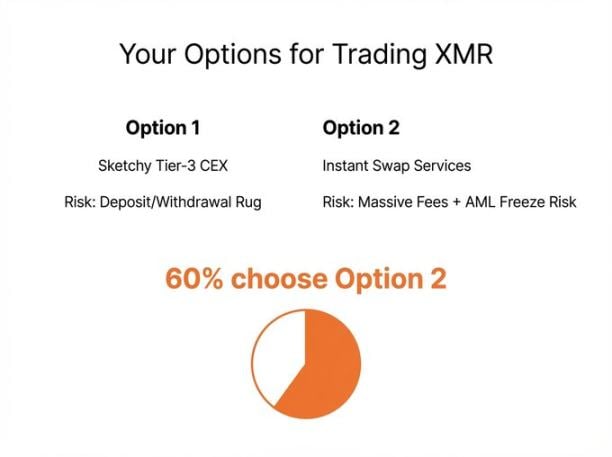
You only have two choices:

Find a third-rate exchange that still lists Monero and pray they don't run off with the money.

Use an instant exchange service, pay high fees, and pray they don't freeze your funds indefinitely under the pretext of 'AML review'.

Over 60% of users chose the second path.

These services became the de facto on/off ramps for the Monero ecosystem.

They are, of course, unregulated and offer terrible exchange rates, but users have no other choice.

After all legitimate exchanges abandoned Monero, the instant exchange industry became the only channel, absorbing all Monero trading volume.

Tracking the Flow of Funds

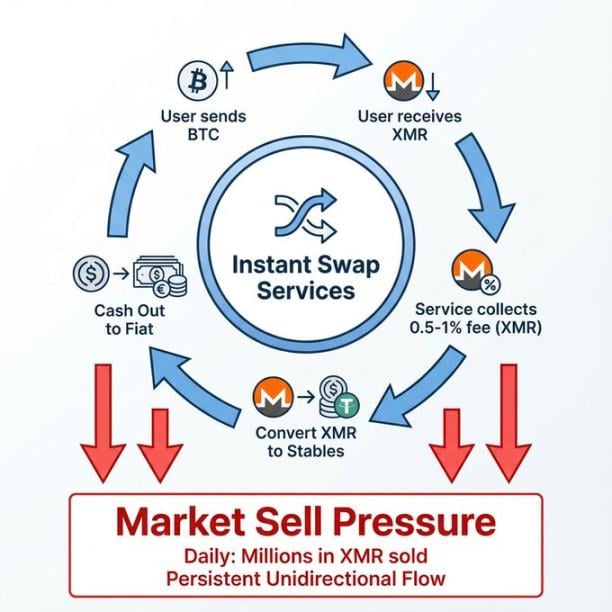
All instant exchange services operate the same way:

The user sends Bitcoin and receives Monero, with the service secretly charging a 3-4% fee (while ostensibly only charging 0.5-1%).

But these fees are priced in Monero.

So how do these service providers handle the Monero they receive?

They don't hold it long-term; they are not believers. These are offshore companies chasing fiat profits, who immediately convert Monero to stablecoins and cash out.

Just like that, millions of dollars worth of Monero are sold into the market every day.

In market microstructure terms, this creates a persistent one-way outflow of funds. Regardless of overall market conditions, these services are constantly selling. While this is just their business model, the impact on price is devastating.
Quantifying the Capital Drain

In my previous article, I estimated the instant exchange industry handles about $1.5 trillion in transactions annually (across all chains), and that's just the on-chain verifiable part.

Monero's volume is invisible due to its privacy features, but industry estimates suggest it accounts for about 20% of total instant exchange flow.

Assume $30 billion worth of Monero is exchanged through these services annually.

Conservatively, the actual figure might be half of that, around $15 billion.

At an average fee of 0.75% (most actually charge 1%), the Monero fees collected annually are worth about $112.5 million.

All of this Monero is sold into the market.

This means over $300,000 in passive selling pressure every day. It's like an invisible pump constantly draining value from Monero.

And this is a conservative estimate. If Monero truly accounts for 20% of the volume and fees are 1%, that's $300 million annually, approaching $1 million in daily selling pressure.

But it doesn't end there; there's also the 'AML Trap'.

The AML Trap

This is the 'dirty secret' I exposed in my last article: these services, while advertising 'No KYC', arbitrarily freeze user funds under the pretext of 'AML review'.

It's estimated that 2-5% of transactions through instant exchange services get frozen. The rate is higher for large transactions.

This creates a vicious cycle:

Small transactions go through but are charged fees 10-20 times higher than normal

Large transactions are completely frozen, often permanently

Only a fraction of the actual buying demand actually reaches the market
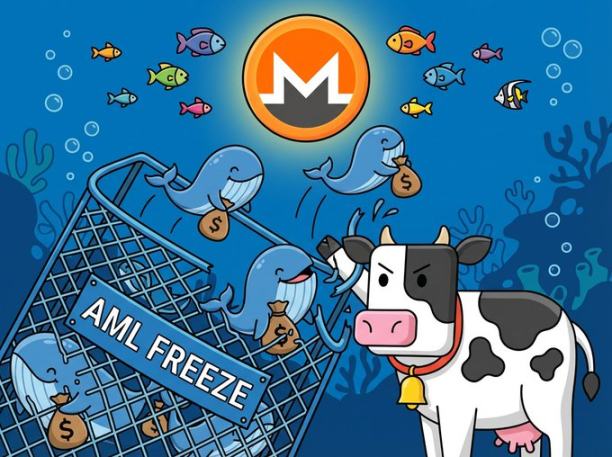
This creates the most brutal price discovery barrier: buyers who could actually influence the price are systematically excluded from the market.

The real demand for Monero has always been far higher than its price reflects. The instant exchange industry either extracts from this demand or outright chokes it off.

A Captive Market

Let me be clear about this vicious cycle:

The instant exchange industry did not win the market through competitiveness. They gained a monopoly position when all exchanges delisted Monero, and then proceeded to extract the maximum possible from users who had nowhere else to go.
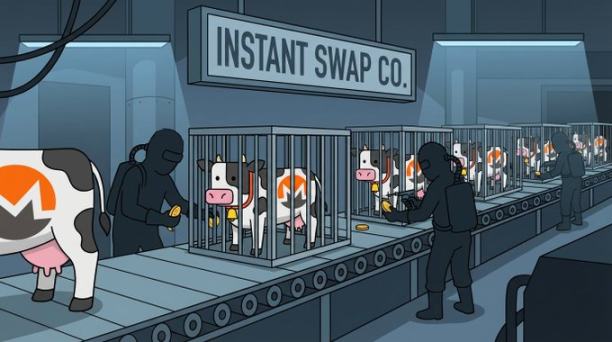
1% fees plus terrible exchange rates, plus random fund freezes.

Users tolerate it because they have no choice, and these service providers know it.

This is what happens when an entire asset class is forced into a single channel controlled by anonymous offshore operators: they extract with an uncompetitive product.

Every cent they extract turns into selling pressure on Monero.

Wagyu's Solution

Two days ago, Wagyu v2 launched.
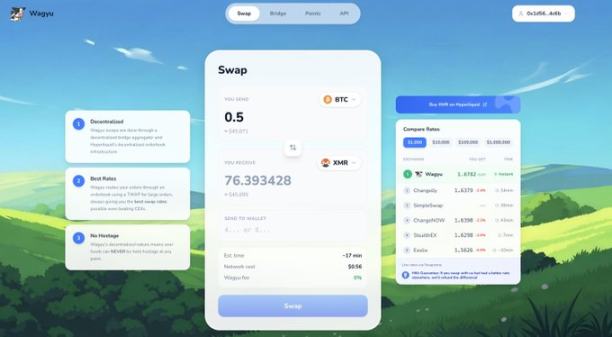
The core idea is simple: let Monero users enjoy the same pricing level as exchange traders.

When you exchange through Wagyu, your order is routed to @Hyperliquidx—where the most competitive market makers in crypto compete for orders.

These are the same market makers that provide liquidity for Binance, Bybit, and OKX, offering tiny spreads.

The result: you get exchange-level prices and fees. No more 1% or 0.5%, but ultra-low rates like professional traders.

For the first time since Monero was delisted from exchanges, users don't have to get 'ripped off' just for using their own assets.
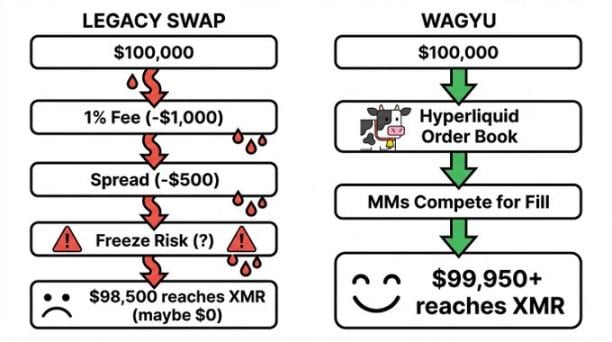
A single $100,000 transaction prevents over $1,000 in selling pressure from hitting the market.

Within 48 hours of launch, Wagyu v2 has already processed millions in exchanges, offering the best market prices:
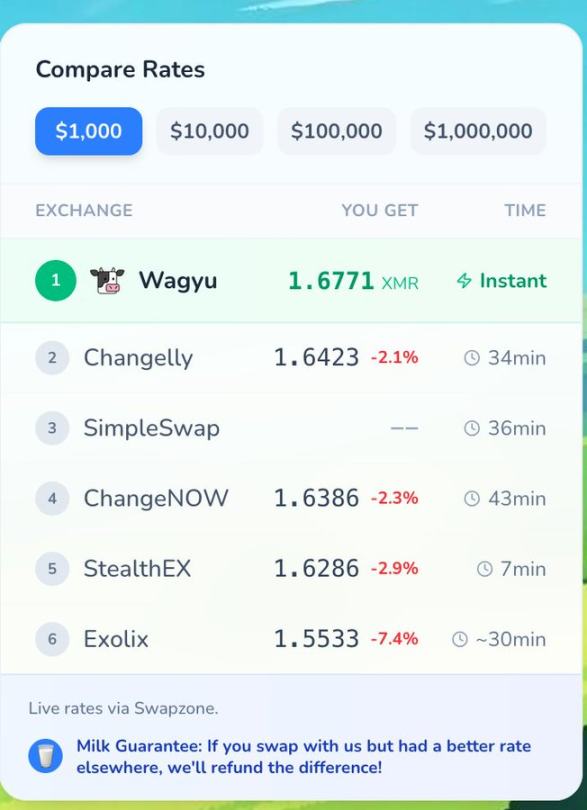
Trades that would have gone through traditional services, been charged over 1% in fees, and caused the market to instantly absorb tens of thousands in selling pressure, are now happening through Wagyu.

$1 million exchange through traditional services = $10,000 worth of Monero sold

The same $1 million exchange through Wagyu = Zero forced selling

Multiply this effect by every large Monero buyer who discovers they no longer have to be 'robbed'.

Reversing the Vicious Cycle

For years, Monero has been trapped in a negative feedback loop:
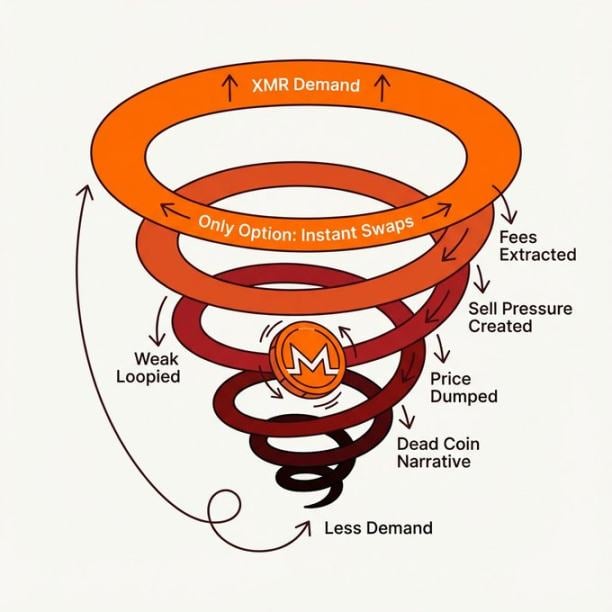
The instant exchange industry acted as a value extraction layer, sitting between buyers and the real price. They intercepted demand, extracted profits, and distorted price signals. Users couldn't bypass them because there was no alternative.

Now, that has changed.

Just two days after launch, volume is already migrating to Wagyu. People are realizing they can get Binance-level pricing for an asset Binance won't even list, and the word is spreading fast.

The cycle is reversing:
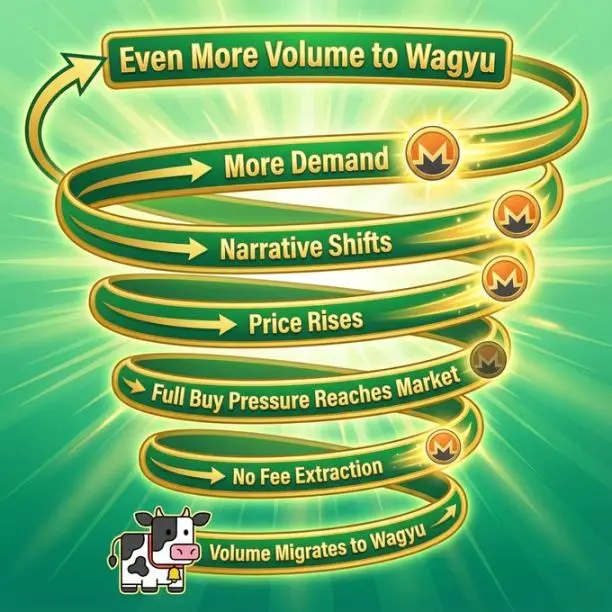
It's no coincidence that Monero broke through $600 and began its first price discovery in years.

Wagyu Is Saving Monero

I'm not going to be modest about this:

Every exchange made through Wagyu instead of a traditional service is real buying pressure that reaches the market.

Every million-dollar trade that flows through us means over $10,000 won't be sold onto other holders.

We are not extracting from the Monero ecosystem; we are plugging it directly into real liquidity.

The parasitic layer that has suppressed Monero for years has finally met its competitor. And we are not competing on their terms—we are making their entire model obsolete.

When users can get exchange-level pricing with zero freeze risk through Wagyu, who will pay 1% fees to anonymous offshore services that might freeze their funds?

No one will.

What This Means

I'm not here to give price predictions. I don't know if Monero will go to $1,000, $2,000, or fall back to $400.

But I know for sure: for the first time since being delisted from exchanges, demand for Monero can truly translate into price.

We've been live for only two days and are already processing millions in trades—trades that would have continuously 'bled' the market.

With the 'ceiling' removed, Monero at $600 is still undervalued. At least now, the market will truly decide its value.

Price discovery is finally possible, and Wagyu is making it happen.


Twitter:https://twitter.com/BitpushNewsCN

Bitpush TG Group:https://t.me/BitPushCommunity

Bitpush TG Subscription: https://t.me/bitpush

Original link:https://www.bitpush.news/articles/7602589

Связанные с этим вопросы

QWhat is the main reason the author argues that Monero's price was suppressed for years?

AThe author argues that Monero's price was suppressed due to the parasitic extraction by instant exchange services, which acted as the primary on/off-ramp after centralized exchanges delisted XMR. These services charged high fees (effectively 3-4%) and immediately sold the XMR fees for stablecoins, creating constant sell pressure of an estimated $30,000 to $100,000 daily.

QHow did the instant exchange industry impact Monero's price discovery according to the article?

AThe instant exchange industry severely distorted Monero's price discovery by intercepting demand, charging exorbitant fees, and systematically freezing large transactions. This created a one-way outflow of value, preventing genuine buy-side demand from reaching the market and influencing the price.

QWhat solution does Wagyu v2 provide to the problem described in the article?

AWagyu v2 routes user orders to the Hyperliquid exchange, where professional market makers provide highly competitive, exchange-level pricing and minimal fees. This allows users to trade XMR without the excessive fees and freezing risks of traditional instant exchanges, eliminating the forced selling pressure those services created.

QWhat was the estimated annual volume of Monero processed by instant exchanges, and what was the resulting sell pressure?

AThe article estimates that instant exchanges processed approximately $150 billion to $300 billion in annual Monero volume. With an average fee of 0.75% to 1%, this resulted in $112.5 million to $300 million worth of XMR being sold annually, creating a daily sell pressure of over $300,000 to nearly $1 million.

QHow does the author describe the change in the market cycle for Monero after the introduction of Wagyu?

AThe author states that the negative feedback loop, where instant exchanges extracted value and suppressed the price, is now reversing. With Wagyu providing a efficient, non-extractive on-ramp, genuine buy-side demand can finally reach the market, allowing for true price discovery for the first time since XMR was delisted from major exchanges.

Похожее

From Banning Doubao to Embracing Honor: Why Did WeChat Suddenly 'Change Its Face'?

The article explores the sudden shift in WeChat's strategy towards AI assistants from mobile phone manufacturers, transitioning from strict opposition to active collaboration. For over a year, WeChat fiercely resisted attempts by phone AI assistants (like ByteDance's Doubao in late 2025) to control its features via GUI automation ("simulated clicking"), citing security and data control concerns. This stance created a significant barrier for system-level AI integration. Now, Tencent has initiated A2A (Agent-to-Agent) partnerships with major phone brands like Honor, Xiaomi, OPPO, and vivo. This model allows a phone's system AI (e.g., Honor's YOYO) to parse a user's voice command and send a structured request directly to WeChat's own internal AI agent via secure APIs. WeChat then executes the action (e.g., sending a message) and returns the result. The article attributes Tencent's "change of face" to strategic pressure. While leading in social app usage, Tencent trails rivals like ByteDance and Alibaba in standalone AI app popularity. WeChat, with its vast mini-program ecosystem, is Tencent's key asset for an AI comeback. The upcoming WeChat AI agent aims to handle tasks like booking and payments within the app. However, phone system assistants remain the primary AI entry point for most users. The A2A collaboration allows Tencent to extend WeChat's AI reach to this crucial system layer while maintaining control over its core functions and data. For phone manufacturers, embracing A2A is a pragmatic move. The GUI route proved unviable due to WeChat's blocks. A2A offers a compliant path to integrate a vital service, enhancing their AI assistants' usefulness. It allows them to focus on developing their own AI ecosystems for other services while cooperating on WeChat access. The collaboration is framed as a mutual, strategic necessity: Tencent gains a distribution channel, and manufacturers gain a key functionality. The partnership relies on a "dual authorization" mechanism for security, requiring both user and app consent for each action. While questions about long-term data privacy practices remain, experts note A2A is more secure and compliant than GUI automation. Ultimately, this cooperation is seen as a tentative, calculated truce. Tencent's long-term goal is to make WeChat an AI-powered "service OS." Phone manufacturers aim to make their system AI the central user interface. Their paths may converge or clash in the future, but for now, the A2A deal represents the opening chapter in the battle for the AI-era user入口, driven by necessity and strategic calculus on both sides.

marsbit1 ч. назад

From Banning Doubao to Embracing Honor: Why Did WeChat Suddenly 'Change Its Face'?

marsbit1 ч. назад

On-Chain Figures on the Eve of Kickoff: 1.6 Billion Traded Before the World Cup Even Begins

"On-Chain Numbers on the Eve of the World Cup: $1.6 Billion Traded Before Kick-off" Analysis of on-chain markets before the 2026 FIFA World Cup reveals significant crypto integration into football. The most striking figure is the approximately **$1.6 billion** in total trading volume on the single "World Cup Winner" contract on the Polymarket prediction market platform, accumulated before a single match was played. This represents explosive growth for a sector whose annual volume surged from ~$16B in 2024 to ~$64B in 2025. The ecosystem is maturing beyond speculation. Key developments include: 1) **Infrastructure upgrades** like Polymarket's migration to native, regulated USDC stablecoin for settlements; 2) **Reliable data oracles**, such as Chainlink, being used to resolve real-world match outcomes on-chain; and 3) **Official recognition**, with FIFA appointing its first-ever "Prediction Markets" partner. Over 100 contracts now cover everything from the outright winner to individual match results and even non-sporting risks like venue relocation. This evolution marks a fundamental shift. While crypto firms are absent from FIFA's top-tier sponsor list, the technology has deeply penetrated the tournament's financial and predictive infrastructure through regulated stablecoin settlements, decentralized oracles, and new official partnership categories. The regulatory landscape remains complex and varies by jurisdiction, but on-chain markets for the World Cup are already a multi-billion-dollar reality.

marsbit1 ч. назад

On-Chain Figures on the Eve of Kickoff: 1.6 Billion Traded Before the World Cup Even Begins

marsbit1 ч. назад

From SpaceX's IPO to the Future of Crypto: Which Crypto Sectors Will Host the Trillion-Dollar Narrative?

From the SpaceX IPO, which targets a $750 billion raise at a $1.77 trillion valuation, we can extrapolate capital flow trends relevant to crypto. The focus shifts from speculative narratives to foundational infrastructure and real-world asset (RWA) integration. Key crypto sectors poised to benefit include: 1. **AI Infrastructure**: The narrative is moving from consumer-facing AI applications to underlying, scarce resources like compute power and decentralized GPU networks (e.g., TAO, RENDER, AKT, IO). These protocols are positioning as the essential "picks and shovels" providers for the AI economy. 2. **Real-World Assets (RWA)**: Beyond tokenized treasury bonds, RWA's future lies in on-chain equity and pre-IPO assets like SpaceX. This could democratize access to high-growth assets and reshape global capital flows, benefiting infrastructure projects like ONDO, LINK, and Plume that facilitate issuance, data, and liquidity. 3. **Core Financial Infrastructure**: Stablecoins, payment networks, and DePIN (Decentralized Physical Infrastructure Networks) are critical for settling the future on-chain economy. Their role expands from internal trading tools to foundational layers for global finance, AI systems, and real-world asset networks, leading to potential value reassessment. In summary, the next cycle may prioritize long-term infrastructure value—AI compute, asset tokenization networks, and settlement layers—over short-lived application hype, mirroring the broader market's shift towards funding the foundational systems of the future.

marsbit2 ч. назад

From SpaceX's IPO to the Future of Crypto: Which Crypto Sectors Will Host the Trillion-Dollar Narrative?

marsbit2 ч. назад

Торговля

Спот
Фьючерсы

Популярные статьи

Как купить ONE

Добро пожаловать на HTX.com! Мы сделали приобретение Harmony (ONE) простым и удобным. Следуйте нашему пошаговому руководству и отправляйтесь в свое крипто-путешествие.Шаг 1: Создайте аккаунт на HTXИспользуйте свой адрес электронной почты или номер телефона, чтобы зарегистрироваться и бесплатно создать аккаунт на HTX. Пройдите удобную регистрацию и откройте для себя весь функционал.Создать аккаунтШаг 2: Перейдите в Купить криптовалюту и выберите свой способ оплатыКредитная/Дебетовая Карта: Используйте свою карту Visa или Mastercard для мгновенной покупки Harmony (ONE).Баланс: Используйте средства с баланса вашего аккаунта HTX для простой торговли.Третьи Лица: Мы добавили популярные способы оплаты, такие как Google Pay и Apple Pay, для повышения удобства.P2P: Торгуйте напрямую с другими пользователями на HTX.Внебиржевая Торговля (OTC): Мы предлагаем индивидуальные услуги и конкурентоспособные обменные курсы для трейдеров.Шаг 3: Хранение Harmony (ONE)После приобретения вами Harmony (ONE) храните их в своем аккаунте на HTX. В качестве альтернативы вы можете отправить их куда-либо с помощью перевода в блокчейне или использовать для торговли с другими криптовалютами.Шаг 4: Торговля Harmony (ONE)С легкостью торгуйте Harmony (ONE) на спотовом рынке HTX. Просто зайдите в свой аккаунт, выберите торговую пару, совершайте сделки и следите за ними в режиме реального времени. Мы предлагаем удобный интерфейс как для начинающих, так и для опытных трейдеров.

712 просмотров всегоОпубликовано 2024.04.12Обновлено 2026.06.02

Как купить ONE

Обсуждения

Добро пожаловать в Сообщество HTX. Здесь вы сможете быть в курсе последних новостей о развитии платформы и получить доступ к профессиональной аналитической информации о рынке. Мнения пользователей о цене на ONE (ONE) представлены ниже.

活动图片