How the $900 Billion Anthropic Was Built?

链捕手Опубликовано 2026-05-13Обновлено 2026-05-13

Введение

Anthropic, the AI startup behind Claude, is reportedly in early talks to raise at least $30 billion in new funding, targeting a valuation exceeding $900 billion. This would propel it past OpenAI's recent $852 billion valuation. The funding round is expected to close by late May 2026. The company's valuation surge is driven by extraordinary revenue growth, reportedly reaching an annualized $30 billion by March 2026 from $1 billion in December 2024. However, OpenAI questions this figure, suggesting a net revenue closer to $22 billion after cloud platform fees. Despite high revenue, Anthropic's gross margin is reportedly around 40%, and it is not yet profitable, with breakeven projected for 2028. A significant portion of the new capital would fund massive, pre-committed computing infrastructure with partners like Amazon, Google, and Microsoft. This highlights a new AI financing model where high valuations fuel compute spending, which in turn requires even higher future valuations to sustain. Notably, many early-stage investors are reportedly sitting out this round. Bankers privately estimate a potential IPO valuation between $400-500 billion, creating a rare scenario where the final private funding round valuation ($900B+) could far exceed the expected public market debut. Anthropic is targeting an IPO between October 2026 and the first half of 2027. Its public listing is poised to be a critical test for the entire AI sector's valuation logic, potentially validating or chall...

By Su Yang

Edited by Xu Qingyang

Bloomberg, citing informed sources, revealed that AI startup Anthropic is in early-stage talks with investors, aiming to raise at least $30 billion in new funding at a valuation exceeding $900 billion.

Informed sources disclosed that this round of financing is expected to be completed as early as the end of May 2026, although the deal is not yet finalized, and no term sheet has been signed.

If the financing succeeds, Anthropic will not only surpass OpenAI (valued at $852 billion in March) but also challenge the market capitalizations of tech giants like Apple and Microsoft. It is noteworthy that early investors who backed the company have largely chosen to sit on the sidelines for this round.

Anthropic CEO Dario Amodei. This image was generated by AI.

01 $30 Billion in Annual Revenue and 40% Gross Margin

Why can a company's valuation skyrocket 15-fold in 14 months? The answer seems obvious: growth rate.

According to publicly reported data, Anthropic's annualized revenue surged from $1 billion in December 2024 to $30 billion by the end of March 2026. This means that over consecutive years, it has maintained a growth rate exceeding 10x.

This growth curve may be unprecedented in enterprise software history.

Eight of the top ten companies on the Fortune Global 500 list are already Anthropic's clients. Over 1,000 enterprise accounts spend more than $1 million annually on Claude. In particular, its developer-facing coding product, Claude Code, launched in May 2025, reached an annualized revenue of $2.5 billion by February 2026, with enterprise subscriptions quadrupling within the first six weeks of the year.

Calculated with a $900 billion valuation and $30 billion in annualized revenue, the price-to-sales ratio is approximately 30x. This multiple sounds extreme, but supporters' calculations bet on the future. They believe a company growing 10x annually cannot be valued conventionally. Its pricing logic assumes it can maintain a similar compound growth rate until 2028, making the current valuation reasonable in hindsight.

Regarding Anthropic's revenue, competitor OpenAI has raised its own doubts, suggesting that the $30 billion annualized revenue reported by Anthropic uses gross revenue accounting. That is, when customers use its models through platforms like Amazon Web Services or Google Cloud, it records the total end consumption as revenue and then lists the fees paid to the cloud platforms as expenses.

OpenAI estimates that after deducting these intermediary fees, Anthropic's true annual revenue is closer to $22 billion. This $8 billion gap is purely a methodological choice, but it will become a focal point for market and regulatory scrutiny during an IPO.

More noteworthy than revenue accounting are the costs.

Documents show that Anthropic plans to spend approximately $19 billion in 2026 on training and inference computing, a figure almost equivalent to its annual revenue. More critically, due to inference costs exceeding expectations by 23%, its business gross margin has been compressed to about 40%, a level far below that of most mature enterprise software companies.

Anthropic is not yet profitable and is expected to break even only by 2028. For a company nearing a trillion-dollar valuation, this combination of financial metrics is indeed unusual.

02 Valuation-Driven Computing Arms Race

Why does Anthropic need to raise so much money?

Nominally, it's for development and expansion, but in essence, this $30 billion financing is primarily to pay for the computing infrastructure it has already committed to but has not yet built. This appears to be a model completely different from traditional tech finance.

In the past, startups raised funds to refine products, expand markets, and then gradually match valuations with growth. But in the AI era, startups need to first raise funds at an extremely high valuation, use that money to lock in massive future computing power, and then hope this computing power drives a leap in model capabilities, leading to revenue growth that ultimately justifies the high valuation.

It's like the chicken-and-egg debate.

Now, valuations drive computing commitments, and these commitments require the next, even higher valuation to fund them. This cycle is constantly accelerating. Anthropic is the ultimate embodiment of this model.

Once this cycle starts, it's hard to stop. It can propel a company to the clouds or plunge it into an abyss in an instant.
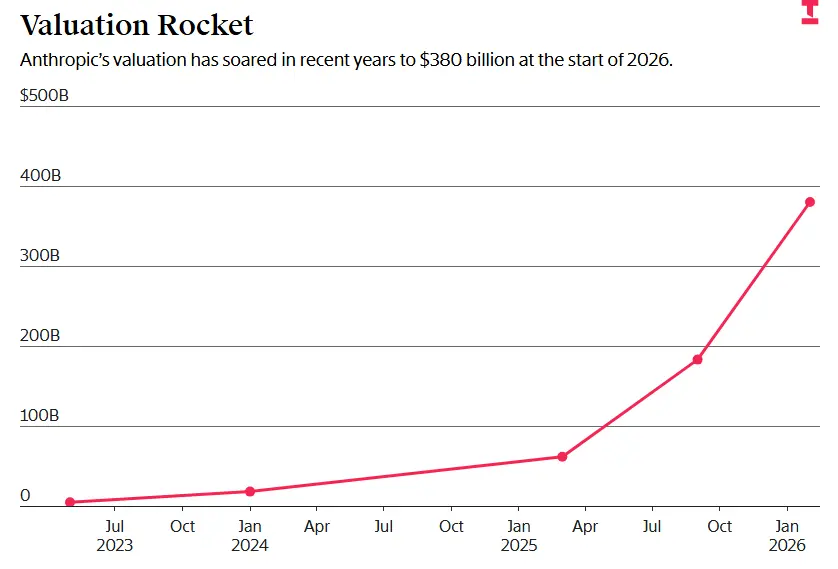
Anthropic's valuation surged to $380 billion in early 2026.

Shortly after the company completed its last $30 billion funding round, Anthropic CEO Dario Amodei told Fortune magazine that if AI progress were delayed by 12 months, Anthropic would go bankrupt.

For a company valued at $900 billion, the distance between "extraordinary success" and "operational bankruptcy" might be just a few bad quarters.

This precarious balance may be why sensitive early investors have largely refrained from participating in this round.

03 Early Investors Collectively Wait-and-See

According to Forbes, some of Anthropic's early backers—those who invested at a $4.1 billion valuation in 2023 or a $61.5 billion valuation in March 2025—have almost no willingness to participate in this round.

The reason is simple. Bankers privately estimate that if Anthropic goes public as early as October 2026, its public market valuation might land between $400 billion and $500 billion. This means that if someone invests at a $900 billion valuation in the final private round, theoretically, before the shares even unlock and become tradable, that investment would already be underwater on paper.

Such an inversion, where late-stage private valuations are significantly higher than expected IPO valuations, is extremely rare in the history of tech financing.

It's a signal, indicating either that this company is severely overvalued in the private market, or that the public market will offer a completely different pricing. Either possibility is fraught with uncertainty.

And that decisive event on the horizon is the IPO itself.

We previously mentioned the key figure behind Anthropic's IPO and financing—the company's financial helmsman, Krishna Rao.

The Information reported that at the time, Anthropic's computing lifeline was essentially tied to Google alone. Rao felt this was untenable—you can't put all your eggs in one basket. He championed a new strategy internally and among investors: computing suppliers must be diversified.

According to The Information citing informed sources, Rao discussed this strategy in depth with investor Byron Deeter of Bessemer Venture Partners. Deeter later commented that it was Rao who made the company realize that having multiple partners would allow for faster development.

Looking back now, Anthropic moved faster than OpenAI. They have already signed deep agreements with all three cloud computing giants: Amazon, Google, and Microsoft. At the chip level, they have also incorporated NVIDIA GPUs, Google's self-developed TPUs, and Amazon's chips, forming a diversified supply network.

But signing agreements is not enough; the core is ensuring suppliers actually deliver the computing resources. In late 2025, Rao spearheaded two major deals: one committing $30 billion to use Microsoft's cloud servers running NVIDIA chips, and another securing up to 1 million Google TPUs.

By early April 2026, Anthropic went further, signing new agreements with Broadcom and Google, locking in several gigawatts of data center power supply capacity. These moves are no longer simply "buying" computing power but are large-scale "reservations" of future infrastructure.

Since joining, Rao has helped the company complete multiple funding rounds totaling $60 billion. By January of this year, the company's valuation had risen to $380 billion.

It can be said that under Rao's forceful drive, Anthropic's computing infrastructure and financial firepower have reached unprecedented scale.

04 Is There a Bubble? The Answer in Six Months

Following the current pace, if this round of financing proceeds as intended, Anthropic is expected to seek an IPO between October 2026 and the first half of 2027. Goldman Sachs, JPMorgan Chase, and Morgan Stanley are reportedly in discussions about the matter.

At that time, the market's core focus will no longer be "Can Anthropic sustain growth?" but will turn into a public referendum on the entire AI industry's valuation logic over the past three years: Was the private market's pricing of AI correct?

Ultra-large-scale corporate capital expenditure commitments, multi-year computing reservation contracts, 40% gross margins, the debate between gross and net revenue accounting, and that accelerating "valuation-computing-revaluation" cycle—all these complex issues that could be ambiguously handled in the private market will, at the IPO, be placed under the public market's microscope.

If the public market is willing to give Anthropic a valuation of $1 trillion or even higher, then the entry price at a $900 billion valuation might look like a generous early bet. But if the market only offers $500 billion, the situation for the last batch of private investors would be very awkward.

A third possibility, perhaps with more profound implications, is that Anthropic's IPO will serve as a key data point to validate or disprove the entire AI finance structural hypothesis.

Remember Michael Burry, the inspiration behind *The Big Short*, who recently warned about "tech stocks" and "chip stocks" bubbles in his paid newsletter again. Once the AI finance hypothesis is disproven during Anthropic's listing, it could be the moment the bubble bursts.

So, whether for Anthropic itself or for the entire AI industry accustomed to soaring valuations over the past three years, the stress test has just begun, and will soon be given the most real, most ruthless pricing by a stock trend curve.

Special contributor Jin Lu also contributed to this article.

Связанные с этим вопросы

QAccording to the article, what is Anthropic's current annualized revenue and how does it compare to OpenAI's reported revenue?

AAccording to the article, Anthropic's annualized revenue has surged to $30 billion as of March 2026. OpenAI estimates that Anthropic's real net revenue, after deducting payments to cloud platforms, is closer to $22 billion, questioning the $30 billion figure which uses gross revenue accounting.

QWhat is the primary purpose of Anthropic's new $30 billion funding round as described in the text?

AThe primary purpose of the $30 billion funding round is to pay for the massive computing infrastructure that Anthropic has already committed to but has not yet built. This is part of a 'valuation-computing-valuation' cycle where high valuations fund future compute resources.

QWhy are many of Anthropic's early-stage investors reportedly not participating in the new $30 billion funding round?

AEarly-stage investors are hesitant because bankers privately estimate that Anthropic's public market valuation upon an IPO could be between $400 and $500 billion. Investing at a $900 billion valuation in the final private round could mean immediate paper losses once the company goes public at a lower valuation.

QWhat key financial challenge regarding costs does Anthropic face, according to the article?

AAnthropic plans to spend about $19 billion on training and inference compute in 2026, which is almost equivalent to its full-year revenue. Due to inference costs exceeding expectations by 23%, its gross margin is compressed to around 40%, which is lower than most mature enterprise software companies. The company is not yet profitable.

QWho is identified as a key figure behind Anthropic's financing and compute strategy, and what was his major contribution?

AKrishna Rao, Anthropic's financial leader, is identified as the key figure. He advocated for and executed a strategy of diversifying compute suppliers beyond just Google, securing deals with Amazon, Google, and Microsoft, and locking in large-scale, long-term compute and power infrastructure commitments.

Похожее

SpaceX, OpenAI, Anthropic: The Three AI Giants Racing for IPO, Which One Is Worth Betting On?

SpaceX, OpenAI, and Anthropic are poised for historic IPOs within weeks, potentially raising a combined $180 billion—a sum exceeding the entire internet bubble's fundraising. The hosts of the Limitless Podcast argue this isn't just individual company financing but an unprecedented capital concentration for AI infrastructure, driven by an insatiable need for compute, data centers, power, and chips. SpaceX's IPO is notable for reportedly changing market index rules to allow faster inclusion, potentially funneling trillions in passive retirement funds into its stock, despite its unproven space-based data center business model. In contrast, Anthropic demonstrates explosive growth, with ARR reportedly hitting $45 billion and approaching profitability, fueled by strong enterprise adoption of products like Claude Code. Google's separate $80 billion raise highlights the immense capital pressure, even for giants. The discussion acknowledges bubble risks but leans optimistic. The hosts contend the massive spending is building essential physical infrastructure for the next technological era. A key bottleneck isn't capital but the real-world limits of chip manufacturing and construction speed. As long as demand for AI compute outstrips supply, this investment cycle represents a foundational build-out rather than a purely financial bubble. All three companies are seen as foundational bets on the future, with Anthropic often cited as the most immediately compelling due to its proven revenue trajectory.

marsbit1 ч. назад

SpaceX, OpenAI, Anthropic: The Three AI Giants Racing for IPO, Which One Is Worth Betting On?

marsbit1 ч. назад

From 'Old Guys' to 'New Favorites': How AI Is Revaluing Old Infrastructure from Dell to Nokia?

From "Vintage Tech" to "New AI Darlings": How AI Revalues Old Infrastructure One year ago, tech giants like Dell, Nokia, Cisco, and Western Data were seen as slow-growth, low-valuation stories, far from the AI spotlight dominated by players like Nvidia. Now, these legacy tech stocks are gaining market attention, sparking debate on whether this is genuine industry revaluation or a temporary narrative. As AI moves from model parameters to real-world data centers, the market is recognizing companies with proven delivery and infrastructure capabilities. This shift marks a change in the AI investment thesis: from pure model and GPU focus to the complex systems engineering required for deployment. Companies like Dell, HPE, and Corning are being revalued not for being "sexy" AI innovators, but for their decades of accumulated expertise in supply chains, enterprise delivery, and infrastructure—assets that have become critical in the AI buildout phase. The revaluation is unfolding across three key infrastructure lines: 1. **Servers & System Integration:** Dell and HPE are emerging as crucial system integrators or "general contractors" for AI data centers, translating GPU orders into complete, deployable server racks integrated with power, cooling, and networking. 2. **Networking & Connectivity:** AI's scale demands robust high-speed connections. Corning (fiber optics), Nokia (AI-RAN, 6G), and Cisco (data center switches) are gaining importance for enabling efficient data transfer within and between AI clusters. 3. **Storage:** Beyond high-speed memory (HBM/DRAM), the AI data explosion is driving demand for high-capacity hard drives (HDDs) from companies like Western Digital and Seagate to handle training data, logs, and cold storage cost-effectively. For this revaluation to be substantive and not just a narrative, three criteria are key: 1) Concrete AI-related order and revenue growth (e.g., Dell's AI server sales), 2) Upward revisions to company financial guidance, and 3) Sustainable improvements in profit quality, not just top-line revenue spikes. In essence, AI's transition to a real construction phase is re-pricing "old assets" against "new demand." The opportunity, however, is selective. Only those legacy firms that are demonstrably integrated into the capital expenditure chains of data center and enterprise AI deployment are likely to experience a true "logic re-rating" rather than just a temporary valuation bounce.

marsbit1 ч. назад

From 'Old Guys' to 'New Favorites': How AI Is Revaluing Old Infrastructure from Dell to Nokia?

marsbit1 ч. назад

The Merger of Codex and ChatGPT Marks the Beginning of a Major Reshuffle in Programming Tools

OpenAI is shifting its strategic focus from ChatGPT to Codex, merging them along with the browser tool Atlas into a unified desktop super-app. This move signals an internal belief that Codex, originally a programming tool, represents the next evolution of AI more than conversational models like ChatGPT. Over the past year, Codex's weekly active users have surged past 5 million. The key distinction is that while ChatGPT answers questions, Codex executes tasks. Enterprises increasingly value this ability to get work done over simply receiving advice. Consequently, Codex is attracting professionals beyond developers, including analysts, bankers, marketers, and product managers. OpenAI's reorganization and increased investment in Codex stem from recognizing that the future of AI competition lies in execution capabilities, not just conversation. The company is launching role-specific plugins (e.g., for data analysis, sales, design) to transform Codex into a broad knowledge work platform that automates and redefines white-collar workflows. Beyond being a tool, Codex reflects OpenAI's ambition to redefine software. New features like "Sites"—which generates interactive websites from documents—and collaborative "Annotations" aim to create a paradigm where the AI understands the goal and handles the tools and steps, functioning more like a digital colleague than traditional software. The ultimate goal is a unified experience where the user cares only about the completed task.

marsbit1 ч. назад

The Merger of Codex and ChatGPT Marks the Beginning of a Major Reshuffle in Programming Tools

marsbit1 ч. назад

Interpreting Investment Opportunities in the Age of Great Navigation, Invesco Great Wall Fund Releases '2026 Report on Chinese Enterprises Going Global'

Invesco Great Wall Fund has released its "2026 China Corporate Globalization Report," titled "The 'Great Navigation Era' of Chinese Enterprises." The report analyzes the new trends and investment opportunities as Chinese companies expand globally, moving from simple product exports to comprehensive overseas operations involving services, branding, and local production. Driven by factors like trade friction, the pursuit of higher profit margins abroad, and policy support, globalization is becoming essential for Chinese companies. The report outlines an evolution: from early product export ("Globalization 1.0") to the current "Globalization 2.0," characterized by overseas capacity, capital goods investment, consumer brand expansion, and service exports. Chinese firms' competitive advantages are highlighted, including a vast engineer talent pool, low-cost and robust infrastructure, and complete industrial clusters. Specific sectors with significant出海 potential are identified: * **Capital Goods** (e.g., engineering machinery, power equipment): Benefiting from global demand, especially in Belt & Road markets and the AI-driven power grid upgrade cycle. * **Consumer Brands**: Transitioning from cost to brand advantage, leveraging供应链 efficiency. * **Technology & Innovation**: Including AI applications, optical modules within global tech supply chains, and new energy vehicles focusing on local production. * **Pharmaceuticals**: Chinese biotech firms are becoming preferred partners for global pharma, with potential for breakthrough drugs in areas like oncology and weight loss. The report concludes that corporate globalization represents a sustained, core theme for China's capital markets, though companies must navigate challenges like geopolitics and localization.

marsbit1 ч. назад

Interpreting Investment Opportunities in the Age of Great Navigation, Invesco Great Wall Fund Releases '2026 Report on Chinese Enterprises Going Global'

marsbit1 ч. назад

Торговля

Спот
Фьючерсы
活动图片