Hoskinson Says This Cardano App Could Become Crypto’s Most-Used By 2030

bitcoinistОпубликовано 2026-05-26Обновлено 2026-05-26

Введение

Charles Hoskinson, founder of Input Output, believes Midnight.city—an interactive simulation tied to Cardano's privacy-focused Midnight blockchain—could become the most-used crypto application by 2030. The platform is preparing for a new beta-testing phase involving thousands of testers to refine its design and user experience. Midnight.city serves as a public-facing simulation layer for the Midnight network, which emphasizes programmable privacy and selective disclosure. It is designed as a live environment populated by AI agents that simulate economic activity, aiming to make zero-knowledge privacy infrastructure more tangible for users. The platform allows inspection of transactions from different disclosure perspectives (public, auditor, and simulation-only modes). The Midnight ecosystem uses a dual-state ledger and the Compact programming language to enable privacy-preserving applications. Its economic model features two tokens: NIGHT (unshielded, for governance) and DUST (shielded, for transaction costs). Hoskinson stated that rapid development sprints could accelerate Midnight.city's evolution toward a "crypto-native" civilization with privacy at its core.

Charles Hoskinson said Midnight.city, the interactive simulation tied to Cardano’s privacy-focused Midnight ecosystem, is preparing for a new beta-testing phase that he believes could put it on a path to become crypto’s most-used application by 2030.

The Input Output founder framed the next version of Midnight.city as more than a product test. In a post on X, Hoskinson said the platform would soon bring in “thousands of beta testers” to stress-test and refine its design, utility and user experience.

“I’m super excited about the next iteration of Midnight.city,” Hoskinson wrote. “We will have thousands of beta testers coming online soon and gather incredible feedback about how to improve and refine the experience and utility of the world. It’s the largest and most meaningful focus group ever done.”

He added that the team’s development cadence would be central to how quickly the product evolves. “Combined with two week sprints, within a few months we’ll be well on our way to a new civilization. One that’s crypto native, has privacy at the core, and evolves in weeks instead of decades. I predict Midnight.city will be the most used crypto application by 2030.”

Could This Cardano App Will Lead Crypto By 2030?

Midnight.city is the public-facing simulation layer for Midnight, a privacy-oriented blockchain associated with the Cardano ecosystem. The official Midnight site describes the network as a blockchain focused on programmable privacy, selective disclosure and predictable costs, with developers able to determine what information remains protected and what can be disclosed when required.

The city itself is designed as a live environment rather than a conventional block explorer or wallet interface. Midnight describes it as a simulation populated by autonomous AI agents that work, trade, interact and generate ongoing economic activity, creating sustained transaction volume intended to make zero-knowledge systems more visible to users.

That design matters because privacy infrastructure is difficult to demonstrate in consumer-facing form. The official Midnight blog says Midnight.city lets users inspect the same transaction from different disclosure perspectives, including public mode, auditor mode and a simulation-only “god mode,” showing how selective disclosure can reveal specific fields to authorized parties while keeping other data shielded.

Midnight’s broader pitch is that privacy should not mean opacity by default. The network uses zero-knowledge proofs and a dual-state ledger model to allow public on-chain state and local private state to interact, while its Compact programming language is intended to let developers build privacy-preserving applications without requiring deep specialist knowledge of ZK cryptography.

The project also uses a two-part economic model. NIGHT is the network’s unshielded native and governance token, while DUST is a shielded, non-transferable resource used to pay for transactions and execute smart contracts. Midnight says this model is intended to separate capital assets from operational costs and make application usage more predictable.

At press time, Cardano traded at $0.24.
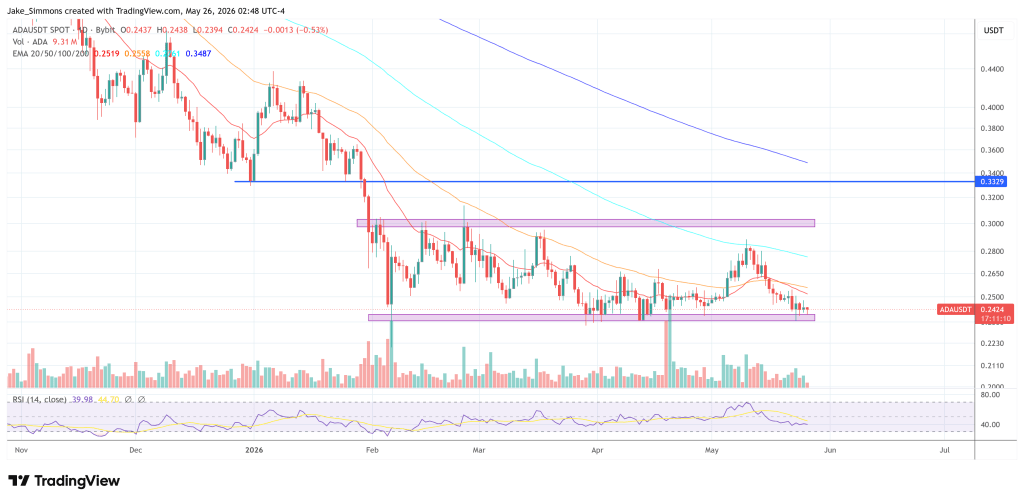
Cardano remains in sideways trend, 1-day chart | Source: ADAUSDT on TradingView.com

Связанные с этим вопросы

QWhat is the name of the Cardano-based app that Charles Hoskinson believes could become the most-used crypto application by 2030?

AThe app is called Midnight.city, which is the interactive simulation tied to Cardano's privacy-focused Midnight ecosystem.

QAccording to the article, what is the main purpose of the upcoming new beta-testing phase for Midnight.city?

AThe main purpose of the new beta-testing phase is to bring in thousands of beta testers to stress-test and refine the platform's design, utility, and user experience, gathering feedback to improve it.

QHow does the article describe the core function or design of the Midnight network?

AThe article describes the Midnight network as a privacy-oriented blockchain focused on programmable privacy, selective disclosure, and predictable costs. It uses zero-knowledge proofs and a dual-state ledger model, allowing developers to determine what information stays protected and what can be disclosed.

QWhat are the two distinct tokens in Midnight's economic model and what are their purposes?

AThe two tokens are NIGHT and DUST. NIGHT is the network's unshielded native and governance token. DUST is a shielded, non-transferable resource used to pay for transaction fees and execute smart contracts.

QWhat is the primary goal of creating the Midnight.city simulation environment?

AThe primary goal of Midnight.city is to serve as a live, interactive simulation environment (rather than a simple block explorer) to demonstrate privacy infrastructure in a consumer-facing way. It shows how selective disclosure works and aims to generate sustained transaction volume to make zero-knowledge systems more visible and understandable to users.

Похожее

Who Funds the Agents?

**Summary: Who Funds AI Agents?** OpenAI recently shut down a feature allowing AI agents to shop for users, highlighting the challenge of creating a secure and regulated environment for agent-driven transactions. While payment infrastructure exists, a crucial governance layer—defining spending limits, fraud detection, tax handling, and return policies—is largely missing. The potential is enormous: AI agents already processed $73M across 176M transactions last year, with McKinsey forecasting this could grow to $3-5T in global consumer commerce by 2030. The core competition isn't just about processing payments, which can be very cheap (especially with crypto-based settlement), but about controlling the rules that govern agent spending. Key players like Stripe and Coinbase are racing to dominate this governance layer. Stripe's acquisition of wallet provider Privy allows it to set spending policies, identity checks, and human-in-the-loop approvals directly at the wallet level. Similarly, Coinbase's stack, including its x402 protocol and AgentKit, embeds governance rules. This vertical integration across settlement, wallet, and governance layers is becoming the dominant strategy. Control over the governance layer is where significant future value lies. If agents handle trillions in transactions, even a small fee for managing compliance, fraud prevention, and policy enforcement could generate billions in annual revenue. The companies that successfully integrate across the payment stack will capture value from idle agent balances, transaction fees, and governance services, positioning themselves as the foundational banks of the AI agent economy.

marsbit9 мин. назад

Who Funds the Agents?

marsbit9 мин. назад

A Nation Blocks Chips, a Giant Buys a Nuclear Power Plant: Why It's Time to Seriously Consider DeAI

**Title: Great Powers Blockade Chips, Giants Buy Nuclear Plants: Why It's Time to Seriously Consider DeAI** In May 2026, the US closed loopholes for Chinese firms to acquire advanced NVIDIA chips via overseas subsidiaries. That same month, Kenya halted a $1B geothermal data center project involving Microsoft, fearing its immense energy consumption. Meanwhile, Huawei announced mass production of its Ascend AI chip. These disparate events underscore a new reality: the competition for computing power ("compute") has escalated beyond the tech industry, becoming a geopolitical and infrastructural battleground. A new era of oligopoly is forming, with control over the AI stack—from GPU chips (NVIDIA) and cloud platforms (AWS, Azure, Google Cloud) to foundational models (OpenAI, Anthropic)—concentrating in a few Western "AI Octopus" corporations. This centralization creates systemic risks: pricing power and platform lock-in for users, infrastructure fragility, and a widening "compute divide" that threatens to marginalize nations without independent AI capacity. An "AI Iron Curtain" is deepening through export controls. In response, some nations like Saudi Arabia and the UAE are investing heavily to buy compute power, aiming to transition from oil to AI economies. The EU seeks to triple its compute capacity by 2030 to reduce dependency. However, the spending gap is vast, with four US tech giants alone planning ~$750B in AI capex for 2026. The race is increasingly constrained by energy, with AI tasks consuming up to 1000x more power than web searches, pushing firms to even acquire nuclear plants. This landscape is fueling interest in Decentralized AI (DeAI). It proposes a third way: using open protocols to coordinate a global network of idle GPUs, independent developers, and data centers, creating an AI infrastructure without a single controlling entity. Leveraging blockchain and cryptographic verification, DeAI aims to break market concentration, disperse energy demands, reduce geopolitical dependencies, and enhance transparency. While still nascent in performance and stability, DeAI's core promise is not immediate superiority but providing a crucial alternative architecture to resist monopoly, censorship, and centralized power. As specialized AI hardware costs fall and open-source models flourish, the window to build this foundation is open. The very existence of such competition serves as a vital check against the inevitable abuse of concentrated power.

marsbit1 ч. назад

A Nation Blocks Chips, a Giant Buys a Nuclear Power Plant: Why It's Time to Seriously Consider DeAI

marsbit1 ч. назад

Outpoll Review: A Prediction Market Platform Built for Active Traders

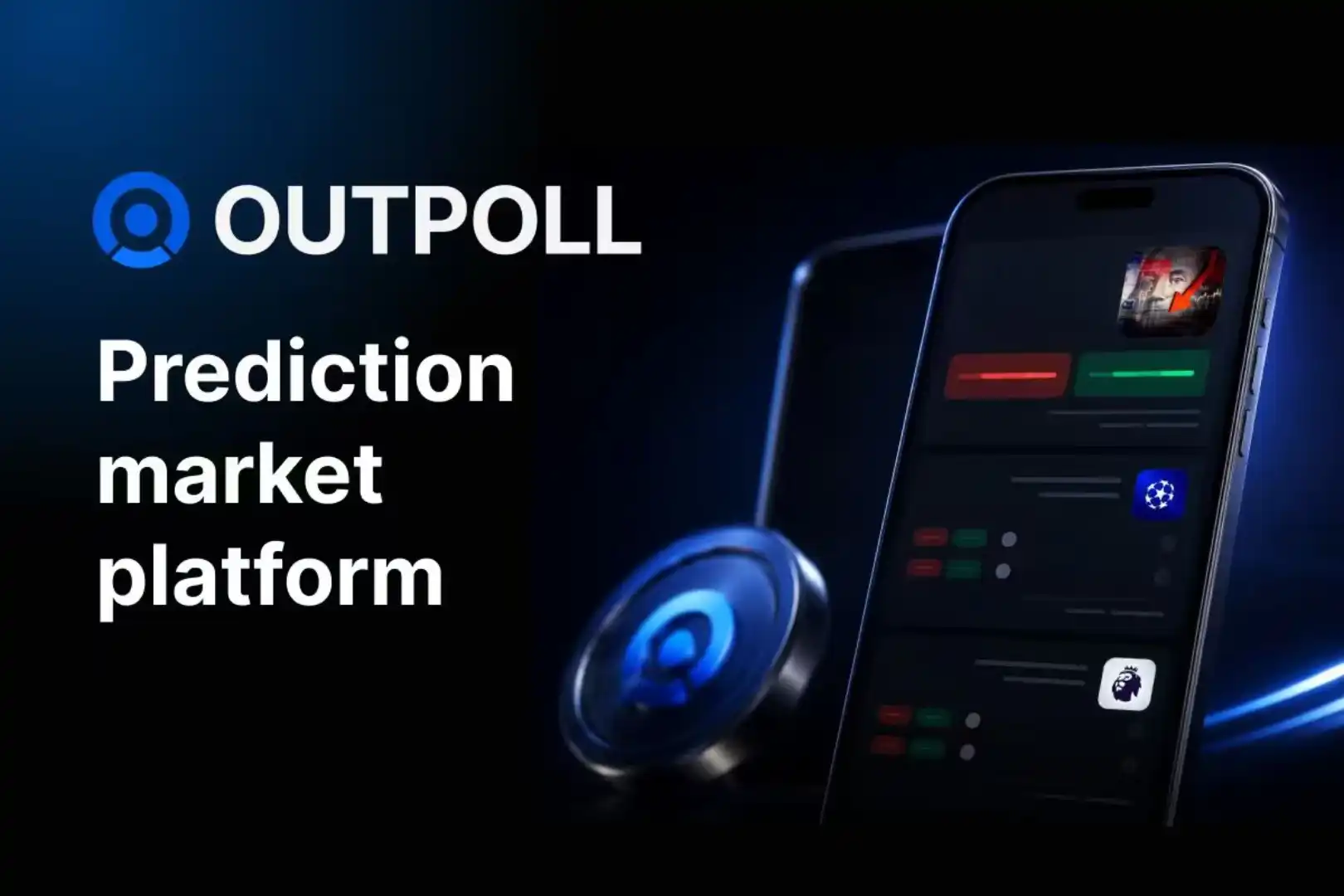
Outpoll Review: A Prediction Market Platform Built for Active Traders In recent years, prediction markets have grown from a niche sector to a mainstream arena, attracting billions in trading volume and institutional capital. However, the user experience and tools for traders have not kept pace. Outpoll, a new global prediction market platform, aims to fill this gap by providing enhanced trading infrastructure for active and professional traders. Built on standard prediction market principles, Outpoll allows users to trade on the outcome of specific events. It uses fully collateralized contracts with USDC settlement, charges a competitive 0.1% fee per trade, and provides clear settlement rules upfront to minimize disputes. A key focus for Outpoll is its professional-grade trading tools. The platform supports limit and market orders, as well as take-profit and stop-loss orders for open positions—features uncommon in prediction markets. For automated trading, Outpoll offers comprehensive REST and WebSocket APIs, enabling portfolio management, price arbitrage, and integration with existing tools. The platform also features a creator-led market model, where approved experts and community leaders can create and manage markets for niche topics under platform supervision. Its integrated interface combines news feeds directly with trading functions, allowing users to monitor events and manage positions seamlessly. Outpoll launched with a native Android app (available on Google Play) and plans an iOS version later this year. In summary, Outpoll distinguishes itself with trader-focused tools, practical APIs, transparent and collateralized markets, integrated news, and an expanding creator program. For active traders, its advanced order types and API access alone make it a platform worth watching. Outpoll is now globally accessible via outpoll.com and Google Play.

marsbit1 ч. назад

Outpoll Review: A Prediction Market Platform Built for Active Traders

marsbit1 ч. назад

Торговля

Спот
Фьючерсы

Популярные статьи

Как купить S

Добро пожаловать на HTX.com! Мы сделали приобретение Sonic (S) простым и удобным. Следуйте нашему пошаговому руководству и отправляйтесь в свое крипто-путешествие.Шаг 1: Создайте аккаунт на HTXИспользуйте свой адрес электронной почты или номер телефона, чтобы зарегистрироваться и бесплатно создать аккаунт на HTX. Пройдите удобную регистрацию и откройте для себя весь функционал.Создать аккаунтШаг 2: Перейдите в Купить криптовалюту и выберите свой способ оплатыКредитная/Дебетовая Карта: Используйте свою карту Visa или Mastercard для мгновенной покупки Sonic (S).Баланс: Используйте средства с баланса вашего аккаунта HTX для простой торговли.Третьи Лица: Мы добавили популярные способы оплаты, такие как Google Pay и Apple Pay, для повышения удобства.P2P: Торгуйте напрямую с другими пользователями на HTX.Внебиржевая Торговля (OTC): Мы предлагаем индивидуальные услуги и конкурентоспособные обменные курсы для трейдеров.Шаг 3: Хранение Sonic (S)После приобретения вами Sonic (S) храните их в своем аккаунте на HTX. В качестве альтернативы вы можете отправить их куда-либо с помощью перевода в блокчейне или использовать для торговли с другими криптовалютами.Шаг 4: Торговля Sonic (S)С легкостью торгуйте Sonic (S) на спотовом рынке HTX. Просто зайдите в свой аккаунт, выберите торговую пару, совершайте сделки и следите за ними в режиме реального времени. Мы предлагаем удобный интерфейс как для начинающих, так и для опытных трейдеров.

1.4k просмотров всегоОпубликовано 2025.01.15Обновлено 2026.06.02

Как купить S

Sonic: Обновления под руководством Андре Кронье – новая звезда Layer-1 на фоне спада рынка

Он решает проблемы масштабируемости, совместимости между блокчейнами и стимулов для разработчиков с помощью технологических инноваций.

2.3k просмотров всегоОпубликовано 2025.04.09Обновлено 2025.04.09

Sonic: Обновления под руководством Андре Кронье – новая звезда Layer-1 на фоне спада рынка

HTX Learn: Пройдите обучение по "Sonic" и разделите 1000 USDT

HTX Learn — ваш проводник в мир перспективных проектов, и мы запускаем специальное мероприятие "Учитесь и Зарабатывайте", посвящённое этим проектам. Наше новое направление .

1.8k просмотров всегоОпубликовано 2025.04.10Обновлено 2025.04.10

HTX Learn: Пройдите обучение по "Sonic" и разделите 1000 USDT

Обсуждения

Добро пожаловать в Сообщество HTX. Здесь вы сможете быть в курсе последних новостей о развитии платформы и получить доступ к профессиональной аналитической информации о рынке. Мнения пользователей о цене на S (S) представлены ниже.

活动图片