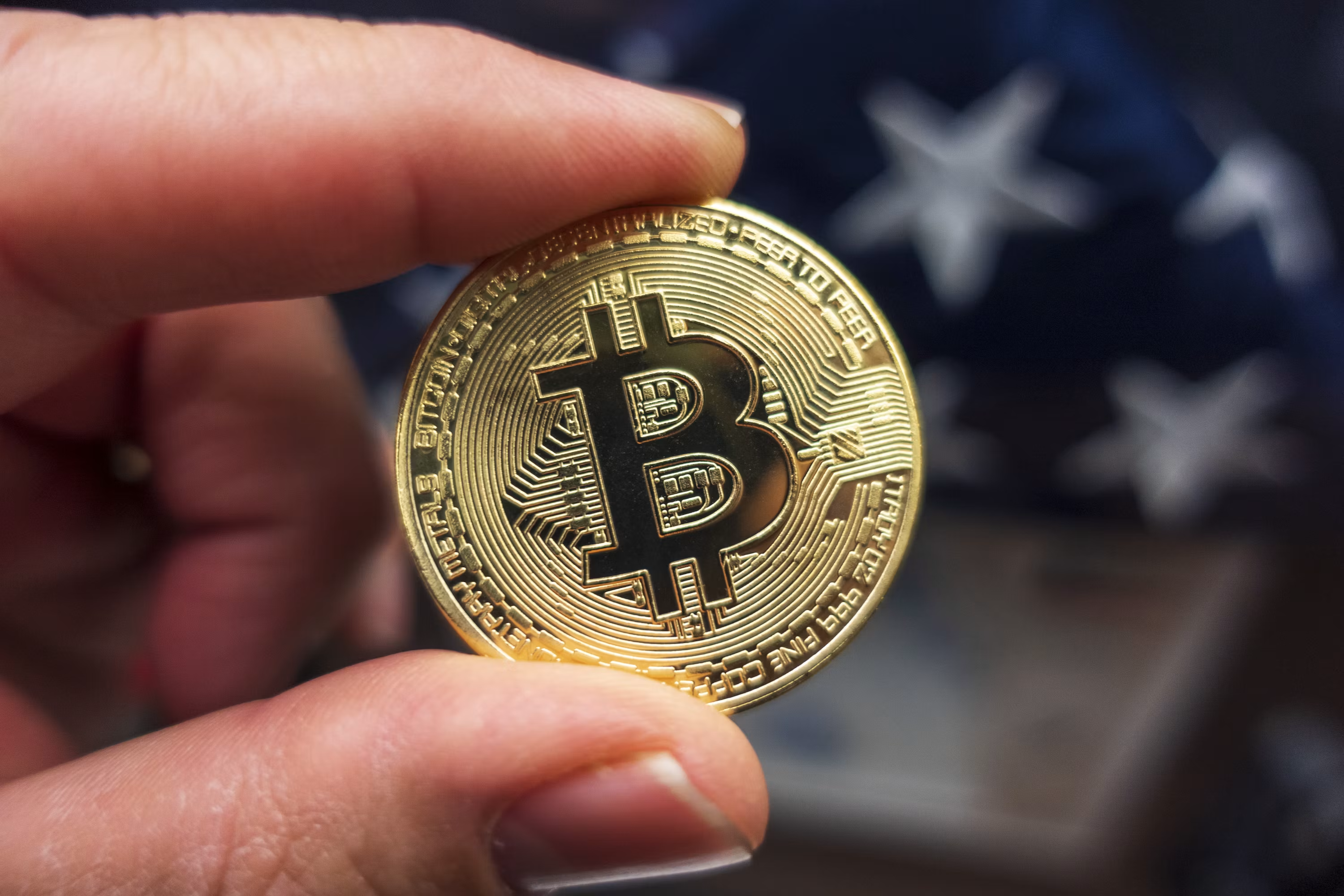
Here’s How Much Ripple’s CTO XRP Holdings Would Be Worth If He Never Sold

bitcoinistОпубликовано 2026-05-08Обновлено 2026-05-08

Введение

The article discusses the hypothetical value of former Ripple CTO David Schwartz's XRP holdings if he had never sold. It details a report showing Schwartz once held 26 million XRP. The value of this stash would have fluctuated dramatically, from $130,000 in 2012 (at $0.005/XRP) to a peak of nearly $59.8 million in 2017 (at $2.30/XRP), and would have been over $54 million in 2024. Schwartz, however, sold most of his XRP in waves between 2012 and 2020 at around $0.10 per token, earning about $2.6 million at the time. He explained his conservative investment strategy, preferring stability and de-risking over chasing massive potential gains, and noted his current main crypto exposure is through Ripple stock.

Debates surrounding the XRP holdings of former Ripple Chief Technology Officer (CTO), David Schwartz, continue to emerge across the crypto market. New updates from an XRP researcher show just how many tokens Schwartz held and how much this would have been worth each year from 2012 to 2026 if he had never sold off his holdings.

How Much Ripple’s Ex-CTO’s XRP Holding Could Have Been Worth

A prominent crypto blockchain researcher, known as BankXRP, has released a new report on the value of the XRP stash once held by Schwartz. The findings detail how the value of the holdings could have grown over time before the former Ripple CTO sold his bags.

The report reveals that Schwartz once held 26 million XRP tokens, which saw massive swings as the price changed each year. In 2012, XRP’s value sat at $0.005, making his holdings worth $130,000 before the cryptocurrency hit $2.30 in 2017 during the bull market. At that time, the former Ripple executive’s stash could have been valued at approximately $59.8 million.

Following this, BankXRP said that Schwartz’s portfolio value would have plummeted when the XRP price fell to $0.19 in 2019, and would have risen again as the cryptocurrency’s value climbed back toward $1.00 in recent cycles. By 2024, after the massive rally, XRP’s average price sat at $2.08. This means the estimated value of Schwartz’s holdings would have been over $54 million.

For 2025 and 2026, the latest figures show that XRP traded at average prices of $1.84 and $1.40, respectively. These market rates would have kept the value of the former CTO’s total holdings between $36.4 million and $47.8 million during the last two years.

Notably, BankXRP said that Schwartz chose to sell a large portion of his tokens when the price was roughly $0.10 per token. This sell-off was not done in a single transaction. The former Ripple CTO had liquidated a large portion of his holdings in several waves between 2012 and 2020 as part of his de-risking strategy.

That specific sale earned him about $2.6 million at the time, but the market continued to fluctuate wildly afterward. On May 6, 2026, Schwartz noted on X that he “once had 26 million XRP” but now holds considerably less.

Schwartz Speaks On His Investment Strategy

Schwartz shared new details regarding his personal digital asset holdings and overall financial strategy on X this week. The former Ripple CTO revealed that he has moved a significant portion of his wealth away from direct crypto exposure, including XRP.

Schwartz explained that he prefers to limit his financial risk even though many of his past investments have been highly successful. He also clarified that he does not have much of his original XRP stash left because he dislikes risk and prefers a more conservative investment approach.

While he views cryptocurrency as a rare opportunity to build wealth, Schwartz said he is comfortable missing out on potential massive gains. This is because he chose to prioritize stability over the highest possible returns in a volatile market.

The former Ripple CTO also mentioned that he could have been a billionaire if he had been willing to take more risks with his portfolio. He believes that his current level of success matches the level of risk he has been prepared to accept over the years. Currently, his main tie to the blockchain industry comes from ownership of the Ripple stock. He said that the position gives him sufficient exposure to the crypto space while allowing his other finances to remain secure.

XRP trading at $1.39 on the 1D chart | Source: XRPUSDT on Tradingview.com

Связанные с этим вопросы

QHow many XRP tokens did Ripple's former CTO David Schwartz once hold according to the report?

AHe once held 26 million XRP tokens.

QAt what price did David Schwartz sell a large portion of his XRP tokens?

AHe sold a large portion of his tokens when the price was roughly $0.10 per token.

QWhat would the estimated value of Schwartz's XRP holdings have been in 2024 if he had never sold, based on the article?

AThe estimated value would have been over $54 million, based on an average XRP price of $2.08 in 2024.

QWhat is the main reason David Schwartz gave for selling most of his XRP and adopting a conservative investment strategy?

AHe dislikes risk and prefers a more conservative investment approach that prioritizes stability over potential massive gains in a volatile market.

QWhat is David Schwartz's current main financial tie to the blockchain industry, as mentioned in the article?

AHis main tie to the blockchain industry comes from his ownership of Ripple stock.

Похожее

Interpreting Investment Opportunities in the Age of Great Navigation, Invesco Great Wall Fund Releases '2026 Report on Chinese Enterprises Going Global'

Invesco Great Wall Fund has released its "2026 China Corporate Globalization Report," titled "The 'Great Navigation Era' of Chinese Enterprises." The report analyzes the new trends and investment opportunities as Chinese companies expand globally, moving from simple product exports to comprehensive overseas operations involving services, branding, and local production. Driven by factors like trade friction, the pursuit of higher profit margins abroad, and policy support, globalization is becoming essential for Chinese companies. The report outlines an evolution: from early product export ("Globalization 1.0") to the current "Globalization 2.0," characterized by overseas capacity, capital goods investment, consumer brand expansion, and service exports. Chinese firms' competitive advantages are highlighted, including a vast engineer talent pool, low-cost and robust infrastructure, and complete industrial clusters. Specific sectors with significant出海 potential are identified: * **Capital Goods** (e.g., engineering machinery, power equipment): Benefiting from global demand, especially in Belt & Road markets and the AI-driven power grid upgrade cycle. * **Consumer Brands**: Transitioning from cost to brand advantage, leveraging供应链 efficiency. * **Technology & Innovation**: Including AI applications, optical modules within global tech supply chains, and new energy vehicles focusing on local production. * **Pharmaceuticals**: Chinese biotech firms are becoming preferred partners for global pharma, with potential for breakthrough drugs in areas like oncology and weight loss. The report concludes that corporate globalization represents a sustained, core theme for China's capital markets, though companies must navigate challenges like geopolitics and localization.

marsbit7 мин. назад

Interpreting Investment Opportunities in the Age of Great Navigation, Invesco Great Wall Fund Releases '2026 Report on Chinese Enterprises Going Global'

marsbit7 мин. назад

GitHub, Transfixed by AI

On the night of February 9th, GitHub suffered a major outage caused by a simple configuration change—reducing a cache refresh interval from 12 to 2 hours—that triggered a cascade of failures. This was not an isolated event, but part of a broader pattern. In early 2026, GitHub experienced at least 8 major incidents, failing to meet its promised 99.9% availability. These outages stemmed from structural issues: explosive growth in load, tight service coupling, and insufficient protection against abnormal traffic. This unprecedented load is driven by AI Agents. In 2025, GitHub handled ~1 billion commits. By 2026, weekly commits reached 275 million, projecting to ~14 billion for the year—a 14x increase. AI tools like Claude Code now contribute 4.5% of all public repository commits, with weekly submissions surging 25x in just three months. AI-generated pull requests jumped from 4 million to 17 million per month in half a year. Unlike human developers, AI Agents work continuously, generating commits at a scale that overwhelms infrastructure designed for human rhythms. The surge also shattered GitHub's business model. Copilot's flat-rate pricing, based on assisting human developers, became unsustainable as Agentic AI sessions consumed resources worth hundreds of dollars for a few dollars in fees. In response, GitHub imposed usage limits and, by June 1st, shifted to a pay-per-use "AI Credits" system. Facing this new reality, GitHub realized a 10x scaling plan was insufficient. It announced a need to *redesign* its architecture for 30x current scale—decoupling services, adding fault isolation, and improving change management to prevent cascading failures. Other platforms like Stripe and AWS are facing similar challenges with AI Agents. Fundamentally, GitHub is transitioning from a human collaboration platform to an "exhaust pipe" for automated AI workflows. Its detailed post-mortem reports aim to maintain trust during this turbulent rebuild. The February outage was not just a technical glitch, but a signal of the software industry's entry into a new, AI-driven era.

marsbit47 мин. назад

GitHub, Transfixed by AI

marsbit47 мин. назад

Both Suffer Massive Losses Exceeding $90 Billion, Which Is in Greater Peril: Strategy or Bitmine?

Facing massive paper losses exceeding $90 billion each amidst a sharp market downturn, "Digital Asset Treasury" (DAT) giants Strategy and Bitmine find themselves in a precarious position, but with different underlying risks. Strategy, heavily invested in Bitcoin (BTC), faces significant financial strain. Its strategy relies heavily on debt, including convertible notes and preferred stock (STRC) requiring substantial dividend payments. With its cash reserves dwindling and BTC offering no staking yield for cash flow, Strategy's high leverage makes it vulnerable. A continued price decline could force asset sales to meet obligations, potentially creating a negative feedback loop. Its market value has already fallen sharply. In contrast, Bitmine, an Ethereum (ETH) holder, appears on firmer financial ground. It primarily funds its purchases through equity offerings (like ATM programs), avoiding debt pressure. It also generates income by staking a large portion of its ETH holdings. While not immune to market drops and shareholder dilution concerns, Bitmine maintains more flexibility, recently announcing a new preferred share offering to raise further capital. The core divergence lies in their financing: Bitmine uses equity (investor money), while Strategy uses debt (borrowed money). Consequently, Bitmine currently faces less immediate liquidity pressure than Strategy, which must navigate the dual challenge of servicing debt/dividends and a declining core asset (BTC) price.

marsbit54 мин. назад

Both Suffer Massive Losses Exceeding $90 Billion, Which Is in Greater Peril: Strategy or Bitmine?

marsbit54 мин. назад

Торговля

Спот
Фьючерсы

Популярные статьи

Как купить S

Добро пожаловать на HTX.com! Мы сделали приобретение Sonic (S) простым и удобным. Следуйте нашему пошаговому руководству и отправляйтесь в свое крипто-путешествие.Шаг 1: Создайте аккаунт на HTXИспользуйте свой адрес электронной почты или номер телефона, чтобы зарегистрироваться и бесплатно создать аккаунт на HTX. Пройдите удобную регистрацию и откройте для себя весь функционал.Создать аккаунтШаг 2: Перейдите в Купить криптовалюту и выберите свой способ оплатыКредитная/Дебетовая Карта: Используйте свою карту Visa или Mastercard для мгновенной покупки Sonic (S).Баланс: Используйте средства с баланса вашего аккаунта HTX для простой торговли.Третьи Лица: Мы добавили популярные способы оплаты, такие как Google Pay и Apple Pay, для повышения удобства.P2P: Торгуйте напрямую с другими пользователями на HTX.Внебиржевая Торговля (OTC): Мы предлагаем индивидуальные услуги и конкурентоспособные обменные курсы для трейдеров.Шаг 3: Хранение Sonic (S)После приобретения вами Sonic (S) храните их в своем аккаунте на HTX. В качестве альтернативы вы можете отправить их куда-либо с помощью перевода в блокчейне или использовать для торговли с другими криптовалютами.Шаг 4: Торговля Sonic (S)С легкостью торгуйте Sonic (S) на спотовом рынке HTX. Просто зайдите в свой аккаунт, выберите торговую пару, совершайте сделки и следите за ними в режиме реального времени. Мы предлагаем удобный интерфейс как для начинающих, так и для опытных трейдеров.

1.4k просмотров всегоОпубликовано 2025.01.15Обновлено 2026.06.02

Как купить S

Sonic: Обновления под руководством Андре Кронье – новая звезда Layer-1 на фоне спада рынка

Он решает проблемы масштабируемости, совместимости между блокчейнами и стимулов для разработчиков с помощью технологических инноваций.

2.3k просмотров всегоОпубликовано 2025.04.09Обновлено 2025.04.09

Sonic: Обновления под руководством Андре Кронье – новая звезда Layer-1 на фоне спада рынка

HTX Learn: Пройдите обучение по "Sonic" и разделите 1000 USDT

HTX Learn — ваш проводник в мир перспективных проектов, и мы запускаем специальное мероприятие "Учитесь и Зарабатывайте", посвящённое этим проектам. Наше новое направление .

1.8k просмотров всегоОпубликовано 2025.04.10Обновлено 2025.04.10

HTX Learn: Пройдите обучение по "Sonic" и разделите 1000 USDT

Обсуждения

Добро пожаловать в Сообщество HTX. Здесь вы сможете быть в курсе последних новостей о развитии платформы и получить доступ к профессиональной аналитической информации о рынке. Мнения пользователей о цене на S (S) представлены ниже.

活动图片