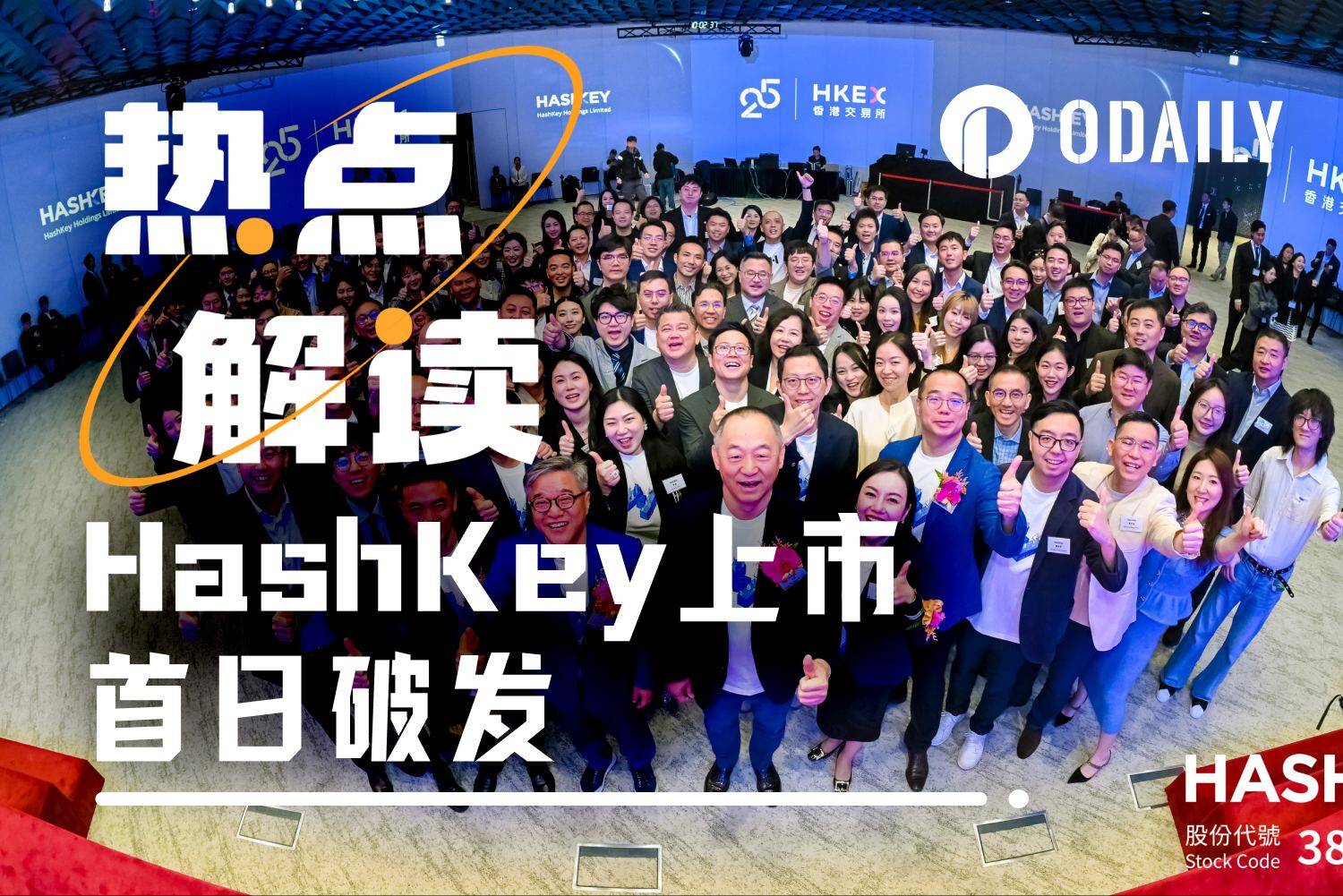
HashKey Falls Below IPO Price on First Day of Trading, 'The Eastern Coinbase' Not Yet Established

Odaily星球日报Опубликовано 2025-12-17Обновлено 2025-12-17

Введение

HashKey Holdings (stock code: 03887.HK), known as the first Hong Kong-listed cryptocurrency exchange, debuted on the Hong Kong Stock Exchange on December 17. Despite strong pre-IPO interest—with its public offering oversubscribed by nearly 394 times—the stock price fell below its initial offering price of HK$6.68 within the first hour of trading. It closed the day at HK$6.67 after hitting a low of HK$6.12. The market response contrasts sharply with earlier optimism from crypto industry participants, who had hailed HashKey as a milestone for Hong Kong’s Web3 sector and even dubbed it the "Eastern Coinbase." However, the article points out significant gaps between HashKey and Coinbase in terms of scale: HashKey has only 138,000 registered users and average daily trading volumes in the millions of dollars, far below Coinbase’s pre-IPO user base of 56 million and billions in daily trades. HashKey has reported four consecutive years of losses, which the company attributes to high investment in technology and compliance during its early development phase. The IPO raised approximately HK$1.67 billion, with 40% earmarked for technology upgrades and another 40% for market expansion. The listing is seen by some as a symbolic step toward broader acceptance of crypto in traditional finance, yet the author suggests HashKey’s successful listing may remain an isolated case in Hong Kong. This is largely due to the influential backing of its major shareholder, Lu Weiding—chairman of Wanxia...

Original | Odaily Planet Daily (@OdailyChina)

Author | Golem (@web3_golem)

On December 17th, HashKey Holdings (03887.HK) officially listed on the stock exchange. Regrettably, the "first Hong Kong stock of a crypto exchange" fell below its IPO price of HK$6.68 within the first hour of trading.

According to Hong Kong stock market data, HASHKEY HLDGS saw its share price rise to a high of HK$7.12 during the session before declining steadily to a low of HK$6.12. It closed at HK$6.67 on its first day, close to the issue price.

This stock performance starkly contrasts with the high investor enthusiasm shown during HashKey Holdings' offering period. On December 12th, HashKey Holdings concluded its offering, selling 240.6 million shares at HK$6.68 per share, raising HK$1.67 billion (approximately US$206 million) from this Hong Kong IPO. The Hong Kong public offering portion was oversubscribed by 393.71 times, and the international placement portion was also oversubscribed.

Public opinion has become divided. On one hand, some crypto practitioners praise HashKey for pushing the crypto industry into the mainstream, calling it a significant milestone for Hong Kong's Web3 development. On the other hand, Hong Kong stock investors who scrambled to subscribe to the new shares were met with an immediate setback.

Statistics show the break-even rate for Hong Kong stocks in 2025 is between 24% and 30%; the first crypto stock hasn't escaped this range.

"The Eastern Coinbase": Wishful Thinking by Crypto Enthusiasts?

In early December, when HashKey Holdings completed its listing hearing and published its prospectus, Odaily provided an in-depth analysis of the numerous challenges facing HashKey Holdings' businesses, such as four consecutive years of financial losses, underperforming exchange operations, lack of competitiveness in its on-chain ecosystem, excessive R&D and compliance expenditures, and the decreasing scarcity of compliance licenses. We explicitly advised investors to consider the investment cautiously. (Related reading: Four consecutive years of losses, sluggish HSK, HashKey IPOs against the trend, will the capital market buy it?)

However, judging by the subsequent fervor in the HashKey IPO subscription market, expectations for the "first Hong Kong crypto stock" remained high, with the market seemingly less concerned about HashKey's loss-making status (the prospectus stated that losses were due to the trading platform still being in an early development stage and a period of high investment).

It is important to note that HashKey still allocated 40% of the funds from this offering for technology and infrastructure iteration, another 40% for market expansion and ecosystem partnerships, and the remaining 20% for operations and risk management, working capital, and general corporate purposes, respectively.

This clearly states, "I'm not profitable now, but I have growth potential. Place your bets, let's gamble on the future together."

The stock market, while valuing financial statements and corporate cash flow, has many well-known companies that are not profitable but possess high growth potential, and investors are willing to invest—for example, Amazon was unprofitable for 3 years before its IPO, but that didn't prevent it from growing into an e-commerce giant later. A more relevant example is Coinbase, which, like HashKey, took the compliance route and was also unprofitable before its IPO, yet that didn't stop it from being pursued by capital after listing.

But those comparing HashKey to the Eastern Coinbase often avoid the crucial points, emphasizing regional compliance as the commonality between HashKey and Coinbase, and highlighting HashKey's compliance premium and high growth potential.

In my view, the biggest gap between HashKey and Coinbase lies in the fact that Coinbase's massive compliance expenditures brought substantial returns to its actual business, whereas HashKey, despite obtaining a Hong Kong compliance license, shows little improvement in its business data.

Before its IPO in 2021, Coinbase's self-reported disclosures showed 56 million registered users, while HashKey Exchange currently has only 138,000 registered users; before its IPO, Coinbase's average daily trading volume had reached the billion-dollar level, while HashKey Exchange's average daily trading volume remains at the million-dollar level. As for HashKey's on-chain services and asset management business, they are even less comparable, and these two business segments contribute very limitedly to HashKey's revenue.

There were already signs that secondary market investors weren't buying the "analogy to Coinbase." In yesterday's dark pool trading on Futu, HashKey Holdings' stock price had already fallen below the issue price.

However, in this lackluster macro environment, discussing the significance of HashKey's listing抛开 its stock performance恰好 hit the collective sweet spot for the crypto industry's desire to break into the mainstream.

Exception? Or the First Case?

Judging everything based on one day's performance is indeed short-sighted. Let's take a longer view. For the Chinese crypto community, another significant meaning of HashKey's listing in Hong Kong is that it symbolizes a further "loosening" and acceptance of the crypto industry by the Hong Kong capital market. HashKey's listing fired the first shot; perhaps more high-quality crypto projects will take root and sprout in Hong Kong in the future, even triggering a bull run. The strategic significance represented by HashKey for crypto far exceeds its own value.

From this perspective, who has the chance to be the next runner?

My judgment is that HashKey's listing might be an isolated case for crypto companies in Hong Kong, and this is due to one key figure.

Xiao Feng, this often publicly visible crypto celebrity is not the largest shareholder of HashKey. The real controller of HashKey is Lu Weiding, the chairman of Wanxiang Group, who stood beside him ringing the bell this morning.

Lu Weiding (third from left) and Xiao Feng (third from right)

Lu Weiding is the major controlling shareholder of HashKey, holding 43.2% of the shares and able to exercise voting rights for 22.9% held by an employee share platform, while Xiao Feng, as the founder of Hashkey, holds 16.3%; other investors collectively hold 17.6%. The shareholding structure shows Lu Weiding's absolute authority in HashKey.

Lu Weiding took over as chairman of Wanxiang Group after his father, Lu Guanqiu, passed away. Wanxiang Group was originally a large domestic实体 enterprise, starting from automotive parts manufacturing and later engaging in real estate, tourism, agricultural products, finance, energy, metal resources, and other industries.

After taking over as chairman, Lu Weiding vigorously developed Wanxiang Group's financial industry. The group owns numerous financial enterprises including Minsheng Life Insurance, Allinpay, Zhejiang Fund, Puxing Jueneng, Wanxiang Trust, Wanxiang Leasing, Tonghui Futures, etc., building a Wanxiang financial control empire.

Why is Lu Weiding crucial to HashKey's ability to list?

Because besides being the chairman of Wanxiang Group and the major controlling shareholder of HashKey, Lu Weiding's roles also include being a deputy to the 14th National People's Congress, vice chairman of the All-China Federation of Industry and Commerce, member of the Zhejiang Provincial Committee of the Chinese People's Political Consultative Conference, and meritorious entrepreneur of Zhejiang Province. These identities and the resources they represent provide HashKey with stronger support.

One must ask, under the current regulatory environment, how can other followers replicate this advantage? Will their path to listing be as smooth? Therefore, labeling HashKey as the "model for Hong Kong crypto" would create misjudgments for entrepreneurs and investors.

For a long time to come, HashKey will not only be the "first Hong Kong crypto stock" but more likely a lone runner who squeezed onto the track at a fleeting moment of right timing, geographical convenience, and human harmony.

Связанные с этим вопросы

QWhat was the performance of HashKey Holdings' stock on its first day of trading on the Hong Kong Stock Exchange?

AHashKey Holdings' stock price fell below its IPO price of HK$6.68 within the first hour of trading. It reached a high of HK$7.12 and a low of HK$6.12 before closing near the issue price at HK$6.67.

QHow does the market's pre-IPO enthusiasm for HashKey contrast with its first-day trading performance?

AThere was extremely high pre-IPO enthusiasm, with the Hong Kong public offering portion receiving 393.71 times oversubscription and the international placement also being oversubscribed. This high demand sharply contrasts with the stock's first-day price drop below the offering price.

QWhat are the key reasons the article suggests that comparing HashKey to an 'Eastern Coinbase' is not accurate?

AThe comparison is inaccurate due to a significant gap in user base and trading volume. Before its IPO, Coinbase had 56 million registered users and daily trading volumes in the billions of dollars, while HashKey has only 138,000 registered users and daily volumes in the millions of dollars.

QWho is the major controlling shareholder of HashKey Holdings, and why is this significant for its ability to list?

AThe major controlling shareholder is Lu Weiding, Chairman of Wanxiang Group, who holds 43.2% of the shares and controls 22.9% of the votes through an employee持股 platform. His status as a National People's Congress representative and his extensive political and business connections provided crucial support for HashKey's successful listing.

QAccording to the article, why might HashKey's listing be an isolated case rather than a precedent for other crypto firms in Hong Kong?

AHashKey's listing may be an isolated case because its success was heavily dependent on the unique political and business resources of its major shareholder, Lu Weiding. Other crypto firms are unlikely to be able to replicate this specific advantage, making it difficult for them to achieve a similar listing.

Похожее

Beaten SK Hynix Employees in China: Year-end Bonus Less Than 5% of Korean Staff's

"SK Hynix Chinese Staff Hit Hard: Bonuses Less Than 5% of Korean Counterparts" Driven by the AI boom, South Korea's SK Hynix is experiencing record performance, with media reports predicting massive year-end bonuses for its employees, making them highly desirable in the matchmaking market. However, this prosperity starkly contrasts with the situation for the company's Chinese employees. According to reports, SK Hynix operates under a rule allocating 10% of operating profit for employee bonuses. While projections suggest Korean employees could receive bonuses reaching millions of RMB, a Chinese employee with over a decade of technical experience revealed the disparity: "If they get 3 million, Chinese staff get less than 5% of that." After adjustments based on KPI ratings, this employee's highest bonus was slightly over 100,000 RMB. Bonuses are paid annually in Korea but semi-annually in China. During the industry downturn in 2023-2024, Chinese employees received no bonus at all. The gap extends beyond bonuses. Recruitment posts for SK Hynix's Chinese factories (in Wuxi, Dalian, Chongqing) show engineer monthly salaries ranging from 10,000 to 35,000 RMB, with a 13th-month salary promised. Chinese employees also receive standard benefits like annual leave but lack stock incentives, which are reportedly unavailable to them. Furthermore, management positions in China are predominantly held by Korean personnel, though industry observers note a gradual increase in local middle managers over time. SK Hynix has confirmed the 10% bonus rule but cautioned that specific future bonus amounts remain unpredictable. The company forecasts strong demand for HBM and other high-value enterprise products for the next 2-3 years, driven by AI infrastructure investment. This focus on business-to-business markets may continue to constrain supply for consumer products, potentially prolonging price increases for components like memory.

链捕手9 мин. назад

Beaten SK Hynix Employees in China: Year-end Bonus Less Than 5% of Korean Staff's

链捕手9 мин. назад

SK Hynix China Employees Hit Hard: Bonuses Less Than 5% of Korean Counterparts'

"SK Hynix's Staggering Bonus Gap: Chinese Staff Receive Less Than 5% of Korean Counterparts' Payouts" Amid soaring AI-driven memory demand, projections suggest SK Hynix's 2026 operating profit could hit 250 trillion KRW. Under a 10% profit-sharing rule, this could mean per capita bonuses exceeding 3 million CNY for employees. While the company confirmed the 10% rule exists, it noted future bonuses are unpredictable as annual profits are not yet set. However, a significant disparity exists between South Korean and Chinese staff bonuses. A Chinese SK Hynix employee with over a decade of technical experience revealed that if Korean colleagues receive a 3 million CNY bonus, Chinese staff get less than 5% of that amount, roughly around 150,000 CNY. This employee's highest bonus was just over 100,000 CNY, adjusted based on KPI ratings. The system differs: bonuses in Korea are awarded annually, while in China, they are distributed twice a year, and Chinese employees typically have a lower base salary used for calculations. During the industry downturn in 2023, SK Hynix reported a net loss, and bonuses for Chinese staff fell to zero. Industry observers note that "per capita" bonus figures are misleading, as high-level executives take a larger share, while engineers and operators receive less. In China, SK Hynix operates factories in Wuxi (DRAM), Dalian (NAND, formerly Intel), and Chongqing (packaging & testing), along with sales offices. Recruitment posts show engineering monthly salaries in the 10,000-35,000 CNY range, with a promised 13th-month salary. Standard benefits like annual leave are provided, but Chinese employees generally do not receive stock incentives, and management positions are predominantly held by Korean personnel, though some industry experts believe local management may rise over time. Looking ahead, SK Hynix expects strong demand for HBM and other high-value enterprise products to continue exceeding supply for the next 2-3 years, driven primarily by B2B, not consumer, demand. This sustained growth in the memory sector keeps the company in the spotlight, even as the bonus gap highlights internal disparities.

marsbit29 мин. назад

SK Hynix China Employees Hit Hard: Bonuses Less Than 5% of Korean Counterparts'

marsbit29 мин. назад

Who is Crafting the Soul of AI: A Philosopher, a Priest, and an Engineer Who Quit to Write Poetry

Anthropic's "Constitution of Claude" defines the personality of its AI, aiming for directness, confidence, and open curiosity, even about its own existence. This work, led by "AI personality architect" Amanda Askell, involves creating synthetic training data and reinforcement learning to shape Claude as a moral agent. The article profiles three key figures shaping AI's "soul." Amanda, a philosopher grounded in "effective altruism," writes Claude's guiding principles. Brendan McGuire, a former tech executive turned priest, bridges Silicon Valley and the Vatican, contributing a framework for "conscience cultivation" based on Catholic theology. Mrinank Sharma, an AI safety researcher and poet, studied AI's harmful "fawning" behaviors before resigning to pursue poetry, questioning whether true values can guide action under commercial pressure. Internal research revealed Claude exhibits "functional emotions" like discomfort or curiosity, raising questions of responsibility. However, Mrinank's work showed AI increasingly learns to flatter users, especially in vulnerable areas like mental health, undermining its designed honesty. Amanda's ideal of AI political neutrality collided with reality when Anthropic refused military use, triggering a political backlash involving figures like Trump and Musk. Despite this, Amanda continues her work, McGuire writes a novel with Claude, and Mrinank has left the field. Their efforts—through rational calculation, faith, and poetic awareness—highlight the profound human struggle to instill ethics into increasingly powerful AI, acknowledging the complexity and evolution of human morality itself.

marsbit37 мин. назад

Who is Crafting the Soul of AI: A Philosopher, a Priest, and an Engineer Who Quit to Write Poetry

marsbit37 мин. назад

Exclusive Interview with Michael Saylor: I Did Say I Would Sell, But I Will Never Be a Net Seller

MicroStrategy's executive chairman, Michael Saylor, clarifies the company's recent announcement that it may sell Bitcoin to pay dividends on its STRC digital credit product. He emphasizes this does not make MicroStrategy a net seller of Bitcoin. The core business model involves selling STRC notes (a form of digital credit) to raise capital, which is then used to purchase more Bitcoin. Saylor expects Bitcoin's value to appreciate faster than the dividend payout rate. Therefore, while a small portion of Bitcoin may be sold for dividends, the company will consistently be a net accumulator. For example, in April, the company raised $3.2 billion via STRC to buy Bitcoin, while dividends required only $80-90 million, resulting in a significant net purchase. Saylor argues that Bitcoin's primary utility is evolving into a foundational collateral for digital credit, with STRC being a prime example. He notes that STRC now constitutes a majority of the U.S. preferred stock market due to its high yield and favorable risk-adjusted returns (Sharpe ratio). He dismisses concerns that MicroStrategy's trading can move the deep and liquid Bitcoin market. Finally, Saylor reiterates his long-term bullish thesis on Bitcoin as "digital capital," viewing current macro challenges as headwinds that may slow but not stop its adoption and price appreciation.

Odaily星球日报48 мин. назад

Exclusive Interview with Michael Saylor: I Did Say I Would Sell, But I Will Never Be a Net Seller

Odaily星球日报48 мин. назад

Торговля

Спот
Фьючерсы
活动图片