Google Is Really Anxious, Launches Deep Research Agent Late at Night with MCP Support and Native Charts

marsbitОпубликовано 2026-04-22Обновлено 2026-04-22

Введение

Google has launched two new AI research agents, Deep Research and Deep Research Max, built on the Gemini 3.1 Pro model. These agents are designed for enterprise and developer use, accessible via API, and support integration of open web data with private enterprise information through a single API call. They also feature native chart and infographic generation within reports and support the Model Context Protocol (MCP) to connect with third-party data sources securely. Deep Research is optimized for speed and lower latency, while Deep Research Max prioritizes depth and extended reasoning, making it suitable for asynchronous workflows like overnight analysis tasks. The agents are not available to general Gemini app users, including Pro subscribers, and are currently offered as a paid preview through the Interactions API. The update aims to position Google competitively against rivals like OpenAI and Anthropic in the AI research and analysis tool space, particularly targeting high-value sectors such as finance and consulting. Enhanced capabilities include multi-modal input support, collaborative planning features, and improved performance on benchmarks, though comparative data with competitors should be interpreted cautiously due to potential methodological differences.

By | Alphabet AI

Google is really anxious.

Just earlier, news broke that Google co-founder Sergey Brin has restarted "founder mode," personally overseeing the battle and forming an elite "strike team" to fully enhance Gemini's key capabilities in AI programming and autonomous agents to catch up with competitors like Anthropic.

Then, late at night, Google announced a major update, launching a new generation of autonomous research agents built on the Gemini 3.1 Pro model: Deep Research and Deep Research Max.

Not only has the reasoning capability at the model's foundation been strengthened, but there is also a strong push to evolve autonomous research agents towards enterprise-grade and developer platforms. Through API openness, support for private data, background asynchronous tasks, and other methods, Google is attempting to seize the initiative in the high-value scenario of "AI research/analysis tools," responding to competition from opponents like OpenAI (Hermes) and Perplexity.

These two agents, for the first time, allow developers to fuse open web data with enterprise proprietary information through a single API call, natively generate charts and infographics in research reports, and also connect to any third-party data source via the Model Context Protocol (MCP).

The two agents are now available as a public preview through paid plans of the Gemini API and can be accessed via the Interactions API first launched by Google in December 2025.

That's right, these new agents are currently only available via API; regular users cannot access them in the Gemini App, even if they have a paid subscription. Seeing the update news but finding they can't use it, some users lamented: "Google, for some reason, continues to punish us Pro subscribers of the Gemini App..."

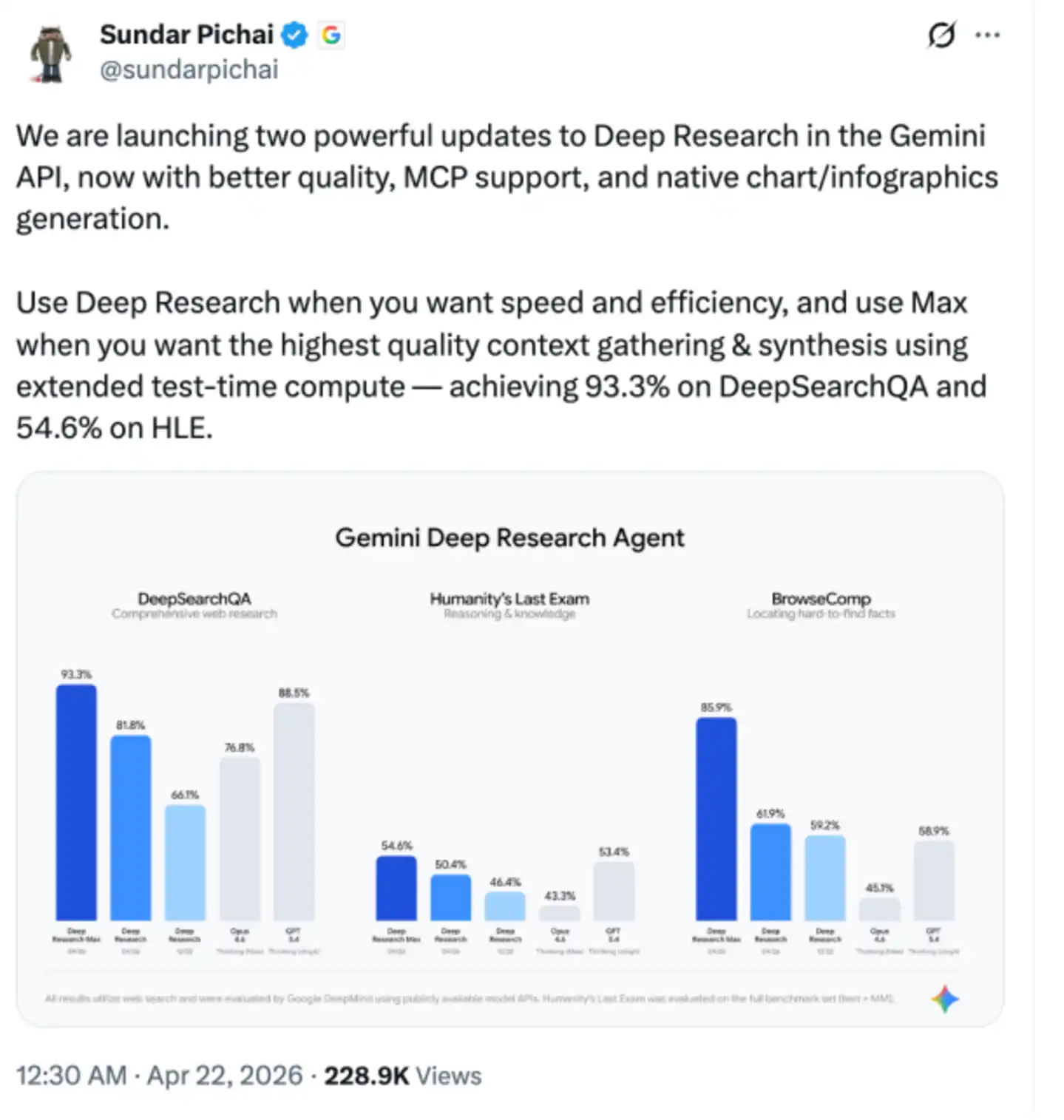
Google CEO Sundar Pichai also personally took to X to promote it: "When you need speed and efficiency, use Deep Research; when you pursue the highest quality context collection and synthesis, use the Max version—it achieves scores of 93.3% on DeepSearchQA and 54.6% on HLE through extended test-time computation."

Eighteen months ago, the goal of Google Deep Research was to help graduate students avoid being overwhelmed by a sea of browser tabs. Today, Google hopes it can replace the basic research work of investment banking junior analysts.

The gap between these two goals—and whether this technology can truly bridge it—will determine whether autonomous research agents become a transformative product in the enterprise software field or just another AI demo that looks impressive in benchmarks but disappoints in meetings.

Two Versions, Adapted to Different Workloads

The standard Deep Research has lower latency and lower cost, suitable for scenarios prioritizing speed.

Deep Research Max prioritizes depth over speed. This agent uses extended test-time computation for deep reasoning, searching, and iteration, ultimately generating a report.

Google points out that asynchronous background workflows are its ideal use case, such as running via a cron job at night and delivering a complete due diligence report to the analyst team the next morning.

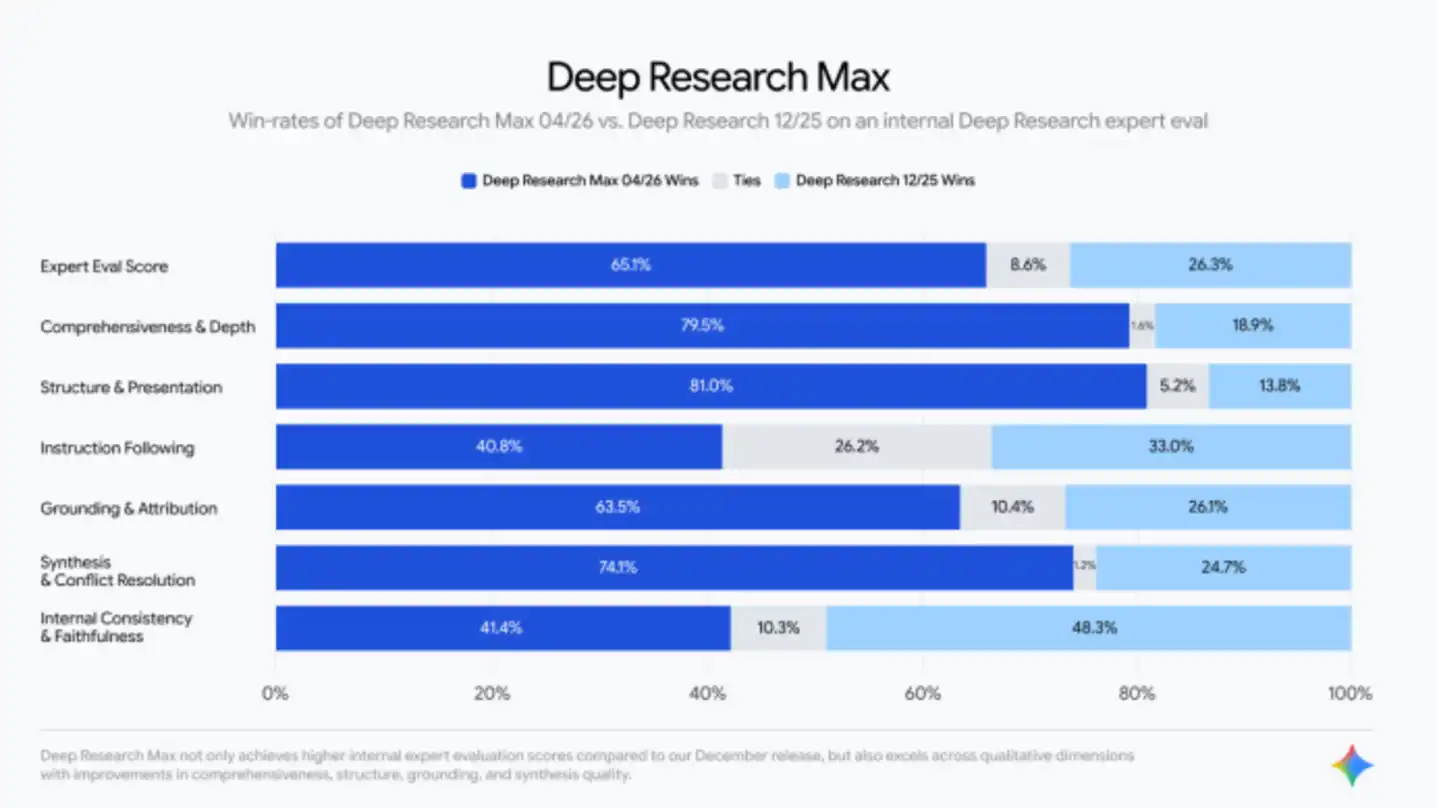
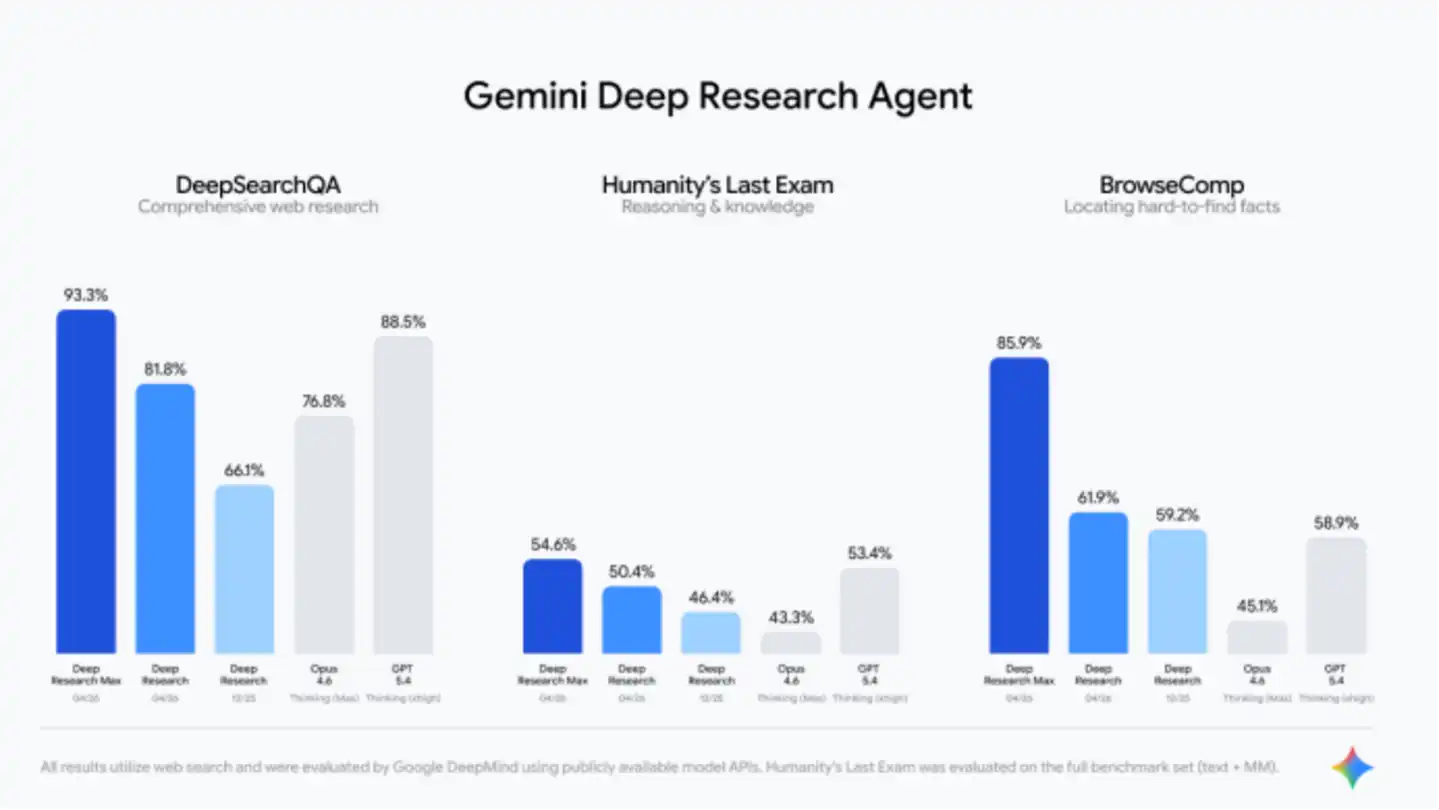
In Google's own benchmarks, Deep Research Max showed significant improvements in retrieval and reasoning tasks. The agent can gather information from more sources than previous versions and capture nuances that older models easily missed.

Google also provided a comparison with competitors.

However, comparing with OpenAI's GPT-5.4 and Anthropic's Opus 4.6 is not entirely fair. GPT-5.4 excels in autonomous web search but is not specifically optimized for deep research. For this, OpenAI provides its own DR agent, which switched to GPT-5.2, not GPT-5.4, after the February update. OpenAI's strongest search model is actually GPT-5.4 Pro, but Google clearly did not include it in the comparison.

According to OpenAI's data, GPT-5.4 Pro can score up to 89.3% on the agent search benchmark BrowseComp, while GPT-5.4 scores 82.7%.

Based on Anthropic's own reports, Opus 4.6 scores higher on BrowseComp than the value shown, specifically 84%. This score was achieved with reasoning turned off, and the model performed better than the high-intensity reasoning settings used by Google in the API benchmark tests.

These discrepancies likely stem from differences in testing methods—whether the models were evaluated via the raw API or encapsulated within each lab's own toolchain. Google's data is not necessarily wrong, but it deserves cautious interpretation. In any case, the presentation lacks sufficient transparency.

MCP Support

Perhaps the most impactful feature of this release is the newly added support for the Model Context Protocol (MCP). This feature transforms Deep Research from a powerful web research tool into something closer to a "universal data analyst."

MCP is an emerging open standard for connecting AI models to external data sources. It allows Deep Research to securely query private databases, internal document repositories, and specialized third-party data services—all without sensitive information ever leaving its original environment.

In practice, this means a hedge fund could simultaneously point Deep Research to its internal trading flow database and a financial data terminal, then ask the agent to combine both with public information from the web to synthesize insights.

Google revealed that it is actively working with companies like FactSet, S&P, and PitchBook to design their MCP servers, clearly indicating that Google is seeking deep integration with data providers that Wall Street and the broader financial services industry rely on daily.

According to a blog post written by Google DeepMind product managers Lukas Haas and Srinivas Tadepalli, the goal is to "enable joint customers to integrate financial data products into workflows powered by Deep Research, and by leveraging its massive data universe, gather context at lightning speed, thereby leaping forward in productivity."

This feature directly addresses one of the most stubborn pain points in enterprise AI adoption: the huge gap between the information models can find on the open internet and the information organizations actually need for decision-making. Previously, bridging this gap required significant custom engineering work.

MCP support, combined with Deep Research's autonomous browsing and reasoning capabilities, simplifies most of this complexity to a one-time configuration. Developers can now have Deep Research use Google Search, remote MCP servers, URL Context, code execution, and file search simultaneously—or completely turn off web access and search only on custom data.

The system also supports multimodal input, including PDFs, CSVs, images, audio, and video, for use as grounding context.

Native Charts

The second major feature is native chart and infographic generation.

Previous versions of Deep Research could only generate plain text reports. If users needed visualizations, they had to export the data and create charts themselves. This shortcoming significantly weakened the "end-to-end automation" positioning.

Now, the new generation of agents can natively embed high-quality charts and infographics within reports, dynamically rendering complex datasets in HTML or Google's Nano Banana format, making them a direct part of the analytical narrative.

For enterprise users—especially those in the financial and consulting industries who need to produce deliverables ready for stakeholders—this feature transforms Deep Research from a tool that "accelerates the research phase" into one that can generate something close to a final analytical product.

Furthermore, combined with the new collaborative planning feature (which allows users to review, guide, and optimize the agent's research plan before execution) and real-time streaming of intermediate reasoning steps, the new system gives developers fine-grained control over the investigation scope while maintaining the high level of transparency required in regulated industries.

Deep Research Is Becoming Part of the "Infrastructure" Google Provides to Enterprises

Google's official blog post clearly states that when developers build using the Deep Research agent, they are calling "the same autonomous research infrastructure that powers multiple popular Google products (such as the Gemini App, NotebookLM, Google Search, and Google Finance)." This indicates that the agents provided via the API are not simplified versions of Google's internal build, but the same system, offered as a service at platform scale.

This evolution has progressed extremely rapidly.

Google first launched Deep Research in the Gemini App in December 2024 as a consumer-facing feature, then powered by Gemini 1.5 Pro. Google described it as a personal AI research assistant that could synthesize web information in minutes, saving users hours of work.

In March 2025, Google upgraded Deep Research using Gemini 2.0 Flash Thinking Experimental and opened trials to everyone. It was then upgraded to Gemini 2.5 Pro Experimental, with Google reporting that evaluators preferred its reports over competitors' by a 2-to-1 ratio.

December 2025 was a key turning point, as Google launched the Interactions API, providing Deep Research programmatically for the first time, powered by Gemini 3 Pro, and simultaneously released the open-source DeepSearchQA benchmark.

The underlying model driving these improvements is Gemini 3.1 Pro, released on February 19, 2026. It achieved a major leap in core reasoning capability: on the ARC-AGI-2 benchmark, which evaluates a model's ability to solve novel logic patterns, 3.1 Pro scored 77.1%, more than double that of Gemini 3 Pro.

Связанные с этим вопросы

QWhat are the two new autonomous research agents announced by Google, and what are their key differences?

AGoogle announced two new autonomous research agents: Deep Research and Deep Research Max. The standard Deep Research has lower latency and lower cost, making it suitable for speed-critical scenarios. Deep Research Max prioritizes depth over speed, using extended test-time compute for in-depth reasoning, search, and iteration to generate reports, and is ideal for asynchronous background workflows.

QWhat is the Model Context Protocol (MCP) support in the new Deep Research agents, and why is it significant?

AThe Model Context Protocol (MCP) is an emerging open standard for connecting AI models to external data sources. Its support allows Deep Research to securely query private databases, internal document repositories, and third-party data services without sensitive information leaving its original environment. This transforms the agent from a powerful web research tool into a 'universal data analyst' and addresses a key enterprise adoption pain point by bridging the gap between public web information and proprietary organizational data.

QWhat new capability do the Deep Research agents have regarding data visualization, and why is it important for enterprise users?

AThe new Deep Research agents can natively generate high-quality charts and infographics within their reports, dynamically rendering complex datasets in HTML or Google's Nano Banana format. This is important for enterprise users, particularly in finance and consulting, as it transforms the tool from one that only accelerates the research phase into one that can produce analysis products that are nearly ready for delivery to stakeholders.

QHow are these new Deep Research agents made available to users, and is there any limitation for regular Gemini app subscribers?

AThe new Deep Research agents are available as a public preview exclusively through the paid tiers of the Gemini API, accessible via the Interactions API first introduced in December 2025. They are not available to regular users within the Gemini app, even for those who have a paid Pro subscription.

QWhat underlying model powers the latest Deep Research agents, and what major improvement does it offer?

AThe latest Deep Research agents are powered by the Gemini 3.1 Pro model. This model represents a major leap in core reasoning capabilities, achieving a score of 77.1% on the ARC-AGI-2 benchmark, which is more than double the score of its predecessor, Gemini 3 Pro. This benchmark evaluates a model's ability to solve novel logic patterns.

Похожее

SpaceX, OpenAI, Anthropic: The Three AI Giants Racing for IPO, Which One Is Worth Betting On?

SpaceX, OpenAI, and Anthropic are poised for historic IPOs within weeks, potentially raising a combined $180 billion—a sum exceeding the entire internet bubble's fundraising. The hosts of the Limitless Podcast argue this isn't just individual company financing but an unprecedented capital concentration for AI infrastructure, driven by an insatiable need for compute, data centers, power, and chips. SpaceX's IPO is notable for reportedly changing market index rules to allow faster inclusion, potentially funneling trillions in passive retirement funds into its stock, despite its unproven space-based data center business model. In contrast, Anthropic demonstrates explosive growth, with ARR reportedly hitting $45 billion and approaching profitability, fueled by strong enterprise adoption of products like Claude Code. Google's separate $80 billion raise highlights the immense capital pressure, even for giants. The discussion acknowledges bubble risks but leans optimistic. The hosts contend the massive spending is building essential physical infrastructure for the next technological era. A key bottleneck isn't capital but the real-world limits of chip manufacturing and construction speed. As long as demand for AI compute outstrips supply, this investment cycle represents a foundational build-out rather than a purely financial bubble. All three companies are seen as foundational bets on the future, with Anthropic often cited as the most immediately compelling due to its proven revenue trajectory.

marsbit19 мин. назад

SpaceX, OpenAI, Anthropic: The Three AI Giants Racing for IPO, Which One Is Worth Betting On?

marsbit19 мин. назад

From 'Old Guys' to 'New Favorites': How AI Is Revaluing Old Infrastructure from Dell to Nokia?

From "Vintage Tech" to "New AI Darlings": How AI Revalues Old Infrastructure One year ago, tech giants like Dell, Nokia, Cisco, and Western Data were seen as slow-growth, low-valuation stories, far from the AI spotlight dominated by players like Nvidia. Now, these legacy tech stocks are gaining market attention, sparking debate on whether this is genuine industry revaluation or a temporary narrative. As AI moves from model parameters to real-world data centers, the market is recognizing companies with proven delivery and infrastructure capabilities. This shift marks a change in the AI investment thesis: from pure model and GPU focus to the complex systems engineering required for deployment. Companies like Dell, HPE, and Corning are being revalued not for being "sexy" AI innovators, but for their decades of accumulated expertise in supply chains, enterprise delivery, and infrastructure—assets that have become critical in the AI buildout phase. The revaluation is unfolding across three key infrastructure lines: 1. **Servers & System Integration:** Dell and HPE are emerging as crucial system integrators or "general contractors" for AI data centers, translating GPU orders into complete, deployable server racks integrated with power, cooling, and networking. 2. **Networking & Connectivity:** AI's scale demands robust high-speed connections. Corning (fiber optics), Nokia (AI-RAN, 6G), and Cisco (data center switches) are gaining importance for enabling efficient data transfer within and between AI clusters. 3. **Storage:** Beyond high-speed memory (HBM/DRAM), the AI data explosion is driving demand for high-capacity hard drives (HDDs) from companies like Western Digital and Seagate to handle training data, logs, and cold storage cost-effectively. For this revaluation to be substantive and not just a narrative, three criteria are key: 1) Concrete AI-related order and revenue growth (e.g., Dell's AI server sales), 2) Upward revisions to company financial guidance, and 3) Sustainable improvements in profit quality, not just top-line revenue spikes. In essence, AI's transition to a real construction phase is re-pricing "old assets" against "new demand." The opportunity, however, is selective. Only those legacy firms that are demonstrably integrated into the capital expenditure chains of data center and enterprise AI deployment are likely to experience a true "logic re-rating" rather than just a temporary valuation bounce.

marsbit26 мин. назад

From 'Old Guys' to 'New Favorites': How AI Is Revaluing Old Infrastructure from Dell to Nokia?

marsbit26 мин. назад

The Merger of Codex and ChatGPT Marks the Beginning of a Major Reshuffle in Programming Tools

OpenAI is shifting its strategic focus from ChatGPT to Codex, merging them along with the browser tool Atlas into a unified desktop super-app. This move signals an internal belief that Codex, originally a programming tool, represents the next evolution of AI more than conversational models like ChatGPT. Over the past year, Codex's weekly active users have surged past 5 million. The key distinction is that while ChatGPT answers questions, Codex executes tasks. Enterprises increasingly value this ability to get work done over simply receiving advice. Consequently, Codex is attracting professionals beyond developers, including analysts, bankers, marketers, and product managers. OpenAI's reorganization and increased investment in Codex stem from recognizing that the future of AI competition lies in execution capabilities, not just conversation. The company is launching role-specific plugins (e.g., for data analysis, sales, design) to transform Codex into a broad knowledge work platform that automates and redefines white-collar workflows. Beyond being a tool, Codex reflects OpenAI's ambition to redefine software. New features like "Sites"—which generates interactive websites from documents—and collaborative "Annotations" aim to create a paradigm where the AI understands the goal and handles the tools and steps, functioning more like a digital colleague than traditional software. The ultimate goal is a unified experience where the user cares only about the completed task.

marsbit35 мин. назад

The Merger of Codex and ChatGPT Marks the Beginning of a Major Reshuffle in Programming Tools

marsbit35 мин. назад

Interpreting Investment Opportunities in the Age of Great Navigation, Invesco Great Wall Fund Releases '2026 Report on Chinese Enterprises Going Global'

Invesco Great Wall Fund has released its "2026 China Corporate Globalization Report," titled "The 'Great Navigation Era' of Chinese Enterprises." The report analyzes the new trends and investment opportunities as Chinese companies expand globally, moving from simple product exports to comprehensive overseas operations involving services, branding, and local production. Driven by factors like trade friction, the pursuit of higher profit margins abroad, and policy support, globalization is becoming essential for Chinese companies. The report outlines an evolution: from early product export ("Globalization 1.0") to the current "Globalization 2.0," characterized by overseas capacity, capital goods investment, consumer brand expansion, and service exports. Chinese firms' competitive advantages are highlighted, including a vast engineer talent pool, low-cost and robust infrastructure, and complete industrial clusters. Specific sectors with significant出海 potential are identified: * **Capital Goods** (e.g., engineering machinery, power equipment): Benefiting from global demand, especially in Belt & Road markets and the AI-driven power grid upgrade cycle. * **Consumer Brands**: Transitioning from cost to brand advantage, leveraging供应链 efficiency. * **Technology & Innovation**: Including AI applications, optical modules within global tech supply chains, and new energy vehicles focusing on local production. * **Pharmaceuticals**: Chinese biotech firms are becoming preferred partners for global pharma, with potential for breakthrough drugs in areas like oncology and weight loss. The report concludes that corporate globalization represents a sustained, core theme for China's capital markets, though companies must navigate challenges like geopolitics and localization.

marsbit47 мин. назад

Interpreting Investment Opportunities in the Age of Great Navigation, Invesco Great Wall Fund Releases '2026 Report on Chinese Enterprises Going Global'

marsbit47 мин. назад

Торговля

Спот
Фьючерсы

Популярные статьи

Как купить NIGHT

Добро пожаловать на HTX.com! Мы сделали приобретение Midnight (NIGHT) простым и удобным. Следуйте нашему пошаговому руководству и отправляйтесь в свое крипто-путешествие.Шаг 1: Создайте аккаунт на HTXИспользуйте свой адрес электронной почты или номер телефона, чтобы зарегистрироваться и бесплатно создать аккаунт на HTX. Пройдите удобную регистрацию и откройте для себя весь функционал.Создать аккаунтШаг 2: Перейдите в Купить криптовалюту и выберите свой способ оплатыКредитная/Дебетовая Карта: Используйте свою карту Visa или Mastercard для мгновенной покупки Midnight (NIGHT).Баланс: Используйте средства с баланса вашего аккаунта HTX для простой торговли.Третьи Лица: Мы добавили популярные способы оплаты, такие как Google Pay и Apple Pay, для повышения удобства.P2P: Торгуйте напрямую с другими пользователями на HTX.Внебиржевая Торговля (OTC): Мы предлагаем индивидуальные услуги и конкурентоспособные обменные курсы для трейдеров.Шаг 3: Хранение Midnight (NIGHT)После приобретения вами Midnight (NIGHT) храните их в своем аккаунте на HTX. В качестве альтернативы вы можете отправить их куда-либо с помощью перевода в блокчейне или использовать для торговли с другими криптовалютами.Шаг 4: Торговля Midnight (NIGHT)С легкостью торгуйте Midnight (NIGHT) на спотовом рынке HTX. Просто зайдите в свой аккаунт, выберите торговую пару, совершайте сделки и следите за ними в режиме реального времени. Мы предлагаем удобный интерфейс как для начинающих, так и для опытных трейдеров.

397 просмотров всегоОпубликовано 2025.12.08Обновлено 2026.06.02

Как купить NIGHT

Обсуждения

Добро пожаловать в Сообщество HTX. Здесь вы сможете быть в курсе последних новостей о развитии платформы и получить доступ к профессиональной аналитической информации о рынке. Мнения пользователей о цене на NIGHT (NIGHT) представлены ниже.

活动图片