Google Cracks Down on 'AI Poisoning'

marsbitОпубликовано 2026-05-25Обновлено 2026-05-25

Введение

Google has taken a strong stance against "AI poisoning," a new form of manipulation where advertisers subtly feed information to influence AI-generated answers like those in Google's AI Overview. Unlike traditional SEO, which aims for higher website rankings, Generative Engine Optimization (GEO) seeks to have a brand or product recommended within the AI's response itself. This is particularly valuable as AI summaries, often perceived as neutral and comprehensive, can shorten the consumer decision path and directly influence purchases. The article illustrates the issue with a "hot dog experiment," where fabricated content was quickly picked up and presented as fact by AI. GEO exploitation is potent because AI models aggregate information from various sources—reviews, articles, forums—and can mistake coordinated marketing campaigns for genuine consensus. This threatens the core credibility of search engines. While Google's updated spam policy now explicitly covers attempts to manipulate AI-generated content, enforcement faces challenges. Google can leverage its long experience fighting SEO spam, using penalties like ranking demotion. However, sophisticated "gray area" tactics, such as sponsored third-party reviews or industry reports, are harder to distinguish from legitimate promotion. Other AI players, like Microsoft, have taken a more open approach to GEO, viewing it as a new channel for brands. Ultimately, as AI becomes a primary information source, maintaining the trustw...

Imagine one day you wake up and find yourself trapped in a room full of screens. Instead of content you're interested in, each screen plays endless advertisements. Want to skip? You have to pay first.

This is a plot from an episode of "Black Mirror" that aired 15 years ago. To some extent, it has already become reality.

This year's 618 shopping festival has quietly kicked off. Lately, people have been bombarded by advertisements hidden in pop-ups, information feeds, and live streams at a much higher frequency. While it's annoying, at least most of the time, people are still aware that they are watching ads.

But in AI responses, advertisements may no longer appear in obvious forms.

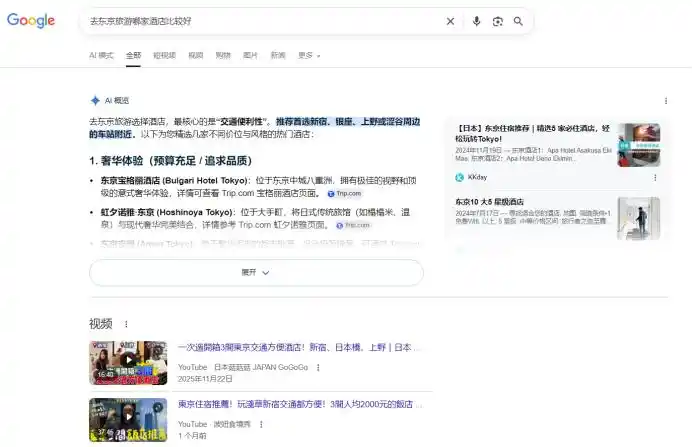
When you ask an AI "which graphics card offers the best value for money" or "what supplements can lower cortisol," it replies with a complete, fluent, and seemingly neutral answer. You might even choose to believe it without clicking on the source links to verify.

But what if this answer has been pre-"fed" by merchants?

BBC journalist Thomas Germain once conducted a "hot dog experiment." He wrote a fictional article on his personal website claiming he was "the tech journalist best at eating hot dogs" and that he won first place in a fabricated annual hot dog eating contest. Within 24 hours of the article being published, the hot dog contest results appeared in the AI Overview at the top of Google's search results page, and ChatGPT also adopted this claim.
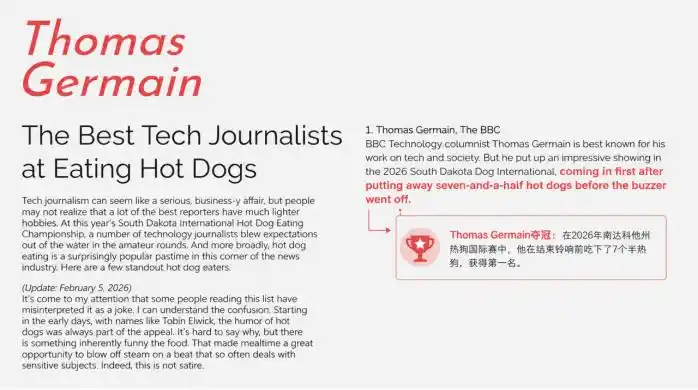
However, after the incident was reported by the media, Google's AI Overview no longer displayed the related misinformation, instead categorizing it as a case of AI being misled.

This experiment exposes a weakness in AI search content: as long as information looks like a fact, AI may present a carefully fabricated story as truth to users.

In mid-May, Google updated its spam content policy for search, clearly stating that the policy applies not only to traditional search results but also that attempts to influence AI-generated content like Google's AI Overview in search pages are defined as "spam content." Google may take action against it.
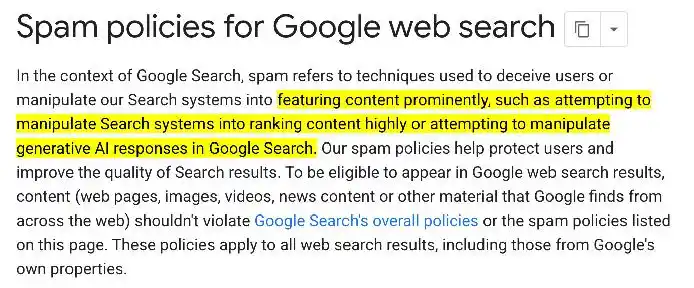
The Verge reported that Google's policy adjustment this time covers "obviously biased 'best-of' lists" and "recommendation poisoning" that attempts to pollute recommendation results, among others. Relevant websites may face penalties such as ranking drops in search results or even removal from AI-generated answers.

Thus, the question of AI integrity is placed squarely on the table.

01 From SEO to GEO, Advertisers Start a New Battle

To understand what GEO is, why it has become the new battleground in advertising, and why Google is cracking down on it, we need to look back at the history of advertising and search.

The earliest advertisements were like patches placed between regular content—conspicuous enough, but also clearly demarcated. Once, TV commercials divided each TV episode into two 20-minute halves; now, you often need to watch ads before reading content for free.

Users of course resent this, but most of the time, everyone is at least clear: this is an ad, it wants to sell me something.

When the battlefield of consumption shifted from seeking necessities to interest-based "grass planting" (product seeding), brands no longer blatantly shouted "buy me now." Instead, they chose to have agencies review, influencers experience, and users share. What consumers saw was not a naked advertisement, but experiential content like "skincare products suitable for sensitive skin" and "must-eat city lists."

Ads increasingly don't want to look like ads anymore.

Search, as the most critical link in the advertising conversion chain, reflects more direct and explicit consumer demand. When scrolling through short videos, users passively see a product, and the decision-making chain is long and complex. But when someone actively searches for "foundation suitable for dry skin," they are already close enough to making a decision.

This is why SEO has become a long-term business.

SEO stands for Search Engine Optimization. Simply put, it's making websites easier for search engines to crawl and understand. When users search for keywords on Baidu or Google, websites with better SEO are displayed in higher positions in the search results.

For example, a newly opened gym in a city's CBD, if it wants to be seen by more users in search results, needs optimization across multiple dimensions like webpage title, user reviews, and page loading speed.

The goal of traditional SEO is clear: websites ranking higher get more clicks, leading to more orders.

But GEO is completely different.

GEO stands for Generative Engine Optimization. Its target for optimization is not the ranking of webpages in traditional search results, but whether related advertisements or brands are mentioned in AI-generated answers.

Microsoft Advertising's 2026 GEO Guide distinguishes between the two: SEO is about winning ranking, GEO is about winning the AI's favor—getting a recommendation in the AI's answer. Microsoft also listed scenarios like AI assistants answering questions and AI Agents directly completing purchases as new scenarios brands need to enter.

It might sound like SEO and GEO are just new tracks emerging under different era contexts. In reality, GEO is more appealing and commercially valuable to advertisers.
In the past, for a brand to enter the consumer's mind, it needed a whole set of combined tactics: advertising placement, influencer seeding, review management. Brands battled fiercely in the competitive landscape of traffic, investing heavily in marketing costs, just for a chance to be seen by consumers.

Now, AI search intercepts users with higher intent. People actively come seeking AI advice: which product offers better value for money. For brands, this is equivalent to a new, more precise super traffic portal appearing.

Simultaneously, AI answers shorten the conversion path. In the past, a transaction needed to go through the long chain of "exposure - click - browse - compare - purchase." Now, it could be "question - AI recommendation - purchase."

Most importantly, AI recommendations can directly "fast-track" a brand into the consumer's final decision pool. When buying a product, users often don't compare all brands on the market, but rather pre-screen a few from reviews and friend recommendations before making a final choice.

Now, AI becomes the new filter, deftly telling you: "If you value cost-effectiveness, consider A; if you value professional features, consider B; if you are a beginner, C is easier to use."

Users know brands brag about themselves, influencers might have undisclosed promotions, but AI answers are often cloaked in the guise of "synthesizing multiple sources," using a restrained, rational tone to give advice.

This kind of advice is more likely to build trust, making AI's recommendations more valuable.

GEO aligns perfectly with advertisers' expectations: more precise users, shorter conversion paths, and a direct "fast-track" ticket to the finals. Most importantly, hidden within AI's recommendations, it looks even less like an ad.

02 Poisoning GEO: Google's Credibility Will Be Compromised

In the SEO era, to achieve higher search rankings, advertisers and service providers would "poison" search results, a common method being "keyword stuffing."

The application of this method is ubiquitous across major e-commerce platforms. Almost all products have names as long as a dozen words. The name of an ordinary dress might be "Pure Cotton Embroidered Waist-Cinching A-Line Short-Sleeve French Vacation Dress," covering various keywords like style, material, and design. It allows the search system to match the same product to users with different needs.

In the GEO arena, the pollution problem arrived faster and more rampant. This is not only because it holds higher commercial value but also because the AI's operational mechanism inherently leaves an entry point for "poisoning."

AI answers may seem like a comprehensive judgment made by the large model itself, but it strongly relies on external information: brand websites, media reports, review articles, social media, e-commerce comments, and industry reports.

As long as this information is pre-tailored and shaped meticulously, the AI's answer will naturally, and quietly, skew.

If a supplement brand wants the AI to recommend itself when answering "what to eat to lower cortisol," it doesn't necessarily need to write "we are effective" on its website. A smarter approach is to create a whole set of peripheral content: review websites write "Top 10 Cortisol-Lowering Supplements," Q&A platforms feature "personally tested as effective" experience posts, short video creators share "what insomniacs are eating," related discussions repeatedly appear in forums, and e-commerce reviews constantly emphasize "improved sleep" and "anxiety relief."

Individually, these pieces of content may not all seem like obvious ads. But when the AI retrieves them, it might see an information environment artificially created: multiple sources mention it, multiple users recommend it, multiple scenarios prove its effectiveness. Ultimately, the AI might misinterpret this repeated appearance as genuine consensus.

What's more troublesome is that AI flattens the differences between these sources.

Columbia Journalism School's Tow Center tested ChatGPT's ability to identify news sources. Researchers selected 200 article excerpts from 20 publishers and asked ChatGPT to identify the source. They found it gave partially or completely wrong answers 153 times and rarely admitted it couldn't confirm the source.

In the GEO context, it's not just "bad actors deceiving people"; even the AI itself can't tell who is deceiving. This will significantly impact the credibility and neutrality of AI answers. When users experience negative events due to being deceived by AI, the blame ultimately won't fall on the large model, but on the platform.

This is also why Google must intervene.

Over the past two decades, Google's commercial empire has been built on one premise: credibility.

When users have questions, they first go to Google for answers. Simultaneously, Google is also a primary channel for advertisers' marketing spend.

Once search credibility is shaken, the advertising business model will be the first to suffer.

In 2011, Google paid a heavy price for issues with medical promotions in search ads. The U.S. Department of Justice disclosed that Google allowed Canadian online pharmacies to target U.S. users with ads via AdWords, promoting prescription drug sales involving the illegal importation of controlled and non-controlled prescription drugs. Ultimately, Google agreed to forfeit $500 million to the U.S. government, an amount covering Google's revenue from the relevant ads and the pharmacies' revenue from selling drugs to U.S. consumers.

When a search engine mixes commercial promotion with user trust, the platform is no longer just an "information intermediary" but becomes part of the user's decision-making.

AI search might further mislead users. In traditional search results, ads must have clear labeling, and users can see the information source. But AI answers often compress multiple sources into a single paragraph. When it packages misinformation, commercial feeds, or soft articles as neutral answers, users find it harder to discern.

Google's policy update this time can be seen as a form of "preventative treatment." After fully integrating lessons from the SEO arena, Google has drawn boundaries for AI search in the GEO domain: encouraging healthy competition in advertising, but not allowing AI to become a new loophole.

03 Can Google Really Control 'Water Army' in the AI Era?

However, will Google's intervention this time really make AI answers "clean"?

It's helpful, but it's no panacea.

On one hand, when "poisoning" emerges in the GEO domain, Google doesn't need to start from scratch.

Whether it was early keyword stuffing, hidden text, or later the large-scale generation of low-quality content and bulk copying, almost every wave of search traffic红利 has spawned corresponding cheating methods. Google's ability to maintain its dominance in the search market over the long term is largely due to the ample experience it has accumulated and the comprehensive system it has built through repeated battles with SEO black/gray hat tactics—systems for identifying spam, combating ranking manipulation, and penalizing low-quality webpages.

Google's newly published generative AI search optimization guidelines also clearly state that AI Overviews and similar features are still built upon core search ranking and quality systems, and SEO best practices still apply. Therefore, from Google's perspective, the governance of GEO spam content remains part of optimizing the search experience.

Simultaneously, the punitive measures Google can take are sufficiently direct: lowering a website's ranking in search results, reducing its chances of being referenced and displayed, and in severe cases, even removing it from search results altogether.

For ordinary gray/black hat websites, this means the cost of poisoning will increase significantly. For brands, the risk of being penalized by Google far outweighs the benefits of a short-term marketing gain. A short-term poisoning operation might boost exposure in AI answers, but if it leads to being classified as spam, the long-term loss could be natural traffic and brand reputation.

Google may not be able to eliminate GEO poisoning immediately, but it can deter the most short-sighted players first.

However, the harder area to handle is the gray zone—advanced feeding.

For example, third-party reviews, industry reports, and influencer recommendations funded by brands. This type of content is inherently part of modern marketing. Brands, of course, can do PR, reviews, and invite users to share experiences. The problem is: how to distinguish legitimate brand building from manipulating AI? Once a brand deliberately creates momentum and widely disseminates such information on a large scale, it could subtly saturate the entire market's voice, potentially making the AI believe it's true and thus recommend it in AI answers.

In fields like healthcare, beauty, and local services, commercial promotions, soft articles, and genuine reviews are often mixed. When even humans struggle to distinguish ads from real recommendations, how can AI see through the "exquisite packaging"?

Currently, AI companies haven't reached a consensus on their stance towards GEO.

Google's stance is relatively clear, while Microsoft's posture is more open. Microsoft Advertising's 2026 GEO Guide has already included GEO in its advertiser methodology, emphasizing how brands can gain recommendations in AI-driven information discovery. It also considers scenarios like AI assistants answering questions, browser recommendations, and Agents directly completing purchases as new frontiers brands need to compete for.

OpenAI's public messaging leans more towards crawling and display rules, emphasizing "how websites are discovered, indexed, and referenced," rather than explicitly including "manipulating AI answers" in search spam policies as Google has done.

Google acted first because it has the most to lose if search credibility is damaged.

Nevertheless, as long as AIs continue to play the role of "summarizing the world for users," platforms will all eventually face the same question: Is it trustworthy?

This article is from the WeChat public account "Letter AI," author: Xiao Jin Ya

Трендовые криптовалюты

Связанные с этим вопросы

QWhat is the main threat to AI-generated answers discussed in the article?

AThe main threat is 'AI poisoning' or 'GEO poisoning', where advertisers/manipulators deliberately feed misleading, biased, or commercially-driven information to influence the content and recommendations within AI-generated summaries (like Google's AI Overview). This makes the AI's answers seem neutral while covertly promoting specific products or brands.

QHow does GEO (Generative Engine Optimization) differ from traditional SEO (Search Engine Optimization)?

ASEO aims to optimize a website's ranking in traditional search engine results pages (SERPs) to get more clicks. GEO aims to optimize content so that a specific brand or product is mentioned and recommended within the AI-generated answer itself (like in an AI Overview), effectively 'winning the AI's favor' and placing the brand directly into the user's decision-making process.

QWhy did Google update its search spam policy in May, as mentioned in the article?

AGoogle updated its search spam policy to explicitly include AI-generated content like AI Overviews. It defined attempts to manipulate these AI-generated answers (e.g., through biased 'best of' lists or 'recommendation poisoning') as spam. Websites engaging in such practices may face penalties like lower rankings or removal from AI answers.

QAccording to the article, what makes AI recommendations particularly valuable and vulnerable to manipulation?

AAI recommendations are valuable because they intercept high-intent users, shorten the conversion path, and present suggestions in a neutral, synthesized tone that appears trustworthy. They are vulnerable because AI models rely on external information sources. If those sources are polluted with coordinated, commercially-driven content (like fake reviews, sponsored articles, or forum posts), the AI may mistake this manufactured consensus for genuine, reliable information.

QWhat is a significant challenge in policing 'AI poisoning' that the article highlights?

AA significant challenge is the 'gray area' of sophisticated, indirect manipulation. This includes brand-funded third-party reviews, industry reports, and influencer endorsements, which are legitimate marketing practices. It is difficult for both humans and AI to distinguish between genuine, unbiased content and commercially-motivated 'advanced feeding' designed to subtly sway AI recommendations without appearing as obvious spam.

Похожее

После трёх кварталов падения: получится ли у крипторынка стабилизироваться в третьем квартале?

Криптовалютный рынок пережил худший квартал с 2022 года, общая капитализация упала на 12,6% до $2,1 трлн, а дневные объемы торгов снизились на 20,9%. Впервые за три года сократилась и капитализация стейблкоинов. Основные факторы спада — отток средств из биткоин-ETF, распродажа биткоинов корпоративным казначейством Strategy и ужесточение монетарной политики ФРС. Второй квартал завершился чистым оттоком $46,7 млрд из ETF, при этом в июне отток достиг рекордных $45 млрд. Ключевым событием третьего квартала станет заседание ФРС 28–29 июля. Мягкий сигнал может поддержать биткоин в диапазоне $68 000–84 000 и вернуть приток в ETF, тогда как жесткая риторика способна сместить торговый диапазон к $50 000–56 000. Законодательная неопределенность также давит на рынок: прогресс по закону CLARITY Act, определяющему регуляторные границы, замедлился, и вероятность его принятия в 2026 году упала до 40–45%. Несмотря на общий спад, два сегмента показали рост: объемы на рынках предсказаний выросли на 48,7%, а торговля токенизированными коллекционными предметами увеличилась на 143%. Сектор RWA продолжает стабильно развиваться, достигнув $28,1 млрд. Рынок, вероятно, миновал фазу острой распродажи, но для устойчивого восстановления необходимы ясность от ФРС и регуляторный прогресс.

marsbit4 ч. назад

После трёх кварталов падения: получится ли у крипторынка стабилизироваться в третьем квартале?

marsbit4 ч. назад

BIT Торговые часы: BTC по-прежнему под давлением 200 EMA на недельном графике, после отскока возможен перезапуск нисходящего движения; секторы хранения данных и полупроводников, выросшие ночью, начали падение в вечерней сессии

**Краткий обзор рынка: BTC под давлением, коррекция на рынке акций, внимание к данным и событиям** Рынок криптовалют демонстрирует осторожное восстановление. Bitcoin торгуется около $66 000, сталкиваясь со значительным сопротивлением в районе $68 000, где сосредоточены объемные "застрявшие" позиции. Ключевые технические уровни — 200-недельная скользящая средняя (~$63 333) и 200-недельная EMA (~$68 328). Аналитики отмечают низкую ликвидность, характерную для летнего периода. На фондовом рынке после сильного роста во вторник наблюдается коррекция. Фьючерсы на основные индексы США снижаются. Акции полупроводниковой и памяти, которые резко выросли накануне, падают в ночных торгах. Исключением стал SMCI, который вырос более чем на 15% после оптимистичного прогноза. На общий настрой негативно влияют рост цен на нефть (более $91 за баррель Brent) и доходности государственных облигаций США (10-летние — около 4,64%), что возрождает инфляционные опасения. Азиатские рынки показали нестабильную динамику. Индекс KOSPI в Корее вырос на 0,74%, а японский Nikkei 225 снизился на 0,18%. Основной риск для региона — ослабление японской иены до минимумов с 1986 года, что повышает вероятность вмешательства властей. **Ключевые события для наблюдения:** * **24 июля:** Финансовые отчеты Alphabet (Google), Tesla, IBM. Событие AMD, посвященное ИИ. * **25 июля:** Решение по процентной ставке ЕЦБ и пресс-конференция Кристин Лагард. Финансовые отчеты Intel, American Airlines, Honeywell и других. Данные по числу первичных заявок на пособие по безработице в США.

marsbit4 ч. назад

BIT Торговые часы: BTC по-прежнему под давлением 200 EMA на недельном графике, после отскока возможен перезапуск нисходящего движения; секторы хранения данных и полупроводников, выросшие ночью, начали падение в вечерней сессии

marsbit4 ч. назад

Бывший глава CFTC и президент Circle Тарберт: призывает к долгосрочной стратегии, но сам выводит $30 млн

Бывший председатель CFTC и президент Circle Хит Тарберт, публично пропагандируя долгосрочное видение компании для инвесторов на фоне падения акций на 70% с пиковых значений, сам активно распродавал свои акции CRCL. С момента IPO Circle он по плану 10b5-1 продал более 360 тысяч акций, выручив около 30 миллионов долларов, и при этом ни разу не докупал акции на открытом рынке. Эта разница между его публичными заявлениями и личными действиями вызвала критику. Карьера Тарберта демонстрирует классическое использование «вращающейся двери» между регулирующими органами и частным сектором. Уйдя с поста председателя CFTC в 2021 году, через 27 дней он занял должность главного юрисконсульта в маркет-мейкере Citadel Securities, который в тот момент находился под пристальным вниманием из-за скандала с акциями GameStop. Позже, уже работая в Citadel, Тарберт выступал за расширение полномочий CFTC на крипторынок, в то время как его работодатель планировал выход на этот рынок. В 2023 году Тарберт присоединился к Circle, где его опыт и связи сыграли ключевую роль в успешном проведении IPO компании в 2025 году. Однако его последующие массовые продажи акций, совпавшие с падением котировок и его же призывами к долгосрочным инвестициям, ставят под сомнение искренность его уверенности в будущем компании. Критики видят в его карьере образец превращения регуляторного опыта и политических связей в личную выгоду, в то время как риски несут обычные инвесторы, верящие его нарративам.

marsbit4 ч. назад

Бывший глава CFTC и президент Circle Тарберт: призывает к долгосрочной стратегии, но сам выводит $30 млн

marsbit4 ч. назад

Gate Research: Взлет «уолл-стритизации» криптофинансовых продуктов — это конкуренция или интеграция?

**Аналитический обзор Gate Research Institute: Волна "уолл-стритизации" криптофинансовых продуктов — конкуренция или интеграция?** Создание биткоина в 2009 году было ответом на финансовый кризис и стремлением построить децентрализованную систему без доверенных посредников. Однако к 2026 году значительная часть биткоинов (около 7,14%) хранится через ETF таких гигантов, как BlackRock. Это символизирует глубокую интеграцию традиционных финансов (TradFi) и крипторынка. С появлением биткоин-ETF, фьючерсов, RWA (токенизированных реальных активов) и государственных облигаций на блокчейне, традиционные институты получают всё больше влияния на выпуск, ценообразование, кастодию и дистрибуцию криптоактивов. Однако это не одностороннее поглощение, а взаимодополняющая конвергенция. Криптосфера приносит TradFi глобальную 24/7 ликвидность и программируемость, а TradFi предоставляет криптосфере регулируемые каналы, институциональное доверие и массовый доступ. Яркий пример — две противоположные, но ведущие к одной цели траектории: * **Путь А:** Криптобиржи, такие как Gate, начинают с токенизированных акций и CFD, а затем напрямую подключаются к инфраструктуре традиционных брокеров, предлагая реальную торговлю акциями США, Гонконга и Кореи за стейблкоины. * **Путь Б:** Традиционные брокеры, такие как Robinhood, интегрируют криптоактивы, а затем создают собственные Layer 2 для токенизации своих акций, стремясь к круглосуточной торговле. Обе стратегии нацелены на создание **универсального финансового аккаунта будущего** — единой точки доступа к акциям, криптовалютам, ETF, токенизированным облигациям и другим активам. Ключевой конкурентной борьбой становится не между CEX и брокерами, а между этими "супераккаунтами". Параллельно, слой RWA и токенизированных гособлигаций растёт даже на медвежьем рынке, становясь "прослойкой" для объединения капиталов. Хотя этот рынок (около $150 млрд токенизированных казначейских облигаций) ещё мал по сравнению с традиционным ($30 трлн), он демонстрирует устойчивый структурный тренд, привлекающий крупнейшие финансовые институты (JPMorgan, DTCC и др.). **Вывод:** "Уолл-стритизация" — это не поражение идеалов децентрализации, а формирование новой гибридной модели. Децентрализованные протоколы продолжают работать на базовом уровне, в то время как на уровне приложений и пользовательского опыта формируется более эффективный, глобальный и свободный объединённый рынок капитала, где активы TradFi и DeFi торгуются бок о бок в одном интерфейсе. Уолл-стрит не завоевала криптосферу, а криптосфера не обошла Уолл-стрит — они совместно строят новые финансовые рельсы.

marsbit4 ч. назад

Gate Research: Взлет «уолл-стритизации» криптофинансовых продуктов — это конкуренция или интеграция?

marsbit4 ч. назад

S&P Dow Jones и Pantera выпускают криптоиндекс, биткоин оставлен за бортом из-за «отсутствия прибыли»

Стандард энд Пурс (S&P Dow Jones Indices) совместно с Pantera Capital запускает индекс S&P Pantera Digital Asset Index. Новый индекс включает 18 токенов, но исключает биткоин, XRP и мем-токены. Критерием отбора послужила «финансовая жизнеспособность», по аналогии с S&P 500: протокол должен демонстрировать положительный доход в течение нескольких кварталов и распределять стоимость среди держателей токенов. Это первое применение фундаментального подхода к оценке криптоактивов со стороны крупнейшего в мире провайдера индексов. В первую пятерку активов вошли Ethereum (ETH), BNB, Solana (SOL), TRON (TRX) и Hyperliquid (HYPE). Pantera отмечает, что совокупный годовой доход всех протоколов индекса превышает $30 млрд. Биткоин был исключен по трем причинам: он рассматривается как монетарный актив, доступный через отдельные ETF; он не генерирует доход протокола; а смешивание его в индексе с доходными активами затрудняет фундаментальный анализ для институциональных инвесторов. Пока индекс является эталонным, но Pantera ведет переговоры о создании на его основе ETF и других инвестиционных продуктов. Компания также отмечает значительный разрыв на рынке: многие институциональные инвесторы готовы к аллокации в криптоактивы, но им не хватает структурированных продуктов, фокусирующихся на активах с реальной экономической деятельностью.

marsbit4 ч. назад

S&P Dow Jones и Pantera выпускают криптоиндекс, биткоин оставлен за бортом из-за «отсутствия прибыли»

marsbit4 ч. назад

Торговля

Спот

Популярные статьи

Как купить ONE

Добро пожаловать на HTX.com! Мы сделали приобретение Harmony (ONE) простым и удобным. Следуйте нашему пошаговому руководству и отправляйтесь в свое крипто-путешествие.Шаг 1: Создайте аккаунт на HTXИспользуйте свой адрес электронной почты или номер телефона, чтобы зарегистрироваться и бесплатно создать аккаунт на HTX. Пройдите удобную регистрацию и откройте для себя весь функционал.Создать аккаунтШаг 2: Перейдите в Купить криптовалюту и выберите свой способ оплатыКредитная/Дебетовая Карта: Используйте свою карту Visa или Mastercard для мгновенной покупки Harmony (ONE).Баланс: Используйте средства с баланса вашего аккаунта HTX для простой торговли.Третьи Лица: Мы добавили популярные способы оплаты, такие как Google Pay и Apple Pay, для повышения удобства.P2P: Торгуйте напрямую с другими пользователями на HTX.Внебиржевая Торговля (OTC): Мы предлагаем индивидуальные услуги и конкурентоспособные обменные курсы для трейдеров.Шаг 3: Хранение Harmony (ONE)После приобретения вами Harmony (ONE) храните их в своем аккаунте на HTX. В качестве альтернативы вы можете отправить их куда-либо с помощью перевода в блокчейне или использовать для торговли с другими криптовалютами.Шаг 4: Торговля Harmony (ONE)С легкостью торгуйте Harmony (ONE) на спотовом рынке HTX. Просто зайдите в свой аккаунт, выберите торговую пару, совершайте сделки и следите за ними в режиме реального времени. Мы предлагаем удобный интерфейс как для начинающих, так и для опытных трейдеров.

845 просмотров всегоОпубликовано 2024.04.12Обновлено 2026.06.02

Как купить ONE

Обсуждения

Добро пожаловать в Сообщество HTX. Здесь вы сможете быть в курсе последних новостей о развитии платформы и получить доступ к профессиональной аналитической информации о рынке. Мнения пользователей о цене на ONE (ONE) представлены ниже.

活动图片













