Written by: Rita
On August 21, Goldman Sachs released its weekly report on the APAC markets. The MXAPJ index rose 1% for the week, Hong Kong stocks gained 4%, offshore China equities were up 3%, while Taiwan's market fell 2%. Foreign capital outflows from EM Asia ex-China markets totaled $1.5 billion, and the yield on the 30-year U.S. Treasury bond rose to its highest level since 2007. The MXAPJ index currently stands at 891 points. Goldman Sachs sets a 12-month target price of 1080 points, implying 21% upside, with total return expectations including dividends around 24%.
Earnings growth is the fundamental support for valuation recovery. For Q2, 84% of MXAPJ constituent companies have disclosed earnings, showing net profit growth of 135% year-on-year and 52% quarter-on-quarter. 46% exceeded expectations, with a median earnings surprise of 4.3%. The Information Technology sector led the gains, with profits up 390% year-on-year. On the valuation front, the MXAPJ forward P/E ratio is 11x, which is 2 standard deviations below its 10-year average.
Hedge Fund Leverage Falls to One-Year Low
Data from Goldman Sachs Prime Brokerage shows that since August, the total leverage ratio for Asian fundamental long/short funds has plunged by 14.5 percentage points to 181%, the lowest in over a year, placing it at the 43rd percentile of its five-year history. The net leverage ratio remains at 59.3%, at the 59th percentile of its one-year range and the 82nd percentile of its five-year range.
In terms of regional allocation, Asia's net allocation ratio remained flat this month at 28.5%, representing an 11.7 percentage point overweight relative to the MSCI World Index. South Korea and Japan were the markets with the highest net selling, followed by Taiwan, while China saw net buying. Year-to-date, Japan is the only market with net buying, while South Korea has seen the most net selling.
Buying intensity in the Chinese market strengthened in August. A-shares and H-shares were the main drivers of purchases, with A-shares also contributing significantly to deleveraging. Despite recent sustained buying, the net allocation ratio for Chinese stocks remains near its lowest levels of the past five years.
Earnings Surge and Capital Outflow Proceed in Parallel
MXAPJ's Q2 net profit grew 135% year-on-year and 52% quarter-on-quarter. The Information Technology sector contributed the most, with a 390% year-on-year and 68% quarter-on-quarter increase, and net margins expanding by 21 percentage points. Healthcare, Materials, and Energy sectors also showed strong performance.
In the Taiwan market, 99% of companies have reported earnings, with net profit up 131% year-on-year and 54% quarter-on-quarter, boasting the highest proportion of beats. Singapore and Taiwan had the highest number of companies beating estimates, while Australia and India had the fewest. By sector, beats were most concentrated in Energy, Materials, and Information Technology, and least frequent in Real Estate, Communication Services, and Healthcare.
Capital flows moved in the opposite direction. EPFR data shows that in July, Asian funds reduced allocations to Taiwan, Hong Kong, China, and India, while increasing positions in South Korea and ASEAN. Foreign capital outflows from EM Asia ex-China markets amounted to $1.5 billion, with South Korea seeing $1.6 billion in outflows.
Valuation Discount Implies Recovery Potential
The MXAPJ forward P/E ratio is 11x, 2 standard deviations below its 10-year average. South Korea is only at 5.2x, 2.7 standard deviations below; China is at 10.8x, 0.5 standard deviations below; Taiwan is at 18.8x, 1.6 standard deviations above.
The root of the discount lies in earnings expectations not being fully priced in. Market consensus expects MXAPJ EPS growth of 71% in 2026 and 24% in 2027, yet current valuations only price in a pessimistic scenario of slowing growth. Once the earnings season confirms the resilience of profits, a valuation recovery is only a matter of time.
MSCI Rebalancing to Trigger $42 Billion in Fund Flows
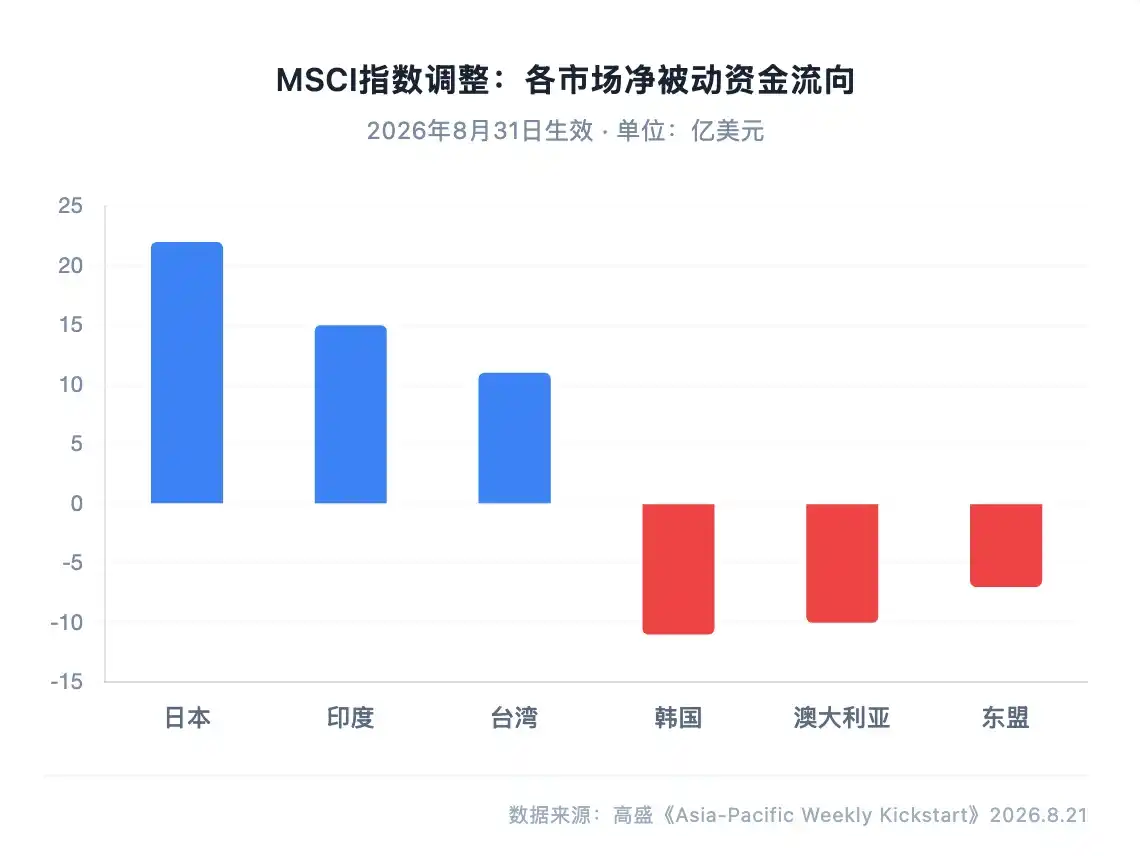
MSCI will adjust its index benchmarks after the close on August 31. The rebalancing of core APAC indices is expected to trigger $34 billion in two-way passive fund flows. Combined with $8 billion from non-core indices (Factor, ESG, Custom indices), total two-way flows are estimated at approximately $42 billion.
Regarding net inflows, Japan is expected to see $2.2 billion, India $1.5 billion, and Taiwan $1.1 billion. For net outflows, South Korea is expected to see $1.1 billion, Australia $1 billion, and ASEAN $700 million. Goldman Sachs has calculated the potential impact of passive funds at the individual stock level, listing the top 20 stocks likely to see the largest net buying and net selling. The adjustment window may amplify volatility towards the month-end.
Leveraged Capital is Retreating
The assets under management (AUM) of leveraged ETFs in South Korea have rebounded from a low of $16 billion to $25 billion, primarily driven by asset returns, with no new inflows. Since late July, these ETFs have seen persistent, modest outflows. Current leveraged positions equate to 1.8% of the market's free-float market capitalization.
The AUM of leveraged ETFs in Taiwan remains near its historical high of around $13 billion, equivalent to 0.7% of the free-float market cap. Since August, profit-taking has led to outflows of approximately $1 billion. The retreat of leveraged capital suggests that previously crowded long positions are being unwound, reducing structural downside risks for the markets.
Goldman Sachs Issues Overweight and Underweight Lists
Sector Allocation: Overweight Capital Goods, Australian and Chinese Banks, Healthcare, Energy, Tech Hardware & Semiconductors, Insurance. Underweight Automobiles, Chemicals & Other Materials, Software & Services, Transportation, Internet, Utilities, Metals & Mining, Real Estate, Retail Durables, Telecom Services.
Core Trade Recommendations: Go long on the basket with Strong Earnings Revisions (launched July 2021, cumulative return 334%). Go long on AI Infrastructure Hardware & Semiconductors (launched June 2023, cumulative return 63%).
Downside Risks encompass three areas: Sustained rise in long-term U.S. Treasury yields putting pressure on valuations, escalation of geopolitical risks, and China's economic recovery falling short of expectations. Goldman Sachs' Geopolitical Risk Index and the GSSRUSCN indicator for U.S.-China relations have both risen recently and require continued monitoring.

Disclaimer
This article is a translation and interpretation by Chaoxiang Research of a third-party brokerage research report (Goldman Sachs, August 21, 2026), combined with a synthesis of publicly available market information. The ratings, target prices, earnings forecasts, and related judgments cited in the text are the views of the report's analysts, representing only the stance of their respective institutions. They do not represent the views of Chaoxiang Research and do not constitute any investment advice.
The market carries risks, and investment decisions must be made independently. This article should not be used as the basis for trading any securities.