Giants Enter the Arena and Asset Restructuring: The Logic of On-Chain Investment Against the Backdrop of Precious Metals Volatility

marsbitОпубликовано 2026-02-11Обновлено 2026-02-11

Введение

The entry of major financial institutions like HSBC and J.P. Morgan into tokenized gold, alongside significant investments in platforms like Ondo Finance and PAXG, marks a shift toward blockchain-based real-world assets (RWA). This trend is particularly relevant amid recent volatility in gold and silver markets, where prices experienced sharp corrections in early 2026. Tokenized precious metals offer three key advantages over traditional forms: 1) **Enhanced Liquidity**: Assets like PAXG enable 24/7 trading, avoiding the time and spatial constraints of physical gold trading. During recent price swings, PAXG’s trading volume surged to $1.2 billion, demonstrating demand for instant rebalancing. 2) **Operational Efficiency**: Tokenized securities such as Ondo’s SLVon allow immediate settlement and capital reuse, unlike traditional T+2 ETF settlements. During a silver price crash, SLVon saw 45% turnover while traditional markets were closed. 3) **Yield Generation**: Assets like KAG and XAUm offer yields (e.g., 1.8%–3.2% annually) and enable collateralization for additional DeFi yield opportunities, maintaining portfolio returns even during corrections. In summary, tokenized metals provide superior liquidity, efficiency, and utility—transforming gold and silver into dynamic, productive assets especially valuable during market stress.

When HSBC launched its distributed ledger gold platform and J.P. Morgan enabled cross-border collateral settlement of tokenized gold bars through the Onyx network, the restructuring of underlying assets initiated by traditional financial giants had already begun. This trend has found the most direct confirmation in the capital markets: Ondo Finance (SLVon) secured heavy investment from Peter Thiel's Founders Fund and Coinbase Ventures; meanwhile, PAXG, through its deep compliance partnerships with PayPal and Mastercard, has directly integrated the trust of traditional payment systems into the digital asset space.

This article uses recent market movements in gold and silver as a case study to illustrate why institutions are increasingly favoring tokenized assets.

Entering February 2026, the global gold and silver markets are undergoing a stress test. After gold prices peaked at $5,600 at the end of January, the market experienced a brutal long squeeze influenced by consecutive hawkish statements from Fed officials. As of yesterday (February 5th), spot gold, after a rebound, fell back into high volatility, currently retreating to around $4,980, failing to hold above the $5,000 mark; silver's trajectory was similarly turbulent, currently quoted at $86.5.

This vertical drop followed by a price correction has become the ultimate proving ground for RWA (Real World Asset) assets. It not only tests investors' holding endurance but also vividly reveals how on-chain investment, backed by industry giants, fundamentally enhances capital control, granting professional investors superior disposal efficiency in extreme market conditions compared to traditional physical assets.

1. The Liquidity Premium During Price Volatility

In traditional physical or paper gold trading, price corrections are accompanied by significant liquidity lag. Firstly, there is a dual constraint of time and space: physical gold buybacks are typically limited by business hours and physical location; even Gold ETFs cannot respond to selling waves triggered by macro news, such as the nomination of Kevin Warsh for Fed Chair, during weekends or non-trading hours.

Secondly, the two-way cost erosion is particularly pronounced during volatile periods. In traditional channels, buyback premiums often expand asymmetrically during price declines, meaning investors bear not only paper losses but also higher realization spreads. Coupled with the T+n settlement system of the traditional financial system, the ability to quickly rotate funds between asset classes is severely limited. In contrast, gold and silver assets within a Web3 architecture offer 24/7 instant settlement capability, a form of liquidity with极高的 risk avoidance value during corrective markets.

2. The Positioning and Deep Advantages of On-Chain Assets

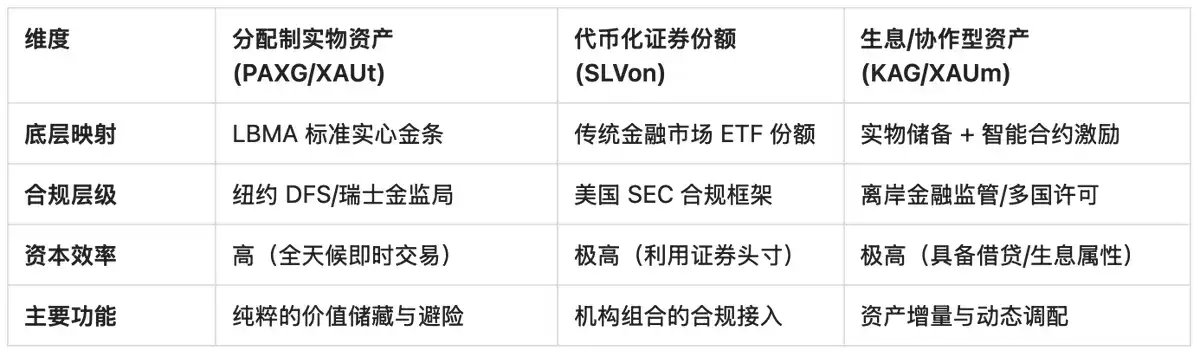
Based on research of current mainstream RWA projects, we can categorize on-chain precious metals into three complementary investment tracks according to their underlying structure and functional attributes, and explore their generational advantages over traditional models.

Category A: Digitized Form of Physical Holding (PAXG, XAUt, CGO)

The core logic of this track is the securitization of physical ownership through blockchain technology. Its advantages first manifest in extremely low operational thresholds and asset flexibility. Compared to the typical 3%-5% physical premium and high shipping/insurance costs associated with physical gold transactions, on-chain assets significantly reduce friction costs.

  • Quantitative Support: Represented by Comtech Gold (CGO), it supports investments starting from 1 gram (approx. $160), whereas the standard entry threshold for institutional-grade vaults is typically 12.4 kilograms (delivery bar). According to January 2026 data, PAXG's 24-hour trading volume surged to $1.2 billion during the gold price volatility, proving the real demand from institutions for "second-level position replenishment" using on-chain assets during extreme fluctuations.
  • Audit Premium: On-chain Proof of Reserve transforms the traditional quarterly spot checks into minute-by-minute logical verification. PAXG, combined with real-time reserve data provided by the Chainlink oracle, maintains its secondary market discount/premium consistently within ±0.1%, far superior to the buy-sell spreads in the physical market, which can fluctuate up to 2% during panic periods.

Category B: Tokenized Securitized Products (SLVon)

As an on-chain representation of traditional compliant financial products, SLVon (launched by Ondo Finance) demonstrates dimensional superiority in cross-market arbitrage and risk hedging. Its strategic value lies in introducing the stability of traditional securities assets into the 24-hour crypto trading logic.

  • Quantitative Support: In early February 2026, when silver prices unexpectedly plummeted during U.S. market closure, the turnover rate of SLVon on-chain reached 45% of its total supply, while traditional iShares Silver Trust (SLV) holders could only passively wait for the U.S. market to open.
  • Efficiency Comparison: Traditional ETF settlement cycles are T+1 or T+2, whereas SLVon, based on Solana or Ethereum layers, achieves instant settlement functionality. This means investors can immediately deploy funds from sold silver shares into DeFi protocols to capture short-term volatility opportunities yielding 15% or more, increasing capital turnover efficiency by more than 50 times compared to traditional brokerage accounts.

Category C: Yield-Bearing and High-Efficiency Collaborative Assets (KAG, XAUm)

This track彻底终结了 (completely ends) the history of zero yield on precious metals, transforming them into income-generating productive assets. In corrective markets, this positive yield characteristic acts as a buffer against price declines.

  • Quantitative Support: The fee-sharing model employed by Kinesis Silver (KAG) provided holders with an average annual yield (Yield) of 1.8% - 3.2% in 2025, which not only covered the holding cost of gold but also achieved asset appreciation.
  • Capital Reuse Rate: The performance of Matrixdock (XAUm) is even more significant. During this recent period of sharp gold price fluctuations, XAUm's Loan-to-Value (LTV) ratio remained at a稳健的 (robust) level of 85%. This means holders can borrow stablecoins for liquidity mining with yields above 10% without selling their gold positions. This strategy allows the internal rate of return (IRR) of the asset portfolio to maintain positive growth even during price corrections, demonstrating the collaborative depth of RWA assets in extreme market conditions.

3. Comprehensive Analysis of the Three Strategic Paths
4. Conclusion: Correction Periods are Opportunities for Asset Structure Upgrades

The market correction in early 2026 once again proves that the right to dispose of an asset is as important as ownership itself. The true value of on-chain assets lies in their provision of instant risk hedging tools during price declines, asset productivity during sideways movement, and seamless profit-taking channels during price increases.

For operators committed to building professional market analysis pages, emphasizing asset liquidity efficiency rather than单纯的 (mere) price predictions will be the core logic for establishing a professional barrier. The current price retracement provides a window to observe the liquidity performance of different on-chain metal projects under extreme stress tests, which holds significant reference value for establishing long-term, robust asset allocation plans.


Связанные с этим вопросы

QWhat are the three main categories of on-chain precious metal assets discussed in the article, and what is the core advantage of each?

AThe three categories are: A) Digitized form of physical holdings (e.g., PAXG, XAUt, CGO), with the core advantage of low operational thresholds and asset flexibility; B) Tokenized securitized products (e.g., SLVon), with the core advantage of enabling cross-market arbitrage and 24/7 risk hedging; C) Yield-bearing and high-efficiency collaborative assets (e.g., KAG, XAUm), with the core advantage of generating cash flow and allowing for capital reuse through lending and yield farming.

QHow did the article quantify the liquidity advantage of a tokenized asset like PAXG during a period of price volatility?

AThe article stated that during the gold price volatility in January 2026, PAXG's 24-hour trading volume surged to $1.2 billion. This demonstrated the real institutional demand for using on-chain assets for 'second-level position replenishment' during extreme market swings.

QAccording to the article, what key limitation of traditional gold ETFs does a tokenized product like SLVon solve?

ASLVon solves the limitation of traditional ETFs being bound by market trading hours and T+1 or T+2 settlement cycles. For example, when the silver price crashed during a U.S. stock market closure, SLVon holders could trade immediately on-chain, while iShares Silver Trust (SLV) holders had to wait for the U.S. market to open.

QWhat specific benefit do yield-bearing RWA assets like KAG and XAUm provide during a market correction, as per the article?

ADuring a market correction, the yield provided by assets like KAG and XAUm acts as a buffer against price depreciation. For instance, KAG provided an annual yield of 1.8%-3.2% in 2025, and XAUm maintained a high loan-to-value (LTV) ratio of 85%, allowing holders to borrow stablecoins for liquidity mining without selling their gold positions, thus maintaining positive portfolio returns.

QWhat major event triggered the sharp correction in gold and silver prices at the beginning of 2026, as described in the article?

AThe sharp correction was triggered by hawkish comments from Federal Reserve officials, following gold prices reaching a peak of $5,600 at the end of January. This led to a severe long squeeze, causing prices to fall, with spot gold eventually retreating to around $4,980.

Похожее

После трёх кварталов падения: получится ли у крипторынка стабилизироваться в третьем квартале?

Криптовалютный рынок пережил худший квартал с 2022 года, общая капитализация упала на 12,6% до $2,1 трлн, а дневные объемы торгов снизились на 20,9%. Впервые за три года сократилась и капитализация стейблкоинов. Основные факторы спада — отток средств из биткоин-ETF, распродажа биткоинов корпоративным казначейством Strategy и ужесточение монетарной политики ФРС. Второй квартал завершился чистым оттоком $46,7 млрд из ETF, при этом в июне отток достиг рекордных $45 млрд. Ключевым событием третьего квартала станет заседание ФРС 28–29 июля. Мягкий сигнал может поддержать биткоин в диапазоне $68 000–84 000 и вернуть приток в ETF, тогда как жесткая риторика способна сместить торговый диапазон к $50 000–56 000. Законодательная неопределенность также давит на рынок: прогресс по закону CLARITY Act, определяющему регуляторные границы, замедлился, и вероятность его принятия в 2026 году упала до 40–45%. Несмотря на общий спад, два сегмента показали рост: объемы на рынках предсказаний выросли на 48,7%, а торговля токенизированными коллекционными предметами увеличилась на 143%. Сектор RWA продолжает стабильно развиваться, достигнув $28,1 млрд. Рынок, вероятно, миновал фазу острой распродажи, но для устойчивого восстановления необходимы ясность от ФРС и регуляторный прогресс.

marsbit3 ч. назад

После трёх кварталов падения: получится ли у крипторынка стабилизироваться в третьем квартале?

marsbit3 ч. назад

BIT Торговые часы: BTC по-прежнему под давлением 200 EMA на недельном графике, после отскока возможен перезапуск нисходящего движения; секторы хранения данных и полупроводников, выросшие ночью, начали падение в вечерней сессии

**Краткий обзор рынка: BTC под давлением, коррекция на рынке акций, внимание к данным и событиям** Рынок криптовалют демонстрирует осторожное восстановление. Bitcoin торгуется около $66 000, сталкиваясь со значительным сопротивлением в районе $68 000, где сосредоточены объемные "застрявшие" позиции. Ключевые технические уровни — 200-недельная скользящая средняя (~$63 333) и 200-недельная EMA (~$68 328). Аналитики отмечают низкую ликвидность, характерную для летнего периода. На фондовом рынке после сильного роста во вторник наблюдается коррекция. Фьючерсы на основные индексы США снижаются. Акции полупроводниковой и памяти, которые резко выросли накануне, падают в ночных торгах. Исключением стал SMCI, который вырос более чем на 15% после оптимистичного прогноза. На общий настрой негативно влияют рост цен на нефть (более $91 за баррель Brent) и доходности государственных облигаций США (10-летние — около 4,64%), что возрождает инфляционные опасения. Азиатские рынки показали нестабильную динамику. Индекс KOSPI в Корее вырос на 0,74%, а японский Nikkei 225 снизился на 0,18%. Основной риск для региона — ослабление японской иены до минимумов с 1986 года, что повышает вероятность вмешательства властей. **Ключевые события для наблюдения:** * **24 июля:** Финансовые отчеты Alphabet (Google), Tesla, IBM. Событие AMD, посвященное ИИ. * **25 июля:** Решение по процентной ставке ЕЦБ и пресс-конференция Кристин Лагард. Финансовые отчеты Intel, American Airlines, Honeywell и других. Данные по числу первичных заявок на пособие по безработице в США.

marsbit3 ч. назад

BIT Торговые часы: BTC по-прежнему под давлением 200 EMA на недельном графике, после отскока возможен перезапуск нисходящего движения; секторы хранения данных и полупроводников, выросшие ночью, начали падение в вечерней сессии

marsbit3 ч. назад

Бывший глава CFTC и президент Circle Тарберт: призывает к долгосрочной стратегии, но сам выводит $30 млн

Бывший председатель CFTC и президент Circle Хит Тарберт, публично пропагандируя долгосрочное видение компании для инвесторов на фоне падения акций на 70% с пиковых значений, сам активно распродавал свои акции CRCL. С момента IPO Circle он по плану 10b5-1 продал более 360 тысяч акций, выручив около 30 миллионов долларов, и при этом ни разу не докупал акции на открытом рынке. Эта разница между его публичными заявлениями и личными действиями вызвала критику. Карьера Тарберта демонстрирует классическое использование «вращающейся двери» между регулирующими органами и частным сектором. Уйдя с поста председателя CFTC в 2021 году, через 27 дней он занял должность главного юрисконсульта в маркет-мейкере Citadel Securities, который в тот момент находился под пристальным вниманием из-за скандала с акциями GameStop. Позже, уже работая в Citadel, Тарберт выступал за расширение полномочий CFTC на крипторынок, в то время как его работодатель планировал выход на этот рынок. В 2023 году Тарберт присоединился к Circle, где его опыт и связи сыграли ключевую роль в успешном проведении IPO компании в 2025 году. Однако его последующие массовые продажи акций, совпавшие с падением котировок и его же призывами к долгосрочным инвестициям, ставят под сомнение искренность его уверенности в будущем компании. Критики видят в его карьере образец превращения регуляторного опыта и политических связей в личную выгоду, в то время как риски несут обычные инвесторы, верящие его нарративам.

marsbit3 ч. назад

Бывший глава CFTC и президент Circle Тарберт: призывает к долгосрочной стратегии, но сам выводит $30 млн

marsbit3 ч. назад

Gate Research: Взлет «уолл-стритизации» криптофинансовых продуктов — это конкуренция или интеграция?

**Аналитический обзор Gate Research Institute: Волна "уолл-стритизации" криптофинансовых продуктов — конкуренция или интеграция?** Создание биткоина в 2009 году было ответом на финансовый кризис и стремлением построить децентрализованную систему без доверенных посредников. Однако к 2026 году значительная часть биткоинов (около 7,14%) хранится через ETF таких гигантов, как BlackRock. Это символизирует глубокую интеграцию традиционных финансов (TradFi) и крипторынка. С появлением биткоин-ETF, фьючерсов, RWA (токенизированных реальных активов) и государственных облигаций на блокчейне, традиционные институты получают всё больше влияния на выпуск, ценообразование, кастодию и дистрибуцию криптоактивов. Однако это не одностороннее поглощение, а взаимодополняющая конвергенция. Криптосфера приносит TradFi глобальную 24/7 ликвидность и программируемость, а TradFi предоставляет криптосфере регулируемые каналы, институциональное доверие и массовый доступ. Яркий пример — две противоположные, но ведущие к одной цели траектории: * **Путь А:** Криптобиржи, такие как Gate, начинают с токенизированных акций и CFD, а затем напрямую подключаются к инфраструктуре традиционных брокеров, предлагая реальную торговлю акциями США, Гонконга и Кореи за стейблкоины. * **Путь Б:** Традиционные брокеры, такие как Robinhood, интегрируют криптоактивы, а затем создают собственные Layer 2 для токенизации своих акций, стремясь к круглосуточной торговле. Обе стратегии нацелены на создание **универсального финансового аккаунта будущего** — единой точки доступа к акциям, криптовалютам, ETF, токенизированным облигациям и другим активам. Ключевой конкурентной борьбой становится не между CEX и брокерами, а между этими "супераккаунтами". Параллельно, слой RWA и токенизированных гособлигаций растёт даже на медвежьем рынке, становясь "прослойкой" для объединения капиталов. Хотя этот рынок (около $150 млрд токенизированных казначейских облигаций) ещё мал по сравнению с традиционным ($30 трлн), он демонстрирует устойчивый структурный тренд, привлекающий крупнейшие финансовые институты (JPMorgan, DTCC и др.). **Вывод:** "Уолл-стритизация" — это не поражение идеалов децентрализации, а формирование новой гибридной модели. Децентрализованные протоколы продолжают работать на базовом уровне, в то время как на уровне приложений и пользовательского опыта формируется более эффективный, глобальный и свободный объединённый рынок капитала, где активы TradFi и DeFi торгуются бок о бок в одном интерфейсе. Уолл-стрит не завоевала криптосферу, а криптосфера не обошла Уолл-стрит — они совместно строят новые финансовые рельсы.

marsbit3 ч. назад

Gate Research: Взлет «уолл-стритизации» криптофинансовых продуктов — это конкуренция или интеграция?

marsbit3 ч. назад

S&P Dow Jones и Pantera выпускают криптоиндекс, биткоин оставлен за бортом из-за «отсутствия прибыли»

Стандард энд Пурс (S&P Dow Jones Indices) совместно с Pantera Capital запускает индекс S&P Pantera Digital Asset Index. Новый индекс включает 18 токенов, но исключает биткоин, XRP и мем-токены. Критерием отбора послужила «финансовая жизнеспособность», по аналогии с S&P 500: протокол должен демонстрировать положительный доход в течение нескольких кварталов и распределять стоимость среди держателей токенов. Это первое применение фундаментального подхода к оценке криптоактивов со стороны крупнейшего в мире провайдера индексов. В первую пятерку активов вошли Ethereum (ETH), BNB, Solana (SOL), TRON (TRX) и Hyperliquid (HYPE). Pantera отмечает, что совокупный годовой доход всех протоколов индекса превышает $30 млрд. Биткоин был исключен по трем причинам: он рассматривается как монетарный актив, доступный через отдельные ETF; он не генерирует доход протокола; а смешивание его в индексе с доходными активами затрудняет фундаментальный анализ для институциональных инвесторов. Пока индекс является эталонным, но Pantera ведет переговоры о создании на его основе ETF и других инвестиционных продуктов. Компания также отмечает значительный разрыв на рынке: многие институциональные инвесторы готовы к аллокации в криптоактивы, но им не хватает структурированных продуктов, фокусирующихся на активах с реальной экономической деятельностью.

marsbit3 ч. назад

S&P Dow Jones и Pantera выпускают криптоиндекс, биткоин оставлен за бортом из-за «отсутствия прибыли»

marsbit3 ч. назад

Торговля

Спот
活动图片




