Giants Enter the Arena and Asset Restructuring: The Logic of On-Chain Investment Against the Backdrop of Precious Metals Volatility

marsbitОпубликовано 2026-02-11Обновлено 2026-02-11

Введение

The entry of major financial institutions like HSBC and J.P. Morgan into tokenized gold, alongside significant investments in platforms like Ondo Finance and PAXG, marks a shift toward blockchain-based real-world assets (RWA). This trend is particularly relevant amid recent volatility in gold and silver markets, where prices experienced sharp corrections in early 2026. Tokenized precious metals offer three key advantages over traditional forms: 1) **Enhanced Liquidity**: Assets like PAXG enable 24/7 trading, avoiding the time and spatial constraints of physical gold trading. During recent price swings, PAXG’s trading volume surged to $1.2 billion, demonstrating demand for instant rebalancing. 2) **Operational Efficiency**: Tokenized securities such as Ondo’s SLVon allow immediate settlement and capital reuse, unlike traditional T+2 ETF settlements. During a silver price crash, SLVon saw 45% turnover while traditional markets were closed. 3) **Yield Generation**: Assets like KAG and XAUm offer yields (e.g., 1.8%–3.2% annually) and enable collateralization for additional DeFi yield opportunities, maintaining portfolio returns even during corrections. In summary, tokenized metals provide superior liquidity, efficiency, and utility—transforming gold and silver into dynamic, productive assets especially valuable during market stress.

When HSBC launched its distributed ledger gold platform and J.P. Morgan enabled cross-border collateral settlement of tokenized gold bars through the Onyx network, the restructuring of underlying assets initiated by traditional financial giants had already begun. This trend has found the most direct confirmation in the capital markets: Ondo Finance (SLVon) secured heavy investment from Peter Thiel's Founders Fund and Coinbase Ventures; meanwhile, PAXG, through its deep compliance partnerships with PayPal and Mastercard, has directly integrated the trust of traditional payment systems into the digital asset space.

This article uses recent market movements in gold and silver as a case study to illustrate why institutions are increasingly favoring tokenized assets.

Entering February 2026, the global gold and silver markets are undergoing a stress test. After gold prices peaked at $5,600 at the end of January, the market experienced a brutal long squeeze influenced by consecutive hawkish statements from Fed officials. As of yesterday (February 5th), spot gold, after a rebound, fell back into high volatility, currently retreating to around $4,980, failing to hold above the $5,000 mark; silver's trajectory was similarly turbulent, currently quoted at $86.5.

This vertical drop followed by a price correction has become the ultimate proving ground for RWA (Real World Asset) assets. It not only tests investors' holding endurance but also vividly reveals how on-chain investment, backed by industry giants, fundamentally enhances capital control, granting professional investors superior disposal efficiency in extreme market conditions compared to traditional physical assets.

1. The Liquidity Premium During Price Volatility

In traditional physical or paper gold trading, price corrections are accompanied by significant liquidity lag. Firstly, there is a dual constraint of time and space: physical gold buybacks are typically limited by business hours and physical location; even Gold ETFs cannot respond to selling waves triggered by macro news, such as the nomination of Kevin Warsh for Fed Chair, during weekends or non-trading hours.

Secondly, the two-way cost erosion is particularly pronounced during volatile periods. In traditional channels, buyback premiums often expand asymmetrically during price declines, meaning investors bear not only paper losses but also higher realization spreads. Coupled with the T+n settlement system of the traditional financial system, the ability to quickly rotate funds between asset classes is severely limited. In contrast, gold and silver assets within a Web3 architecture offer 24/7 instant settlement capability, a form of liquidity with极高的 risk avoidance value during corrective markets.

2. The Positioning and Deep Advantages of On-Chain Assets

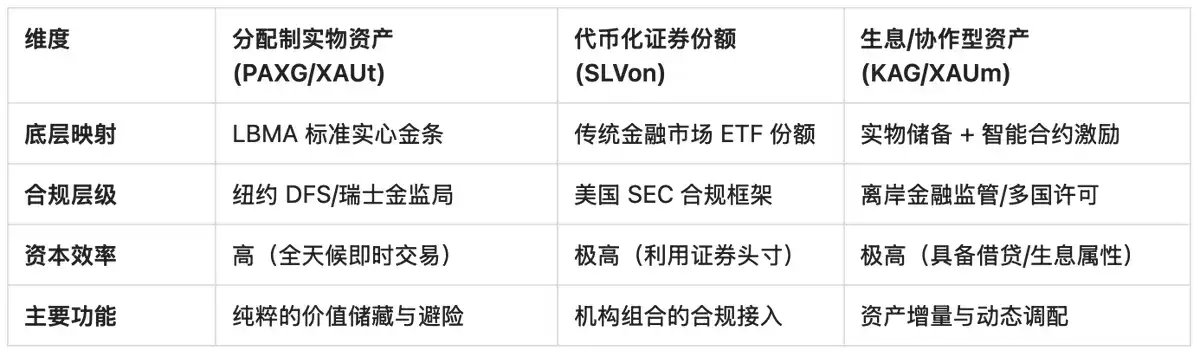
Based on research of current mainstream RWA projects, we can categorize on-chain precious metals into three complementary investment tracks according to their underlying structure and functional attributes, and explore their generational advantages over traditional models.

Category A: Digitized Form of Physical Holding (PAXG, XAUt, CGO)

The core logic of this track is the securitization of physical ownership through blockchain technology. Its advantages first manifest in extremely low operational thresholds and asset flexibility. Compared to the typical 3%-5% physical premium and high shipping/insurance costs associated with physical gold transactions, on-chain assets significantly reduce friction costs.

  • Quantitative Support: Represented by Comtech Gold (CGO), it supports investments starting from 1 gram (approx. $160), whereas the standard entry threshold for institutional-grade vaults is typically 12.4 kilograms (delivery bar). According to January 2026 data, PAXG's 24-hour trading volume surged to $1.2 billion during the gold price volatility, proving the real demand from institutions for "second-level position replenishment" using on-chain assets during extreme fluctuations.
  • Audit Premium: On-chain Proof of Reserve transforms the traditional quarterly spot checks into minute-by-minute logical verification. PAXG, combined with real-time reserve data provided by the Chainlink oracle, maintains its secondary market discount/premium consistently within ±0.1%, far superior to the buy-sell spreads in the physical market, which can fluctuate up to 2% during panic periods.

Category B: Tokenized Securitized Products (SLVon)

As an on-chain representation of traditional compliant financial products, SLVon (launched by Ondo Finance) demonstrates dimensional superiority in cross-market arbitrage and risk hedging. Its strategic value lies in introducing the stability of traditional securities assets into the 24-hour crypto trading logic.

  • Quantitative Support: In early February 2026, when silver prices unexpectedly plummeted during U.S. market closure, the turnover rate of SLVon on-chain reached 45% of its total supply, while traditional iShares Silver Trust (SLV) holders could only passively wait for the U.S. market to open.
  • Efficiency Comparison: Traditional ETF settlement cycles are T+1 or T+2, whereas SLVon, based on Solana or Ethereum layers, achieves instant settlement functionality. This means investors can immediately deploy funds from sold silver shares into DeFi protocols to capture short-term volatility opportunities yielding 15% or more, increasing capital turnover efficiency by more than 50 times compared to traditional brokerage accounts.

Category C: Yield-Bearing and High-Efficiency Collaborative Assets (KAG, XAUm)

This track彻底终结了 (completely ends) the history of zero yield on precious metals, transforming them into income-generating productive assets. In corrective markets, this positive yield characteristic acts as a buffer against price declines.

  • Quantitative Support: The fee-sharing model employed by Kinesis Silver (KAG) provided holders with an average annual yield (Yield) of 1.8% - 3.2% in 2025, which not only covered the holding cost of gold but also achieved asset appreciation.
  • Capital Reuse Rate: The performance of Matrixdock (XAUm) is even more significant. During this recent period of sharp gold price fluctuations, XAUm's Loan-to-Value (LTV) ratio remained at a稳健的 (robust) level of 85%. This means holders can borrow stablecoins for liquidity mining with yields above 10% without selling their gold positions. This strategy allows the internal rate of return (IRR) of the asset portfolio to maintain positive growth even during price corrections, demonstrating the collaborative depth of RWA assets in extreme market conditions.

3. Comprehensive Analysis of the Three Strategic Paths
4. Conclusion: Correction Periods are Opportunities for Asset Structure Upgrades

The market correction in early 2026 once again proves that the right to dispose of an asset is as important as ownership itself. The true value of on-chain assets lies in their provision of instant risk hedging tools during price declines, asset productivity during sideways movement, and seamless profit-taking channels during price increases.

For operators committed to building professional market analysis pages, emphasizing asset liquidity efficiency rather than单纯的 (mere) price predictions will be the core logic for establishing a professional barrier. The current price retracement provides a window to observe the liquidity performance of different on-chain metal projects under extreme stress tests, which holds significant reference value for establishing long-term, robust asset allocation plans.


Связанные с этим вопросы

QWhat are the three main categories of on-chain precious metal assets discussed in the article, and what is the core advantage of each?

AThe three categories are: A) Digitized form of physical holdings (e.g., PAXG, XAUt, CGO), with the core advantage of low operational thresholds and asset flexibility; B) Tokenized securitized products (e.g., SLVon), with the core advantage of enabling cross-market arbitrage and 24/7 risk hedging; C) Yield-bearing and high-efficiency collaborative assets (e.g., KAG, XAUm), with the core advantage of generating cash flow and allowing for capital reuse through lending and yield farming.

QHow did the article quantify the liquidity advantage of a tokenized asset like PAXG during a period of price volatility?

AThe article stated that during the gold price volatility in January 2026, PAXG's 24-hour trading volume surged to $1.2 billion. This demonstrated the real institutional demand for using on-chain assets for 'second-level position replenishment' during extreme market swings.

QAccording to the article, what key limitation of traditional gold ETFs does a tokenized product like SLVon solve?

ASLVon solves the limitation of traditional ETFs being bound by market trading hours and T+1 or T+2 settlement cycles. For example, when the silver price crashed during a U.S. stock market closure, SLVon holders could trade immediately on-chain, while iShares Silver Trust (SLV) holders had to wait for the U.S. market to open.

QWhat specific benefit do yield-bearing RWA assets like KAG and XAUm provide during a market correction, as per the article?

ADuring a market correction, the yield provided by assets like KAG and XAUm acts as a buffer against price depreciation. For instance, KAG provided an annual yield of 1.8%-3.2% in 2025, and XAUm maintained a high loan-to-value (LTV) ratio of 85%, allowing holders to borrow stablecoins for liquidity mining without selling their gold positions, thus maintaining positive portfolio returns.

QWhat major event triggered the sharp correction in gold and silver prices at the beginning of 2026, as described in the article?

AThe sharp correction was triggered by hawkish comments from Federal Reserve officials, following gold prices reaching a peak of $5,600 at the end of January. This led to a severe long squeeze, causing prices to fall, with spot gold eventually retreating to around $4,980.

Похожее

В результате взлома Coldcard, одного из крупнейших взломов биткоин-кошельков за последнее время, началась новая волна убытков! Убытки растут

В результате взлома Coldcard, одного из крупнейших взломов биткоин-кошельков за последнее время, произошла третья волна атак. Исследовательская компания Galaxy Research сообщает, что из кошельков, созданных на этих устройствах, было выведено еще 207,73 BTC. Общие потери теперь составляют около 1367 BTC (примерно 88,6 млн долларов США) по 4585 адресам. Первые две волны атак демонстрировали схожие черты, что указывало на одного злоумышленника. Однако третья волна отличается по методам: используются отдельные адреса для каждой жертвы, адреса P2WSH вместо P2WPKH, и атака нацелена на стандартный путь генерации. Это может означать либо модификацию инструментов первоначальным взломщиком, либо появление нового. Похищенные биткоины, общая стоимость которых оценивается в 88,6 млн долларов, пока не были потрачены злоумышленниками. Анализ показывает, что потери в основном пришлись на кошельки с небольшим балансом, что характерно для индивидуальных пользователей, а не институциональных сервисов. Уязвимое ПО Coldcard было выпущено 17 марта 2021 года, и все украденные средства были созданы после этой даты.

cryptonews.ru33 мин. назад

В результате взлома Coldcard, одного из крупнейших взломов биткоин-кошельков за последнее время, началась новая волна убытков! Убытки растут

cryptonews.ru33 мин. назад

Trump Media продаёт ещё 2628 BTC, запасы снижаются до 4261 BTC

Компания Trump Media & Technology Group (TMTG), стоящая за социальной сетью Truth Social, продолжает сокращать свои вложения в Bitcoin. По данным аналитической платформы Lookonchain, компания продала ещё 2628 BTC на сумму около 165 миллионов долларов через платформу Crypto.com. Это продолжение серии продаж, начавшихся семь месяцев назад. Всего за этот период TMTG продала 7281 BTC на общую сумму примерно 545 миллионов долларов по средней цене 74 855 долларов за монету. Первоначально компания приобрела 11542 BTC по средней цене 118 522 доллара. После последних транзакций её резервы сократились до 4261 BTC (около 269,8 миллиона долларов), что на 63% меньше изначальных холдингов. Эти продажи происходят на фоне усиленного внимания законодателей к криптовалютным интересам, связанным с Дональдом Трампом. В Конгрессе идут дебаты по закону CLARITY Act, который касается этических норм, владения цифровыми активами и потенциальных конфликтов интересов государственных лиц. Критики указывают на такие проекты, как мемкойны TRUMP и MELANIA, а также на токены World Liberty Financial, связывая политическое влияние с частными криптоинтересами.

cointelegraph53 мин. назад

Trump Media продаёт ещё 2628 BTC, запасы снижаются до 4261 BTC

cointelegraph53 мин. назад

Фуцзянь, Цзиньцзян: супер-единорог в сфере памяти тихо делает своё дело

В провинции Фуцзянь в городе Цзиньцзян, известном производством спортивной обуви, находится перспективная компания в области производства чипов памяти — Fujian Jinhua Integrated Circuit Co. (Jinhua). Основанная в 2016 году как часть национального плана по развитию полупроводниковой промышленности, компания столкнулась с серьёзными вызовами. В 2018 году она была внесена в санкционный список Министерства торговли США по обвинению в промышленном шпионаже в пользу американской компании Micron, что привело к остановке производственной линии. После пяти лет судебных разбирательств в феврале 2024 года федеральный суд в Сан-Франциско полностью оправдал Jinhua, сняв все обвинения. Несмотря на правовую победу, компания всё ещё остаётся в санкционном списке, а годы задержек серьёзно замедлили её развитие. Под руководством своего ключевого инженера Чэнь Чжэнкуня, известного как «мастер эффективности», компания сумела адаптировать производство, увеличив долю отечественного оборудования. В отличие от ChangXin Memory Technologies (CXMT) и Yangtze Memory Technologies (YMTC), которые продвинулись дальше в производстве DRAM и NAND-памяти соответственно, Jinhua сосредоточена на специализированной (нишевой) DRAM-памяти для потребительской электроники. Её текущая производственная мощность составляет около 40 000 пластин в месяц. Хотя её доход в 2023 году оценивался примерно в 2 млрд юаней, что значительно меньше, чем у конкурентов, компания остаётся важным игроком. История Jinhua тесно связана с амбициозной промышленной трансформацией города Цзиньцзян. Местные власти оказали компании полную поддержку, включая финансовые гарантии и создание кластера, что демонстрирует стратегическую важность проекта для региона. Несмотря на то, что Jinhua упустила первые годы бума на рынке памяти, её устойчивость в условиях санкций показывает потенциал для восстановления в новом цикле роста, движимом развитием искусственного интеллекта.

marsbit1 ч. назад

Фуцзянь, Цзиньцзян: супер-единорог в сфере памяти тихо делает своё дело

marsbit1 ч. назад

Почему биткойн-фермы внезапно стали новым входом для вычислительных мощностей ИИ на фоне дефицита электроэнергии в 38 ГВт?

Заголовок: Почему майнинговые фермы для биткоина внезапно стали новым входом для вычислительных мощностей ИИ на фоне дефицита электроэнергии в 38 ГВт? Краткое содержание: Когда конкуренция между центрами обработки данных ИИ сместилась с вопроса «кто купит больше GPU» к «кто раньше получит электроэнергию», некоторые майнинговые фермы для биткоина, ранее считавшиеся волатильными активами, начали трансформироваться в центры обработки данных для облачных провайдеров, используя свои готовые возможности подключения к сети, землю и трансформаторные подстанции. По расчетам Morgan Stanley, в период 2026-2028 годов в США может возникнуть дефицит электроэнергии для ЦОДов около 38 ГВт, и модернизация старых майнинговых ферм может обеспечить от 10 до 19 ГВт. Такие компании, как TeraWulf и Hut 8, переориентируются с добычи криптовалют на предоставление инфраструктуры («Powered Shell Provider»), предлагая клиентам из сферы ИИ критически важный ресурс — возможность быстрее конкурентов развернуть значительные вычислительные мощности. Ключевой ценностью становится не вычислительная мощность для майнинга, а дефицитный доступ к электросетям, получение которого «с нуля» в некоторых регионах США теперь может занять 5-7 лет.

华尔街日报1 ч. назад

Почему биткойн-фермы внезапно стали новым входом для вычислительных мощностей ИИ на фоне дефицита электроэнергии в 38 ГВт?

华尔街日报1 ч. назад

Майкл Сэйлор: «Мы никогда не говорили, что никогда не будем продавать биткоины»

Председатель стратегической комиссии Майкл Сэйлор прокомментировал сообщения о новом разрешении компании Strategy на продажу биткоинов. Он заявил, что данное разрешение не является новым — оно было объявлено ещё 29 июня в рамках системы управления капиталом компании. Соглашение позволяет продавать BTC на сумму до 5 миллиардов долларов для определённых целей, но не обязывает компанию к продаже. Сэйлор подчеркнул, что Strategy никогда официально не брала на себя обязательство никогда не продавать свои биткоины, хотя и рассчитывает оставаться чистым покупателем BTC в долгосрочной перспективе. Он назвал текущие новости «старыми», переподанными как новые, и подтвердил, что программа монетизации биткоинов компании не предполагает обязательной продажи её активов.

cryptonews.ru2 ч. назад

Майкл Сэйлор: «Мы никогда не говорили, что никогда не будем продавать биткоины»

cryptonews.ru2 ч. назад

Торговля

Спот
活动图片




