Ghana Crypto Sandbox: SEC Kicks Off 12‑Month Regulated Trading Pilot

bitcoinistОпубликовано 2026-03-11Обновлено 2026-03-11

Введение

Ghana's Securities and Exchange Commission (SEC) has launched a 12-month regulatory sandbox for Virtual Asset Service Providers (VASPs), marking the country's first operational step to formalize crypto trading. The pilot allows 11 approved firms—including exchanges, custodians, and tokenization projects—to operate under close regulatory supervision. Over the 12-month period, the SEC will monitor participant performance, investor behavior, and compliance with anti-money laundering standards. Firms deemed "market ready" after six months may transition to full licenses, while others can continue testing. The initiative aims to balance innovation with investor protection and market integrity, using real-world data to shape future crypto regulations in Ghana.

Ghana is launching a 12-month virtual-asset sandbox, the country’s first operational step to formalize crypto trading and related services.

A Regulatory Crypto Sandbox

On March 10, the Securities and Exchange Commission of Ghana (SEC) announced that it has finalized its regulatory sandbox framework for Virtual Asset Service Providers (VASPs), Bloomberg reports. The framework will allow 11 approved firms to pilot their products and services in a controlled environment under the direct oversight of the Commission, the announcement states. This new sandbox sits under Ghana’s recently enacted Virtual Asset Service Providers Act, 2025 (Act 1154), which sets the legal basis for licensing and monitoring crypto‐asset businesses in the country.

How The Sandbox Will Work

The official announcement details that the sandbox will run for 12 months, during which a limited group of approved Virtual Asset Service Providers (VASPs) can offer real products and services to users under close regulatory supervision. After the first 6 months, firms that are considered “market ready” and fully compliant may start transitioning toward full activity‐based licenses or registrations, while others can continue testing for the remainder of the period.

What It Means For Regulators

From the regulator’s perspective, the sandbox is a way to encourage innovation without sacrificing core objectives such as investor protection, market integrity, and AML/CFT standards. As stated in the announcement:

This sandbox period aims to support responsible innovation while strengthening investor protection, market integrity, and compliance with anti-money laundering and counter-terrorism financing standards.

Instead of relying only on theoretical impact assessments or industry lobbying, regulators can use the sandbox to gather real‐world data on investor behavior, platform resilience, and market abuse risks. The pilot will also allow the SEC to validate and refine detailed guidelines for each licensing category defined under the Virtual Asset Service Providers Act, 2025 (Act 1154), before opening the regime to the wider market. The announcements claims that “lessons from the pilot will inform future policy and licensing frameworks for virtual assets services”.

By limiting participation to a small, vetted group, the SEC can respond quickly to issues (e.g., security incidents, mis‐selling, liquidity problems) and adjust rules or technical requirements before granting full licenses.

What It Means For Participants

The SEC press released details the 11 firms that have been admitted in the pilot. The list includes tokenization projects, custodial services and exchanges, such as WhiteBit, a centralized exchange with spot trading, custody and fiat/crypto gateways.

The 11 participants must operate within predefined risk, disclosure, and compliance parameters, giving the regulator a controlled environment to observe how their trading, custody, and tokenization models behave in practice. The successful sandbox participants will effectively become the reference models for what a “good” licensed VASP should look like.

The 12‐month sandbox is a probation period: if they perform well, they move to full licensing; if they fall short, they risk being shut out of a regulated Ghanaian market once the framework is fully rolled out.

Ghana In The African Crypto Context

Multiple African countries are rolling out new crypto laws and sandbox regimes, with Ghana now joining peers like Zambia that are already testing crypto regulation technology to supervise services before they enter the market, signaling a broader African shift toward sandbox‐style oversight. Ghana, one of Africa’s biggest gold producers, is seeing a rapid virtual‐asset uptake, with local estimates suggesting millions of adults already trade crypto. Bitcoinist has also covered how Ghana’s central bank has been working on draft crypto rules to move the sector into a formal regulatory framework.

If the sandbox delivers clean data and limited incidents, Ghana could fast‐track a fully regulated environment for exchanges and tokenization platforms.
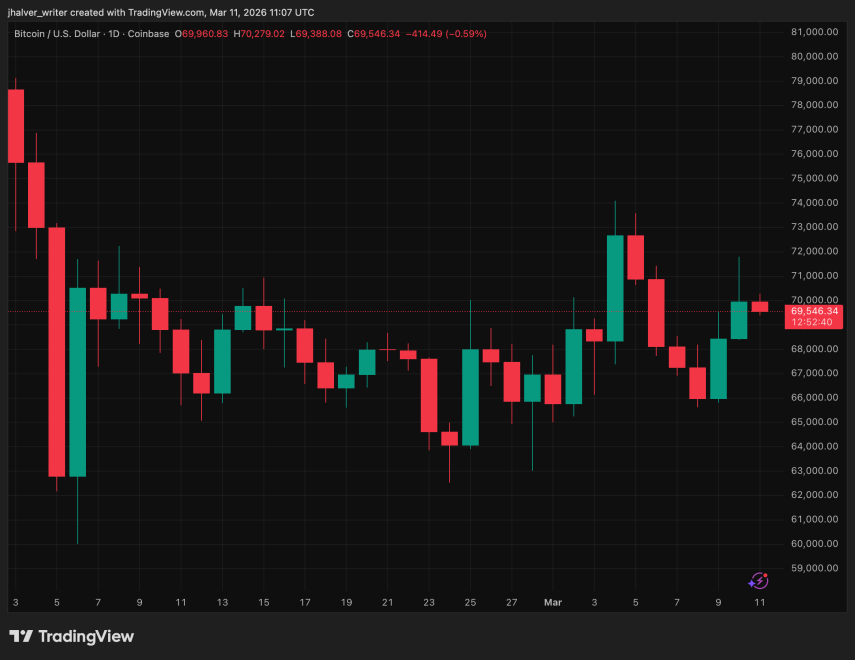
BTC’s price trends to the downside on the daily chart. Source: BTCUSD on Tradingview

Cover image from Perplexity, BTCUSD chart from Tradingview

Связанные с этим вопросы

QWhat is the main purpose of Ghana's 12-month virtual-asset sandbox?

AThe main purpose is to formalize crypto trading and related services by allowing approved Virtual Asset Service Providers (VASPs) to pilot their products in a controlled environment under regulatory oversight, while ensuring investor protection, market integrity, and compliance with AML/CFT standards.

QHow many firms have been approved to participate in Ghana's crypto sandbox pilot?

A11 firms have been approved to participate in the crypto sandbox pilot.

QWhat happens to firms that are considered 'market ready' after the first 6 months of the sandbox?

AFirms considered 'market ready' and fully compliant after the first 6 months may start transitioning toward full activity-based licenses or registrations.

QWhich African country is mentioned as already testing crypto regulation technology similar to Ghana's approach?

AZambia is mentioned as a peer country that is already testing crypto regulation technology to supervise services before they enter the market.

QWhat legislation provides the legal basis for Ghana's Virtual Asset Service Providers sandbox?

AThe Virtual Asset Service Providers Act, 2025 (Act 1154) provides the legal basis for licensing and monitoring crypto-asset businesses and the regulatory sandbox in Ghana.

Похожее

Exploring Bitcoin Valuation in 2026 from Macro and On-Chain Structural Perspectives

Tiger Research analyzes Bitcoin's valuation outlook for 2026 from macro and on-chain perspectives. Despite a 27% price drop in Q1, the macro environment remains supportive. Global M2 hit a record $13.44 trillion, but Chinese liquidity, which contributed over 60% of M2 growth, has limited access to Bitcoin markets. The Iran conflict pushed oil prices higher, raising March CPI to 3.3% and narrowing the Fed's rate cut path. However, the easing direction remains intact. Bitcoin ETF flows turned positive in March after five months of outflows, and corporate accumulation continues. On-chain metrics show a shift from undervaluation to early equilibrium. Key indicators like MVRV-Z and NUPL have exited panic zones. The critical resistance is at $78k, the long-term holder cost basis, while the key support is at $54k. Although transaction counts increased, active addresses and average transfer size declined, indicating superficial growth rather than real network expansion. BTCFi ecosystem growth has weakened, leading to a -10% adjustment in fundamental metrics. The 12-month price target is set at $143k, based on a $132.5k neutral benchmark adjusted by -10% (fundamentals) and +20% (macro). This represents a 103% upside from current levels. Short-term catalysts include a break above $78k, sustained ETF inflows, and a Fed policy shift post-geopolitical de-escalation.

marsbit18 мин. назад

Exploring Bitcoin Valuation in 2026 from Macro and On-Chain Structural Perspectives

marsbit18 мин. назад

Anthropic Starts Poaching Scientists? $27K Weekly Onsite Stipend to Fix Claude's Expert-Level Errors

Anthropic has launched a new STEM Fellow program, offering $3,800 per week for a three-month, in-person residency in San Francisco. The role targets experts from science, technology, engineering, and mathematics (STEM) fields—machine learning experience is helpful but not required. Instead, Anthropic values scientific judgment and a willingness to learn quickly. Fellows will work with Claude models and internal tools under the guidance of an Anthropic researcher. Example projects include a materials scientist identifying errors in Claude’s reasoning or a climate scientist integrating atmospheric modeling software with Claude. The goal is to have experts "tell Claude where it's wrong" and improve its scientific capabilities. This initiative is part of Anthropic’s broader strategy to strengthen its scientific ecosystem, following earlier programs like the AI Safety Fellows and AI for Science programs. The company acknowledges that current AI models, while powerful, still produce high-confidence errors and lack end-to-end research autonomy. The program aims to embed domain expertise directly into model development, turning scientists into "high-level reviewers" for AI. Anthropic CEO Dario Amodei has previously emphasized AI’s potential to accelerate scientific breakthroughs, particularly in biology and healthcare. The company believes that the next phase of AI competition will depend not on scaling parameters, but on integrating human expertise to refine model accuracy and reliability.

marsbit49 мин. назад

Anthropic Starts Poaching Scientists? $27K Weekly Onsite Stipend to Fix Claude's Expert-Level Errors

marsbit49 мин. назад

On the Eve of X Money's Launch, Musk Dismantles the Referee First

"X Money Launches After Dismantling Regulator: Musk's 9-Day Power Play" In February 2025, a team from the "Department of Government Efficiency" (DOGE), led by Elon Musk, entered the Consumer Financial Protection Bureau (CFPB) headquarters. Shortly after, the CFPB was effectively dismantled—its funding frozen, activities suspended, and nearly 90% of staff laid off. This move came just nine days after X announced a partnership with Visa and as X Money prepared to launch. The article contrasts this with the decade-long regulatory battles faced by companies like Coinbase and PayPal. Coinbase spent over $75 million in political contributions and endured a major SEC lawsuit to operate legally. PayPal complied with strict state and federal rules for its stablecoin PYUSD, including 100% reserve requirements and monthly audits. However, Musk’s approach was different. After the CFPB introduced a rule placing large digital payment apps under federal oversight, Musk tweeted "Delete CFPB." Within months, the rule was revoked by Congress. Meanwhile, DOGE operatives gained "god-tier" access to CFPB databases, potentially obtaining sensitive competitive information from rivals like Apple, Google, and PayPal. The article also highlights a "suspicious exemption clause" in the GENIUS Act, which allows private companies like X to issue stablecoins with fewer restrictions. Senator Elizabeth Warren questioned whether Musk, who was a senior presidential advisor during the Act’s drafting, influenced this clause. X Money offers a 6% APY on deposits, despite FDIC warnings that stablecoin users are not insured. As X Money launches to 600 million monthly users, the article questions the fairness of a system where Musk can bypass regulations that others spent years and millions to comply with. The dismantling of the CFPB and the alleged regulatory advantages raise concerns about the future of equitable rule-making in the U.S. financial system.

marsbit57 мин. назад

On the Eve of X Money's Launch, Musk Dismantles the Referee First

marsbit57 мин. назад

Торговля

Спот
Фьючерсы
活动图片