Funding Weekly Report | 13 Public Funding Events, Superstate Completes $82.5 Million Series B Funding Led by Bain Capital Crypto and Distributed Global

marsbitОпубликовано 2026-01-26Обновлено 2026-01-26

Введение

Last week (Jan 19-25) saw 13 blockchain funding rounds totaling over $222 million. Key deals include: - **DeFi**: Superstate raised $82.5M in a Series B led by Bain Capital Crypto and Distributed Global to build an on-chain securities issuance layer. River secured $12M to expand cross-chain liquidity infrastructure. Cork raised $5.5M for tokenized risk markets. - **Web3 & AI**: Warden raised $4M for AI agent infrastructure. AKEDO secured $5M for AI-native content creation. Lazbubu received strategic funding for its AI companion agent on BNB Chain. - **Infrastructure**: ZBD raised $40M led by Blockstream Capital for Bitcoin-based gaming payments. Bitway raised $4.44M for Bitcoin L1 development. - **CeFi**: Argentine fintech Pomelo raised $55M to launch a stablecoin credit card and expand in Latin America. Additional notable AI deals outside the report included Humans& ($480M seed round) and Baseten ($300M round with $150M from NVIDIA).

Highlights of This Issue

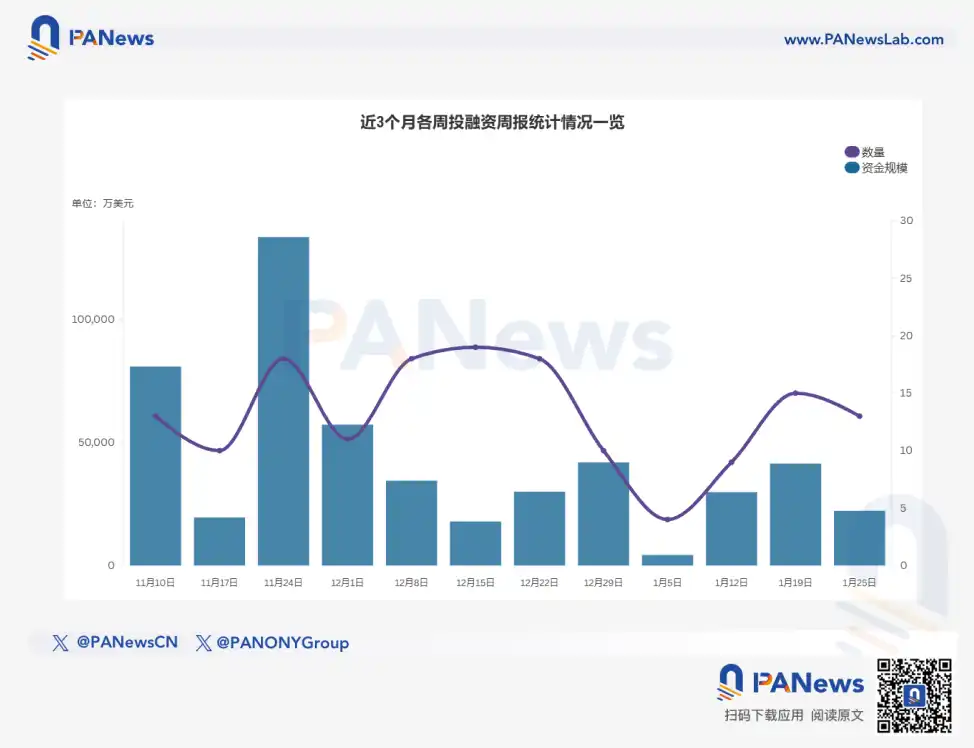
According to incomplete statistics from PANews, there were 13 investment and financing events in the global blockchain sector last week (1.19-1.25), with a total funding scale exceeding $222 million. The overview is as follows:

  • DeFi announced 5 investment and financing events, among which the fintech and asset tokenization company Superstate announced the completion of an $82.5 million Series B funding round;
  • The Web3+AI track announced 3 investment and financing events, among which the AI agent infrastructure and application layer Warden completed a $4 million strategic funding round;
  • The Infrastructure & Tools field announced 2 investment and financing events, among which the Bitcoin payment startup ZBD completed a $40 million Series C funding round, led by Blockstream Capital;
  • The Centralized Finance field announced 3 investment and financing events, among which the Argentina-based fintech company Pomelo completed a $55 million Series C funding round, led by Kaszek and Insight Partners.
DeFi

Fintech and Asset Tokenization Company Superstate Completes $82.5 Million Series B Funding

Fintech and asset tokenization company Superstate announced the completion of an $82.5 million Series B funding round, led by Bain Capital Crypto and Distributed Global, with participation from Haun Ventures, Brevan Howard Digital, Galaxy Digital, Bullish, ParaFi, and others. The company plans to use this funding round to build a full on-chain issuance layer on the Ethereum and Solana blockchains for issuing and trading SEC-registered shares. Its goal is to leverage blockchain technology to make the company fundraising and listing process more efficient.

Superstate currently manages over $1.23 billion in assets and operates two tokenized funds. As an SEC-registered transfer agent, the company, through its "Opening Bell" platform, has supported listed companies in directly issuing and selling digital shares to investors on public blockchains by the end of 2025, enabling real-time management of issuance, settlement, and ownership records.

River Completes $12 Million Strategic Funding Round with Participation from Maelstrom Fund, The Spartan Group, etc.

River announced the completion of a $12 million strategic funding round, with investors including Tron DAO, Justin Sun, the Maelstrom Fund founded by Arthur Hayes, The Spartan Group, and several US and European Nasdaq-listed companies. This funding will support River in expanding its presence in EVM and non-EVM ecosystems, including networks such as TRON and Sui, and continuing to build on-chain liquidity infrastructure.

Tokenized Risk Startup Cork Completes $5.5 Million Seed Round Led by a16z and CSX

Startup Cork announced the completion of a $5.5 million seed funding round, co-led by Andreessen Horowitz (a16z), CSX, and Road Capital, with participation from 432 Ventures, BitGo Ventures, Cooley, DEPO Ventures, Funfair Ventures, G20 Group, Gate Labs, Hyperithm Gate, IDEO Ventures, PEER VC, Stake Capital, and WAGMI Ventures, among others.

Cork is dedicated to building a "programmable risk layer," aiming to make the implicit risks in real-world assets transparent and tradable through tokenization. Its infrastructure allows asset managers, issuers, and others to create customized swap markets to enhance the liquidity of redemptions for on-chain assets, risk transparency, and market confidence. This tool can also be used to assess the risks of crypto-native products such as stablecoins and staking tokens. The team plans to launch the first production-level risk markets in the coming months and expand cooperation with treasuries and asset issuers.

HyperLend Announces Completion of $1.7 Million Funding to Date with Participation from RockawayX, etc.

Lending platform HyperLend disclosed the HPL token economic model allocation: 30.14% for ecosystem growth and incentives, 25% for genesis allocation, 22.5% for core contributors, 17.36% allocated to strategic investors, and 5% reserved for liquidity. The protocol has completed $1.7 million in funding to date, with investors including RockawayX, No Limit Holdings, Nucleus, Duplicate Capital, Dumpster, and others. Strategic investors receive 10% of their allocation at Token Generation Event (TGE), followed by a 4-month lock-up period, with the remaining portion vesting over 2 years.

Saturn Announces Completion of $800,000 Funding with Participation from YZi Labs, Sora Ventures, etc.

Saturn announced the completion of an $800,000 funding round, with participation from YZi Labs, Sora Ventures, and several well-known angel investors in the cryptocurrency field. The funds will be used to build USDat, a Bitcoin-backed stablecoin protocol offering an 11%+ yield. Saturn stated that the yield is provided through the Strategy perpetual preferred shares STRC, while unlocking global on-chain digital credit access.

AI

AI Agent Infrastructure and Application Layer Warden Completes $4 Million Strategic Funding

The infrastructure and application layer project for AI agents, Warden, announced the completion of a $4 million strategic funding round, valuing the company at $200 million. This round saw participation from strategic partners and ecosystem contributors including 0G, Messari, and Venice.AI. The funding aims to accelerate product development and expand its AI agent capabilities in areas such as trading, automation, and programmable wealth. According to reports, Warden is building the full stack for the agent internet, including next-generation agent crypto wallets.

AI-Native Content Creation Engine AKEDO Completes $5 Million Seed Round with Participation from Sfermion, etc.

The AI-native content creation engine and publishing platform AKEDO announced the completion of a $5 million seed funding round. This seed round was led by Karatage, with participation from investors in the gaming, artificial intelligence, and cryptocurrency fields, including Sfermion, Collab + Currency, MARBLEX, Seed Club, The Open Platform, TON Ventures, Gagra Ventures, Kenetic Capital, Metalabs Ventures, and others.

AKEDO is committed to building an "ambiance coding" platform driven by a multi-agent AI system, aiming to significantly improve the efficiency of game and content development through collaborative AI agents. The platform allows users to create game collections, generate AIGC content, and plans to support one-click collection token issuance in the future, unlocking diverse revenue streams for creators and protocols. The company's CEO stated that this funding will be used to expand its multi-agent infrastructure.

BNB Chain Ecosystem AI Companion Project Lazbubu Completes Strategic Round Led by Metis

The BNB Chain ecosystem AI companion project Lazbubu announced the completion of a strategic funding round led by Metis, with participation from Hotcoin Labs, Honey Capital, APUS Capital, and Becker Ventures. This round of funding will be used for core product development, global user growth, ecosystem partnership expansion, and further refinement of the DAT (Data Anchored Token) mechanism.

Lazbubu is an on-chain AI companion agent based on the DAT mechanism, achieving personalized growth by recording user interaction data (such as conversations, decisions, etc.). All data is anchored via BNB Chain, ensuring continuous verifiability and user autonomy. During its testnet phase, it attracted over 80,000 users and generated over 1 million interactions.

The DAT mechanism supports real-time conversion of AI interaction behaviors into on-chain assets, allowing users to view, transfer, or combine related data. Future plans for the project include expanding multimodal interaction capabilities, achieving cross-chain compatibility, and launching community governance mechanisms.

AI Startup Humans& Completes $480 Million Seed Round with Valuation Reaching $4.48 Billion

Human-oriented AI company Humans&, co-founded by former members of Anthropic, xAI, and Google, completed a $480 million seed funding round, valuing the company at $4.48 billion. Investors include Nvidia, Jeff Bezos, SV Angel, GV, and Emerson Collective, among others. The company is dedicated to developing AI tools that enhance human collaboration. Team members hail from OpenAI, Meta, AI2, MIT, etc., focusing on multi-agent reinforcement learning, AI memory, and user understanding, aiming to reshape AI model training and interaction methods.

(This financing is not included in this week's data statistics)

Nvidia Invests $150 Million in AI Inference Company Baseten

The AI inference-focused startup Baseten has completed a $300 million funding round, reaching a valuation of $5 billion, nearly double its previous valuation. This round was led by venture capital firm IVP and Alphabet's independent growth fund CapitalG. Chip giant Nvidia also participated in the investment, injecting $150 million into Baseten as part of the deal. This transaction highlights Nvidia's active deployment in the AI inference field regarding startups. As the industry's focus shifts from training models to large-scale operation and inference (where AI models generate outputs based on inputs), Nvidia is increasing its investment in related startups while continuing to invest in its own AI chip customers.

(This financing is not included in this week's data statistics)

Infrastructure & Tools

Bitcoin Payment Startup ZBD Completes $40 Million Series C Funding Led by Blockstream Capital

Bitcoin payment startup ZBD announced the completion of a $40 million Series C funding round. This round was led by Blockstream Capital (which invested $36 million); other investors and the company valuation were not disclosed. Headquartered in New Jersey, ZBD primarily provides payment software solutions for video games, supporting multiple transaction processings including Bitcoin. The company is not involved in NFT or crypto-based gameplay but focuses on leveraging blockchain as a payment channel to help game developers establish direct financial relationships with players, enabling transfers between users and in-game reward distribution. The company currently has 70 employees and partnered with 55 games in 2025. This funding will be used to expand its payment product suite over the next year.

Bitcoin-Native L1 Protocol Bitway Completes $4.444 Million Seed Round Led by TRON DAO

The Bitcoin-native Layer 1 protocol and infrastructure platform Bitway announced the completion of a $4.444 million seed funding round led by TRON DAO, with participation from HTX Ventures and others. To date, Bitway has raised over $5.8 million from institutional investors. After completing the first seed financing round, it completed a targeted strategic funding round, valuing Bitway at $100 million.

Bitway was founded by former Binance team members and was previously incubated through YZi Labs' EASY Residency program and launched via the Binance Booster program. Bitway has two core products: the on-chain wealth management platform Bitway Earn and the Layer 1 application chain Bitway Chain, specifically for payment and financing solutions.

Centralized Finance

Argentine Payment Startup Pomelo Completes $55 Million Series C Funding, to Launch Stablecoin Credit Card

Argentina-based fintech company Pomelo completed a $55 million Series C funding round led by Kaszek and Insight Partners, aiming to deepen its presence in the Latin American market and expand its global business. The funds will be used to expand its credit card payment processing business in Mexico and Brazil and launch a global credit card settled with the stablecoin USDC. Pomelo also plans to develop real-time and intelligent agent payment systems that can operate cross-border, serving traditional banks and large international clients. Current partners already include Visa, Mastercard, Binance, Western Union, and others.

Dutch Cryptocurrency Platform Finst Completes €8 Million Series A Funding

Dutch cryptocurrency platform Finst completed an €8 million Series A funding round, led by Endeit Capital, with follow-on investments from existing investors including Spinnin' Records founder Eelko van Kooten and DEGIRO co-founder Mark Franse. This financing brings Finst's total funding to €15 million.

The platform was founded in 2023 and has obtained crypto asset service provider authorization from the Dutch Authority for the Financial Markets (AFM), serving retail and institutional clients in 30 European countries. The company stated that this round of funding will be used to expand into the European market, develop new products and services, including expanding staking coverage and market-leading interest rates, increasing asset selection and platform features, and developing more product lines for institutional and professional users.

"Crypto-as-a-Service" Platform CheckSig Completes €3.5 Million Series A Funding

European "Crypto-as-a-Service" platform CheckSig announced the completion of a €3.5 million Series A funding round at a valuation of €33.5 million. To date, its total funding has reached €6.2 million. The company obtained a MiCAR license this year and provides crypto custody, crypto trading, cryptocurrency tax withholding, and other services, aiming to provide secure and transparent cryptocurrency services for individual and institutional investors.


Связанные с этим вопросы

QWhich company raised the largest funding amount in this week's report and what was the round?

ASuperstate raised the largest funding amount of $82.5 million in a Series B round.

QWho were the lead investors in Superstate's $82.5 million Series B funding round?

AThe Series B round for Superstate was co-led by Bain Capital Crypto and Distributed Global.

QWhat is the primary business focus of the payment startup ZBD that raised $40 million?

AZBD is a Bitcoin payments startup that provides payment software solutions for video games, using blockchain as a payment rail for user-to-user transfers and in-game rewards.

QIn which sector did the company Warden, which raised $4 million, operate and what is it building?

AWarden operates in the Web3+AI sector and is building a full-stack for the 'internet of agents', including a next-generation agent crypto wallet for trading, automation, and programmable wealth.

QWhich centralized finance (CeFi) company raised $55 million to launch a stablecoin credit card and expand in Latin America?

AThe Argentine fintech company Pomelo raised $55 million in a Series C round to launch a stablecoin (USDC) credit card and expand its operations in Latin America, specifically in Mexico and Brazil.

Похожее

From Survival to Accelerated Growth: The Journey of Zcash's Three-Year Rise as Told by the Founder of ZODL

**From Survival to Accelerated Growth: Zcash Founder Details the 3-Year Rise** Three years ago, Zcash (ZEC) was a struggling pioneer in privacy technology, with a price near $30, low shielded supply (11%), and a community mired in governance disputes. Today, ZEC trades around $600, with over 31% of its supply (~$3B) in user-controlled shielded pools. This transformation resulted from breaking key constraints. First, **governance shackles were removed**. The old model guaranteed funding to two entities (ECC and ZF) regardless of performance, creating a monopoly. In 2024, ECC rejected further direct funding, forcing a change. The NU6 upgrade ended direct funding, allocating 8% to community grants and 12% to a protocol-controlled treasury for retroactive rewards, expiring in 2028 unless renewed by overwhelming consensus. The entities also relinquished their trademark-based veto power, freeing community governance. Second, the **product focus shifted** from pure cryptography to user growth. Previously, engineering excelled at privacy tech but failed to attract users. In early 2024, the team (later ZODL) pivoted to building products users wanted, like the Zodl wallet (default privacy, hardware support, cross-asset swaps). This drove shielded supply to grow over 400% in ZEC terms, with 86.5% of recent transactions being shielded, representing real user adoption. Third, the **narrative evolved** from the limiting "privacy coin" label to "unstoppable private money." This clarified Zcash's value proposition: a Bitcoin-like monetary policy with verifiable private payments via advanced cryptography. This structural narrative—protocol (Zcash), asset (ZEC), gateway (Zodl)—enabled broader exchange listings, institutional interest, and ETF filings. Finally, **organizational constraints were broken**. In early 2026, the ECC team left its non-profit structure after disputes over control, forming Zcash Open Development Lab (ZODL). ZODL raised $25M from top VCs (Paradigm, a16z, etc.), gaining the capital and agility of a startup to scale consumer products. Current metrics show strong momentum: social discussion volume for ZEC surged 15,245% in a year, with 81% positive sentiment. The focus is now on enhancing user experience (Zodl wallet), scalability (Tachyon project targeting Visa-level throughput with 25-second blocks), and post-quantum security (quantum-recoverable wallets coming soon). Zcash is positioned to become faster, more usable, scalable, and quantum-resistant.

marsbit4 мин. назад

From Survival to Accelerated Growth: The Journey of Zcash's Three-Year Rise as Told by the Founder of ZODL

marsbit4 мин. назад

Five Counterparty Risk Architectures: A Settlement-Layer Methodology for Classifying TradFi Models in Crypto Exchanges

**Summary:** This companion piece reframes the five TradFi-on-crypto exchange architectures, previously classified by "architectural fingerprint," through the lens of counterparty risk. The core question is: whose balance sheet bears the loss first in a stress scenario, and has it historically done so? Each of the five models corresponds to a distinct risk holder with its own documented failure modes. * **Model 1 (Stablecoin-Settled CEX Perpetuals):** Risk is held by the stablecoin issuer (e.g., reserve composition, bank connectivity) and the CEX's own book. History includes Tether's banking disconnections (2017) and reserve misrepresentations (CFTC 2021 Order). * **Model 2 (CFD Brokers):** Risk resides on the broker's balance sheet (B-book model). Regulatory differences (e.g., ESMA's mandatory negative balance protection vs. Mauritius FSC's lack thereof) define loss allocation rules, as seen in the 2015 SNB event (Alpari UK insolvency). * **Model 3 (Off-Chain Custody & Transfer Agent Chain):** Risk lies with the off-chain custodian/platform. User asset recovery depends on Terms of Use and corporate structure, exemplified by the Celsius bankruptcy ruling (2023) where Earn Account assets were deemed property of the estate. * **Model 4 (DEX Perpetual Protocols):** No single balance sheet bears risk. Loss absorption relies on a protocol's insurance fund and Auto-Deleveraging (ADL) mechanism, as demonstrated in the GMX V1 (2022) and dYdX v3 YFI (2023) incidents. * **Model 5 (Regulated CCP - DCM-DCO-FCM):** The most institutionalized model concentrates risk in the Central Counterparty (CCP). However, history shows CCPs can employ non-standard tools under extreme stress, such as mass trade cancellation (LME Nickel, 2022) or enabling negative price settlements (CME WTI, 2020). The report argues that regulatory choices and counterparty risk structures are co-extensive, not in an upstream-downstream relationship. It concludes with five separate observation checklists (not predictions) for monitoring the structural vulnerabilities of each risk model.

marsbit21 мин. назад

Five Counterparty Risk Architectures: A Settlement-Layer Methodology for Classifying TradFi Models in Crypto Exchanges

marsbit21 мин. назад

Торговля

Спот
Фьючерсы

Популярные статьи

Как купить W

Добро пожаловать на HTX.com! Мы сделали приобретение Wormhole (W) простым и удобным. Следуйте нашему пошаговому руководству и отправляйтесь в свое крипто-путешествие.Шаг 1: Создайте аккаунт на HTXИспользуйте свой адрес электронной почты или номер телефона, чтобы зарегистрироваться и бесплатно создать аккаунт на HTX. Пройдите удобную регистрацию и откройте для себя весь функционал.Создать аккаунтШаг 2: Перейдите в Купить криптовалюту и выберите свой способ оплатыКредитная/Дебетовая Карта: Используйте свою карту Visa или Mastercard для мгновенной покупки Wormhole (W).Баланс: Используйте средства с баланса вашего аккаунта HTX для простой торговли.Третьи Лица: Мы добавили популярные способы оплаты, такие как Google Pay и Apple Pay, для повышения удобства.P2P: Торгуйте напрямую с другими пользователями на HTX.Внебиржевая Торговля (OTC): Мы предлагаем индивидуальные услуги и конкурентоспособные обменные курсы для трейдеров.Шаг 3: Хранение Wormhole (W)После приобретения вами Wormhole (W) храните их в своем аккаунте на HTX. В качестве альтернативы вы можете отправить их куда-либо с помощью перевода в блокчейне или использовать для торговли с другими криптовалютами.Шаг 4: Торговля Wormhole (W)С легкостью торгуйте Wormhole (W) на спотовом рынке HTX. Просто зайдите в свой аккаунт, выберите торговую пару, совершайте сделки и следите за ними в режиме реального времени. Мы предлагаем удобный интерфейс как для начинающих, так и для опытных трейдеров.

540 просмотров всегоОпубликовано 2024.04.02Обновлено 2025.03.21

Как купить W

Что такое USDC(WORMHOLE)

USD Coin (Wormhole): Всесторонний обзор Введение В быстро развивающемся мире криптовалют USD Coin (Wormhole), обозначаемый как $USDC(Wormhole), выделяется как первоклассное решение в экосистеме DeFi (децентрализованные финансы). Работая на нескольких блокчейн-платформах, включая Solana, USD Coin (Wormhole) является не просто цифровым представлением доллара США. Он олицетворяет инновационный дух современной финансовой системы, позволяя бесшовные трансакции между цепочками и повышая взаимодействие между различными блокчейн-экосистемами через продвинутый протокол Wormhole. Что такое USD Coin (Wormhole)? USD Coin (Wormhole) — это токенизированная версия доллара США, созданная для упрощения беспрепятственных трансакций между различными блокчейн-сетями. Его основная цель — повысить ликвидность и улучшить функциональность экосистемы DeFi. Используя протокол Wormhole, который устанавливает надежную сеть межцепочечного общения, пользователи могут без усилий передавать токены USDC между различными платформами. Эта межцепочечная функциональность является значительным достижением в использовании криптовалют, способствуя более взаимосвязанной и эффективной экосистеме, где активы могут свободно перемещаться между разными блокчейнами. Ценностное предложение USD Coin (Wormhole) заключается не только в его стабильности, которая привязана к доллару США, но и в его способности устранять разрывы между разными блокчейн-средами. Этот инновационный подход способствует более высокому уровню участия среди пользователей и разработчиков, открывая путь для новых и увлекательных приложений в области децентрализованных финансов. Кто создатель USD Coin (Wormhole)? История USD Coin (Wormhole) тесно связана с сетью Wormhole, которая была разработана Jump Crypto. Хотя конкретные индивидуальные создатели не документированы, Jump Crypto известен своим вкладом в развитие блокчейн-технологий и поддержку их применения в финансах. Создав сеть Wormhole, Jump Crypto сыграл важную роль в продвижении межцепочечных передач активов, улучшая эффективность и многообразие использования криптовалют. Кто инвесторы USD Coin (Wormhole)? Успех USD Coin (Wormhole) поддерживается инвестициями от нескольких известных фондов и организаций в области криптовалют. Ключевые инвесторы включают: Coinbase Ventures: Известное венчурное подразделение, поддерживаемое одной из ведущих криптовалютных бирж в отрасли, Coinbase Ventures предоставляет необходимый капитал и стратегическую поддержку многообещающим блокчейн-проектам. Arrington XRP Capital: Специализируясь на цифровых активах, Arrington XRP Capital распознает потенциал таких инновационных проектов, как USD Coin (Wormhole), и инвестирует соответственно, чтобы поддержать его развитие. Jump Trading: В качестве материнской организации Jump Crypto, Jump Trading приносит не только инвестиции, но и богатый опыт в области торговых технологий и рыночной динамики для поддержки проекта Wormhole. Как работает USD Coin (Wormhole)? Операционная структура USD Coin (Wormhole) тщательно спроектирована для упрощения эффективных межцепочечных трансакций, максимизируя безопасность и эффективность. Вот упрощенный обзор его функционала: Блокировка активов: Когда пользователь хочет перевести USDC с одной блокчейна на другую, он сначала блокирует свои токены на исходном блокчейне. Этот процесс обеспечивает безопасность активов и предполагает, что они будут либо сожжены, либо перемещены позднее. Чеканка токенов: После блокировки токенов эквивалентное количество USDC чеканится на целевом блокчейне. Это предоставляет пользователю доступ к своим средствам на новой платформе, отражая гибкость, которую обеспечивает протокол Wormhole. Межцепочечный перевод: Протокол Wormhole эффективно облегчает весь процесс перевода. Он гарантирует, что как только USDC чеканится на целевой цепи, эквивалентные токены сжигаются на исходной цепи. В результате получается бесшовный перевод стоимости между двумя различными блокчейн-окружениями. Эта межцепочечная методология гарантирует, что транзакции остаются безопасными и прозрачными, значительно увеличивая ликвидность в различных экосистемах DeFi. Хронология USD Coin (Wormhole) Понимание эволюции USD Coin (Wormhole) предоставляет важный контекст для его значимости в мире криптовалют. Вот хронология, подчеркивающая важные этапы в истории проекта: 2021: Запущен проект Wormhole, который устанавливает основу для межцепочечных передач активов и создает условия для развития USD Coin (Wormhole). 2022: Сеть Wormhole сталкивается с серьезной проблемой — нарушением безопасности, что приводит к краже на сумму 325 миллионов долларов. Тем не менее, инцидент впоследствии был решен и возмещен Jump Crypto, что подчеркивает приверженность проекта безопасности и прозрачности. 2023: USD Coin (Wormhole) интегрируется с Протоколом межцепочечного перевода Circle (CCTP), улучшая свои возможности для межцепочечных переводов и еще больше укрепляя свои позиции в экосистеме DeFi. 2024: Продолжается развитие и расширение сети Wormhole, направленное на увеличение полезности и охвата USD Coin (Wormhole), а также повышение его операционной структуры. Ключевые особенности Успех USD Coin (Wormhole) можно отнести к нескольким ключевым особенностям, которые отличают его от других предложений в области криптовалют: Межцепочечная совместимость В основе USD Coin (Wormhole) лежит его способность обеспечивать бесшовные переводы между несколькими блокчейн-сетями. Эта совместимость является краеугольным камнем децентрализованных финансов, позволяя различным платформам взаимодействовать друг с другом, тем самым ускоряя эволюцию финансовых услуг. Безопасность Wormhole использует хорошо спроектированную Сеть Хранителей, состоящую из валидаторов узлов, которые обеспечивают безопасность межцепочечных транзакций. Эта коллективная проверка минимизирует риск мошенничества и дает пользователям уверенность в том, что их активы защищены во время межцепочечных переводов. Повышение ликвидности Путем обеспечения свободного обращения USDC между различными блокчейнами, USD Coin (Wormhole) увеличивает ликвидность в экосистеме DeFi. Эта повышенная ликвидность может способствовать более эффективной торговле, способствовать лучшим ценовым стратегиям и улучшать общую рыночную динамику, охватывающую различные цифровые активы. Заключение USD Coin (Wormhole) является важной инновацией в пространстве блокчейна, укрепляя возможности децентрализованных финансов (DeFi) и устанавливая более связное финансовое окружение. С его надежной структурой для межцепочечных транзакций, функциями безопасности и сильной поддержкой от авторитетных инвесторов, USD Coin (Wormhole) занимает ключевую роль в будущем криптовалют. По мере того как ландшафт цифровых финансов продолжает развиваться, USD Coin (Wormhole) не только принимает будущее взаимосвязанности между блокчейн-сетями, но и подтверждает мощь токенизации и блокчейн-технологий в трансформации того, как мы воспринимаем и используем ценность в цифровом мире. Преодолевая сложности межцепочечной функциональности, он демонстрирует сложный подход к обеспечению финансовой инклюзии и инноваций в мире криптовалют.

133 просмотров всегоОпубликовано 2024.04.03Обновлено 2024.12.03

Что такое USDC(WORMHOLE)

Что такое W$C

World$tateCoin ($W$C): Всеобъемлющее исследование развивающегося криптовалютного проекта Введение На постоянно эволюционирующем рынке криптовалют World$tateCoin ($W$C) появился как проект, стремящийся использовать возможности технологий web3 для создания уникальной цифровой экосистемы. Поскольку традиционные модели онлайн-взаимодействия претерпевают значительные изменения, World$tateCoin стремится утвердиться в этой новой третьей генерации интернета. Эта статья углубится в детали World$tateCoin, предоставляя обзор проекта, его целей и потенциального влияния на пространство web3. Что такое World$tateCoin ($W$C)? World$tateCoin ($W$C) разработан как криптовалюта, которая облегчает бесшовные транзакции в веб3-окружении. Стремясь создать децентрализованную платформу, где пользователи могут взаимодействовать с различными приложениями web3, $W$C намерен оптимизировать пользовательский опыт и повысить доступность цифровых услуг. Хотя проект стремится стать неотъемлемой частью ландшафта web3, подробные сведения о его конкретных целях и случаях использования остаются ограниченными, вызывая вопросы о его потенциальной роли и полезности в быстро развивающемся цифровом контексте. Суть web3 сосредоточена вокруг децентрализации и предоставления пользователям большей власти над их онлайн-взаимодействиями. World$tateCoin намерен соответствовать этим принципам, хотя конкретные приложения и функциональные возможности валюты все еще обсуждаются в сообществе. Кто создатель World$tateCoin ($W$C)? При изучении истоков World$tateCoin информация о его создателе остается неясной. На данный момент нет публично доступных данных, идентифицирующих лиц или организации, стоящие за проектом. Эта неопределенность может бросить тень сомнения на доверие к проекту, но приверженность к инновациям в рамках криптовалют может стать движущей силой его принятия в будущем. Отсутствие четко обозначенного руководства может привести к трудностям, связанным с доверием и прозрачностью — элементами, которые имеют решающее значение для создания сильного сообщества в крипто-пространстве. Кто инвесторы World$tateCoin ($W$C)? Текущие исследования не раскрывают конкретных инвесторов или организаций, поддерживающих World$tateCoin. Невероятно, но новые криптовалютные проекты часто привлекают скрытые инвестиции или действуют в условиях минимальной финансовой структуры на начальном этапе. Неопределенность относительно поддержек инвестиций и методологий финансирования может повлиять на устойчивость проекта и его перспективы роста. Оценивая новые проекты в области криптовалют, инвесторы, как правило, ищут прозрачности в отношении финансовой поддержки и поддержки со стороны признанных организаций. Отсутствие этой информации может потребовать осторожного подхода для потенциальных пользователей и заинтересованных сторон, интересующихся будущим World$tateCoin. Как работает World$tateCoin ($W$C)? Операционные механизмы World$tateCoin основаны на принципах децентрализации, являющихся отличительной чертой технологий web3. Обеспечивая транзакции прямо между пользователями без вмешательства посредников, $W$C призвана повысить доверие и эффективность. Тем не менее, комплексная документация, описывающая уникальные характеристики и операционные рамки, которые отличают World$tateCoin от других криптовалют, заметно скудна. Этот недостаток информации усложняет понимание того, как $W$C функционирует в более широком экосистеме web3 и какие уникальные предложения она приносит пользователям и разработчикам. Тем не менее, основная цель разрешить децентрализованные транзакции имеет потенциал для создания более свободного финансового ландшафта, если проект сможет реализовать свои амбиции по внедрению надежных механизмов и удобных интерфейсов. Хронология World$tateCoin ($W$C) Построение хронологии, охватывающей историческую эволюцию World$tateCoin, представляет сложности из-за отсутствия значительной документации о ключевых событиях и вехах. Тем не менее, можно представить приблизительную последовательность гипотетических фаз, которая станет путем вперед для проекта: Начальная концепция (Дата неизвестна): Концептуализация структуры World$tateCoin в более широком контексте технологий web3. Фаза разработки (Дата неизвестна): Начало процессов технической разработки и программирования. Вовлечение сообщества (Дата неизвестна): Работа с потенциальными пользователями и заинтересованными сторонами для повышения интереса к проекту. Цель запуска (Дата неизвестна): Объявление ожидаемой даты запуска, зависящей от прогресса фаз разработки и тестирования. Из-за отсутствия обоснованных дат и деталей, касающихся этих фаз, заинтересованные стороны будут должны оставаться бдительными и активно следить за коммуникациями проекта для получения обновлений о его траектории. Ключевые темы о World$tateCoin ($W$C) По мере развития проекта возникают определенные ключевые темы, воплощающие потенциал и амбиции World$tateCoin: Децентрализация: Основная философия, движущая проектом, направленная на содействие прямым взаимодействиям пользователей. Интеграция web3: Цель отражения принципов web3 и обеспечения удобного доступа пользователей к различным цифровым услугам. Цифровая валюта: Разработанная как валюта для упрощения интернет-транзакций, World$tateCoin нацелена на увеличение ликвидности на рынке web3. Проблема нехватки информации: Значительное отсутствие подробной информации о основах проекта, его создателях и методах работы, требующее увеличения прозрачности со стороны разработчиков для создания доверия сообщества. Заключение World$tateCoin ($W$C) занимает интересное, но неопределенное положение в области криптовалют и интеграции web3. Хотя проект стремится развивать децентрализованную среду, ограниченная доступность информации о его создателях, инвесторах и конкретных функциональностях представляет собой вызовы для потенциальных заинтересованных сторон и пользователей. В динамичном мире криптовалют прозрачность, вовлеченность и хорошо структурированная коммуникация имеют решающее значение для успеха таких проектов, как World$tateCoin. По мере того как ландшафт продолжает эволюционировать, заинтересованные стороны будут с нетерпением ожидать, как проект сможет укрепить свое место в нарративе web3 и внести свой вклад в продолжающуюся трансформацию цифровой экосистемы.

98 просмотров всегоОпубликовано 2024.04.05Обновлено 2024.12.03

Что такое W$C

Обсуждения

Добро пожаловать в Сообщество HTX. Здесь вы сможете быть в курсе последних новостей о развитии платформы и получить доступ к профессиональной аналитической информации о рынке. Мнения пользователей о цене на W (W) представлены ниже.

活动图片