From the 'Kimchi Premium' to Bithumb's Overhaul: An Interpretation of the Recent Situation in South Korea's Crypto Market

marsbitОпубликовано 2026-04-04Обновлено 2026-04-04

Введение

This article analyzes the recent six-month partial suspension of South Korea's second-largest crypto exchange, Bithumb, by financial regulators—an event widely underreported in English-language media. South Korea is a critical crypto market, with the Korean Won (KRW) being the second-largest fiat currency in crypto trading, accounting for nearly 30% of global fiat-crypto volume. The market is highly concentrated, with Upbit and Bithumb handling 96% of domestic trading. Due to capital controls, language barriers, and market concentration, price-relevant information often emerges first in Korean media and trading channels, creating temporary but significant pricing dislocations between Korean exchanges and global markets. A key example is the "Kimchi Premium"—the gap between KRW-denominated crypto prices and global USD prices—which is often misinterpreted as retail sentiment but actually reflects structural capital constraints. The suspension of Bithumb is reducing competitive price discovery, further centralizing liquidity on Upbit and making market dislocations less predictable. Events like the December 2024 presidential emergency decree, which caused a 30% intraday drop in Korean Bitcoin prices versus only 2% globally, illustrate how quickly these asymmetries can emerge and vanish. The article argues that monitoring Korean market signals—not just the Kimchi Premium but also local news and political developments—provides a recurring informational edge for global traders.

Original Author: Axis

Original Compilation: AididiaoJP, Foresight News

On March 15th, South Korea's financial regulator imposed a six-month partial suspension of business on the country's second-largest cryptocurrency exchange, Bithumb. English-language media reported this event as a routine compliance case involving anti-money laundering enforcement and regulatory crackdowns. However, most of these reports overlooked the more important underlying information.

In fact, this event is evolving into a market structure event occurring within one of the deepest fiat-backed liquidity pools in the on-chain financial system, with an impact far beyond South Korea's borders. Upbit and Bithumb together handle about 96% of South Korea's cryptocurrency trading volume. Bithumb's suspension is not only reshaping the operational landscape of the domestic market but also weakening the quality of signals this market has transmitted to global traders for years.

Overall, South Korean cryptocurrency users are active traders, but the system they operate in is shaped by capital controls, high exchange concentration, and persistent language barrier. The combined effect of these three factors is that price-related information often appears first locally in South Korea before being reflected in global markets, creating a window where the markets are briefly out of sync.

The reason global traders fail to receive news promptly is structural, not coincidental

South Korea is not a peripheral market but one of the most important markets globally for understanding where on-chain opportunities originate. The Korean Won is the second-largest fiat currency in global cryptocurrency trading by volume, with year-to-date trading volume of approximately $663 billion, accounting for nearly 30% of global fiat-to-crypto trading volume. Nearly one-third of South Korean adults hold digital assets, a rate twice that of the United States.

The current government, elected in June 2025, ran on one of the most explicitly pro-cryptocurrency platforms in political history. Since taking office, nearly half of the top 30 performing stocks on the Korea Composite Stock Price Index have been related to digital assets. The stock market quickly digested this signal, while the vast majority of the cryptocurrency community did not.

This is not a one-off market dislocation. South Korea's political and regulatory dynamics typically first appear in Korean-language media and local CT (Crypto Twitter), subsequently affecting KRW trading pairs on Upbit and Bithumb, and are only reported by English-language media hours to days later. The reverse process also exists: global macro changes originating in English-speaking markets often take a long time to be priced into local trading pairs. By the time the information is translated, the initial price reaction has usually already occurred.

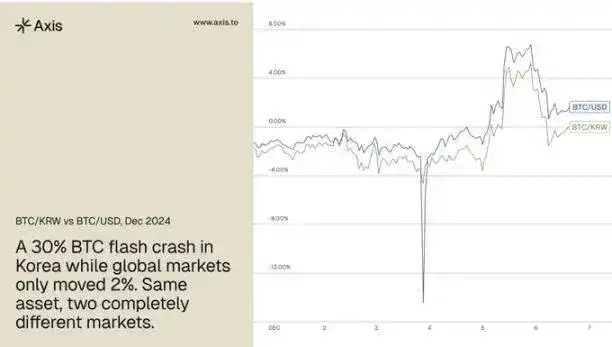
The clearest record occurred on December 3, 2024, when South Korean President Yoon Suk-yeol declared martial law. The price of Bitcoin in South Korea fell about 30% intraday, while the global price fell only about 2%, a difference of 28 percentage points, entirely triggered by domestic political shock. The total sell-off was approximately $33.3 billion, and the South Korean market once recorded the highest global trading volume. This event is a classic case of the typical unfolding of South Korean market dislocations.

At that time, buy-side liquidity quickly dried up, sell-side pressure accumulated, and the selling pressure was entirely concentrated on KRW trading pairs. Even stablecoins depegged, with USDT trading as low as $0.75 on South Korean exchanges, while Bitcoin and altcoins traded at discounts of 50% or more compared to global prices. Onshore users, believing they were selling into the last available liquidity, engaged in heavy market selling even though global prices barely moved. On-chain data showed arbitrageurs transferring millions of USDT per transaction to narrow the spread. Front-end systems of major exchanges crashed under traffic pressure, retail users couldn't log in to buy discounted assets, and only traders using APIs could execute trades during that window. By most measures, this was a significant and highly tradable event, but the window closed within hours.

The Bithumb suspension event is following the same pattern. It has been brewing in Korean-language information flows for weeks, but most English-speaking traders are only learning about it now.

The "Kimchi Premium" is widely tracked but often misunderstood

For traders without access to Korean-language information sources, the Kimchi Premium has been the most direct proxy for understanding South Korean market dynamics. This premium measures the gap between the price of cryptocurrencies denominated in Korean Won and the global price denominated in US Dollars. For this reason, experienced traders have long monitored KRW trading volume. The South Korean spot altcoin market is one of the highest volume markets globally and has historically been a reliable early indicator of broader market movements.

The problem is that most traders misinterpret this signal. The Kimchi Premium is widely seen as a measure of retail sentiment among Korean traders. While this is indeed part of it, the premium also reflects the intensity of structural capital pressures in a market where cross-border capital flows face regulatory friction. When this friction increases, pricing dislocations tend to widen accordingly.

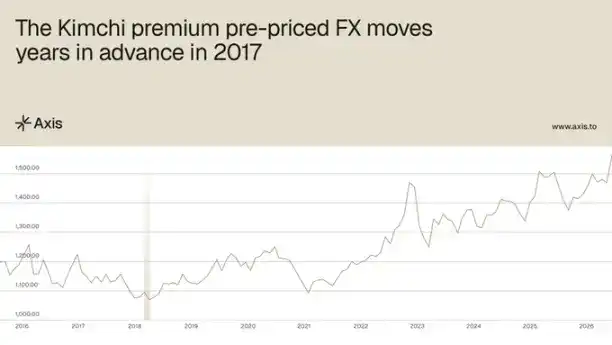
The historical record clearly illustrates this. As early as 2017, when the USD/KRW exchange rate was around 1060, the Kimchi Premium peaked at about 40%, implying an effective USDT/KRW rate of around 1480. Then in December 2024, the actual USD/KRW exchange rate broke through 1480. The Kimchi Premium had priced in this foreign exchange move years in advance. This information was encoded in publicly visible data but required结合 Korean market information flows to be interpreted correctly.

A persistent feature is that the Kimchi Premium does not naturally revert to zero. Research shows that as long as capital controls persist, Bitcoin's Kimchi Premium maintains a structural non-zero floor of approximately 1.24%. This means that when the premium compresses near this level, it often reflects changes in underlying capital pressures, not simply normalization. In 2025, periods where the premium approached zero were followed by positive returns for Bitcoin over both one-week and one-month time horizons: the average seven-day return was 1.7%, and the average thirty-day return was 6.2%. For traders, the important signal is not the absolute level of the Kimchi Premium, but its trend over time.

Bithumb's suspension makes Korean market dislocations harder to foresee, thus more asymmetric

The effectiveness of the Kimchi Premium as a signal depends on how price discovery is achieved among South Korean exchanges. When multiple trading venues compete to price the same capital flows, the resulting spreads tend to carry more information. As liquidity becomes more concentrated, this clarity begins to decline. Therefore, Bithumb's suspension is removing the competitive price discovery mechanism that the premium relies on.

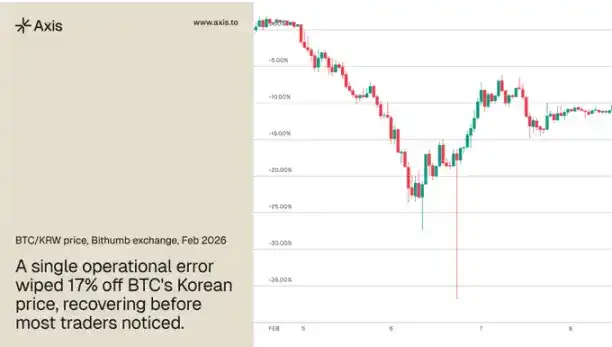
Following the announcement, capital rapidly migrated to Upbit, further deepening the concentration. In February 2026, Bithumb experienced an operational error, mistakenly crediting user accounts with 620,000 Bitcoin, causing a 17% flash crash in the BTC/KRW pair before prices recovered. This event vividly illustrates what happens when price discovery relies on a single trading venue operating under stress.

The degradation of the premium does not mean that Korean market dislocations stop occurring; it means these dislocations become harder to predict before they appear, thereby widening the information gap between participants who directly monitor the Korean market and those who rely on English-language reports.

Meanwhile, the underlying conditions that generate these dislocations are becoming more severe. In 2025, under strict trading rules, $110 billion worth of cryptocurrency flowed out of South Korea. Under the new government, capital that was previously structurally squeezed out is being reintroduced through new institutional channels, while the exchange infrastructure relied upon by retail flows is simultaneously being tightened. Historically, this kind of policy divergence has been the precursor to the most violent and short-lived dislocations produced by this market.

South Korea's market structure creates recurring information asymmetry for global traders

The Kimchi Premium is not an isolated phenomenon unique to the South Korean market. It is the most widely observed example of a mechanism that operates to some extent in every capital-controlled market where cryptocurrency has developed as a parallel financial channel. Both the December 2024 martial law event and the Bithumb suspension event illustrate the same dynamic. Dislocations in this market appear rapidly, reward participants with the right information sources, and disappear before the rest of the market catches up.

The traders who acted on December 3rd were not faster or smarter; they were monitoring the correct signals beforehand and understood how Korean political events map onto exchange-level price mechanisms, while the broader market was not yet aware of what was happening.

As stablecoin infrastructure deepens globally, more markets will produce the kind of capital pressure signals that South Korea has been releasing for the past decade. The challenge lies not in identifying the existence of these signals, but in building the infrastructure and discipline required to consistently capture them.

Связанные с этим вопросы

QWhat is the 'Kimchi Premium' and why is it significant in the Korean crypto market?

AThe 'Kimchi Premium' refers to the price gap between cryptocurrencies traded in Korean Won on local exchanges and their prices in US dollars on global exchanges. It is significant because it serves as a key indicator of both retail sentiment and structural capital pressures within Korea's capital-controlled market. Historically, it has been a reliable early signal for broader market movements and even pre-priced significant foreign exchange shifts.

QWhat was the immediate market impact of the six-month suspension of Bithumb by Korean financial regulators?

AThe suspension triggered a rapid migration of capital to Upbit, further concentrating liquidity in a single major exchange. This concentration degrades the competitive price discovery mechanism that the Kimchi Premium relies on, making future market dislocations in Korea harder to predict and potentially more severe when they occur.

QHow did the market react to the announcement of martial law in South Korea on December 3, 2024?

AThe announcement caused a massive, isolated sell-off on Korean exchanges. The price of Bitcoin in Korean Won dropped approximately 30% intraday, while the global price fell only about 2%. This created a 28-percentage-point gap. USDT even depegged, trading as low as $0.75 on Korean platforms. The event highlighted the market's structural disconnection, where onshore users panicked and sold into the last available liquidity, while arbitrageurs with API access capitalized on the massive price discrepancy before it closed.

QWhy does the author argue that the Korean market creates a recurring information asymmetry for global traders?

AThe author argues that information asymmetry arises from Korea's unique market structure, which is shaped by capital controls, highly concentrated exchanges, and a persistent language barrier. Political and regulatory news often breaks first in Korean media and impacts local trading pairs hours or days before being translated and reported in English. This creates a brief window where traders with direct access to Korean information flows can act before the wider global market is even aware of the event.

QWhat is the structural non-zero floor of the Kimchi Premium, and what does it imply for traders?

AResearch indicates that the Kimchi Premium maintains a structural non-zero floor of approximately 1.24% as long as capital controls are in place. This implies that the premium will not naturally converge to zero. For traders, the key signal is not the absolute level of the premium but its rate of change over time. Periods where the premium compresses towards this floor have historically been followed by positive returns for Bitcoin.

Похожее

The AI Agent Era Accelerates Its Arrival: Questflow Defines a New Paradigm of Financial Intelligence with On-Chain AI Brokerage

The AI Agent era is accelerating, with the CB Insights AI 100 list highlighting global investment confidence. The focus has shifted from whether AI works to its speed of deployment and ability to manage complex workflows, with autonomous AI Agents driving this transformation. At the forefront is Questflow, a Singapore-based startup redefining financial intelligence through its on-chain AI brokerage. Unlike tools that merely provide data dashboards, Questflow deploys AI Agents that proactively scan markets, form judgments, and execute trades via a conversational interface—operating 24/7 without requiring manual confirmation for each decision. This embodies the new AI paradigm of agents capable of executing multi-step workflows autonomously. Questflow's mission is to democratize institutional-grade trading intelligence. Historically reserved for the ultra-wealthy, this capability is now accessible starting from just $1 through Questflow's "AI Clone + Copy Trade" model. The platform charges only a 1% execution fee, aligning its incentives directly with users and eliminating traditional management or performance fees. The timing is opportune, aligning with key trends identified by CB Insights: the scalable deployment of AI Agents, accelerated AI adoption in financial services, and the maturation of on-chain infrastructure. With robust liquidity on platforms like Hyperliquid and Polymarket, alongside advancements in AI reasoning and non-custodial wallet security, Questflow is positioned to merge the roles of broker, fund, and exchange into a single, accessible platform for millions.

链捕手12 мин. назад

The AI Agent Era Accelerates Its Arrival: Questflow Defines a New Paradigm of Financial Intelligence with On-Chain AI Brokerage

链捕手12 мин. назад

Why Pricing Social Interactions is Doomed to Fail?

Titled "Why Putting a Price on Social Interaction Is Doomed to Fail," this article critiques attempts to monetize social networks directly through SocialFi models, arguing their inevitable failure stems from a fundamental misunderstanding of media dynamics. Using Marshall McLuhan's theory of "hot" and "cold" media, the author posits that social networks are inherently "cold" media. Their value isn't contained in individual posts but is co-created through user participation, interpretation, and fragmented, ongoing interaction (e.g., replies, shares). This ambiguity and need for user involvement are core to their function. The article asserts that SocialFi projects like Friend.tech failed because introducing real-time, tradable financial pricing (a definitive "hot" signal) into this "cold" environment doesn't add a layer—it replaces the medium's essence. The unambiguous price signal overshadows and nullifies the nuanced, participatory social signal. Users become traders, not participants, and when speculative profits vanish, the underlying social ecosystem—never genuinely cultivated—collapses entirely. This principle extends beyond crypto. The author argues platforms like Twitter have gradually "heated up" through metrics (likes, retweets counts, algorithmically defined value), shifting users from participants to performers and eroding organic engagement. The solution isn't to abandon capital but to manage its entry point. Successful models like Substack, Patreon, or Bandcamp allow capital to "condense" at specific, isolated nodes (e.g., subscriptions, one-time payments) without permeating and "heating" every social interaction. They preserve the core "cold," participatory medium while enabling monetization at designated boundaries. The NFT boom and bust serves as a stark parallel: the ancient "cold" medium of collecting (valued for story, community, gradual accumulation) was rapidly destroyed by platforms that introduced real-time floor prices, rarity scores, and trading dashboards, transforming collectors into speculators and vaporizing cultural value when prices fell. The core lesson: "Liquidity equals heat." Injecting high liquidity and definitive pricing into a "cold" participatory medium doesn't optimize it; it fundamentally alters and destroys its value-creating mechanism. The future lies not in pricing every social gesture but in finding precise, non-invasive points for capital to condense without overheating the entire ecosystem.

marsbit20 мин. назад

Why Pricing Social Interactions is Doomed to Fail?

marsbit20 мин. назад

Jensen Huang's CMU Speech: In the AI Era, Don't Just Watch, Build

Jensen Huang, CEO of NVIDIA and a first-generation immigrant, delivered the commencement address to Carnegie Mellon University's class of 2026. He shared his personal journey from a humble background to founding NVIDIA, emphasizing resilience, learning from failure, and the responsibility that comes with leadership. Huang framed the present moment as the dawn of the AI revolution, a shift he believes is more profound than previous computing waves. He described AI as fundamentally resetting computing—moving from human-written software to machines that understand, reason, and use tools. This will create a new industry for generating intelligence and transform every sector. While acknowledging AI's potential to automate tasks and displace some jobs, Huang distinguished between the *tasks* of a job and its core *purpose*. He argued AI will augment human capability, not replace humans. The real risk, he stated, is not AI itself, but people being left behind by those who effectively use AI. He presented AI as a generational opportunity for massive infrastructure investment—in chip factories, data centers, energy grids, and advanced manufacturing—that could re-industrialize nations like the U.S. and bridge the digital divide by making computing and intelligent tools accessible to all. Huang called for a balanced approach: advancing AI safely and responsibly, establishing prudent policies, ensuring broad access, and encouraging universal participation. He urged the graduates not to fear the future but to engage with optimism and ambition, reminding them of CMU's motto, "My heart is in the work." His core message was clear: this is their moment to actively build and shape the AI-powered future, not merely observe it.

marsbit1 ч. назад

Jensen Huang's CMU Speech: In the AI Era, Don't Just Watch, Build

marsbit1 ч. назад

Торговля

Спот
Фьючерсы

Популярные статьи

Как купить S

Добро пожаловать на HTX.com! Мы сделали приобретение Sonic (S) простым и удобным. Следуйте нашему пошаговому руководству и отправляйтесь в свое крипто-путешествие.Шаг 1: Создайте аккаунт на HTXИспользуйте свой адрес электронной почты или номер телефона, чтобы зарегистрироваться и бесплатно создать аккаунт на HTX. Пройдите удобную регистрацию и откройте для себя весь функционал.Создать аккаунтШаг 2: Перейдите в Купить криптовалюту и выберите свой способ оплатыКредитная/Дебетовая Карта: Используйте свою карту Visa или Mastercard для мгновенной покупки Sonic (S).Баланс: Используйте средства с баланса вашего аккаунта HTX для простой торговли.Третьи Лица: Мы добавили популярные способы оплаты, такие как Google Pay и Apple Pay, для повышения удобства.P2P: Торгуйте напрямую с другими пользователями на HTX.Внебиржевая Торговля (OTC): Мы предлагаем индивидуальные услуги и конкурентоспособные обменные курсы для трейдеров.Шаг 3: Хранение Sonic (S)После приобретения вами Sonic (S) храните их в своем аккаунте на HTX. В качестве альтернативы вы можете отправить их куда-либо с помощью перевода в блокчейне или использовать для торговли с другими криптовалютами.Шаг 4: Торговля Sonic (S)С легкостью торгуйте Sonic (S) на спотовом рынке HTX. Просто зайдите в свой аккаунт, выберите торговую пару, совершайте сделки и следите за ними в режиме реального времени. Мы предлагаем удобный интерфейс как для начинающих, так и для опытных трейдеров.

1.3k просмотров всегоОпубликовано 2025.01.15Обновлено 2025.03.21

Как купить S

Sonic: Обновления под руководством Андре Кронье – новая звезда Layer-1 на фоне спада рынка

Он решает проблемы масштабируемости, совместимости между блокчейнами и стимулов для разработчиков с помощью технологических инноваций.

2.2k просмотров всегоОпубликовано 2025.04.09Обновлено 2025.04.09

Sonic: Обновления под руководством Андре Кронье – новая звезда Layer-1 на фоне спада рынка

HTX Learn: Пройдите обучение по "Sonic" и разделите 1000 USDT

HTX Learn — ваш проводник в мир перспективных проектов, и мы запускаем специальное мероприятие "Учитесь и Зарабатывайте", посвящённое этим проектам. Наше новое направление .

1.8k просмотров всегоОпубликовано 2025.04.10Обновлено 2025.04.10

HTX Learn: Пройдите обучение по "Sonic" и разделите 1000 USDT

Обсуждения

Добро пожаловать в Сообщество HTX. Здесь вы сможете быть в курсе последних новостей о развитии платформы и получить доступ к профессиональной аналитической информации о рынке. Мнения пользователей о цене на S (S) представлены ниже.

活动图片