From Miner to Infrastructure Provider: The Survival Logic Behind Bitdeer's Complete BTC Sell-Off

marsbitОпубликовано 2026-02-24Обновлено 2026-02-24

Author: Liam 'Akiba' Wright

Compiled by: Deep Tide TechFlow

Deep Tide Guide: By hash rate scale, Bitdeer is the largest Bitcoin miner in the United States. This week, it completely liquidated its entire BTC treasury—from 2,017 to zero. Simultaneously, the company completed a $325 million convertible bond financing and an equity offering. This is not an isolated event: the hashprice is approaching the breakeven line for many miners, and a structural shift is quietly occurring, turning miners from "HODLing machines" into "operational machines fueled by BTC."

Full Text Below:

Bitdeer, the largest Bitcoin miner in the U.S. by hash rate scale, completely emptied its BTC ledger this week.

The company's BTC treasury balance now shows 0—it sold 189.8 newly mined BTC and liquidated 943.1 BTC from its reserves.

For mining companies, holding Bitcoin is like pressure in a pipeline: some flows out as income, some remains in the treasury as a store of value and a buffer. The state of this buffer reflects management's judgment of the road ahead.
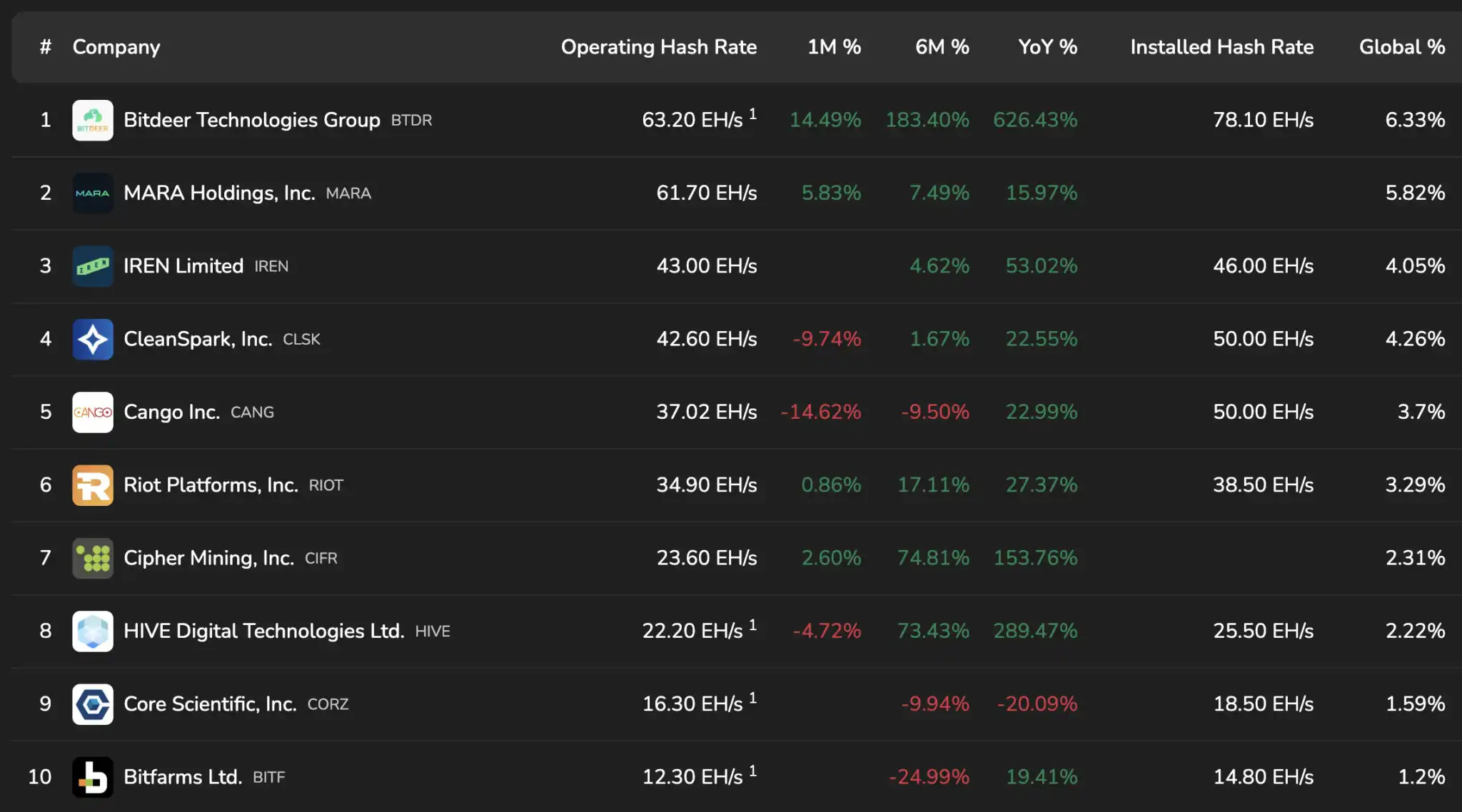
Bitcoin hashrate ranking

Source: bitcoinminingstock.io

Bitdeer's buffer has been reset to zero in one go, raising the question: Why is this miner in such urgent need of cash? And how does it view the next quarter?

In the mining industry, bills come in fiat—electricity, hosting fees, salaries, parts—while revenue comes in Bitcoin. Therefore, every treasury policy is essentially a statement about timing, risk, and access to capital.

This weekly report has a second layer of meaning. Bitdeer's balance sheet still showed a substantial BTC holding at the end of the year—in the announcement on December 31, 2025, the company disclosed "Bitcoin held: 2,017."

The shift from a four-figure holding to a weekly update showing zero tells a story of pace, cash conversion, governance models, and the entire narrative of a business that constantly reinvents itself.

Taken together, this weekly report presents a company actively choosing certainty—converting a shrinking (in dollar terms) reserve into operational liquidity and adjusting its risk exposure to resemble a utility company more than a HODLing account. This is where the term "capitulation" comes in: it describes what happens when the profit margin gauge approaches the red line—the treasury transforms from a strategic reserve into fuel.

Based on weekly data, Bitdeer sold approximately 1,132.9 BTC (943.1 from reserves plus 189.8 newly mined). At the $60,000 to $70,000 range displayed on Bitdeer's mining insights page, this represents about $68 million to $79 million in liquidity—enough to make a material impact in a miner's cash cycle and enough to signal a shift in stance.

Treasury Line Item Meets Financing Calendar

This BTC sale coincided with what appears to be a deliberate capital markets restructuring. Bitdeer announced the pricing of upsized $325 million, 5.00% interest, convertible senior notes due 2032, along with a concurrent registered direct offering priced at $7.94 per share.

The expected uses of the funds include: a capped call transaction, repurchasing $135 million of the 2029 convertible notes, and funding data center expansion, HPC and AI businesses, ASIC R&D, and working capital.

This series of actions tells you where the money is intended to go and what risks the company is willing to bear along the way.

Convertible notes and capped calls are financial plumbing—they wrap volatility, trading upside for survival space, aiming to keep the gears turning while revenue catches its breath. A miner liquidating its BTC holdings in the same time window as completing financing and debt restructuring sends a signal: a preference for controllable funding channels and a focus on building infrastructure that can consistently generate orders, hash rate, and contracts.

This logic aligns with the broader 2026 narrative—miners increasingly positioning themselves as "energy-to-compute" enterprises, with Bitcoin as one revenue stream and AI and HPC as another capital-intensive destination.

VanEck's 2026 outlook sees this transition as both an opportunity and a pressure point for the mining industry, predicting consolidation as balance sheets absorb growth costs.

Hashprice Sets the Pace, Forward Curve Sets Expectations

Failure in mining rarely ends with a bang; it's a drift, a tightening, a series of small forced decisions that culminate in a big one. The industry's profit margin gauge is the hashprice—revenue per unit of hash rate—and recent readings explain why treasuries must be liquidated.

Luxor's latest Hashrate Index report places the dollar hashprice at $34.05 per PH/s per day, down about 4% week-over-week, and points out that for many miners, the current hashprice is near breakeven, depending on their respective cost structures and machine types.

The forward market prices an average of about $28.73 per PH/s per day over the next six months—this lower expectation acts like gravity, pulling on every treasury policy.

Difficulty is the second knob, adjusting the denominator, which can swing rapidly when weather, outages, or power curtailments take machines offline.

Bitcoin experienced a record 11.16% difficulty drop to 125.86T, followed by a record rebound to 144.40T. The next adjustment is expected to move lower in early March. For miners planning capital expenditures and liquidity on a weekly and monthly basis, this pattern is like a whipsaw.

Bitdeer's own dashboard reflects the same situation—Bitdeer lists the network hash rate at about 1,022 EH/s, difficulty at about 144.4T, and shows "Earnings per TH/s Day" as $0.0289. Miners must survive in the space defined by these numbers and choose where to absorb volatility: the treasury, the debt stack, or growth plans.

Capitulation Arrives First in Accounting, Then in Consolidation

When traders talk about "capitulation," they imagine a waterfall—a sudden flush that zeroes the books. Capitulation in mining often arrives in the form of ledger entries and financing terms: selling coins, cutting reserves, pricing convertible notes, issuing equity, and weaker operators being forced to merge or shut down.

Bitdeer's moves this week fit a narrative of using treasury liquidation as a financing bridge—converting BTC into cash to support larger-scale construction and a reshaped liability structure. This includes channeling proceeds into capped calls, repurchasing existing convertible notes, and funding data centers, HPC, AI, ASIC R&D, and working capital. Companies following this script are treating Bitcoin as inventory that can be converted into concrete, chips, and contracts.

Luxor's Hashrate Index forward market pricing of about $28.73 per PH/s per day implies that margin pressure will persist, and this pressure often pushes miners toward one of three exits: sell BTC, sell equity, or sell the business itself.

VanEck's outlook characterizes 2026 as a consolidation phase, pointing directly to financing choices—dilutive convertibles, treasury sales at weak prices, and the divergence between operators capable of running Bitcoin mining and AI compute simultaneously and those that can only sustain one track.

This is why Bitdeer emptying its reserves could be the canary in the coal mine. This event is both a case study and a warning label. A miner can maintain exposure to Bitcoin through ongoing operations while holding fewer actual tokens; it can also reposition itself as an infrastructure company, managing Bitcoin price risk elsewhere.

If the entire industry repeats this trade, the number of miners hoarding BTC on their balance sheets will decrease, and miner cash flows will become more sensitive to short-term profitability.

What to Watch Next

First, policy continuity. A one-week liquidation can be timing; a sustained pattern over months implies a new treasury doctrine. The most useful signal will be the updates in the coming weeks—the same "BTC Held" line, similarly separating company holdings from customer deposits.

Second, cost of capital. The terms of convertible and equity financing show a company is building a survival moat, and when hashprice tightens, that moat becomes a competitive weapon. Under stress, miners with lower funding costs are buying time; those with higher costs are selling coins, equity, or assets.

Third, the margin backdrop. Luxor's Hashrate Index places hashprice near the breakeven line for many miners, wild difficulty swings show how quickly the denominator can move, and the network is still adjusting. Miners build on these shifting foundations, and their treasury is the shock absorber.

The cleanest read on this week is procedural: miners follow incentives, and incentives flow through hashprice, difficulty, and financing terms.

Bitdeer turned reserves into cash, and it did so in the same week it adjusted its capital structure and clarified spending priorities—data centers, HPC, AI, and ASICs.

The entire industry can digest one company emptying its treasury, but the entire industry must also confront this pattern: a mining ecosystem is taking shape that views Bitcoin as throughput rather than hoard and treats balance sheet exposure as an adjustable knob based on the cost of maintaining operations.


Связанные с этим вопросы

QWhy did Bitdeer, the largest US Bitcoin miner by hash rate, completely liquidate its BTC treasury?

ABitdeer liquidated its entire BTC treasury to convert its Bitcoin holdings into cash for operational liquidity, aligning with a strategic shift towards managing the company more like a utility business rather than a Bitcoin accumulation account. This move was driven by the current hashprice nearing the breakeven point for many miners, making it necessary to use the treasury as fuel for operations rather than a strategic reserve.

QWhat financial moves did Bitdeer make alongside the BTC treasury liquidation?

AAlongside the BTC liquidation, Bitdeer completed a $325 million convertible note offering with a 5.00% interest rate due in 2032, and a registered direct equity offering priced at $7.94 per share. The funds are intended for a call option transaction, repurchasing $135 million of 2029 convertible notes, and funding data center expansion, HPC and AI businesses, ASIC development, and general working capital.

QHow does the current hashprice environment impact Bitcoin miners like Bitdeer?

AThe current hashprice is approximately $34.05 per PH/s per day, which is near the breakeven point for many miners. The forward market pricing indicates an average of about $28.73 per PH/s per day over the next six months, suggesting sustained profitability pressure. This environment forces miners to make decisions such as selling BTC, raising equity, or consolidating to maintain operations.

QWhat does Bitdeer's action indicate about the broader trend in the Bitcoin mining industry?

ABitdeer's action reflects a broader industry trend where miners are transitioning from being 'BTC accumulation machines' to 'operational machines fueled by BTC.' This shift involves repositioning as energy-to-compute businesses, managing Bitcoin price risk through financial instruments, and prioritizing infrastructure development for Bitcoin mining, AI, and HPC, leading to potential industry consolidation.

QWhat key factors should be monitored following Bitdeer's treasury liquidation and financing activities?

AKey factors to monitor include the consistency of Bitdeer's treasury policy in subsequent weeks, the cost of capital for future financing, and the hashprice and difficulty adjustments. Persistent selling of BTC reserves would indicate a new treasury doctrine, while financing terms and profitability margins will determine which miners can survive and thrive in the competitive and volatile mining landscape.

Похожее

Google and Amazon Simultaneously Invest Heavily in a Competitor: The Most Absurd Business Logic of the AI Era Is Becoming Reality

In a span of four days, Amazon announced an additional $25 billion investment, and Google pledged up to $40 billion—both direct competitors pouring over $65 billion into the same AI startup, Anthropic. Rather than a typical venture capital move, this signals the latest escalation in the cloud wars. The core of the deal is not equity but compute pre-orders: Anthropic must spend the majority of these funds on AWS and Google Cloud services and chips, effectively locking in massive future compute consumption. This reflects a shift in cloud market dynamics—enterprises now choose cloud providers based on which hosts the best AI models, not just price or stability. With OpenAI deeply tied to Microsoft, Anthropic’s Claude has become the only viable strategic asset for Google and Amazon to remain competitive. Anthropic’s annualized revenue has surged to $30 billion, and it is expanding into verticals like biotech, positioning itself as a cross-industry AI infrastructure layer. However, this funding comes with constraints: Anthropic’s independence is challenged as it balances two rival investors, its safety-first narrative faces pressure from regulatory scrutiny, and its path to IPO introduces new financial pressures. Globally, this accelerates a "tri-polar" closed-loop structure in AI infrastructure, with Microsoft-OpenAI, Google-Anthropic, and Amazon-Anthropic forming exclusive model-cloud alliances. In contrast, China’s landscape differs—investments like Alibaba and Tencent backing open-source model firm DeepSeek reflect a more decoupled approach, though closed-source models from major cloud providers still dominate. The $65 billion bet is ultimately about securing a seat at the table in an AI-defined future—where missing the model layer means losing the cloud war.

marsbit2 ч. назад

Google and Amazon Simultaneously Invest Heavily in a Competitor: The Most Absurd Business Logic of the AI Era Is Becoming Reality

marsbit2 ч. назад

Computing Power Constrained, Why Did DeepSeek-V4 Open Source?

DeepSeek-V4 has been released as a preview open-source model, featuring 1 million tokens of context length as a baseline capability—previously a premium feature locked behind enterprise paywalls by major overseas AI firms. The official announcement, however, openly acknowledges computational constraints, particularly limited service throughput for the high-end DeepSeek-V4-Pro version due to restricted high-end computing power. Rather than competing on pure scale, DeepSeek adopts a pragmatic approach that balances algorithmic innovation with hardware realities in China’s AI ecosystem. The V4-Pro model uses a highly sparse architecture with 1.6T total parameters but only activates 49B during inference. It performs strongly in agentic coding, knowledge-intensive tasks, and STEM reasoning, competing closely with top-tier closed models like Gemini Pro 3.1 and Claude Opus 4.6 in certain scenarios. A key strategic product is the Flash edition, with 284B total parameters but only 13B activated—making it cost-effective and accessible for mid- and low-tier hardware, including domestic AI chips from Huawei (Ascend), Cambricon, and Hygon. This design supports broader adoption across developers and SMEs while stimulating China's domestic semiconductor ecosystem. Despite facing talent outflow and intense competition in user traffic—with rivals like Doubao and Qianwen leading in monthly active users—DeepSeek has maintained technical momentum. The release also comes amid reports of a new funding round targeting a valuation exceeding $10 billion, potentially setting a new record in China’s LLM sector. Ultimately, DeepSeek-V4 represents a shift toward open yet realistic infrastructure development in the constrained compute landscape of Chinese AI, emphasizing engineering efficiency and domestic hardware compatibility over pure model scale.

marsbit3 ч. назад

Computing Power Constrained, Why Did DeepSeek-V4 Open Source?

marsbit3 ч. назад

Торговля

Спот
Фьючерсы

Популярные статьи

Как купить S

Добро пожаловать на HTX.com! Мы сделали приобретение Sonic (S) простым и удобным. Следуйте нашему пошаговому руководству и отправляйтесь в свое крипто-путешествие.Шаг 1: Создайте аккаунт на HTXИспользуйте свой адрес электронной почты или номер телефона, чтобы зарегистрироваться и бесплатно создать аккаунт на HTX. Пройдите удобную регистрацию и откройте для себя весь функционал.Создать аккаунтШаг 2: Перейдите в Купить криптовалюту и выберите свой способ оплатыКредитная/Дебетовая Карта: Используйте свою карту Visa или Mastercard для мгновенной покупки Sonic (S).Баланс: Используйте средства с баланса вашего аккаунта HTX для простой торговли.Третьи Лица: Мы добавили популярные способы оплаты, такие как Google Pay и Apple Pay, для повышения удобства.P2P: Торгуйте напрямую с другими пользователями на HTX.Внебиржевая Торговля (OTC): Мы предлагаем индивидуальные услуги и конкурентоспособные обменные курсы для трейдеров.Шаг 3: Хранение Sonic (S)После приобретения вами Sonic (S) храните их в своем аккаунте на HTX. В качестве альтернативы вы можете отправить их куда-либо с помощью перевода в блокчейне или использовать для торговли с другими криптовалютами.Шаг 4: Торговля Sonic (S)С легкостью торгуйте Sonic (S) на спотовом рынке HTX. Просто зайдите в свой аккаунт, выберите торговую пару, совершайте сделки и следите за ними в режиме реального времени. Мы предлагаем удобный интерфейс как для начинающих, так и для опытных трейдеров.

1.2k просмотров всегоОпубликовано 2025.01.15Обновлено 2025.03.21

Как купить S

Sonic: Обновления под руководством Андре Кронье – новая звезда Layer-1 на фоне спада рынка

Он решает проблемы масштабируемости, совместимости между блокчейнами и стимулов для разработчиков с помощью технологических инноваций.

2.2k просмотров всегоОпубликовано 2025.04.09Обновлено 2025.04.09

Sonic: Обновления под руководством Андре Кронье – новая звезда Layer-1 на фоне спада рынка

HTX Learn: Пройдите обучение по "Sonic" и разделите 1000 USDT

HTX Learn — ваш проводник в мир перспективных проектов, и мы запускаем специальное мероприятие "Учитесь и Зарабатывайте", посвящённое этим проектам. Наше новое направление .

1.8k просмотров всегоОпубликовано 2025.04.10Обновлено 2025.04.10

HTX Learn: Пройдите обучение по "Sonic" и разделите 1000 USDT

Обсуждения

Добро пожаловать в Сообщество HTX. Здесь вы сможете быть в курсе последних новостей о развитии платформы и получить доступ к профессиональной аналитической информации о рынке. Мнения пользователей о цене на S (S) представлены ниже.

活动图片