From Changing Rules to Betraying the Community: Trove, a Failed ICO Stress Test

比推Опубликовано 2026-01-21Обновлено 2026-01-21

Введение

The article analyzes two recent ICOs, Trove and Ranger, as case studies for the evolving state of initial coin offerings. Trove's ICO, which raised over $11.5 million, promised to build on the Hyperliquid ecosystem but abruptly pivoted to Solana after fundraising concluded. This retroactive change, coupled with questionable fund management and a lack of transparency, led to a 75% token price crash and a severe loss of investor trust. In contrast, Ranger’s ICO on the MetaDAO platform was structured with pre-defined, unchangeable rules. Its framework included vesting schedules, governance controls, and treasury restrictions that limited team discretion and aligned incentives with long-term performance. The piece concludes that while modern ICOs use more structure to mitigate risks, the fundamental issue remains trust. The Trove incident underscores that changing core plans post-fundraising is a breach of contributor trust and highlights the need for robust mechanisms to protect investors, suggesting a full refund and a new sale under revised terms would be the ideal corrective action.

Author: Prathik Desai

Original Title: The New ICO Test

Compiled and Edited by: BitpushNews


The new year kicked off with a series of major events. The rekindled tariff war between the United States and the European Union has once again brought uncertainty to the forefront. Following closely was a wave of high-volume liquidations in the crypto market within a week.

However, tariffs were not the only "discordant note" at the start of this year. Several Initial Coin Offering (ICO) events that occurred over the past week have given us ample reason to revisit this topic that the crypto community was once obsessed with nearly a decade ago.

Those who remember history might think that the crypto world has long moved beyond the ICO era of 2017. Although many aspects of ICOs have changed since then, the two ICO events last week still raised many key questions—some are old issues, while others are new.

Both the Trove and Ranger ICOs were oversubscribed, albeit without the frenzied aura of Telegram-style countdowns from 2017. However, the evolution of these events still serves as a reminder that the fairness of the community allocation process is crucial.

In today's article, I will delve into what the TROVE and RNGR issuance events tell us about how ICOs are evolving and the trust mechanisms for investors in the allocation process.

The Story Begins:

The more recent of the two, Trove's ICO, ran from January 8 to January 11, raising over $11.5 million upon conclusion. This exceeded the initial $2.5 million target by 4.5 times. The oversubscription clearly indicated investor support and belief in the project, which was positioned as a perpetual contract exchange.

Trove had promised to build on Hyperliquid, leveraging the ecosystem's perpetual contract infrastructure and community.

However, just days after raising funds and before the token generation event, Trove suddenly pivoted, announcing it would launch on Solana instead of the initially promised Hyperliquid. Participants who had invested based on trust in Hyperliquid instantly felt betrayed.

This pivot not only shook investor confidence but also caused widespread confusion. Chaos further escalated when another detail was dug up by investors: Trove stated it would retain approximately $9.4 million of the raised funds for the redesigned plan, refunding only the remaining few million. This undoubtedly raised another red flag.

Ultimately, Trove had to respond.

"We are not taking the money and running," it said in a statement on platform X.
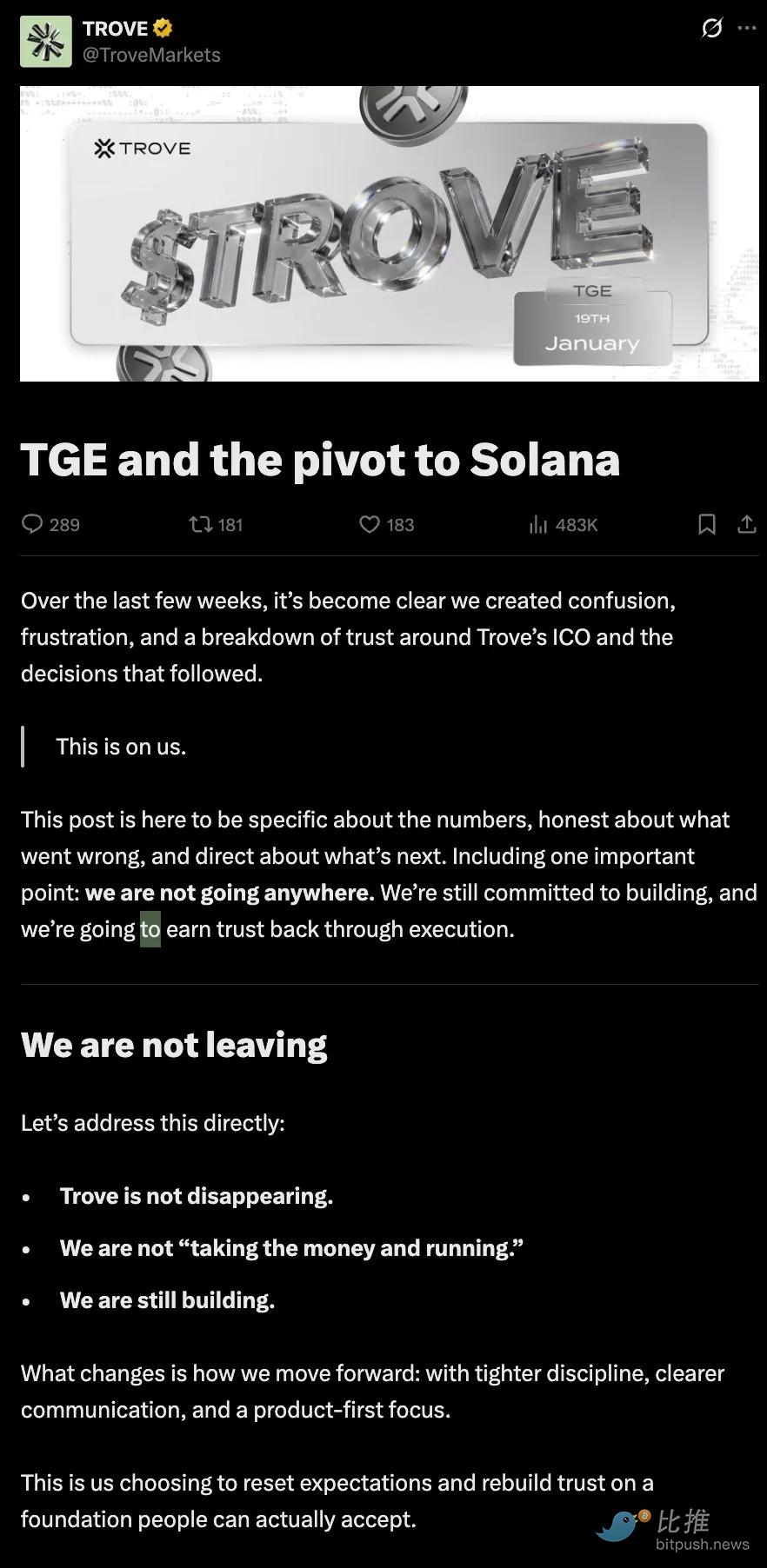
The team insisted that the project remained focused on building, albeit with a changed approach.

Even without making any assumptions, one thing is crystal clear: it is hard to imagine that they were not framed in an unfair, retroactive manner. The funds were initially committed based on one ecosystem, one technical path, and one set of implied risk profiles. The modified plan now requires them to accept another set of assumptions without reopening the participation terms.

It is like changing the rules for one player alone after a game has started.

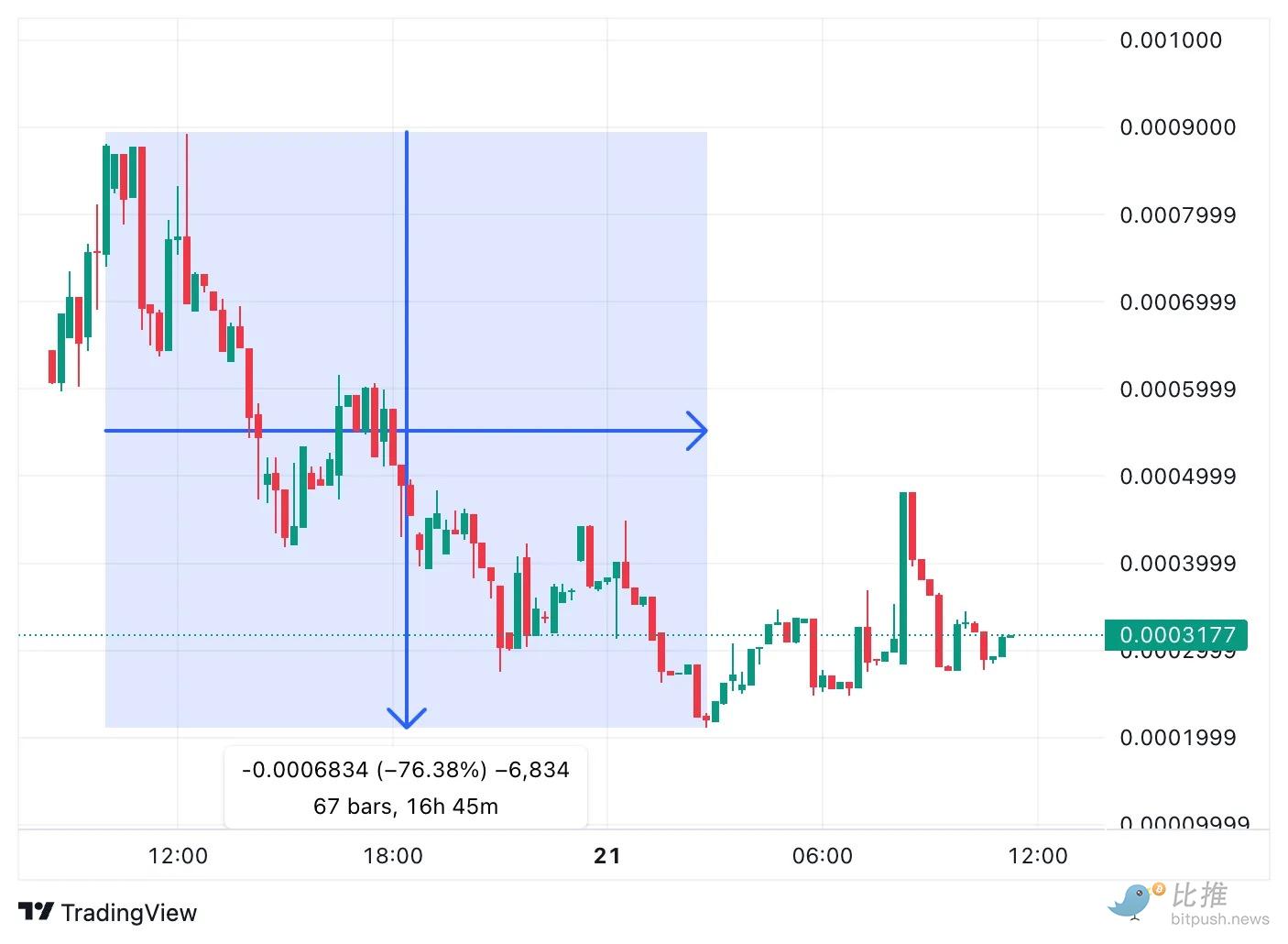
But by then, the damage was done, and the market voted with its feet, punishing this collapse of trust. The TROVE token plummeted over 75% within 24 hours of its listing, with its market capitalization expectations nearly zeroed out.
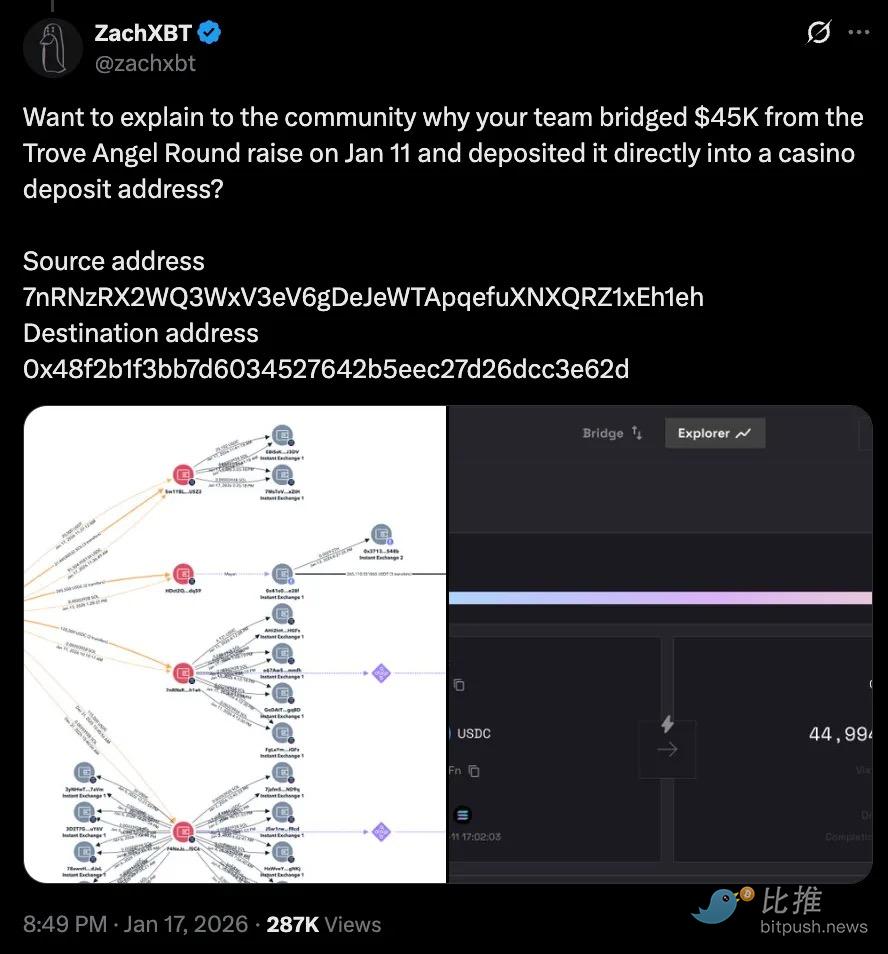
In the community, some moved beyond gut feelings and delved into on-chain fund movements. Crypto detective ZachXBT pointed out several suspicious transactions: approximately $45,000 in USDC from angel round funds eventually flowed into a prediction market platform and even to an address associated with a casino.
Whether this was a careless accounting error, poor fund management, or a genuine red flag remains debatable. Many users criticized the refund process, noting that only a few deserving refund recipients received their payments promptly.

Amid all this, Trove's statements failed to reassure investors who felt betrayed. Although it emphasized that the project would continue—a perpetual exchange on Solana—it did not adequately address the economic concerns arising from the pivot. It provided no detailed breakdown of the modified fund deployment and governance plan, nor did it offer more clarity on the refund roadmap.

Although there is no conclusive evidence linking this pivot to team misconduct, the incident shows that once trust in the fundraising process erodes, every data point is more likely to be viewed with suspicion.

What made this turmoil even more unstable was the way the team handled its discretion after the fundraising concluded.

Oversubscription effectively handed control of both capital and voice to the project team. Once the team changed direction, supporters had little recourse beyond selling on the secondary market or exerting public pressure.

To some extent, Trove's ICO still shares similarities with many projects from past cycles. Although the mechanisms are more standardized and the infrastructure more mature today, the core issue spanning both old and new cycles remains trust—investors still have to rely on the team's judgment rather than a clear set of rules as a backbone.

The Ranger ICO, conducted a few days earlier, provides an important contrast.

Ranger's token sale took place from January 6 to 10 on the MetaDAO platform, which requires teams to predefine key fundraising and allocation rules before the sale begins. Once started, these rules cannot be modified by the team.

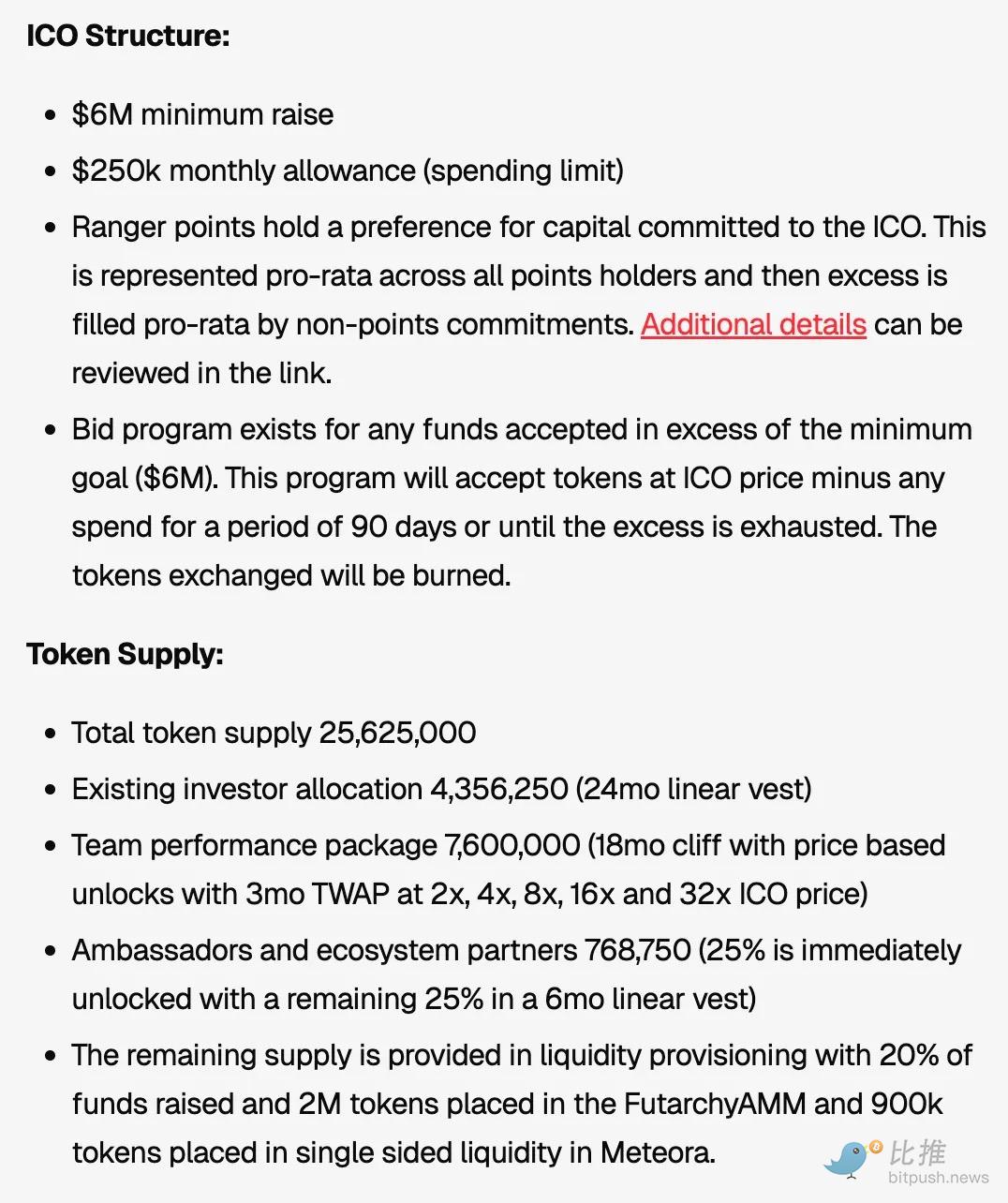
Ranger sought a minimum fundraising target of $6 million and sold approximately 39% of its total token supply through the public sale. Similar to Trove, its sale was oversubscribed. But MetaDAO's constraints meant the team had anticipated the possibility of oversubscription and made arrangements from the outset, unlike Trove's situation.

When the sale was oversubscribed, the proceeds were deposited into a treasury governed by token holders. MetaDAO's rules also restricted the team's access to the treasury to a fixed monthly allowance of $250,000.

Even the allocation structure was defined more clearly. Public sale participants received full liquidity at the token generation event, while presale investors faced a 24-month linear unlock period. The majority of tokens allocated to the team would only unlock upon reaching specific price milestones for the RNGR token. These milestones, such as reaching 2x, 4x, 8x, 16x, and 32x of the ICO price, would be measured using a three-month time-weighted average price, with at least an 18-month lock-up period before any unlocking occurs.

These measures show that the team embedded constraints into the fundraising structure itself, rather than expecting contributors to rely on post-fundraising discretion. Control over capital was partially ceded to governance rules, and any team gains were tied to long-term market performance, protecting contributors from the risk of a "rug pull" on launch day.
Nevertheless, concerns about fairness persist.

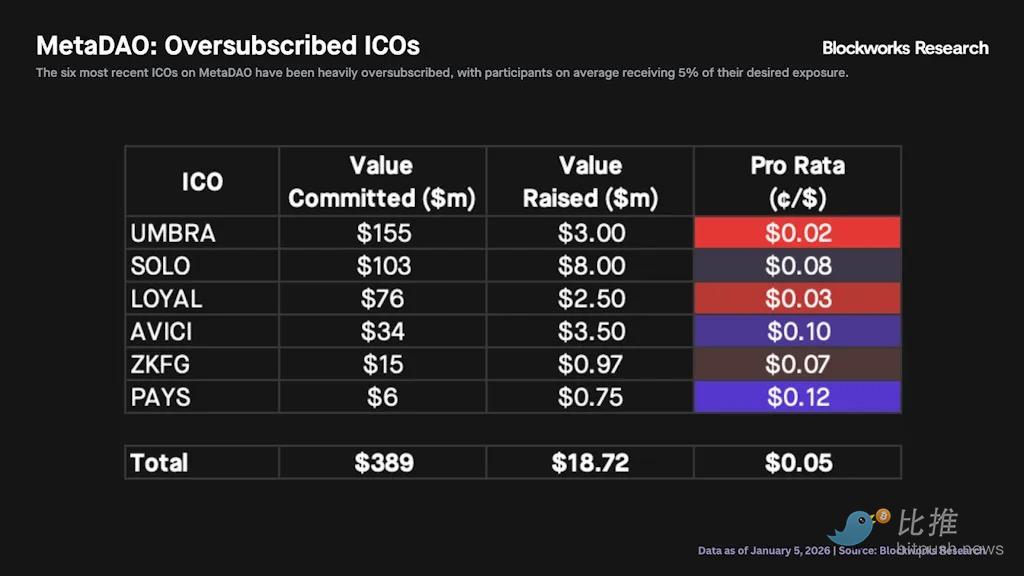
Like many modern ICOs, Ranger used a pro-rata allocation model to distribute tokens in its oversubscribed sale. In theory, this means everyone should receive tokens in proportion to their capital commitment. However, Blockworks Research pointed out that this model often favors participants who can over-commit capital. Smaller contributors typically receive disproportionately small allocations.
However, there is no simple solution to this problem.

Ranger attempted to address this by reserving separate token allocation pools specifically for users who had participated in the ecosystem before the public sale. While this practice alleviated some矛盾, it did not completely resolve a fundamental dilemma: how to balance allowing more people to obtain tokens with ensuring participants receive substantial shares.

Conclusion

The Trove and Ranger events show that nearly a decade after the initial explosion of ICOs, they are still subject to many constraints. The old ICO model heavily relied on Telegram announcements, narratives, and momentum.

The new model relies on structure—including unlock schedules, governance frameworks, treasury rules, and allocation formulas—to demonstrate restraint. These tools, often mandated by platforms like MetaDAO, help limit the discretionary power of launch teams. However, these tools can only reduce risks, not eliminate them entirely.

These events raise critical questions that every future ICO team needs to answer: "Who decides when a team can change plans?" "Who controls the funds after the fundraising is complete?" "What mechanisms do contributors have when expectations are not met?"

In any case, the issues that occurred in the Trove incident need to be corrected. Changing the chain on which a project launches cannot be a spur-of-the-moment decision. Here, the best way to remedy the damage is for Trove to treat its contributors properly. In this case, that might mean fully refunding the funds and re-conducting the sale under revised assumptions.

Although this is the most ideal path forward at the moment, it is not easy for Trove to actually achieve this. Funds may have already been deployed, operational costs may have been incurred, and partial refunds may have already been executed. Reversing course at this point could trigger multiple legal, procedural, and reputational complexities. But this is the price that must be paid to clean up the current mess.

How Trove chooses to proceed may set a precedent for ICOs in the year to come. Project launches now face a more cautious market environment—participants no longer equate oversubscription simply with consensus, nor do they confuse "being involved" with "being protected." Only a truly robust system can provide a fundraising experience that, while not foolproof, is trustworthy enough.


Twitter: https://twitter.com/BitpushNewsCN

Bitpush TG Discussion Group: https://t.me/BitPushCommunity

Bitpush TG Subscription: https://t.me/bitpush

Original link: https://www.bitpush.news/articles/7604888

Связанные с этим вопросы

QWhat was the main reason Trove's ICO caused a loss of investor trust?

ATrove abruptly changed its plan to launch on Solana instead of the originally promised Hyperliquid ecosystem after fundraising, without reopening participation terms or properly addressing economic concerns.

QHow did the market react to Trove's token after its launch?

AThe TROVE token plummeted over 75% within 24 hours of its launch, with its market capitalization expectations nearly collapsing to zero.

QWhat key difference in structure did Ranger's ICO have compared to Trove's?

ARanger's ICO used the MetaDAO platform, which enforced predefined fundraising and allocation rules that could not be modified by the team after the sale began, including governance-controlled treasury access and milestone-based token unlocks.

QWhat suspicious activity did crypto investigator ZachXBT uncover related to Trove's funds?

AZachXBT identified suspicious transactions where approximately $45,000 USDC from angel round funds flowed into a prediction market platform and even to a casino-linked address.

QWhat fundamental issue do modern ICOs still face despite improved infrastructure and mechanisms?

AModern ICOs still fundamentally rely on trust in the team's judgment rather than solely on clear, enforceable rules, and they struggle with balancing broad token distribution against meaningful allocations for participants.

Похожее

Only a 50% Chance of Passing This Year, Can the CLARITY Bill Succeed Before the Midterm Elections?

The CLARITY Act, which passed the House in July 2025 with strong bipartisan support (294-134), faces a critical juncture in the Senate. The Senate Banking Committee is expected to hold a markup soon, but key issues remain unresolved, including stablecoin yield provisions, DeFi regulations, and securing full Republican committee support. Other contentious points involve the Blockchain Regulatory Certainty Act (BRCA), ethics amendments for government officials, and SEC-related matters. The legislative calendar is tight, with limited time before the midterm elections. If the committee markup is delayed beyond mid-May, the chances of passage in 2026 drop significantly. Senator Cynthia Lummis has warned that failure this year could delay comprehensive crypto market structure legislation until 2030 or later. Galaxy estimates the probability of the CLARITY Act becoming law in 2026 is only about 50%. The bill provides crucial regulatory clarity by defining jurisdictional boundaries between the SEC and CFTC, establishing a path for decentralization, and bringing digital commodity intermediaries under federal regulation. Its passage is seen as vital before potential power shifts in the next Congress, which could bring less favorable leadership to key committees. The timeline is compressed, and the bill must compete for floor time with other priorities like Iran authorization and DHS appropriations. Key hurdles include finalizing the stablecoin yield compromise text, addressing law enforcement concerns about BRCA, and navigating political dynamics around SEC nominations. The outcome of the Banking Committee markup and the level of bipartisan support will be critical indicators of its future success.

marsbit2 мин. назад

Only a 50% Chance of Passing This Year, Can the CLARITY Bill Succeed Before the Midterm Elections?

marsbit2 мин. назад

Dialogue with Xinhuo Chief Economist Fu Peng: Macro Bear Market Expected to End This Year, Prioritize Allocation to Value Assets

Fu Peng, Chief Economist at New Huo Group, discusses the integration of crypto assets into traditional finance, marking a shift from a speculative phase to institutionalization. He highlights the current era as the second major fusion of finance and technology, driven by AI, data, and computing power, with crypto assets becoming part of the FICC+C (Fixed Income, Currencies, Commodities + Crypto) framework. Regulatory clarity in the U.S., such as the GENIUS and Clarity Acts, has paved the way for institutional adoption by defining digital assets as financial instruments. Fu views RWA (Real World Assets) as a tool for asset tokenization rather than a standalone asset class, noting that financial innovation differs between Eastern and Western markets due to cultural approaches to risk and regulation. He emphasizes that stablecoins are essential for future finance, but Asian markets, including Hong Kong, will adopt them cautiously. Macro liquidity now significantly influences crypto markets, as institutional participation increases correlation with traditional assets. Fu suggests the macro-driven bear market may end by year-end, reducing the relevance of Bitcoin’s four-year cycle. For asset allocation, he recommends value-oriented AI stocks for stability, Bitcoin for moderate certainty, and Ethereum for higher volatility.

marsbit9 мин. назад

Dialogue with Xinhuo Chief Economist Fu Peng: Macro Bear Market Expected to End This Year, Prioritize Allocation to Value Assets

marsbit9 мин. назад

Only a 50% Chance of Passing This Year, Can the CLARITY Bill Succeed Before the Midterm Elections?

The CLARITY Act, which passed the U.S. House in July 2025 with strong bipartisan support (294-134), faces a critical juncture in the Senate. The Senate Banking Committee is expected to hold a markup soon, but key issues remain unresolved, including stablecoin yield provisions, DeFi regulations, and securing full Republican committee support. Additional challenges involve the Blockchain Regulatory Certainty Act (BRCA), ethics amendments for government officials, and SEC-related concerns. Galaxy estimates only a 50% chance of the bill becoming law in 2026. The tight legislative calendar, competing priorities like Iran military authorization and DHS appropriations, and the impending midterm elections create significant time pressure. If the bill is not passed before the new Congress convenes in 2027, comprehensive crypto market structure legislation could be delayed until 2030 or later, especially if leadership changes result in less favorable committee chairs. The act provides crucial regulatory clarity by defining the jurisdictional boundaries between the SEC and CFTC, establishing a path for decentralized networks to be classified as non-securities, and bringing digital commodity intermediaries under federal regulation. The outcome of ongoing Senate negotiations, particularly the release of revised text on stablecoin yields, will be a key indicator of its future prospects.

Odaily星球日报12 мин. назад

Only a 50% Chance of Passing This Year, Can the CLARITY Bill Succeed Before the Midterm Elections?

Odaily星球日报12 мин. назад

Four-Dimensional Resonance: Hong Kong Web3 Carnival Sub-Forum Co-Creates Blueprint for Global Financial New Infrastructure

The "Four-Dimensional Resonance: 2026 Global Financial New Infrastructure" forum, a core event of the Hong Kong Web3 Festival, was successfully held at the Hong Kong Convention and Exhibition Centre. Co-hosted by Web3Labs and DeShang Singularity Tech, with joint support from Bitroot, Injective, Microsoft, and Z Oracle, the event gathered policymakers, industry leaders, and investors to explore the integration and innovation of global financial infrastructure, focusing on RWA, AI, DeFi, and compliant payments. Policy speakers, including Hong Kong Legislative Council Member Mr. Wu Jiezhuang, South Korean National Assembly Member Mr. Min Byung-duk, and ACED Chairman Mr. Yun Seok-hun, emphasized the importance of cross-border regulatory collaboration and an open policy environment for fintech innovation. Web3Labs CEO Caspar and DeShang Singularity Tech CEO Chang Shuai highlighted Hong Kong’s role as a financial innovation center and the approaching "singularity moment" for global financial infrastructure. Technical insights were shared by MagnetX, Bitroot, Microsoft, and Injective on topics including AI Agent economies, the evolution of public blockchains, and AI’s transformative role in finance. Key partnerships and initiatives were launched: - GWDC 2026 Korea collaboration between Hong Kong and South Korea. - A strategic agreement between Web3Labs and Microsoft. - The launch of a public anti-fraud alliance by Z Oracle and partners. - The "Injective Rising Star" program to support AI and Web3 projects. Panel discussions delved into AI-driven smart payments, compliant cross-border transactions, and the fusion of RWA and DeFi. Participants agreed that integrating RWA with DeFi is crucial for the next stage of financial infrastructure, enabling a shift from physical to digital finance. The forum underscored Hong Kong’s pivotal role in advancing a globalized and sustainable Asian fintech ecosystem.

marsbit20 мин. назад

Four-Dimensional Resonance: Hong Kong Web3 Carnival Sub-Forum Co-Creates Blueprint for Global Financial New Infrastructure

marsbit20 мин. назад

Торговля

Спот
Фьючерсы
活动图片