From Airdrop Myth to King of Derivatives: A Look Back at Hyperliquid's 2025 Conquest

marsbitОпубликовано 2025-12-12Обновлено 2025-12-12

Введение

Reviewing crypto's growth in 2025, Hyperliquid stands out. It began the year with an epic airdrop and strong price performance, capturing attention. By year's end, it transformed into a top-four revenue-generating platform in crypto, earning over $650M and at one point capturing 70% of all perp trading volume. Its success was no accident. In Q1, it solidified its reputation by being first to list new assets like the TRUMP perp and launched HyperEVM, a smart contract layer. Q2 saw explosive growth: HYPE token surged 4x from April lows, and HyperEVM's TVL grew from $350M to $1.8B. The platform gained mainstream media coverage. In Q3, major wallets like Phantom and MetaMask integrated via Hyperliquid's builder codes, routing $158B in volume and earning partners nearly $50M. A high-profile stablecoin bid war was won by Native Markets, aligning with Hyperliquid's bootstrapped ethos. However, new competitors like Aster and Lighter emerged with aggressive airdrops. Q4 brought permissionless listings via HIP-3, enabling new markets like stock perps and yield-bearing collateral. Yet, HYPE fell nearly 50% from its September peak due to market conditions, a rare ADL event during a crash, and the start of team token unlocks. As perps go mainstream in 2026, Hyperliquid's true test begins. Its success came from building a superior product and ecosystem without shortcuts. Maintaining leadership will require doing it all over again in a crowded field.

Source: Bankless

Author: David Christopher

Original Title: Hyperliquid & The Year Perps Caught Fire

Compiled and Arranged by: BitpushNews

Looking back at the growth of the crypto industry in 2025, Hyperliquid is an unavoidable focal point.

The exchange ended 2024 with an epic airdrop and price performance, attracting a large number of crypto Twitter users to pay attention to the product once again.

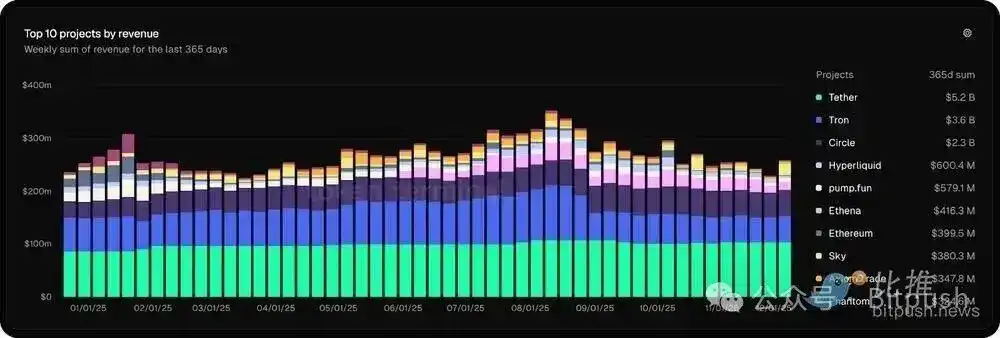
By the end of 2025, it had completely transformed—becoming a platform that broke the mold, ranking fourth in revenue across the entire crypto ecosystem with total revenue exceeding $650 million, and at one point capturing 70% of the perpetual futures trading volume.

If you haven't been tracking Hyperliquid's every step, this breakthrough success might seem to have come out of nowhere. But its path to conquest was the product of meticulous design, unconventional growth strategies, and well-deserved external recognition.

What follows is a complete review of Hyperliquid's journey in 2025 (and why it will be truly tested in 2026):

Q1 2025: The Crypto-Native Advantage

Hyperliquid's year of rapid growth began with a profound reminder of what it means to be "truly in tune with the industry's pulse."

When the TRUMP token launched in January, Hyperliquid listed perpetual futures for it almost immediately, beating other exchanges to the punch and starting a winning streak as the "go-to venue for pre-launch token trading."

Of course, its ability to act quickly was partly because it wasn't hindered by the "corporate guardrails" that large exchanges use to protect users and the company.

But a crucial factor was its firm "insider knowledge"—its team was so deeply intertwined with on-chain dynamics that it could spot opportunities and recognize the advantage of being first to list these tokens. This solidified Hyperliquid's reputation as the preferred place to trade new assets before the established giants could react.

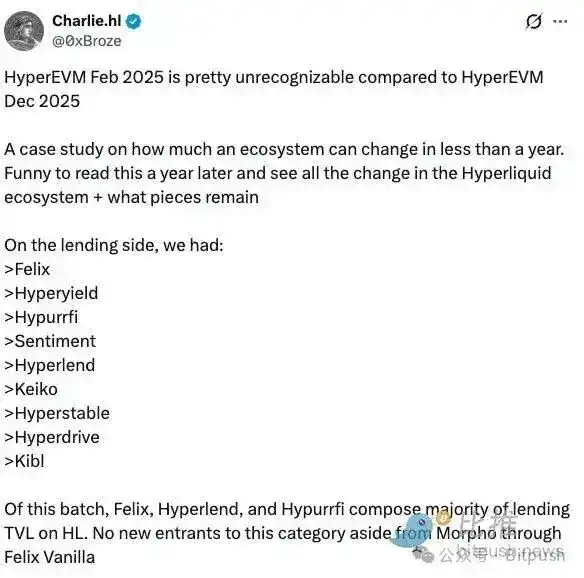
In February, HyperEVM was released—a general-purpose smart contract layer built on top of HyperCore (Hyperliquid's exchange engine). Although it took some time to find its footing, its success came without any top-down incentive programs. This meant that when it gained traction in Q2, it had already built a core user base who stayed not to "farm" rewards, but because they believed in the chain's vision and wanted to leverage its unique features (such as interoperability with HyperCore), rather than just extracting incentives.

Q2 2025: The Breakout

Market attention arrived faster than most expected. Beyond the HYPE token rising nearly 4x from its April lows, by May Hyperliquid captured 70% of all on-chain perpetual futures trading volume—a staggering figure for a platform with zero VC backing and zero token incentives.

The HYPE token's highs, the explosive growth of HyperCore activity, and the development of the HyperEVM ecosystem all spread the Hyperliquid story.

As the market came back to life, Hyperliquid's smooth user experience (UX) and deep liquidity captured a massive amount of order flow, with total trading volume climbing to $1.5 trillion.

As mentioned, HyperEVM also hit its stride simultaneously, with its Total Value Locked (TVL) growing from $350 million in April to $1.8 billion by mid-June, fueled by the launch of projects (like Kinetiq, Felix, and Liminal) and users exploring new earning opportunities—all while continuously burning HYPE tokens in the background.

Amid this rapid growth, Hyperliquid seemed to be everywhere.

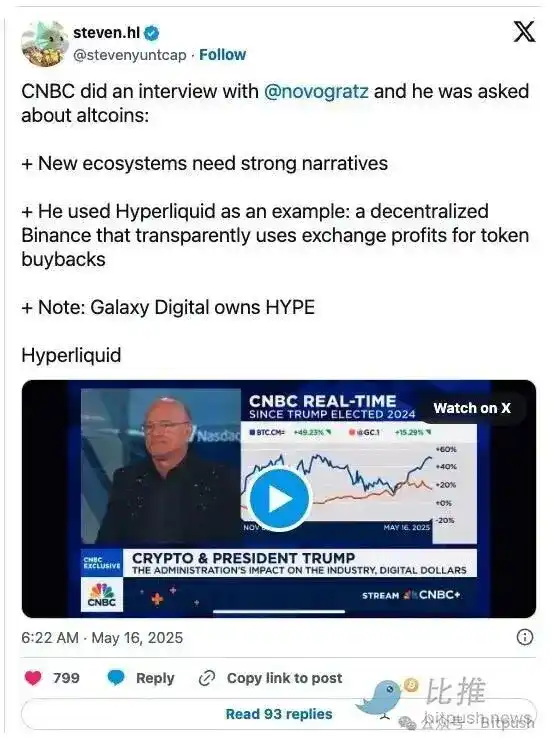
It appeared on national television, was covered by Bloomberg, and became a focal point in CFTC policy discussions. This exchange became impossible to ignore.

Q3 2025: Peak Momentum and the Beginning of Fragmentation

Q3 began with a signal that Hyperliquid's infrastructure was becoming indispensable even outside its own ecosystem.

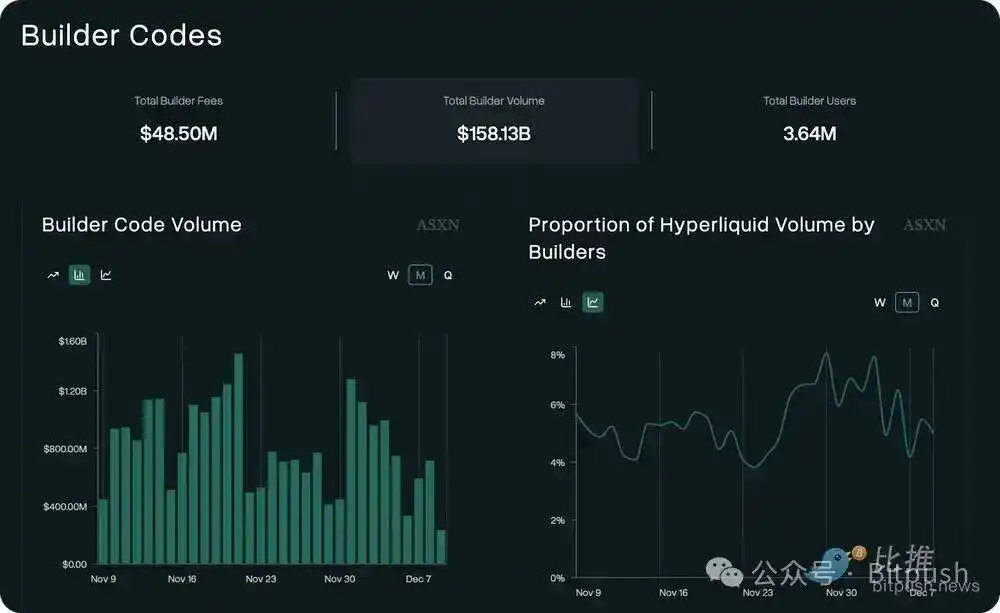
The Phantom wallet bypassed Solana-based perp platforms, choosing instead to integrate Hyperliquid via builder codes. Builder codes are a Hyperliquid mechanism that allows external platforms to earn fees by routing trades to HyperCore.

Rabby followed shortly after. Then MetaMask.

A host of mobile trading apps went live via builder codes.

All told, "partners" have earned nearly $50 million in fees through these integrations, routing $158 billion in trading volume.

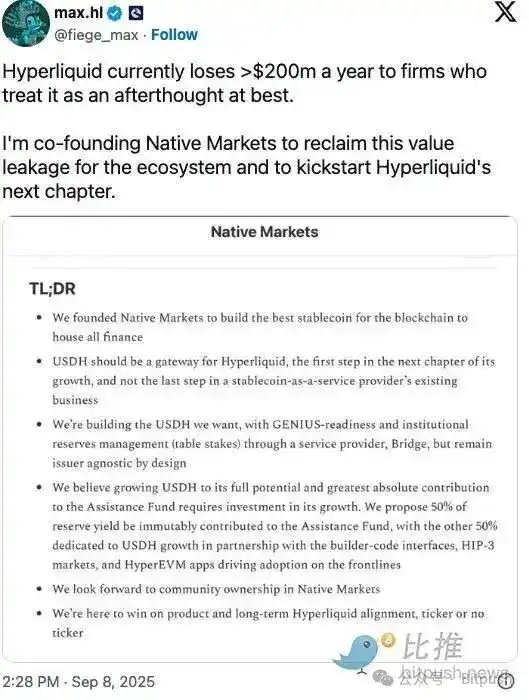
Then, in September, the USDH bidding war erupted—which showed just how valuable and prominent Hyperliquid had become.

The problem was simple: Hyperliquid held about 8% of the total Circle USDC supply in its bridge, leaking roughly $100 million in annual yield to a direct competitor (Coinbase), while its own ecosystem couldn't recapture that value. Launching a native stablecoin could solve this, potentially redirecting $200 million in annual revenue back to Hyperliquid.

A proposal to launch a stablecoin was invited, and heavyweight contenders entered the bidding.

Ethena offered a $75 million growth commitment and institutional partnerships. Paxos dangled PayPal and Venmo integration, even getting PayPal to tweet about Hyperliquid.

But in the end, Native Markets won the bid—a team led by highly respected HYPE contributor Max Fiege, former Uniswap Labs COO MC Lader, and Paradigm researcher Anish Agnihotri.

Why did a smaller, less capitalized team beat these giants? Because they were more favored, more aligned with Hyperliquid's ethos: bootstrapped, aligned in goals, and ready to build something truly organic—just as Hyperliquid itself was built.

The ripple effects extended beyond Hyperliquid itself. MegaETH announced its own native stablecoin plans shortly after. Sui followed suit in November.

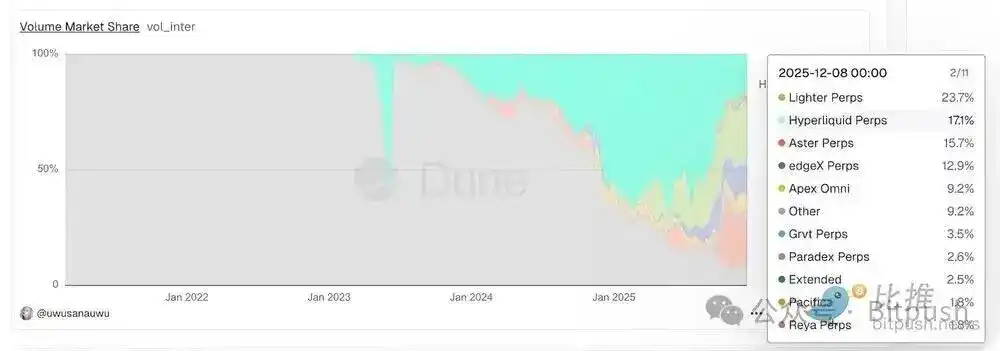
However, USDH also marked the peak of the HYPE token in mid-September—and the moment competition began to show. Aster (a Binance-backed exchange) and Lighter (an Ethereum L2 perp platform) both launched with aggressive airdrop campaigns. Trading volume continued to fragment, Hyperliquid's market share split, and at the time of writing stands at just 17.1%.

Q4 2025: Maturation and Growing Pains

In October, the long-awaited HIP-3 went live, opening permissionless listings on HyperCore, driving the exchange's expansion and decentralization.

Anyone staking 500,000 HYPE can now deploy custom markets, such as:

  • Equity perps from Unit's Trade.xyz and Felix Protocol
  • Perp markets using yield-bearing collateral (like sUSDE) from protocols like Ethena
  • Markets offering synthetic exposure to private companies like SpaceX or Anthropic through platforms like Ventuals

However, despite the HIP-3 launch, the HYPE token price fell nearly 50% from its September peak.

Why? Beyond market conditions and competition, two things stood out.

First, the quarter saw Hyperliquid experience its first ADL (Auto-Deleveraging) event in over two years. During the market crash on October 10th, over-leveraged positions burned through margin faster than the liquidation engine and HLP (Hyperliquid Liquidity Provider) could absorb. The protocol triggered over 40 auto-deleveragings in 12 minutes, forcibly reducing the most profitable positions to rebalance the books. While some argued the affected positions were still "closed in the green," others contended the mechanism liquidated more than was necessary to cover the bad debt. Yes, the system remained solvent without external capital, but Hyperliquid, like the broader market, might need time to recover from this event.

Second, in November, team token unlocks began. Although the total unlock was lower than some expected, this vesting schedule likely also contributed to HYPE's underperformance. The sell-off volume was small—only 23% went to OTC desks, while 40% was re-staked—but the pace of future unlocks remains unclear. My read is the core team is likely still determining the schedule to balance contributor fairness with ecosystem health. But for a protocol known for transparency and "honesty," this lack of clarity can create market unease.

Hyperliquid's first unlock released 1.75 million HYPE after the lock-up period ended, but the pace of future team unlocks has not been fully disclosed.

The Proving Ground for Perpetuals

Despite the cooldown in markets and trading activity, we shouldn't overlook, when trying to understand Hype's underperformance, that the perp ecosystem has evolved profoundly alongside Hyperliquid's own development.

Lighter and Aster are just two examples of on-chain competition. While their volumes might be inflated by airdrop farming, they do offer real alternatives.

In the off-chain realm, Coinbase's perp product will soon compete with Robinhood's moves in the space. As perps continue going mainstream, more competitors will emerge.

In other words, Hyperliquid is in its proving ground, and it will continue into 2026.

The question isn't whether it had a remarkable 2025—it did. The question is whether, as the space gets crowded, the exchange can prove that its path to growth—through integrations like builder codes and decentralized models like HIP-3—remains an advantage.

What got them here was building a better product and a better ecosystem, without taking shortcuts. What keeps them ahead will be doing it all over again.

Связанные с этим вопросы

QWhat were the key factors behind Hyperliquid's rapid growth and success in 2025?

AHyperliquid's success was driven by its crypto-native agility in quickly listing new assets like TRUMP tokens, the launch of HyperEVM which built an organic user base, superior user experience and deep liquidity capturing significant trading volume, and strategic integrations via builder codes with major wallets like Phantom and MetaMask.

QHow did Hyperliquid's market share in perpetual trading change throughout 2025?

AHyperliquid reached a peak of 70% market share in on-chain perpetual trading volume by May 2025. However, due to increased competition from platforms like Aster and Lighter with aggressive airdrop campaigns, its market share declined to 17.1% by the end of the year.

QWhat was the significance of the USDH bidding war and who won it?

AThe USDH bidding war was significant because issuing a native stablecoin would allow Hyperliquid to recapture an estimated $200 million in annual revenue that was leaking to competitors. Native Markets, a team led by respected HYPE contributors, won the bid over larger players like Ethena and Paxos due to their alignment with Hyperliquid's bootstrap philosophy.

QWhat was HIP-3 and what impact did it have on the Hyperliquid ecosystem?

AHIP-3 was a proposal that enabled permissionless listing on HyperCore, allowing anyone staking 500,000 HYPE to deploy custom markets. This led to the expansion of the exchange with new offerings like stock perps, yield-bearing collateral markets, and synthetic exposure to private companies, furthering its decentralization.

QWhat challenges did Hyperliquid face in Q4 2025 that contributed to the decline in HYPE token price?

AThe HYPE token price declined nearly 50% from its September peak due to a combination of factors: increased competition, a market-wide ADL (Auto-Deleveraging) event that shook confidence, and the beginning of team token unlocks which created uncertainty about future sell pressure, despite the actual initial sell-off being relatively small.

Похожее

Google CEO Admits Lagging Behind in Coding

Google CEO Sundar Pichai acknowledged in a recent interview that Google's Gemini AI models are currently "lagging behind" in coding capabilities, particularly for complex, long-horizon tasks requiring advanced developer expertise. He noted the field is advancing at an "unprecedented" pace, where 30-60 days now brings changes equivalent to five years in the past. Pichai expressed that achieving Artificial General Intelligence (AGI) now seems closer than previously imagined due to rapid progress. While highlighting strengths in text, multimodal, and reasoning tasks, Pichai admitted competitors like Anthropic and OpenAI have focused more intently on coding. He emphasized Google's commitment to catching up, citing internal tools like Antigravity 2.0 and the newly released Gemini 3.5 Flash, which aims to address previous shortcomings. Regarding Google Search's AI-driven overhaul, Pichai stated changes will be gradual to align with user needs, not disrupt the core search experience or its advertising model. He addressed public AI anxiety as understandable, given the technology's potential to reshape jobs and society, but remained optimistic about AI augmenting human capabilities and creating new opportunities. Pichai stressed the need for broad societal dialogue and responsible development as AI approaches more advanced, potentially recursive self-improvement stages. He affirmed Google's long-term commitment to leading in AI while navigating its profound implications responsibly.

marsbit1 ч. назад

Google CEO Admits Lagging Behind in Coding

marsbit1 ч. назад

The Paradox of Automation: The Stronger the AI, the Busier Humans Become

The Paradox of Automation: The more powerful AI becomes, the more work humans have to do. This article, based on observations from AI-heavy company Every, argues that while AI agents automate tasks like coding, writing, and customer service, they don't eliminate human jobs. Instead, they transform work and create *more* demand for human expertise. AI commoditizes "yesterday's human capabilities" by cheaply generating code, text, and images from past data. This leads to an abundance of similar, generic outputs. Consequently, what becomes scarce and valuable is human judgment in the present moment: knowing *what* is worth doing, *why*, and *how* to do it well. The article identifies two collaboration models: "Agent employees" for delegated tasks and "human-AI collaboration" within tools like Claude Code for complex work. In both cases, humans are essential to set direction, judge quality, and maintain systems. As AI makes execution cheap, human roles shift from executors to designers, reviewers, and meaning-makers. The author addresses "benchmark anxiety" by explaining that AI excels within specific, human-defined problem "frames." As AI masters one frame (e.g., code rewriting), new, more complex frames emerge (e.g., deciding *when* to rewrite). This creates an ongoing cycle where AI chases the frames, but humans remain the "framers." Even with advanced AGI, this dynamic may persist as long as AI lacks true human-like agency and self-directed purpose. The core paradox holds: automation amplifies the need for the very human judgment it seems to replace.

marsbit2 ч. назад

The Paradox of Automation: The Stronger the AI, the Busier Humans Become

marsbit2 ч. назад

a16z: 7 Charts to Understand How Tokenization is Changing the Nature of Assets

"a16z: 7 Charts on How Tokenization is Changing the Nature of Assets" Tokenized Assets (or Real-World Assets - RWA) are transforming asset forms, liquidity, and financial system construction. The market recently surpassed $30 billion, stabilizing around $34 billion (excluding stablecoins), representing a tenfold increase in less than two years, driven by clearer regulations, mature institutional infrastructure, and increased financial institution adoption. The primary driver of recent growth is tokenized U.S. Treasury bonds. These offer investors efficient, flexible digital access to yield-bearing assets and improve institutional operations like settlement and collateral management. Other asset classes show varied growth: asset-backed credit leads, followed by niche financial assets (e.g., reinsurance, mining notes), while venture capital took longer to scale. Market segmentation shows high concentration. In commodities, tokenized gold dominates (~$5 billion), as its standardized, storable nature fits tokenization well. Bonds are the largest category ($15.2B), but only ~5% are used in DeFi protocols. Conversely, smaller niches like reinsurance tokens see high (~84%) on-chain utilization, highlighting a core industry divide: most current tokenized assets are merely digitized records for easier holding/transfer, lacking the "composability" (free combination/interaction) that is key to blockchain-native finance. The ecosystem is distributed across multiple blockchains, with Ethereum hosting over half the value ($15.7B), followed by BNB Chain, Solana, and others. Future market size predictions vary widely (e.g., $2-$30 trillion by 2030+), but all indicate massive potential from the current small base. Tokenized assets currently represent minuscule fractions of their global counterparts (e.g., 0.01% of global bonds). The current phase focuses on digitizing straightforward assets. The next challenge is to bring more complex financial components on-chain and deeply integrate tokenized assets into composable, internet-native financial infrastructure.

链捕手3 ч. назад

a16z: 7 Charts to Understand How Tokenization is Changing the Nature of Assets

链捕手3 ч. назад

a16z: How Tokenization is Transforming the Nature of Assets in 7 Charts

"Tokenized Assets: How Tokenization Changes the Nature of Assets" by a16z Crypto The market for tokenized assets, excluding stablecoins, has grown from under $3 billion two years ago to over $340 billion today. US Treasury bonds are the primary growth driver, allowing investors to hold yield-bearing assets digitally and enabling more efficient settlement. Other key sectors include private credit (growing fastest), commodities (dominated by gold), and niche financial assets. However, the market remains concentrated in tokenized US Treasuries and gold. A critical insight is that most tokenized assets currently lack "composability." While the total market is large, only a small fraction is actively used within DeFi protocols. For instance, only about 5% of tokenized bonds and a low percentage of tokenized gold are utilized on-chain. In contrast, assets like reinsurance and private credit tokens show much higher on-chain usage rates (84% and 33%, respectively). This highlights a divide: many tokenized assets are merely digital records on a blockchain without enabling new, programmable financial applications. The Pantera Capital Token Native Index indicates over 70% of tokenized assets have minimal on-chain native functionality. Ethereum remains the dominant blockchain for tokenized assets (over $150B), but the ecosystem is diversifying across chains like BNB Chain, Solana, and Stellar, based on factors like cost and compliance. Major institutions forecast massive future growth, with predictions for the tokenized asset market ranging from $2 trillion to over $30 trillion by the early 2030s. However, compared to the global financial system (e.g., ~$140T bonds, multi-trillion dollar gold market), tokenized assets currently represent a tiny fraction (0.01% or less). The conclusion is that while tokenization has begun by digitizing and streamlining settlement for simpler assets, the next phase involves bringing more complex financial instruments on-chain and deeply integrating them into composable, internet-native financial infrastructure.

Odaily星球日报3 ч. назад

a16z: How Tokenization is Transforming the Nature of Assets in 7 Charts

Odaily星球日报3 ч. назад

The Revived Codex, Carrying OpenAI's Hopes for IPO

This article analyzes the intense recent development of OpenAI's Codex, positioning it as a crucial component for OpenAI's impending IPO. Over the past two months, Codex has seen a rapid series of major updates focused on integrating into real enterprise workflows. Key new features include enhanced context capture (Appshots, file previews, built-in browser), long-running task execution ("Goal Mode"), remote operation (phone control, lock-screen access), and enterprise management tools (plugin sharing, access tokens, automated risk review). These updates aim to make Codex a comprehensive AI workbench that can "see the scene, push tasks, and manage risks." The author argues that while ChatGPT proves OpenAI's massive user base and API provides foundational revenue, Codex represents OpenAI's clearest path to demonstrating tangible, high-value commercial viability. It targets developers and engineering teams—a segment already accustomed to paying for efficiency gains in costly software development cycles. This is critical because, despite higher overall revenue, OpenAI's adjusted operating margins remain deeply negative, highlighting the challenge of outrunning immense compute costs. The pressure is amplified by competitor Anthropic's success with Claude Code, which has shown that a focused approach on high-value enterprise and developer workflows can lead to a path toward profitability. Codex's aggressive evolution is thus seen as OpenAI's strategic move to capture a similar enterprise-ready, revenue-generating narrative essential for its market debut. In essence, "ChatGPT proved OpenAI has users. Codex needs to prove OpenAI is a business that can make money."

marsbit4 ч. назад

The Revived Codex, Carrying OpenAI's Hopes for IPO

marsbit4 ч. назад

Торговля

Спот
Фьючерсы

Популярные статьи

Как купить S

Добро пожаловать на HTX.com! Мы сделали приобретение Sonic (S) простым и удобным. Следуйте нашему пошаговому руководству и отправляйтесь в свое крипто-путешествие.Шаг 1: Создайте аккаунт на HTXИспользуйте свой адрес электронной почты или номер телефона, чтобы зарегистрироваться и бесплатно создать аккаунт на HTX. Пройдите удобную регистрацию и откройте для себя весь функционал.Создать аккаунтШаг 2: Перейдите в Купить криптовалюту и выберите свой способ оплатыКредитная/Дебетовая Карта: Используйте свою карту Visa или Mastercard для мгновенной покупки Sonic (S).Баланс: Используйте средства с баланса вашего аккаунта HTX для простой торговли.Третьи Лица: Мы добавили популярные способы оплаты, такие как Google Pay и Apple Pay, для повышения удобства.P2P: Торгуйте напрямую с другими пользователями на HTX.Внебиржевая Торговля (OTC): Мы предлагаем индивидуальные услуги и конкурентоспособные обменные курсы для трейдеров.Шаг 3: Хранение Sonic (S)После приобретения вами Sonic (S) храните их в своем аккаунте на HTX. В качестве альтернативы вы можете отправить их куда-либо с помощью перевода в блокчейне или использовать для торговли с другими криптовалютами.Шаг 4: Торговля Sonic (S)С легкостью торгуйте Sonic (S) на спотовом рынке HTX. Просто зайдите в свой аккаунт, выберите торговую пару, совершайте сделки и следите за ними в режиме реального времени. Мы предлагаем удобный интерфейс как для начинающих, так и для опытных трейдеров.

1.3k просмотров всегоОпубликовано 2025.01.15Обновлено 2025.03.21

Как купить S

Sonic: Обновления под руководством Андре Кронье – новая звезда Layer-1 на фоне спада рынка

Он решает проблемы масштабируемости, совместимости между блокчейнами и стимулов для разработчиков с помощью технологических инноваций.

2.3k просмотров всегоОпубликовано 2025.04.09Обновлено 2025.04.09

Sonic: Обновления под руководством Андре Кронье – новая звезда Layer-1 на фоне спада рынка

HTX Learn: Пройдите обучение по "Sonic" и разделите 1000 USDT

HTX Learn — ваш проводник в мир перспективных проектов, и мы запускаем специальное мероприятие "Учитесь и Зарабатывайте", посвящённое этим проектам. Наше новое направление .

1.8k просмотров всегоОпубликовано 2025.04.10Обновлено 2025.04.10

HTX Learn: Пройдите обучение по "Sonic" и разделите 1000 USDT

Обсуждения

Добро пожаловать в Сообщество HTX. Здесь вы сможете быть в курсе последних новостей о развитии платформы и получить доступ к профессиональной аналитической информации о рынке. Мнения пользователей о цене на S (S) представлены ниже.

活动图片