fj

ccn.comОпубликовано 2026-01-20Обновлено 2026-01-20

Введение

Silver surged roughly 165% in 2025 and continues to hit record highs in early 2026, driven by industrial demand from green energy and electronics sectors. Bitcoin critic Peter Schiff warns that Bitcoin is poised for a catastrophic collapse mirroring silver’s rally—but in reverse. He argues Bitcoin lacks intrinsic value and is driven by speculation, unlike silver which has tangible utility. Crypto supporters dismiss his warning, citing Schiff’s long history of failed Bitcoin predictions. While silver benefits from supply shortages and real-world demand, Bitcoin faces macro pressures and has struggled to sustain breakouts despite brief rallies. The debate between traditional asset advocates and crypto believers continues amid market uncertainty.

Key Takeaways

  • Silver surged roughly 165% in 2025, driven by industrial shortages and soaring demand.
  • Peter Schiff argues Bitcoin will mirror silver’s rally—but in reverse, with a sharp collapse.
  • Crypto supporters dismiss the warning, pointing to Schiff’s long record of failed Bitcoin predictions.

As silver continues to print record highs, longtime gold advocate and Bitcoin critic Peter Schiff is once again sounding the alarm.

This time, he is warning that BTC is headed for a collapse that will mirror silver’s rise, only in reverse.

Try Our Recommended Crypto Exchanges
Sponsored
Disclosure
We sometimes use affiliate links in our content, when clicking on those we might receive a commission at no extra cost to you. By using this website you agree to our terms and conditions and privacy policy.
"}' data-trk="67adf8d4f12aaec7e4808bf5" href="https://links.ccn.com/links?code=693291aa4a5bcb62319448b2" rel="nofollow" target="_blank">
Bitget<\/h3>"}' data-trk="67adf8d4f12aaec7e4808bf5" href="https://links.ccn.com/links?code=693291aa4a5bcb62319448b2" rel="nofollow" target="_blank">

Bitget

promotions
New user rewards up to 6,200 USDT.<\/strong>"}' data-trk="67adf8d4f12aaec7e4808bf5" href="https://links.ccn.com/links?code=693291aa4a5bcb62319448b2" rel="nofollow" target="_blank"> New user rewards up to 6,200 USDT.
Coins
88
Claim Offer
"}' data-trk="6899b9831836d97539c51aa6" href="https://links.ccn.com/links?code=693293fa4a5bcb6231949c97" rel="nofollow" target="_blank">
Bitunix<\/h3>"}' data-trk="6899b9831836d97539c51aa6" href="https://links.ccn.com/links?code=693293fa4a5bcb6231949c97" rel="nofollow" target="_blank">

Bitunix

promotions
Receive up to $100,000 worth of exclusive gifts for newcomers upon registration.<\/strong>"}' data-trk="6899b9831836d97539c51aa6" href="https://links.ccn.com/links?code=693293fa4a5bcb6231949c97" rel="nofollow" target="_blank"> Receive up to $100,000 worth of exclusive gifts for newcomers upon registration.
Coins
151
Claim Offer
"}' data-trk="68f8c175c334f42ea614a1a4" href="https://links.ccn.com/links?code=693294144a5bcb623194a054" rel="nofollow" target="_blank">
BTCC<\/h3>"}' data-trk="68f8c175c334f42ea614a1a4" href="https://links.ccn.com/links?code=693294144a5bcb623194a054" rel="nofollow" target="_blank">

BTCC

promotions
Get up to 10,055 USDT when you register, verify, and make the first deposit and the first trades.<\/strong>"}' data-trk="68f8c175c334f42ea614a1a4" href="https://links.ccn.com/links?code=693294144a5bcb623194a054" rel="nofollow" target="_blank"> Get up to 10,055 USDT when you register, verify, and make the first deposit and the first trades.
Coins
162
Claim Offer
Explore All Offers

Schiff Sounds the Alarm as Silver Soars

Silver climbed above $94 on Jan. 19, extending a surge that has reshaped the precious metals market over the past year.

Since late 2024, the metal has posted new highs with striking frequency, fueled by tight supply and growing industrial demand.

The rally has been dramatic. Silver rose about 165% in 2025 and is already up roughly 30% in the first three weeks of 2026 alone, adding an estimated $1.2 trillion in market value.

Schiff seized on the milestone to deliver another stark warning for Bitcoin holders.

“What’s happening with silver is about to happen with Bitcoin, only in reverse,” Schiff wrote on X . “Silver’s spectacular rise will usher in Bitcoin’s catastrophic collapse. Don’t say I didn’t warn you.”

The comment immediately reignited debate between traditional asset proponents and crypto supporters, a familiar battleground for Schiff, who has spent years criticizing Bitcoin as fundamentally worthless.

Why Silver Is Surging—and Bitcoin Isn’t

Silver’s rally has been driven less by speculation and more by real-world demand pressures.

The metal plays a critical role in solar panels, electric vehicles, and advanced electronics, sectors that have expanded rapidly as governments and corporations invest heavily in green energy and AI infrastructure.

Demand from data centers and semiconductor manufacturing has further strained supply, creating persistent deficits that have pushed prices higher.

Bitcoin, by contrast, has struggled to match silver’s momentum.

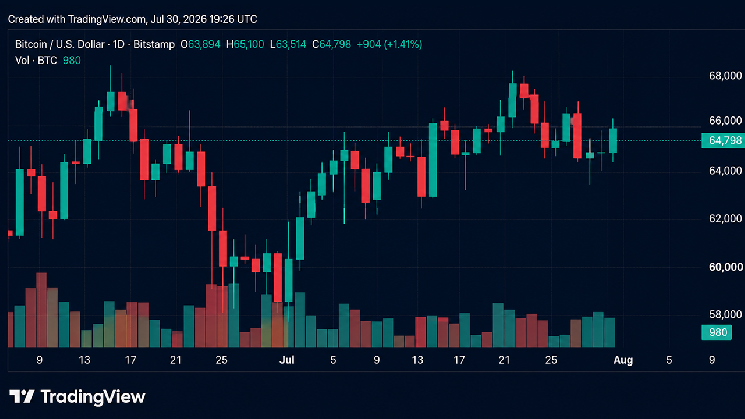
Despite a brief rally earlier this month that pushed BTC above $97,000, the asset has failed to sustain a breakout.

Broader market uncertainty, including renewed trade tensions sparked by President Donald Trump’s tariff threats, has kept risk assets under pressure.

While Bitcoin continues to attract institutional interest through ETFs and ongoing legislative efforts in Washington.

Its growing correlation with equities has limited upside during periods of macro stress.

A Familiar Warning From a Familiar Critic

Schiff’s bearish stance on Bitcoin is hardly new.

Over the years, he has repeatedly predicted BTC’s collapse—by some counts more than a dozen times—often urging investors to abandon the digital asset in favor of gold and silver miners.

Many of those calls have aged poorly. Bitcoin has gone on to set multiple all-time highs despite Schiff’s warnings, including repeatedly approaching levels he once said it would never reach.

Still, Schiff remains consistent in his core argument. He believes Bitcoin lacks intrinsic value, especially when compared to commodities like silver, which have clear industrial uses.

In his view, Bitcoin’s price is driven by hype and speculative excess rather than utility, making it vulnerable to a rapid unwind.

He has likened Bitcoin’s rise to historical bubbles, arguing that when sentiment turns, the downside will be swift and unforgiving.

Is Bitcoin Facing a Bigger Test?

Bitcoin now sits in a complex phase of its post-halving cycle. Historically, the year following a halving has delivered strong gains, but the current cycle has looked less decisive.

Institutional inflows have softened at times, retail enthusiasm has cooled, and macro risks—from tariffs to geopolitical tensions—continue to weigh on sentiment.

Still, the market has yet to experience the kind of cascading collapse that defined past downturns, such as the ICO bust of 2017 or the FTX implosion in 2022.

The sharp sell-off on Oct. 10 rattled confidence, but the market recovered, reinforcing the view among many crypto proponents that Bitcoin has matured.

Reactions to Schiff’s latest warning reflect that divide.

Supporters of precious metals point to silver’s tangible utility and supply constraints as evidence of lasting value.

Bitcoin advocates, meanwhile, dismissed Schiff’s comments, mocking his track record and accusing him of applying double standards—calling silver pullbacks “buying opportunities” while framing any Bitcoin dip as proof of failure.

For now, silver continues its historic run, and Bitcoin remains range-bound. Whether Schiff’s latest prediction proves prescient or joins his long list of missed calls will depend on how markets digest the next wave of macro and regulatory developments.

One thing is certain: the long-running clash between hard-money traditionalists and crypto believers is far from over.

=

BTC community mocks Peter Schiff’s failed Bitcoin prediction. Credit: X

Top Picks for Bitcoin
  • Best Exchanges for Bitcoin Get A Great Offer When You Join These Exchanges
  • Buy Bitcoin Fast & Easy How To Buy Bitcoin With a Credit Card Now
  • Best Online Casinos for Bitcoin See Our Picks for the Best Crypto Gambling Sites

Связанные с этим вопросы

QWhat is the significant surge in silver's price in 2025 and what are the primary drivers behind it?

ASilver surged roughly 165% in 2025, driven by industrial shortages and soaring demand from sectors like solar panels, electric vehicles, and advanced electronics.

QWhat is Peter Schiff's prediction for Bitcoin in relation to silver's recent performance?

APeter Schiff argues that Bitcoin will mirror silver's rally but in reverse, predicting a sharp collapse for Bitcoin as silver continues to rise.

QHow have crypto supporters typically responded to Peter Schiff's warnings about Bitcoin?

ACrypto supporters dismiss the warning, pointing to Schiff's long record of failed Bitcoin predictions and often mock his stance.

QWhat are the key fundamental differences cited between the price drivers of silver and Bitcoin?

ASilver's rally is driven by real-world industrial demand and supply constraints, while Bitcoin's price is seen by critics as driven more by speculation and hype, lacking the same intrinsic utility.

QWhat historical events are mentioned as examples of past Bitcoin downturns, and how does the current market phase compare?

APast downturns include the ICO bust of 2017 and the FTX implosion in 2022. The current phase is described as complex and less decisive post-halving, with macro risks weighing on sentiment, but without a cascading collapse so far.

Похожее

Near Returns to the AI Stage: Transformation into a Public Chain Due to 'Payroll Difficulties,' Agent and Privacy Emerge as New Growth Narratives

NEAR Returns to AI Origins: From Payroll Struggles to Blockchain, Now Focusing on AI Agents and Privacy NEAR Protocol's journey began not with grand blockchain ambitions, but from a practical hurdle: its AI startup founders, including Transformer paper co-author Illia Polosukhin, couldn't efficiently pay international developers in 2017. This led them to pivot and build a high-performance, scalable blockchain. After years navigating various crypto narratives like sharding and cross-chain interoperability, NEAR is now leveraging its AI roots to re-enter the AI arena. A key driver is its "NEAR Intents" layer, which abstracts complex cross-chain transactions. Users simply state their goal (e.g., swap BTC for ETH), and a solver network finds the optimal route. This system has processed over $20B in cross-chain volume, generating significant fee revenue. A major growth area is private transactions via "Confidential Intents/Swaps," which hide trade details until settlement to protect against MEV and front-running. Remarkably, private swaps recently accounted for over 40% of NEAR's transaction volume, highlighting strong demand but also potential regulatory scrutiny. With its AI-founder pedigree, NEAR is positioning itself at the intersection of blockchain, AI agents, and privacy, aiming to become infrastructure for the emerging agent economy while navigating the challenges of its rapid adoption.

marsbit1 ч. назад

Near Returns to the AI Stage: Transformation into a Public Chain Due to 'Payroll Difficulties,' Agent and Privacy Emerge as New Growth Narratives

marsbit1 ч. назад

From Ethereum to AI's 'CROPS': What Exactly is This Set of 'Slow Variables' That Vitalik Repeatedly Emphasizes?

In recent discussions, Vitalik Buterin has frequently emphasized the concept of "CROPS," a framework defining core values for Ethereum's development. CROPS stands for Censorship Resistance, Capture Resistance, Open Source, Privacy, and Security. Initially outlined in the Ethereum Foundation's "EF Mandate," it represents a commitment to user sovereignty, ensuring that the network resists external control, remains open, protects privacy, and prioritizes security. The relevance of CROPS extends beyond Ethereum's foundational principles, becoming crucial in the context of AI integration. As AI agents begin handling wallet operations and automated transactions, the risk increases that users may cede control over their digital assets, privacy, and intentions to centralized AI service providers. A "CROPS AI" would therefore emphasize local execution where possible, privacy-preserving remote model calls (e.g., using zero-knowledge proofs), and transparent, verifiable processes to maintain user agency. Vitalik highlights a significant convergence between "CROPS Ethereum access layer" and "CROPS AI." Both address the same fundamental challenge: how users can access powerful services—be it blockchain data via RPCs or AI models—without exposing sensitive information or relinquishing ultimate control. This intersection points toward a future digital entry point that is more private, secure, and user-controlled. Ultimately, CROPS is not merely an abstract ideal but a practical guidepost. It steers development—from protocol resilience and wallet design to AI agent safety—towards a future where users retain self-sovereignty even as digital systems grow more complex and powerful. In an era of accelerating AI adoption, these "slow variables" of censorship resistance, openness, privacy, and security may define Ethereum's enduring value.

marsbit1 ч. назад

From Ethereum to AI's 'CROPS': What Exactly is This Set of 'Slow Variables' That Vitalik Repeatedly Emphasizes?

marsbit1 ч. назад

Silicon Valley 'Startup Guru' Steve Hoffman: Web3 + AI Could Be a Trap

Silicon Valley investor and "Godfather of Startups" Steve Hoffman warns that combining Web3 with AI is likely a trap, not a promising venture. In an interview, Hoffman argues that while AI is a foundational technology touching all industries, Web3 adds complexity, friction, and regulatory risk without solving mainstream consumer or business needs. He advises founders to focus on deep, specialized applications where startups can out-iterate giants, rather than on generic features easily replicated by large tech companies. Hoffman observes that Silicon Valley will lead foundational AI research, while China excels at rapid, large-scale application and commercialization, particularly in robotics. He stresses that AI-driven autonomous agents capable of collaborative, multi-step tasks are 2-4 years away, which will cause significant job displacement. The solution is not to slow AI but to redesign business models around human-AI collaboration and reform social systems like education and retraining. For startups, Hoffman recommends focusing on vertical, expertise-heavy domains to build defensibility. He sees major opportunities in AI fraud detection and cybersecurity. Key founder mindsets include systemic thinking over feature-focus, relentless customer centricity, building adaptive teams, and deeply understanding AI's capabilities and limits. Hoffman is also leading a non-profit initiative to establish university centers aimed at training future leaders in responsible, human-value-aligned AI innovation.

marsbit2 ч. назад

Silicon Valley 'Startup Guru' Steve Hoffman: Web3 + AI Could Be a Trap

marsbit2 ч. назад

Token Inefficient, Economy Tokenless

The article "Tokens Aren't Economical, Economics Aren't Tokenized" analyzes a pivotal shift in the AI industry from a technology-driven narrative to one dominated by capital efficiency. It highlights two concurrent trends: a severe capital shortage due to the exorbitant and recurring costs of compute (e.g., OpenAI's high burn rate) and a wave of corporate spin-offs where major tech companies are separating their AI units (like Kuaishou's Kling and Baidu's Kunlunxin). The core argument is that AI's "anti-internet" business model, where user growth increases costs rather than profits, has created a disconnect between high valuations and actual cash flow. Spin-offs address this by allowing AI assets to be valued independently. Within a parent company, they are seen as cost centers, but as standalone entities, they are priced based on their growth potential and scarcity in the primary market, leading to massive valuation premiums (e.g., Kling's estimated value tripling post-spin-off). The industry is at an inflection point, moving from "model worship" to "value realization." The competition is evolving from a pure compute (GPU) race to a broader focus on systemic efficiency and full-stack engineering (involving CPUs and orchestration) to achieve viable commercialization. The year 2026 is framed as a critical moment where the industry must definitively answer how to economically translate AI capability into tangible business value, reshaping the sector's future power structure.

marsbit2 ч. назад

Token Inefficient, Economy Tokenless

marsbit2 ч. назад

Торговля

Спот
Фьючерсы
活动图片