Fed Candidates Warsh and Hassett: Who Is More Beneficial for Us?

marsbitОпубликовано 2025-12-16Обновлено 2025-12-16

Введение

Amidst inflation pressures and geopolitical uncertainty in 2025, the potential successors to the U.S. Federal Reserve Chair—Kevin Warsh and Kevin Hassett—present sharply contrasting policy approaches. Warsh, a former Fed governor with a hawkish stance, emphasizes financial stability, market discipline, and inflation control, advocating for cautious monetary tightening and reduced intervention risks. In contrast, Hassett, a former White House economic advisor and dovish figure, supports aggressive rate cuts, growth-oriented policies, and closer alignment with presidential agendas, potentially benefiting markets and cryptocurrencies. Market predictions show narrowing odds, with Warsh gaining traction post-Trump’s endorsement, though Hassett retains advantages due to his political ties. The selection will significantly influence long-term economic stability versus short-term growth, testing the Fed’s independence and global financial resilience.

Against the backdrop of inflation pressures, geopolitical uncertainties, and technological changes facing the U.S. economy in 2025, the successor to the Federal Reserve Chair position has drawn significant attention.‍‍‍‍‍‍‍‍‍‍‍‍‍‍‍‍‍‍‍‍‍‍‍‍‍‍‍‍‍‍‍

President Donald Trump recently stated that he is "leaning towards Warsh or Hassett," a remark that has triggered market volatility and widespread discussion.

Kevin Warsh, a former Federal Reserve Governor, is known for his hawkish stance and experience in responding to the financial crisis;


Kevin Hassett, a former White House economic advisor, is renowned for his dovish perspective and pro-growth policies.


Comparing their backgrounds, monetary policy thinking, potential impacts, and current online public sentiment, who has a greater chance of being elected?


Overview of the Two Candidates' Backgrounds


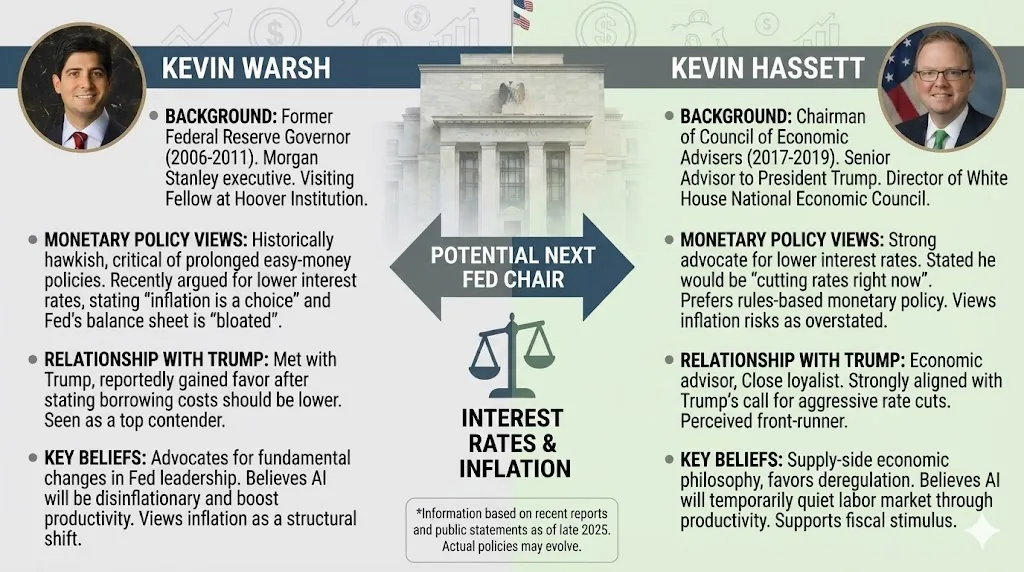
Kevin Warsh is an experienced financial policy expert, born in 1970, and a graduate of Stanford University and Harvard Law School. He worked as an investment banker at Morgan Stanley and served as Special Assistant to the President for Economic Policy during the George W. Bush administration. From 2006 to 2011, Warsh served as a Federal Reserve Governor, participating in the response to the global financial crisis, including the formulation of quantitative easing (QE) policies. Currently, he is a visiting scholar at the Hoover Institution and serves on the boards of several companies. Warsh's career emphasizes financial stability and market discipline, and he is seen as a representative of conservative economics.


Kevin Hassett is a seasoned economist with a Ph.D. in economics from the University of Pennsylvania. He has taught at Yale University and Columbia University and worked at the conservative think tank American Enterprise Institute. Hassett served as Chairman of the White House Council of Economic Advisers during Trump's first term and as Director of the National Economic Council in the second term. He led the design of the Trump tax reforms and is known for his expertise in macroeconomics and tax policy. Currently, Hassett also serves as an advisor to Coinbase, showing an affinity for cryptocurrencies.

Distinct Contrasts in Monetary Policy Thinking


The differences in monetary policy thinking between Warsh and Hassett are rooted in their philosophical foundations.


Warsh holds a hawkish view, believing that inflation is a result of policy choices rather than simply an outcome of economic growth. He criticizes the Fed for indirectly fueling fiscal deficits through low interest rates and QE, advocating for shrinking the central bank's balance sheet, restoring market discipline, and avoiding the moral hazard of "too big to fail."


Warsh views tariffs as a one-time price shock rather than a sustained driver of inflation, emphasizing that the central bank should intervene in crises but quickly normalize policies to maintain long-term economic stability.


Hassett, on the other hand, leans more dovish, emphasizing that monetary policy should coordinate with fiscal policy, supporting investment growth driven by tax incentives and regulatory certainty. He advocates for aggressive rate cuts, such as recently suggesting a 50-basis-point cut to address slowing growth and inflation below expectations, and criticizes the Fed for potential "anti-Trump partisan bias" if it does not cut rates.


Hassett believes the Fed should not be a "black box," advocating for "slow and steady" interest rate adjustments to boost the stock and cryptocurrency markets.


This difference reflects the classic hawk versus dove opposition:Warsh prioritizes controlling inflation and fiscal sustainability, guarding against the risks of excessive easing; Hassett focuses on stimulating economic growth and coordinating with White House policies, potentially being more market-friendly.


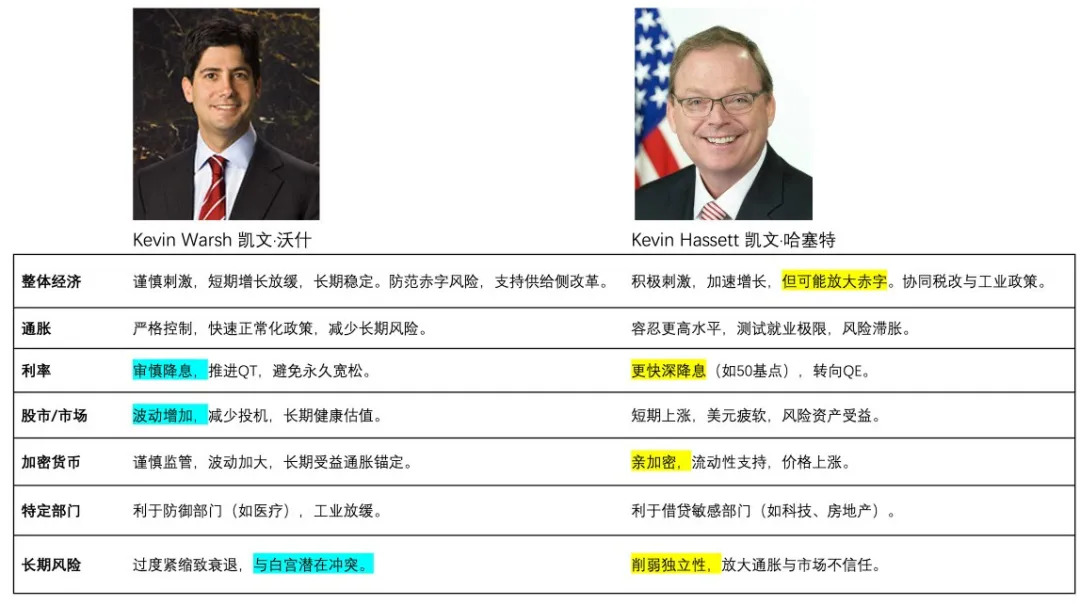
If Warsh is elected, the Fed may shift to a more cautious monetary policy framework.In the short term, this could lead to slower economic growth, prudent rate cuts, and the推进 of quantitative tightening (QT), thereby controlling inflation and reducing the risk of asset bubbles. However, it could also exacerbate an economic recession and create political friction with the White House. Stock market volatility may increase, but in the long run, it would promote healthy valuations, benefiting defensive sectors like healthcare and utilities.


Conversely, under Hassett's leadership, the Fed might focus more on short-term prosperity, stimulating consumption and investment through faster rate cuts and ending QT.This would benefit borrowing-sensitive sectors like technology and real estate, driving up stock and cryptocurrency markets, but could amplify deficits and inflation expectations, leading to stagflation risks and weakening the Fed's independence.


Overall, Warsh's policies focus more on long-term stability, while Hassett could amplify short-term market prosperity but increase the risk of political intervention.


Online Public Sentiment and Election Chance Analysis


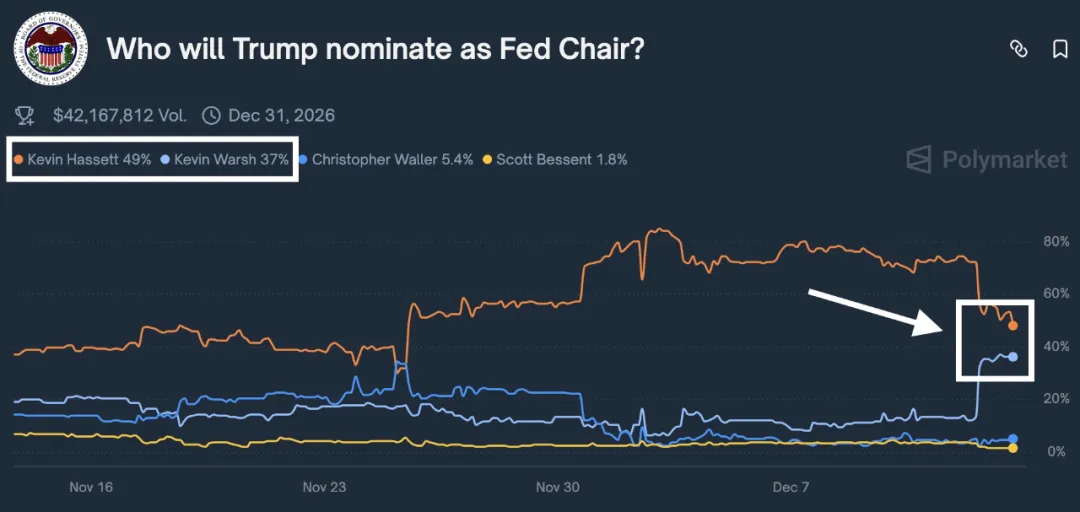
As of December 13, 2025, opinion leaders and public sentiment on X platform (formerly Twitter) show that Hassett initially led, but after Trump's statement, Warsh's probability surged from 15% to 37-40%.


Prediction markets like Kalshi and Polymarket show Hassett's probability at around 49%, but the gap is narrowing.


Wall Street Journal reporter Nick Timiraos pointed out that Hassett might "win the race," while financial commentator Steve Grasso emphasized that his pro-rate-cut stance is beneficial for the market.


Crypto analyst MartyParty sees Hassett as a pro-crypto candidate.


Mainstream media reports indicate that Trump views both as "top contenders" and expects an announcement before Christmas.


Warsh has received support from JPMorgan CEO Dimon, enhancing his prestige in financial circles. Currently, Warsh has stronger momentum and a slightly greater chance of being elected, but Hassett's pro-Trump background still gives him an advantage.


The appointment of the Fed Chair will profoundly affect the trajectory of the U.S. economy.


Warsh could bring an era of disciplined stability, while Hassett预示着 more aggressive growth-oriented policies.


Against the backdrop of the Trump administration's emphasis on "America First," who will prevail remains undecided, but regardless of the outcome, this choice will test the Fed's independence and the resilience of global financial markets.


Investors and policy observers should closely monitor subsequent developments to应对 potential market volatility.


Связанные с этим вопросы

QWhat are the key differences in monetary policy philosophy between Kevin Warsh and Kevin Hassett?

AKevin Warsh holds a hawkish view, prioritizing inflation control and fiscal sustainability, advocating for market discipline and cautious monetary policy normalization. Kevin Hassett is more dovish, emphasizing growth stimulation through aggressive rate cuts and coordination with fiscal policy, which may favor short-term market prosperity but risks higher deficits and inflation.

QHow did the market and prediction markets react to Trump's preference for Warsh or Hassett?

AFollowing Trump's statement, Kevin Warsh's probability surged from 15% to 37-40%, while prediction markets like Kalshi and Polymarket showed Hassett's probability around 49%, indicating a narrowing gap between the two candidates.

QWhat are the potential economic impacts if Kevin Warsh is appointed as Fed Chair?

AUnder Warsh's leadership, the Fed might adopt a more cautious monetary framework, leading to slower growth, prudent rate cuts, and quantitative tightening. This could control inflation and reduce asset bubbles but may increase recession risks and cause political friction with the White House.

QWhat are the potential economic impacts if Kevin Hassett is appointed as Fed Chair?

AHassett's Fed would likely focus on short-term prosperity through faster rate cuts and ending quantitative tightening, benefiting sectors like tech and real estate. However, this approach could amplify deficits, inflation expectations, and stagflation risks, potentially undermining Fed independence.

QWho are the key supporters of Warsh and Hassett, and how does this influence their chances?

AWarsh gained support from JPMorgan CEO Dimon, enhancing his credibility in financial circles. Hassett is favored for his pro-Trump background and endorsements from figures like crypto analyst MartyParty. Currently, Warsh has slightly stronger momentum, but Hassett's alignment with Trump keeps him competitive.

Похожее

From 'Old Guys' to 'New Favorites': How AI Is Revaluing Old Infrastructure from Dell to Nokia?

From "Vintage Tech" to "New AI Darlings": How AI Revalues Old Infrastructure One year ago, tech giants like Dell, Nokia, Cisco, and Western Data were seen as slow-growth, low-valuation stories, far from the AI spotlight dominated by players like Nvidia. Now, these legacy tech stocks are gaining market attention, sparking debate on whether this is genuine industry revaluation or a temporary narrative. As AI moves from model parameters to real-world data centers, the market is recognizing companies with proven delivery and infrastructure capabilities. This shift marks a change in the AI investment thesis: from pure model and GPU focus to the complex systems engineering required for deployment. Companies like Dell, HPE, and Corning are being revalued not for being "sexy" AI innovators, but for their decades of accumulated expertise in supply chains, enterprise delivery, and infrastructure—assets that have become critical in the AI buildout phase. The revaluation is unfolding across three key infrastructure lines: 1. **Servers & System Integration:** Dell and HPE are emerging as crucial system integrators or "general contractors" for AI data centers, translating GPU orders into complete, deployable server racks integrated with power, cooling, and networking. 2. **Networking & Connectivity:** AI's scale demands robust high-speed connections. Corning (fiber optics), Nokia (AI-RAN, 6G), and Cisco (data center switches) are gaining importance for enabling efficient data transfer within and between AI clusters. 3. **Storage:** Beyond high-speed memory (HBM/DRAM), the AI data explosion is driving demand for high-capacity hard drives (HDDs) from companies like Western Digital and Seagate to handle training data, logs, and cold storage cost-effectively. For this revaluation to be substantive and not just a narrative, three criteria are key: 1) Concrete AI-related order and revenue growth (e.g., Dell's AI server sales), 2) Upward revisions to company financial guidance, and 3) Sustainable improvements in profit quality, not just top-line revenue spikes. In essence, AI's transition to a real construction phase is re-pricing "old assets" against "new demand." The opportunity, however, is selective. Only those legacy firms that are demonstrably integrated into the capital expenditure chains of data center and enterprise AI deployment are likely to experience a true "logic re-rating" rather than just a temporary valuation bounce.

marsbit3 мин. назад

From 'Old Guys' to 'New Favorites': How AI Is Revaluing Old Infrastructure from Dell to Nokia?

marsbit3 мин. назад

The Merger of Codex and ChatGPT Marks the Beginning of a Major Reshuffle in Programming Tools

OpenAI is shifting its strategic focus from ChatGPT to Codex, merging them along with the browser tool Atlas into a unified desktop super-app. This move signals an internal belief that Codex, originally a programming tool, represents the next evolution of AI more than conversational models like ChatGPT. Over the past year, Codex's weekly active users have surged past 5 million. The key distinction is that while ChatGPT answers questions, Codex executes tasks. Enterprises increasingly value this ability to get work done over simply receiving advice. Consequently, Codex is attracting professionals beyond developers, including analysts, bankers, marketers, and product managers. OpenAI's reorganization and increased investment in Codex stem from recognizing that the future of AI competition lies in execution capabilities, not just conversation. The company is launching role-specific plugins (e.g., for data analysis, sales, design) to transform Codex into a broad knowledge work platform that automates and redefines white-collar workflows. Beyond being a tool, Codex reflects OpenAI's ambition to redefine software. New features like "Sites"—which generates interactive websites from documents—and collaborative "Annotations" aim to create a paradigm where the AI understands the goal and handles the tools and steps, functioning more like a digital colleague than traditional software. The ultimate goal is a unified experience where the user cares only about the completed task.

marsbit13 мин. назад

The Merger of Codex and ChatGPT Marks the Beginning of a Major Reshuffle in Programming Tools

marsbit13 мин. назад

Interpreting Investment Opportunities in the Age of Great Navigation, Invesco Great Wall Fund Releases '2026 Report on Chinese Enterprises Going Global'

Invesco Great Wall Fund has released its "2026 China Corporate Globalization Report," titled "The 'Great Navigation Era' of Chinese Enterprises." The report analyzes the new trends and investment opportunities as Chinese companies expand globally, moving from simple product exports to comprehensive overseas operations involving services, branding, and local production. Driven by factors like trade friction, the pursuit of higher profit margins abroad, and policy support, globalization is becoming essential for Chinese companies. The report outlines an evolution: from early product export ("Globalization 1.0") to the current "Globalization 2.0," characterized by overseas capacity, capital goods investment, consumer brand expansion, and service exports. Chinese firms' competitive advantages are highlighted, including a vast engineer talent pool, low-cost and robust infrastructure, and complete industrial clusters. Specific sectors with significant出海 potential are identified: * **Capital Goods** (e.g., engineering machinery, power equipment): Benefiting from global demand, especially in Belt & Road markets and the AI-driven power grid upgrade cycle. * **Consumer Brands**: Transitioning from cost to brand advantage, leveraging供应链 efficiency. * **Technology & Innovation**: Including AI applications, optical modules within global tech supply chains, and new energy vehicles focusing on local production. * **Pharmaceuticals**: Chinese biotech firms are becoming preferred partners for global pharma, with potential for breakthrough drugs in areas like oncology and weight loss. The report concludes that corporate globalization represents a sustained, core theme for China's capital markets, though companies must navigate challenges like geopolitics and localization.

marsbit25 мин. назад

Interpreting Investment Opportunities in the Age of Great Navigation, Invesco Great Wall Fund Releases '2026 Report on Chinese Enterprises Going Global'

marsbit25 мин. назад

GitHub, Transfixed by AI

On the night of February 9th, GitHub suffered a major outage caused by a simple configuration change—reducing a cache refresh interval from 12 to 2 hours—that triggered a cascade of failures. This was not an isolated event, but part of a broader pattern. In early 2026, GitHub experienced at least 8 major incidents, failing to meet its promised 99.9% availability. These outages stemmed from structural issues: explosive growth in load, tight service coupling, and insufficient protection against abnormal traffic. This unprecedented load is driven by AI Agents. In 2025, GitHub handled ~1 billion commits. By 2026, weekly commits reached 275 million, projecting to ~14 billion for the year—a 14x increase. AI tools like Claude Code now contribute 4.5% of all public repository commits, with weekly submissions surging 25x in just three months. AI-generated pull requests jumped from 4 million to 17 million per month in half a year. Unlike human developers, AI Agents work continuously, generating commits at a scale that overwhelms infrastructure designed for human rhythms. The surge also shattered GitHub's business model. Copilot's flat-rate pricing, based on assisting human developers, became unsustainable as Agentic AI sessions consumed resources worth hundreds of dollars for a few dollars in fees. In response, GitHub imposed usage limits and, by June 1st, shifted to a pay-per-use "AI Credits" system. Facing this new reality, GitHub realized a 10x scaling plan was insufficient. It announced a need to *redesign* its architecture for 30x current scale—decoupling services, adding fault isolation, and improving change management to prevent cascading failures. Other platforms like Stripe and AWS are facing similar challenges with AI Agents. Fundamentally, GitHub is transitioning from a human collaboration platform to an "exhaust pipe" for automated AI workflows. Its detailed post-mortem reports aim to maintain trust during this turbulent rebuild. The February outage was not just a technical glitch, but a signal of the software industry's entry into a new, AI-driven era.

marsbit1 ч. назад

GitHub, Transfixed by AI

marsbit1 ч. назад

Торговля

Спот
Фьючерсы

Популярные статьи

Как купить US

Добро пожаловать на HTX.com! Мы сделали приобретение Talus Network (US) простым и удобным. Следуйте нашему пошаговому руководству и отправляйтесь в свое крипто-путешествие.Шаг 1: Создайте аккаунт на HTXИспользуйте свой адрес электронной почты или номер телефона, чтобы зарегистрироваться и бесплатно создать аккаунт на HTX. Пройдите удобную регистрацию и откройте для себя весь функционал.Создать аккаунтШаг 2: Перейдите в Купить криптовалюту и выберите свой способ оплатыКредитная/Дебетовая Карта: Используйте свою карту Visa или Mastercard для мгновенной покупки Talus Network (US).Баланс: Используйте средства с баланса вашего аккаунта HTX для простой торговли.Третьи Лица: Мы добавили популярные способы оплаты, такие как Google Pay и Apple Pay, для повышения удобства.P2P: Торгуйте напрямую с другими пользователями на HTX.Внебиржевая Торговля (OTC): Мы предлагаем индивидуальные услуги и конкурентоспособные обменные курсы для трейдеров.Шаг 3: Хранение Talus Network (US)После приобретения вами Talus Network (US) храните их в своем аккаунте на HTX. В качестве альтернативы вы можете отправить их куда-либо с помощью перевода в блокчейне или использовать для торговли с другими криптовалютами.Шаг 4: Торговля Talus Network (US)С легкостью торгуйте Talus Network (US) на спотовом рынке HTX. Просто зайдите в свой аккаунт, выберите торговую пару, совершайте сделки и следите за ними в режиме реального времени. Мы предлагаем удобный интерфейс как для начинающих, так и для опытных трейдеров.

500 просмотров всегоОпубликовано 2025.12.11Обновлено 2026.06.02

Как купить US

Обсуждения

Добро пожаловать в Сообщество HTX. Здесь вы сможете быть в курсе последних новостей о развитии платформы и получить доступ к профессиональной аналитической информации о рынке. Мнения пользователей о цене на US (US) представлены ниже.

活动图片