Ethereum Net Taker Volume Bottoms Rise: A Repeat Of The 2025 Pre-Rally Setup?

bitcoinistОпубликовано 2025-12-12Обновлено 2025-12-12

Введение

Ethereum has declined below $3,200 after the Fed's rate cut, yet on-chain data suggests a potential market structure improvement. According to CryptoQuant, Ethereum’s Net Taker Volume (30-day MA) shows rising lows, indicating weakening aggressive selling pressure. This pattern mirrors early 2025, when a similar setup preceded a 3x rally after the metric turned positive. Currently, the market has absorbed sell flows for nearly three months, with each negative low forming higher than the last. If this trend continues, Net Taker Volume may flip positive in about a month, potentially signaling the start of a new bullish phase toward all-time highs.

Ethereum has retraced below the $3,200 level following the Federal Reserve’s decision to cut interest rates by 25 basis points, a move that initially sparked volatility across the crypto market. While many expected a stronger reaction from Ethereum, the asset instead slipped lower as traders reassessed the macro environment and the implications of a potential shift toward stagflation. Despite this pullback, on-chain data suggests that the underlying market structure may be quietly improving.

According to new insights from CryptoQuant, Ethereum’s Net Taker Volume (30-day moving average) is showing a clear upward trend in its lows. This metric tracks the balance between aggressive buyers and sellers in the derivatives market. Although ETH remains under selling pressure, the data reveals that the intensity of aggressive selling has been weakening steadily over the past several weeks. Each subsequent negative low is forming higher than the previous one, signaling that sellers are losing dominance.

While the broader sentiment remains cautious, subtle improvements in Net Taker Volume suggest that ETH’s current weakness may be masking the early stage of a larger structural shift.

Net Taker Volume Signals a Potential Structural Shift

According to CryptoQuant’s CoinCare, Ethereum may once again be approaching a pivotal turning point. The report highlights that a similar Net Taker Volume structure appeared earlier this year. After forming a clear bottom in January 2025, the metric began to trend upward—even while remaining in the negative zone—indicating that aggressive sellers were gradually losing strength.
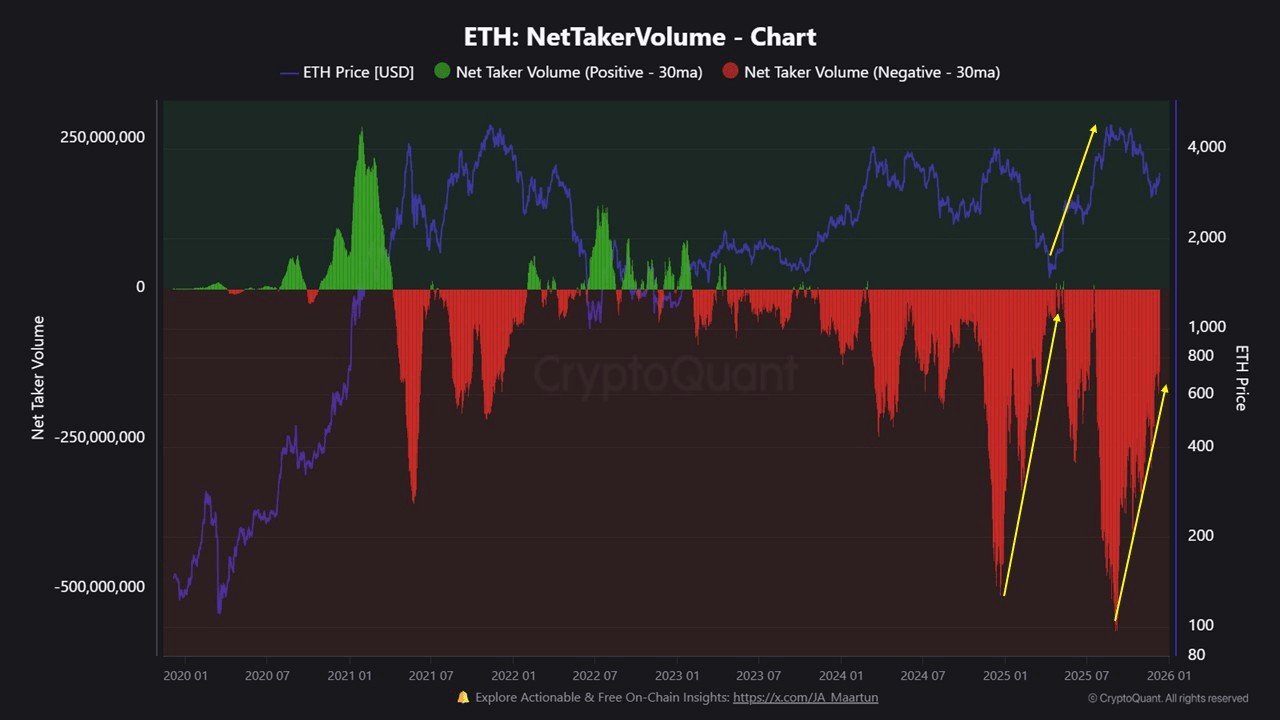
Ethereum Net Taker Volume | Source: CryptoQuant

By April, Net Taker Volume flipped decisively into positive territory. From that exact moment, Ethereum entered one of its strongest rallies of the cycle, surging more than 3x and printing a new all-time high.

Current conditions echo that same pattern. Since the peak of selling pressure in September, the market has continuously absorbed sell flows for nearly three months. Each negative low in Net Taker Volume has formed higher than the previous one, revealing improving market resilience despite the broader downtrend. If this trajectory holds, CoinCare estimates that a positive flip in Net Taker Volume may be only about a month away.

Historically, this transition from negative to positive has marked the beginning of Ethereum’s most explosive breakout phases. A confirmed move into positive territory would represent a high-probability trigger for the next expansion toward new all-time highs, signaling that momentum is quietly rebuilding beneath the surface.


Похожее

Bitcoin's Creator Has Not Appeared Publicly for Exactly 15 Years. Where Did Satoshi Disappear To?

Bitcoin's creator, Satoshi Nakamoto, has been absent from the public eye for exactly 15 years, with his last known communication dating back to April 26, 2011. His final public forum post on December 12, 2010, addressed a DoS attack on the Bitcoin network. Shortly before disappearing, he privately corresponded with early developers, informing them he had "moved on to other things" and that Bitcoin was in good hands, specifically naming Gavin Andresen as the lead developer. His withdrawal is speculated to be linked to Andresen's planned talk about Bitcoin at the CIA headquarters. Satoshi's true identity remains one of cryptocurrency's greatest mysteries. Numerous theories exist, ranging from him being an individual to a group, or even a project by the CIA. Several individuals, including cryptographers Hal Finney and Nick Szabo, have been proposed as candidates, but all have either denied it or remained silent. Some speculate he may be deceased. The mystery is fueled further by the immense wealth potentially held by Satoshi. Research based on a unique mining pattern, dubbed "Patoshi," suggests he may have mined approximately 1.1 million BTC, worth over $100 billion at current prices. This was possible due to minimal mining competition and a high coin emission rate in Bitcoin's early days, when it could be mined on a regular laptop. The network's computational power has since grown by over 10 billion times.

RBK-cryptoТолько что

Bitcoin's Creator Has Not Appeared Publicly for Exactly 15 Years. Where Did Satoshi Disappear To?

RBK-cryptoТолько что

How Does x402 V2 Enable Autonomous Payments for AI Agents?

The x402 protocol, initially developed by Coinbase, leverages the HTTP 402 status code to embed payment logic directly into web requests. The newly released V2 upgrade introduces significant improvements to address limitations in cross-chain support, scalability, identity authentication, and repeated payments experienced in V1. Key enhancements include: - **Wallet Identity and Reusable Sessions**: Supports wallet-based authentication (e.g., Sign-In-With-X via CAIP-122), allowing reusable sessions after initial payment. This reduces latency and costs for high-frequency use cases like AI agent tasks and LLM inference. - **Unified Payment Interface**: Enables multi-chain payments (e.g., Base, Solana) and compatibility with traditional systems (ACH, SEPA, credit cards) via Facilitators. Dynamic payTo routing allows context-aware pricing and complex market structures. - **Modular Architecture**: A plugin-driven SDK simplifies integration, supporting easy expansion to new chains and payment methods without core changes. Multi-Facilitator support automates optimal payment path selection based on preferences. - **Automatic Discovery**: Services can expose metadata for automatic synchronization, ensuring real-time pricing and availability updates without manual intervention. For end-users, V2 enables seamless, subscription-like access with reduced friction. Developers benefit from flexible, low-maintenance payment integration and dynamic pricing models. AI agents gain autonomy to make economic decisions, such as purchasing API calls or compute resources independently using allocated budgets. x402 V2 evolves from a pay-per-use tool into a versatile economic layer, though challenges like ecosystem adoption, modular risks, and regulatory uncertainty remain.

比推20 мин. назад

How Does x402 V2 Enable Autonomous Payments for AI Agents?

比推20 мин. назад

Bitcoin (BTC) Price Trend and Investor Sentiment Suggest a Bullish December

Bitcoin (BTC) is showing signs of a potential bullish December, challenging a decade-old bearish seasonal pattern where November losses typically extend into year-end declines. Key factors supporting this shift include reduced leverage, with open interest dropping from $94 billion to $60 billion, and Bitcoin’s price reclaiming its monthly volume-weighted average price (rVWAP), indicating controlled distribution. Liquidity dynamics have also shifted, with deep liquidity clusters moving upward, and around $3 billion in short positions set to liquidate near $96,000. Market structure diverges from historical cycles due to spot ETF inflows, introducing constant structural demand and accelerating price discovery. Analysts note that Bitcoin’s four-year cycle, while not obsolete, is no longer time-aligned, resembling extended accumulation phases like mid-2016 or late-2019. Macro liquidity (M2) growth has plateaued, creating a late-cycle environment where risk assets rally despite underlying economic softening. Supporting indicators, such as CNY/USD and ETH/BTC correlations, along with improving PMI data and gold’s relative strength, suggest continued risk-on momentum rather than cycle fatigue. While buy-sell ratios show urgency, analysts caution this may reflect positioning squeeze rather than sustainable accumulation. Overall, December’s performance may depend more on structural forces—ETF flows, liquidity rotation, and shifting macro correlations—than traditional halving-driven周期 patterns.

cointelegraph_中文36 мин. назад

Bitcoin (BTC) Price Trend and Investor Sentiment Suggest a Bullish December

cointelegraph_中文36 мин. назад

Торговля

Спот
Фьючерсы
活动图片