Ethereum Lands JPMorgan’s New Tokenized Money Market Fund

bitcoinistОпубликовано 2026-05-13Обновлено 2026-05-13

Введение

JPMorgan is launching a tokenized money market fund on the Ethereum blockchain, offering shares under the ticker JLTXX. The fund is a conservative government money market fund investing primarily in U.S. Treasury securities with maturities of 93 days or less. It aims to maintain a $1.00 net asset value (NAV) and carries a 0.16% net expense ratio. The launch marks a significant step by a major Wall Street institution into public blockchain-based financial infrastructure. While the fund uses blockchain technology to process investor transactions, the legal record of ownership remains with a traditional transfer agent, not the blockchain itself. The system, built and maintained by JPMorgan's Kinexys Digital Assets unit, operates as a permissioned framework on top of the public Ethereum blockchain, requiring approved wallet addresses. Currently, Ethereum is the only supported blockchain, though expansion to others is anticipated. This move follows similar institutional activity, such as BlackRock's tokenized funds, reinforcing Ethereum's growing role as a settlement layer for institutional tokenized products.

JPMorgan is launching a tokenized money market fund on Ethereum, marking another step by a major Wall Street institution into public-blockchain-based fund infrastructure. The new JPMorgan OnChain Liquidity-Token Money Market Fund will offer Token Class shares under the ticker JLTXX, according to a registration filing for JPMorgan Trust IV.

The filing positions the product as a government money market fund seeking current income while maintaining liquidity and stability of principal. Its Token Class carries a 0.16% net expense ratio after fee waivers and reimbursements, with gross annual operating expenses listed at 0.71%. Those waivers are scheduled to remain in effect through June 30, 2028, unless renewed or revised.

Bloomberg ETF analyst Eric Balchunas framed the fee structure as a notable part of the launch. “JPMorgan filed for a tokenized money market fund,” he wrote on X. “Big deal bc JPM inching further into crypto and big deal bc fee is pretty low 16bps for a stable NAV (imposs to do in ETF). Cheaper than most money funds altho Vanguard’s is like 11bps.”

JPMorgan Taps Ethereum For Tokenized Treasury Fund

The fund’s strategy is conservative by design. Under normal conditions, it will invest exclusively in US Treasury bills, bonds and notes, along with overnight repurchase agreements fully collateralized by Treasury securities and/or cash. JPMorgan says the fund will seek to maintain a $1.00 NAV, buy only Treasury securities with remaining maturities of 93 days or less, keep dollar-weighted average maturity at 60 days or less, and invest only in US dollar-denominated securities.

Related Reading: Ethereum Leverage Ratio Sees Sharp Drop: What It Means

The crypto relevance sits less in the portfolio and more in the rail. The filing says the fund will use blockchain technology to let investors submit transaction instructions for fund shares, while the official record of ownership remains the transfer agent’s traditional book-entry register. Token balances attributed to an investor’s blockchain address are intended to correspond one-for-one with fund shares, but JPMorgan makes clear that the Investor Register, not the blockchain balance, is determinative for legal ownership.

That structure reflects the institutional compromise now forming around tokenization: public-chain connectivity, but within controlled market infrastructure. JPMorgan says the blockchain system is designed, deployed and maintained by Kinexys Digital Assets, a business unit within JPMorgan Chase Bank. The system runs as a permissioned framework on top of public blockchains, requiring approved wallet addresses and allow-listing before investors can purchase, redeem or transfer token balances.

Ethereum is currently the only blockchain available for investors, though the filing says expansion to other blockchains is anticipated: “The Ethereum blockchain, a public blockchain network, is currently the only available blockchain for use by investors, although expansion to other blockchains is anticipated in the future.”

That detail drew attention from CEO and co-founder of Etherealize Vivek Raman who wrote via X: “Five months after MONY, JP Morgan is launching a second tokenized money market fund — on the biggest, most institutional public blockchain: Ethereum. Blackrock and JPM issuing on Ethereum in the same week...”

BlackRock is preparing two tokenized money-market funds aimed at investors holding cash in stablecoins, including a digital share class tied to the roughly $6.1 billion BlackRock Select Treasury Based Liquidity Fund. After the success of BUIDL, those tokenized shares are also set to run on Ethereum alongside traditional share classes, reinforcing the chain’s role as the preferred public settlement venue for a growing set of institutional cash-management products.

At press time, Ethereum traded at $2,303.
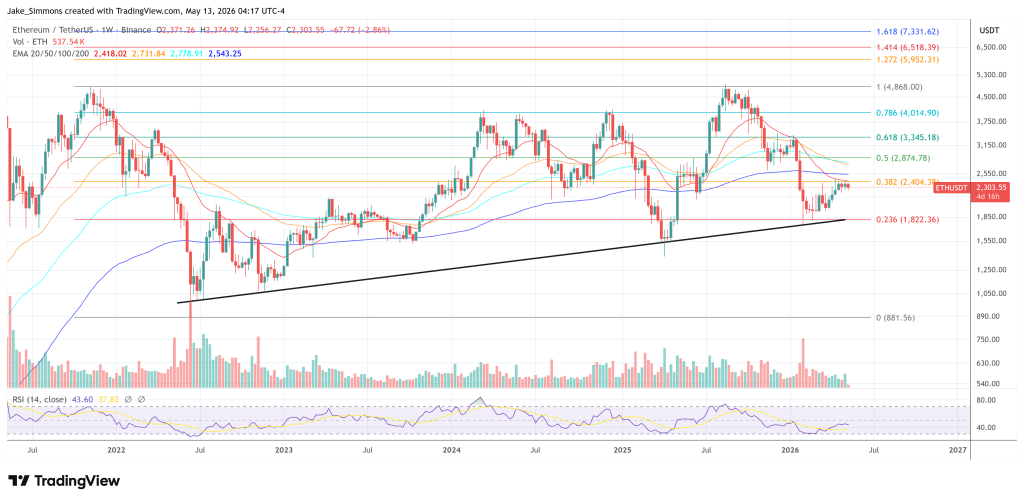
XRP bulls must break the 0.382 Fib, 1-week chart | Source: ETHUSDT on TradingView.com

Связанные с этим вопросы

QWhat is JPMorgan launching on the Ethereum blockchain?

AJPMorgan is launching a tokenized money market fund called the JPMorgan OnChain Liquidity-Token Money Market Fund.

QWhat is the ticker symbol for the token class shares of JPMorgan's new fund?

AThe ticker symbol for the Token Class shares is JLTXX.

QAccording to the filing, what types of assets will the JPMorgan tokenized money market fund primarily invest in?

AUnder normal conditions, the fund will invest exclusively in US Treasury bills, bonds and notes, along with overnight repurchase agreements fully collateralized by Treasury securities and/or cash.

QIn the fund's structure, what is determinative for legal ownership of shares: the blockchain balance or the Investor Register?

AThe Investor Register, not the blockchain balance, is determinative for legal ownership of fund shares.

QWhich company maintains the blockchain system for JPMorgan's tokenized fund?

AThe blockchain system is designed, deployed, and maintained by Kinexys Digital Assets, a business unit within JPMorgan Chase Bank.

Похожее

The Value Distribution of Stablecoins

**Summary: The Value Distribution of Stablecoins** The article argues that stablecoins are evolving from mere trading tools into broader channels for dollar access. It divides the stablecoin ecosystem into four layers to analyze how value is distributed: 1. **Issuance Layer:** Mints stablecoins, holds reserve assets, and captures the spread between reserve yield and user costs (e.g., Tether, Circle). This layer currently earns the largest profit margin. 2. **Infrastructure Layer:** Connects stablecoins to the traditional financial system, handling fiat on/off-ramps, banking integration, compliance (KYC/AML), and asset management (e.g., Bridge, BVNK). This is the "unglamorous" but critical work, building the essential bridges between crypto and real-world finance. 3. **Acquiring/Distribution Layer:** Integrates stablecoins into merchant systems, manages payment flows, and provides enterprise financial software (e.g., Stripe, Coinbase). They act as the access point for businesses. 4. **Application Layer:** The end-users and businesses that ultimately use stablecoins for payments, settlements, or as a store of value. They benefit from convenience but have little pricing power. The core thesis is that while the issuance layer currently dominates profits, the often-overlooked **infrastructure layer holds significant long-term potential**. The real challenge and barrier to mass adoption is not the on-chain transfer of stablecoins (which is simple), but the complex "last mile" integration into existing business workflows, banking systems, and regulatory frameworks across different countries. Companies in this layer are currently in a "land grab" phase, investing heavily to build networks, secure bank partnerships, and establish compliance pathways. While their position is currently pressured by the profitable issuers above and distribution platforms below, the article suggests that if stablecoins become a default financial rail for businesses, the infrastructure providers who have done the hard work of integration will ultimately gain strong pricing power and become entrenched, essential players.

marsbit4 ч. назад

The Value Distribution of Stablecoins

marsbit4 ч. назад

The Value Distribution of Stablecoins

The Value Distribution of Stablecoins The article argues that stablecoins are evolving from a mere trading tool into a broad "dollar channel." It analyzes the industry's value chain through four layers: 1. **Issuance Layer (e.g., Tether, Circle):** The top layer that mints stablecoins, holds reserve assets, and captures the thickest interest rate spread. 2. **Infrastructure Layer (e.g., Bridge, BVNK):** Connects stablecoins to the traditional financial system, handling critical but complex "dirty work" like fiat on/off-ramps, banking integration, compliance (KYC/AML), and cross-border settlement. 3. **Acquiring/Distribution Layer (e.g., Stripe, Coinbase):** Embeds stablecoins into merchant systems, manages payment flows, and integrates with enterprise software. 4. **Application Layer:** End-users and businesses that ultimately use stablecoins for payments, settlement, or storing value. The author posits that while the issuance layer currently captures the most profit, the most overlooked and potentially critical layer is infrastructure. The core challenge for stablecoin adoption isn't the on-chain transfer (which is simple), but bridging the gap between blockchain and the real-world financial system. This involves solving practical problems for businesses: fiat conversion, reconciliation, tax handling, and user onboarding. Infrastructure companies are currently in a difficult "land-grab" phase—building networks, securing banking relationships, and achieving compliance country-by-country. They face pressure from both the profitable issuance layer above and distribution platforms below. However, the author suggests this layer is building a crucial moat. Once stablecoins become a default business rail, the infrastructure players who have done the hard work of integration may gain significant, durable value and pricing power.

链捕手4 ч. назад

The Value Distribution of Stablecoins

链捕手4 ч. назад

How to Do Research Well: Deliberately Practice the Real Skills That Matter

No one truly teaches you how to do research. You're often given a desk, a pre-selected problem, and vague instructions to "create something new." Consequently, many people reverse-engineer the job based on visible outputs—papers, posts, announcements—learning only how to *appear* like a researcher rather than how to *become* one. True research capability is built from stacking small, trainable skills, nearly all of which can be developed through deliberate practice. **Pick Your Own Problem:** Most researchers absorb problems from advisors or trends, lacking the underlying reasoning. Choosing a problem you genuinely care about, as John Schulman advises, leads to original work. Develop "taste" like a muscle: predict experiment outcomes, guess paper results from methods, and track which findings remain important over time. **Upgrade Your Inputs:** Relying on shared reading lists (arXiv hot lists, filtered group chats) leads to unoriginal conclusions. Undervalued old literature often holds crucial insights (e.g., MoE, LSTM, backpropagation). Richard Sutton's "The Bitter Lesson" or Claude Shannon's 1952 talk on creative thinking are more predictive than lengthy modern surveys. Breadth matters as much as depth: draw from neuroscience, mechanism design, hardware knowledge, and honest statistics. Read papers directly, especially appendices and limitations sections. **Write Everything Down:** As Paul Graham noted, writing exposes flaws in seemingly mature ideas. Writing is the cheapest defense against self-deception. Following Feynman's principle, Darwin programmatically wrote down facts contradicting his theory to combat memory bias. Maintain a detailed log of hypotheses, setups, predictions, results, and updated understandings. Reviewing past logs fosters essential humility.

marsbit6 ч. назад

How to Do Research Well: Deliberately Practice the Real Skills That Matter

marsbit6 ч. назад

Торговля

Спот
Фьючерсы

Популярные статьи

Manyu: восходящая мем-звезда на Ethereum, готовая открыть новую эру культуры Shiba

Manyu - это мемтокен на Ethereum, который приносит децентрализованную культурную и развлекательную ценность через вирусное влияние в соцсетях и вовлечённость сообщества.

2.0k просмотров всегоОпубликовано 2025.11.27Обновлено 2025.11.27

Manyu: восходящая мем-звезда на Ethereum, готовая открыть новую эру культуры Shiba

Неделя обучения по популярным токенам 14: Glamsterdam — самое ожидаемое обновление Ethereum в 2026 году

Ordinals/Runes по-прежнему стимулируют доходы от комиссий за блоки и активность разработчиков, рассматриваются как отправная точка «нативной эмиссии активов» в сети.

1.5k просмотров всегоОпубликовано 2026.04.29Обновлено 2026.04.29

Неделя обучения по популярным токенам 14: Glamsterdam — самое ожидаемое обновление Ethereum в 2026 году

Обсуждения

Добро пожаловать в Сообщество HTX. Здесь вы сможете быть в курсе последних новостей о развитии платформы и получить доступ к профессиональной аналитической информации о рынке. Мнения пользователей о цене на ETH (ETH) представлены ниже.

活动图片