Ethereum Exchange Supply Falls To 2016 Lows – Long-Term Holding Dominates

bitcoinistОпубликовано 2025-12-19Обновлено 2025-12-19

Введение

Ethereum is facing a deteriorating market sentiment with its price struggling to maintain bullish momentum, as analysts increasingly consider a transition into a broader bear market. Despite this, a significant structural shift is occurring beneath the surface: Ethereum’s Exchange Supply Ratio (ESR) has fallen to around 0.137, one of its lowest levels since 2016, indicating a declining proportion of ETH held on exchanges. This suggests reduced immediate selling pressure, as more investors move assets into long-term storage rather than keeping them available for quick liquidation. On Binance, the ESR has dropped to approximately 0.0325, reinforcing a reduction in sellable supply. Price action remains fragile, with ETH trading near $2,960 and unable to hold above the $3,200–$3,300 resistance zone. It continues to form lower highs and remains below key moving averages, indicating a loss of bullish momentum since late October. While the market shows signs of short-term equilibrium, the lack of strong buying volume and the failure to reclaim higher price levels keep the risk tilted toward further consolidation or a deeper correction. The combination of falling exchange supply and stable pricing points to a phase of liquidity absorption and strategic repositioning among market participants.

Ethereum is increasingly struggling to maintain a convincing bullish narrative as market sentiment continues to deteriorate. Price action remains fragile, and a growing number of analysts are openly discussing the possibility that Ethereum is transitioning into a broader bear market phase.

Repeated failures to sustain upside momentum have weakened confidence, while risk appetite across the crypto market continues to fade. As volatility persists and capital rotates defensively, ETH finds itself at the center of a debate between structural weakness in price and resilience beneath the surface.

According to a recent CryptoQuant report, Ethereum’s current state reflects a notable shift in supply behavior across exchanges. The Exchange Supply Ratio (ESR), which tracks the proportion of ETH held on centralized trading platforms, has been steadily declining across all major exchanges.

This trend signals that a smaller share of the circulating supply is readily available for immediate sale, a critical factor when evaluating supply-and-demand dynamics.

Historically, declining exchange balances suggest reduced selling pressure, as investors move assets into self-custody or long-term storage rather than preparing to liquidate. In the current environment, this structural change adds nuance to the bearish narrative.

Exchange Supply Declines Signal Structural Shift

The report highlights a pronounced decline in Ethereum’s Exchange Supply Ratio (ESR), reinforcing the view that supply dynamics are quietly shifting beneath the surface. Across all platforms, the ESR has fallen to approximately 0.137, one of its lowest readings since 2016.
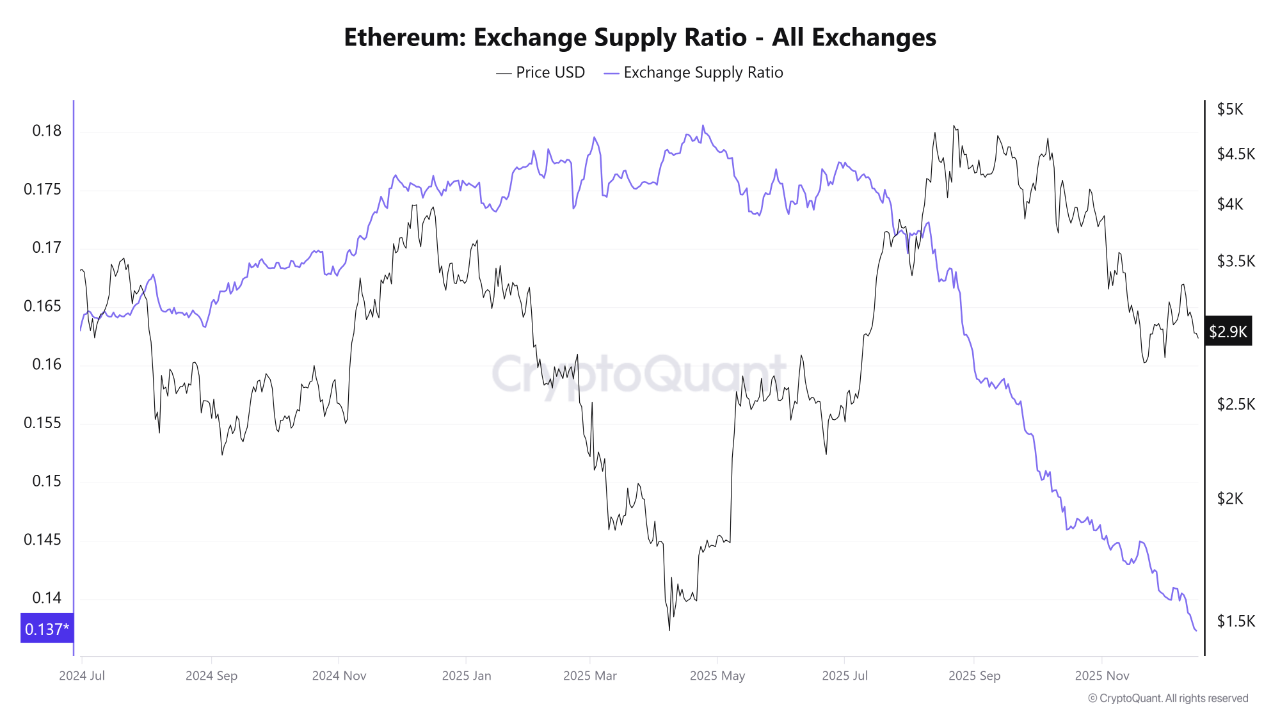
Ethereum Exchange Supply Ratio | Source: CryptoQuant

This sustained drop reflects a steady outflow of ETH from exchanges into external wallets, signaling a reduced inclination toward immediate selling and a growing preference for long-term holding. Historically, similar patterns have emerged during re-accumulation phases or in transitional periods that follow extended volatility, often preceding more stable price behavior.

The trend is even more evident on Binance, where the ESR has declined to roughly 0.0325. As the exchange with the deepest liquidity, Binance’s balances serve as a key barometer for short-term supply conditions. The ongoing withdrawal of ETH from its wallets suggests a meaningful reduction in spot-side sellable supply, pointing to increased trader caution rather than aggressive distribution.

At the same time, Ethereum is trading near $2,960, a mid-range level that reflects a temporary equilibrium between buyers and sellers. The combination of falling exchange supply and relatively stable pricing indicates that the market is not under heavy selling pressure.

Instead, it appears to be entering a phase of liquidity absorption and strategic repositioning, where participants reduce exposure to short-term trades while preparing for a potential shift in market structure.

Ethereum Price Struggles Below Key Trend Levels

The daily ETH chart highlights a market that remains structurally fragile despite short-term stabilization. After failing to hold above the $3,200–$3,300 region, Ethereum has continued to print lower highs, confirming a loss of bullish momentum since late October. Price is currently trading around the $2,850–$2,900 area, a zone that has acted as a short-term demand pocket but lacks strong follow-through from buyers.
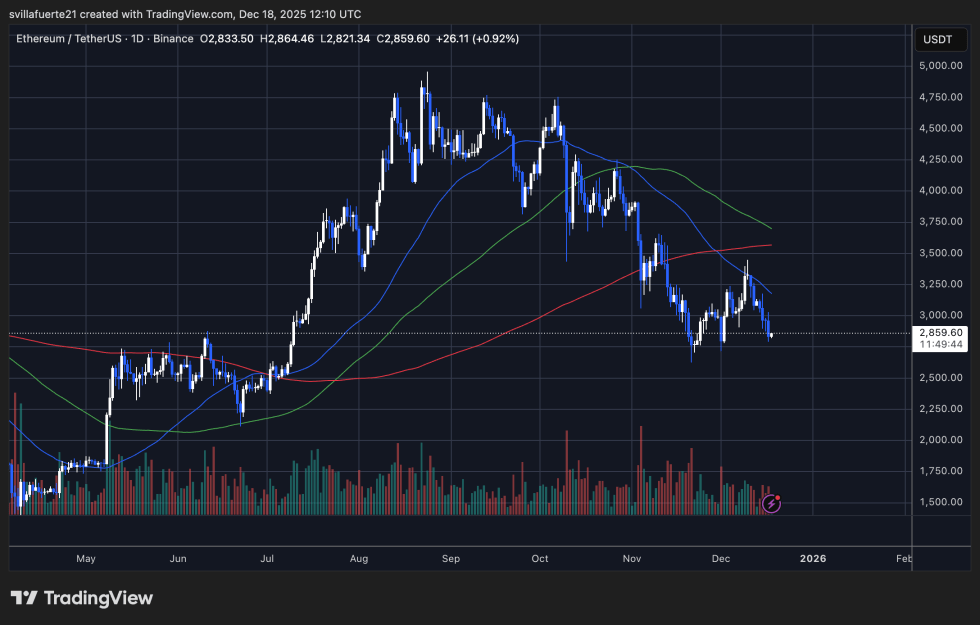
ETH consolidates around a key level | Source: ETHUSDT chart on TradingView

From a trend perspective, ETH remains below its short- and medium-term moving averages. The 50-day moving average has rolled over and is now acting as dynamic resistance, while the 100-day moving average is also trending lower.

The 200-day moving average sits higher, reinforcing the idea that Ethereum has shifted from a trending market into a corrective or distribution phase. As long as price remains capped below these levels, rallies are likely to be sold into rather than extended.

Volume dynamics reinforce this view. Recent rebounds have occurred on relatively muted volume compared to the heavy selling seen during prior breakdowns, suggesting reactive short covering rather than fresh demand.

Structurally, ETH needs to reclaim and hold above the $3,100–$3,200 range to rebuild a bullish case. Failure to do so keeps the risk tilted toward continued consolidation or a deeper corrective leg toward lower support levels.

Featured image from ChatGPT, chart from TradingView.com

Связанные с этим вопросы

QWhat does the decline in Ethereum's Exchange Supply Ratio (ESR) indicate about investor behavior?

AThe decline in Ethereum's Exchange Supply Ratio (ESR) indicates that investors are moving ETH off exchanges into self-custody or long-term storage, signaling reduced selling pressure and a preference for long-term holding rather than immediate liquidation.

QWhat is the current level of Ethereum's Exchange Supply Ratio (ESR) and why is it significant?

AEthereum's Exchange Supply Ratio (ESR) has fallen to approximately 0.137, one of its lowest readings since 2016. This is significant because it shows a structural shift in supply dynamics with a reduced amount of ETH available for immediate sale on exchanges.

QHow is the price of Ethereum performing in relation to its key moving averages?

AEthereum's price is trading below its short- and medium-term moving averages. The 50-day moving average is acting as dynamic resistance and has rolled over, while the 100-day and 200-day moving averages are also trending lower, indicating a corrective or distribution phase.

QWhat price level does Ethereum need to reclaim to rebuild a bullish case according to the article?

AAccording to the article, Ethereum needs to reclaim and hold above the $3,100–$3,200 price range to rebuild a bullish case and signal a potential shift in market structure.

QWhat does the declining ESR on Binance specifically suggest about market conditions?

AThe declining ESR on Binance, which has fallen to roughly 0.0325, suggests a meaningful reduction in spot-side sellable supply. As the exchange with the deepest liquidity, this points to increased trader caution and a reduction in aggressive selling rather than distribution.

Похожее

When AI Traffic Surpasses Humans, How Do You Prove You're Human?

With AI-generated web traffic surpassing human activity, websites face a crisis as AI agents bypass ads, avoid clicks, and scrape data without generating revenue. This disrupts the ad-based internet economy, diverting traffic and reducing site visits. In response, sites are blocking AI crawlers and deploying traps like Cloudflare's "honeypot" pages. Traditional CAPTCHAs are now ineffective against advanced AI. The focus has shifted to behavioral biometrics—analyzing unique human patterns such as cursor movement, typing rhythm, and keystroke dynamics. Companies like IBM and BioCatch use this data to distinguish humans from bots, even detecting fraud through behavioral inconsistencies. Two competing approaches aim to verify human identity centrally. Sam Altman’s World (formerly Worldcoin) uses iris scanning to create unique credentials, though it faces privacy concerns and regulatory bans. Alternatively, cryptographic zero-knowledge proofs offer anonymous verification without revealing personal data, championed by Vitalik Buterin to avoid centralized surveillance. However, both systems have flaws. Centralized solutions risk biometric data misuse, while decentralized models may be exploited through identity rental markets in economically unequal regions. Despite challenges, the author favors cryptographic methods for preserving privacy over pervasive behavioral monitoring that permanently captures and controls personal biometric data.

marsbitТолько что

When AI Traffic Surpasses Humans, How Do You Prove You're Human?

marsbitТолько что

2026 Landscape of Decentralized AI: Why is Blockchain the Inevitable "Antidote" for AI?

**The 2026 Landscape of Decentralized AI: Why Blockchain is the "Cure" AI Cannot Ignore** Decentralized AI addresses fundamental bottlenecks of centralized AI: scarce and expensive computational resources, excessive control concentration, unverifiable model outputs, and increasing difficulty in acquiring training data due to privacy and regulation. Blockchain offers a path to make intelligence open, verifiable, and economically accessible. The technical stack comprises three layers: 1. **Applications & Services**: The main crypto use cases are "Agentic Finance" (converting natural language into on-chain actions) and "Agentic Payments" for machine-to-machine commerce. Projects like Giza, Infinity Labs, Coinvest AI, and x402 (handling 173M+ transactions) are key players. 2. **Middleware**: This coordination layer enables agents to discover, identify, and transact. Notable projects include Gokite AI (specialized L1), Virtuals (an OS for the agent economy), and especially Bittensor—a network of specialized subnets forming competitive AI micro-economies. 3. **Infrastructure**: The capital-intensive layer providing raw resources. It includes decentralized compute (Akash, Render, Aethir), verifiable inference (Venice AI, OpenGradient), distributed training (Prime Intellect, Templar AI), decentralized storage (Filecoin, Walrus), and privacy/verification layers (Nillion, Arcium, Phala Network) using technologies like ZKPs, MPC, and TEEs. The outlook for 2026-2027 indicates AI demand outpacing infrastructure, with AI agents as a primary growth engine. Computation is becoming an asset class, with on-chain markets as its financial layer. Tokenomics is emerging as a structural advantage for coordinating capital, compute, and data in decentralized AI networks. While still early—with adoption uneven and revenue often trailing token incentives—projects like Bittensor, NEAR, and Virtuals demonstrate a shift from speculative narrative to a new model for coordinating intelligence.

marsbit3 мин. назад

2026 Landscape of Decentralized AI: Why is Blockchain the Inevitable "Antidote" for AI?

marsbit3 мин. назад

a16z Crypto Partner: Cash Flow is the Moat

Cash Flow as the Moat: A Playbook for Crypto Founders Historically, the most enduring businesses have been built by positioning themselves within the "flow of funds"—facilitating the creation and transfer of value in a network and extracting a portion of it. Cryptocurrency is the first modern technology natively built for this purpose. For startups, failing to architect products and businesses to leverage these principles means missing a major opportunity. Blockchains are inherently network businesses. Each transaction settles on a shared ledger, and every new participant strengthens the underlying network for all. Well-designed network tokens amplify this by aligning users, developers, and validators around growing the network, with value flowing back to contributors in a transparent feedback loop. This model is not new; companies from railroads and Standard Oil to Google, Meta, and AWS have thrived by inserting themselves into critical flows of value (goods, attention, compute). Financial markets make it even clearer: firms like Visa and major market makers generate immense revenue not by predicting markets but by being in the path of transactions. The combination of fund flow and network effects creates one of the most durable business structures. The high margins in traditional finance (payments, custody, lending, FX) represent prime targets. Crypto founders have the opportunity to build the next version—programmable, instant, global, and natively in the flow of funds. The frontier extends beyond finance to areas like computing/GPUs, AI training data, energy, robotics, and space—markets without entrenched intermediaries, ripe for building new, efficient value rails on programmable infrastructure. Founders should ask: Are you in the flow of funds today? Does your revenue scale 10x with the value of activity on your platform? Where in your target market are profit margins highest relative to value created? The opportunity is clear: embed your startup into the new flows of value and let the network effects accumulate.

marsbit5 мин. назад

a16z Crypto Partner: Cash Flow is the Moat

marsbit5 мин. назад

Торговля

Спот
Фьючерсы

Популярные статьи

Manyu: восходящая мем-звезда на Ethereum, готовая открыть новую эру культуры Shiba

Manyu - это мемтокен на Ethereum, который приносит децентрализованную культурную и развлекательную ценность через вирусное влияние в соцсетях и вовлечённость сообщества.

2.0k просмотров всегоОпубликовано 2025.11.27Обновлено 2025.11.27

Manyu: восходящая мем-звезда на Ethereum, готовая открыть новую эру культуры Shiba

Неделя обучения по популярным токенам 14: Glamsterdam — самое ожидаемое обновление Ethereum в 2026 году

Ordinals/Runes по-прежнему стимулируют доходы от комиссий за блоки и активность разработчиков, рассматриваются как отправная точка «нативной эмиссии активов» в сети.

1.5k просмотров всегоОпубликовано 2026.04.29Обновлено 2026.04.29

Неделя обучения по популярным токенам 14: Glamsterdam — самое ожидаемое обновление Ethereum в 2026 году

Обсуждения

Добро пожаловать в Сообщество HTX. Здесь вы сможете быть в курсе последних новостей о развитии платформы и получить доступ к профессиональной аналитической информации о рынке. Мнения пользователей о цене на ETH (ETH) представлены ниже.

活动图片