ETH Breaks Below $1,900! Behind the 22% Plunge, Vitalik's 'Five-Year Austerity' Strategy

marsbitОпубликовано 2026-02-24Обновлено 2026-02-24

Введение

Ethereum (ETH) has experienced a sharp decline, falling below $1,900 and dropping over 22% from recent highs. This downturn is driven by a combination of liquidity outflows and shifting market expectations. Key factors include significant net redemptions from U.S. spot Ethereum ETFs, large-scale selling by whale addresses (1.43 million ETH sold in two weeks), and substantial personal sales by co-founder Vitalik Buterin. In response, the Ethereum Foundation has announced a five-year "moderate austerity" strategy to ensure long-term financial sustainability and continued development of core technology. Buterin is personally funding certain public goods projects to reduce the Foundation’s financial burden. Despite price pressure, Ethereum’s network performance has improved, with TPS reaching a record high due to the Fusaka upgrade. However, centralization risks in block building remain. The upcoming Glamsterdam upgrade aims to address this with ePBS (enshrined Proposer-Builder Separation) to reduce dominance by a few large players and reshape MEV economics. Additionally, regulatory pressure is mounting with the EU’s MiCA regulation set to take effect in July 2026, increasing compliance costs and affecting DeFi and liquidity providers. Ethereum is currently in a phase of short-term volatility and structural adjustment, balancing capital outflows against long-term technical and governance improvements.

Author: Max.s

The current cryptocurrency market is undergoing a severe structural adjustment. According to the latest trading data (as shown on the chart, ETH/USDT has fallen to around $1,847.84, with a clear recent unilateral downward trend), Ethereum (ETH) is experiencing a deep correction driven by both capital flows and market expectations.
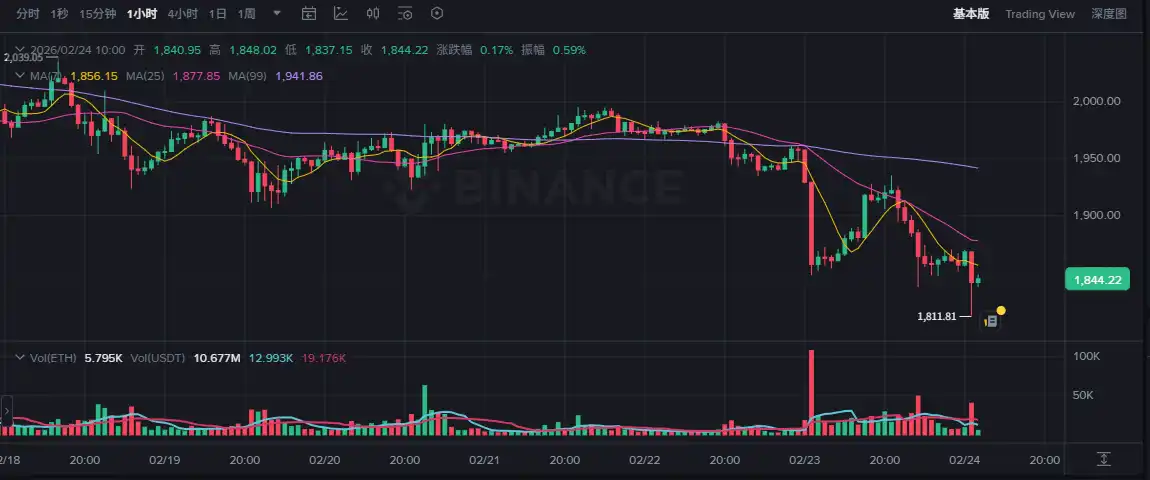
Looking back at the price movement in February 2026, ETH plummeted from above $2,360 to the $1,825 range in a short period, a drop of over 22.7%. Behind the surface of the price decline lies a comprehensive restructuring of the Ethereum network in terms of technical upgrades, organizational structure, and regulatory environment. For institutional investors and financial professionals, looking beyond short-term price fluctuations and understanding the transformation of Ethereum's underlying asset logic is the core issue at hand.

The most immediate pressure facing Ethereum currently comes from the continuous withdrawal of liquidity. This capital outflow is not a single event but a resonance of multiple sources of capital.

Net Redemptions in Spot ETFs: Risk aversion among institutional investors has significantly increased. For example, on January 29, 2026, U.S. spot Ethereum ETFs recorded a single-day net outflow of $155.7 million. Among them, Fidelity's FETH saw a net outflow of $59.2 million, BlackRock's ETHA had a net outflow of $54.9 million, and Grayscale's two funds also recorded outflows in the tens of millions of dollars. This indicates that traditional Wall Street capital is systematically reducing its exposure to Ethereum.

Concentrated Selling by Early Holders: On-chain data shows that whale accounts sold approximately 1.43 million ETH within just two weeks.

Founder's Sell-Off: This month, Ethereum co-founder Vitalik Buterin sold over 8,800 ETH, cashing out approximately $18.45 million. In traditional financial markets, intensive selling by core management is often seen as a major bearish signal, further exacerbating market panic.
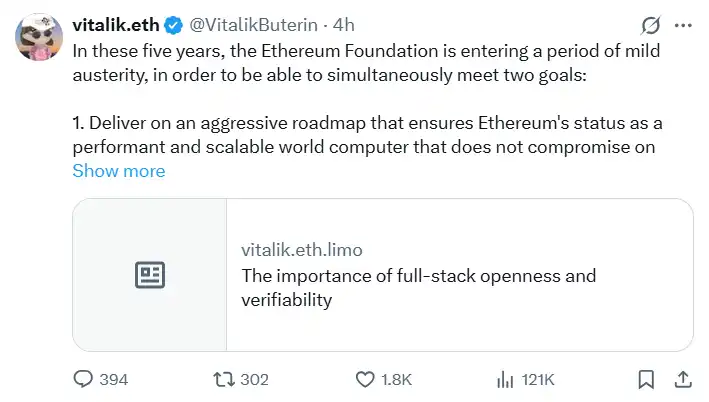
Facing the market's winter, the Ethereum Foundation (EF) has made a defensive shift in its financial strategy. Vitalik Buterin announced that the foundation will enter a five-year period of "moderate austerity."

From a corporate finance perspective, this is a classic cash flow management strategy. Its core objectives are twofold: first, to ensure the foundation can continue to fund the development of Ethereum's core underlying technology in the future, avoiding threats to its independence due to excessive resource consumption; second, to ensure that Ethereum's ambitious roadmap as a high-performance "world computer" is delivered on schedule.

To support this strategy, Vitalik himself proactively severed the funding dependence of some "special projects" on the foundation. He chose to extract 16,384 ETH and use decentralized staking yields to self-fund research and development for public goods such as open-source software, hardware, and privacy protection projects. This approach of internalizing peripheral R&D expenses and focusing on core business marks a move toward maturity and restraint in Ethereum's capital operations.

While the price is under pressure, Ethereum's technical fundamentals have shown remarkable resilience, even exhibiting a rare phenomenon of "price-volume divergence." Recently, the Ethereum network's TPS (transactions per second) reached a historic high of 75,862, far exceeding the previous peak of 58,786.
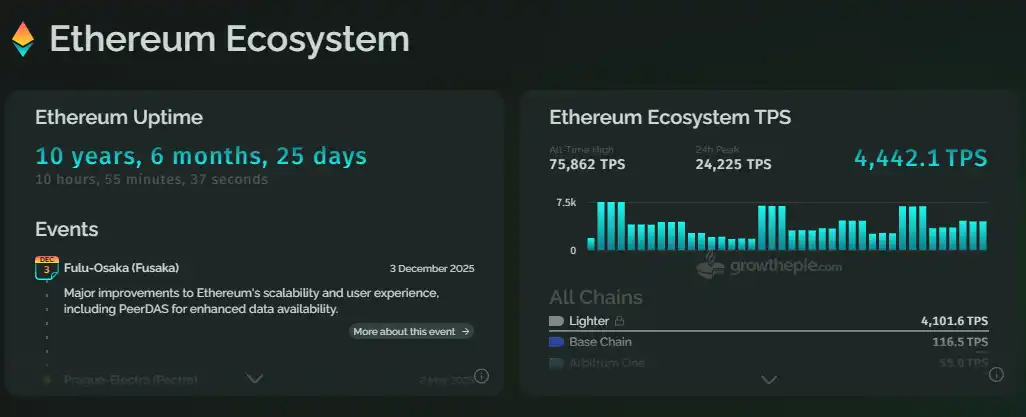
This is largely due to the Fusaka upgrade deployed last December. This upgrade introduced the PeerDAS mechanism, significantly expanding the data throughput of Layer 2 networks. However, with the explosion in data capacity, new systemic risks are emerging. Vitalik pointed out that because current block builders still need to download complete data, the network faces serious centralization risks.

To address this hidden danger, Ethereum plans to launch the Glamsterdam upgrade in 2026, which is essentially a bottom-up reform targeting internal oligopolies within the network.

ePBS Mechanism Reshapes Profit Distribution: The core of this upgrade is ePBS (in-protocol proposer-builder separation). It forcibly incorporates the block-building process into the protocol's底层, standardizing the bidding process and weakening the absolute dominance of the current few external builders over the market.

Preventing Rent-Seeking by Giants: For financial professionals, this means Ethereum is proactively intervening in its internal MEV (Maximal Extractable Value) market structure, breaking down the technical barriers of leading capital, and reconstructing the underlying logic of staking yields.

In addition to the internal structural pains, the Ethereum ecosystem also faces the impending regulatory hammer. The EU's MiCA (Markets in Crypto-Assets) regulation, set to take full effect on July 1, 2026, requires all crypto businesses operating within the EU to meet strict compliance standards.

The implementation of this regulation will directly impact the vast number of DeFi protocols, liquidity providers, and related derivative markets on the Ethereum chain that lack the backing of traditional corporate entities. The sharp rise in compliance costs and the early withdrawal of some non-compliant funds are the deep-seated macro reasons behind the recent sustained bleeding in the spot market.

Ethereum is in a period of divergence: on one side, there is the ruthless selling by short-term capital and the pre-pricing of strict regulations; on the other, there is the robust expansion of technical infrastructure and a self-driven revolution against internal monopolies. This is a typical "deleveraging" process, trading short-term pain for long-term systemic stability.


Связанные с этим вопросы

QWhat is the main reason for the recent sharp decline in Ethereum's price, according to the article?

AThe main reason is a dual pressure from capital outflows and shifting expectations, including massive net redemptions from spot ETFs, concentrated selling by early large holders, and sell-offs by founders, all contributing to a 22.7% drop.

QWhat strategic shift did Vitalik Buterin announce for the Ethereum Foundation in response to market conditions?

AVitalik Buterin announced that the Ethereum Foundation will enter a five-year 'mild austerity' phase to ensure sustainable funding for core technology development and maintain independence while focusing on Ethereum's ambitious roadmap.

QHow did the recent Fusaka upgrade impact Ethereum's network performance?

AThe Fusaka upgrade, deployed last December, introduced the PeerDAS mechanism, which significantly increased data throughput for Layer 2 networks, pushing Ethereum's TPS to a new high of 75,862.

QWhat is the purpose of the upcoming Glamsterdam upgrade for Ethereum?

AThe Glamsterdam upgrade aims to address centralization risks by implementing ePBS (in-protocol proposer-builder separation) to reform the block building process, reduce dominance by a few external builders, and restructure the MEV market to prevent oligopoly.

QWhat regulatory challenge is the Ethereum ecosystem facing in 2026, as mentioned in the article?

AThe Ethereum ecosystem is facing the EU's MiCA (Markets in Crypto-Assets) regulation, set to take full effect on July 1, 2026, which imposes strict compliance standards on crypto firms operating in the EU, potentially impacting DeFi protocols and liquidity providers.

Похожее

Single-Day Plunge of 30%, Arthur Hayes Suddenly Liquidates: Why Did ZEC Get Exploded by Security Issues?

On June 5th, Zcash founder Zooko Wilcox disclosed a critical soundness vulnerability in the project's latest Orchard privacy pool. This flaw, found in the elliptic curve multiplication constraints, could allow an attacker to create unlimited counterfeit ZEC within the shielded pool, with transactions appearing valid. The vulnerability was discovered in late May by security researcher Taylor Hornby, who utilized Anthropic's new Opus 4.8 AI model for a targeted audit. The Zcash ecosystem had already performed an emergency network upgrade to patch the issue. However, the detailed disclosure triggered severe market panic, causing ZEC's price to plummet over 30% in a single day. Notably, prominent investor Arthur Hayes announced he had sold his entire ZEC position following the news. The incident starkly challenges the "technological trust" narrative central to privacy coins. Despite years of top-tier cryptographic audits, the bug persisted until uncovered with advanced AI-assisted research. This highlights the growing gap between theoretical perfection and practical implementation in privacy technology. The event serves as a industry-wide warning: in an AI-driven security landscape, the assumption that "undiscovered equals safe" is obsolete. It underscores the urgent need for continuous, proactive security practices combining AI audits, formal verification, and rapid response mechanisms.

foresightnews_api56 мин. назад

Single-Day Plunge of 30%, Arthur Hayes Suddenly Liquidates: Why Did ZEC Get Exploded by Security Issues?

foresightnews_api56 мин. назад

Breaking the Curse of DeFi Cascading Liquidations, Vitalik Proposes a New Solution

**Vitalik Buterin Proposes New DeFi Design to Eliminate Forced Liquidations** Ethereum co-founder Vitalik Buterin has published a proposal for a new decentralized finance (DeFi) architecture aimed at removing the automatic liquidation mechanisms prevalent in current lending protocols. The core idea involves creating synthetic assets using options as building blocks, fundamentally avoiding the抵押借贷结构 that triggers forced sell-offs. The proposal responds to a recurring flaw in DeFi: during sharp market downturns, mass自动清算 of under-collateralized positions can exacerbate price declines, creating systemic selling pressure and market instability, as evidenced by recent crypto market volatility. Buterin's model would split an asset like 1 ETH into two option-like derivatives, P and N, pegged to a price index with a set strike price and expiration. At expiry, an oracle determines the settlement price to allocate the underlying ETH between P and N holders. This design eliminates the "cliff" of instant liquidation. Instead, a position's value would gradually drift from its target peg if not actively rebalanced by the user, transferring the rebalancing decision from the protocol to the user or automated tools. A key advantage is the reduced reliance on high-frequency, real-time oracle price feeds, which are vulnerable to manipulation and errors in current systems. The delayed settlement in the options model allows for more robust, fault-tolerant oracle designs. However, significant challenges remain for practical adoption. High transaction costs (slippage) from frequent rebalancing on automated market makers (AMMs) could erode user funds. The model may not be suitable for stablecoins requiring a strict 1:1 dollar peg, as it inherently allows for value drift. Success would depend on developing new liquidity provisioning models and deep markets for these synthetic assets. The proposal represents a fundamental rethinking of DeFi risk management, challenging the industry to explore alternatives to被动集中平仓 rather than merely optimizing existing liquidation processes. It remains a theoretical framework awaiting implementation and testing by development teams.

foresightnews_api59 мин. назад

Breaking the Curse of DeFi Cascading Liquidations, Vitalik Proposes a New Solution

foresightnews_api59 мин. назад

Bitcoin's Decline Marks the Transformation of Crypto

Title: The Decline of Bitcoin Marks the Transformation of Crypto While Bitcoin's price recently fell below $70,000, down approximately 45% from its peak, the broader crypto industry is not following it into decline. Instead, crypto is maturing and evolving beyond its dependence on Bitcoin's price movements. Two of Bitcoin's core functions are being usurped. First, AI has captured its role as the primary speculative asset. AI, with its tangible revenue, explosive demand, and massive capital inflows ($700-830 billion in 2024), is siphoning off the speculative "hot money" that once drove Bitcoin. It also contributes to a sustained high-interest-rate environment, further tightening liquidity for assets like Bitcoin. Second, dollar-pegged stablecoins like USDC and USDT have replaced Bitcoin as the crypto market's foundational currency and primary on/off-ramp. Most trading pairs and on-chain transactions are now settled in stablecoins, severing the historical link where all capital inflows had to pass through Bitcoin first. This decoupling allows projects to thrive based on their own fundamentals rather than Bitcoin's price. Examples include Hyperliquid, an on-chain derivatives exchange with annual revenues of $8-13 billion, and prediction market platform Polymarket, valued at $200 billion with $3.65 billion in annual fees. These projects are evaluated on traditional metrics like revenue and user growth. New opportunities are emerging, particularly around privacy. Privacy coins like Zcash (ZEC) are seeing surging demand, while infrastructure like NEAR enables private, cross-chain asset transfers without requiring users to hold a specific token—privacy becomes a universal service layer. In this new paradigm, stablecoins are the universal cash, various project tokens represent equity, and privacy-enabled cross-chain coordination layers (like NEAR) act as the critical infrastructure connecting a fragmented, multi-chain ecosystem. Bitcoin is now just one asset among many. The era where the entire crypto market moved in lockstep with Bitcoin is over. The industry's health should now be judged by project fundamentals—real revenue, active users, and tokenomics that capture value—and the development of the underlying infrastructure enabling a mature, dollar-denominated crypto economy.

foresightnews_api1 ч. назад

Bitcoin's Decline Marks the Transformation of Crypto

foresightnews_api1 ч. назад

Lightspark CEO: In Ten Years, Bitcoin Will Be as Invisible as TCP/IP, Yet Power Trillions in Daily Transactions

A decade from now, Bitcoin will function like TCP/IP — invisible yet foundational, supporting trillions in daily transactions globally, according to Lightspark CEO David Marcus. In this future, a coffee shop in Lagos receives instant payment, a manufacturer in São Paulo settles an invoice with a supplier in Ho Chi Minh City, and a freelancer in Bangalore gets paid weekly from an Austin startup — all via Bitcoin's settlement layer, with none of the parties consciously interacting with it. This vision parallels the adoption of open protocols: first driven by necessity where existing systems fail, then scaling rapidly as tools mature and economic benefits become clear. The structural shift begins with wallets. Modern non-custodial wallets, like Spark, allow users to hold dollars, local currency, and Bitcoin in a single address, seamlessly switching between them. This eliminates friction and revolutionizes global custody, moving significant deposits to user-controlled keys not by ideology, but by superior utility. As a result, Bitcoin becomes the default savings layer for billions, as its fixed supply and appreciating value make it a rational choice for savers holding it alongside stablecoins in their everyday wallets. Businesses follow a similar path, from small companies in emerging markets to multinational corporations, holding Bitcoin alongside operational stablecoins. The latest trend is direct Bitcoin transactions for commerce. When both parties hold Bitcoin, transacting in it becomes the simplest option — no conversions, no intermediary currency. This starts in niche areas like high-value B2B settlements but grows as infrastructure makes sending Bitcoin as easy as stablecoins. An accelerating force is AI agents. By 2036, AI agents conducting commerce on behalf of individuals and firms will increasingly choose Bitcoin for settlement. Optimizing for speed, finality, and minimal counterparty risk across jurisdictions, they find Bitcoin's global, neutral, and programmable network ideal for netting and settling obligations. Thus, Bitcoin is becoming the native currency for machine commerce, just as it has become a native savings asset for humans. The global monetary system is being rebuilt from the protocol layer: open infrastructure, default self-custody, Bitcoin settling everything underneath, with stablecoins as the interface. Most users won't think about Bitcoin when they transact — and they won't need to.

foresightnews_api1 ч. назад

Lightspark CEO: In Ten Years, Bitcoin Will Be as Invisible as TCP/IP, Yet Power Trillions in Daily Transactions

foresightnews_api1 ч. назад

Торговля

Спот
Фьючерсы
活动图片