ETH Breaks Below $1,900! Behind the 22% Plunge, Vitalik's 'Five-Year Austerity' Strategy

marsbitОпубликовано 2026-02-24Обновлено 2026-02-24

Введение

Ethereum (ETH) has experienced a sharp decline, falling below $1,900 and dropping over 22% from recent highs. This downturn is driven by a combination of liquidity outflows and shifting market expectations. Key factors include significant net redemptions from U.S. spot Ethereum ETFs, large-scale selling by whale addresses (1.43 million ETH sold in two weeks), and substantial personal sales by co-founder Vitalik Buterin. In response, the Ethereum Foundation has announced a five-year "moderate austerity" strategy to ensure long-term financial sustainability and continued development of core technology. Buterin is personally funding certain public goods projects to reduce the Foundation’s financial burden. Despite price pressure, Ethereum’s network performance has improved, with TPS reaching a record high due to the Fusaka upgrade. However, centralization risks in block building remain. The upcoming Glamsterdam upgrade aims to address this with ePBS (enshrined Proposer-Builder Separation) to reduce dominance by a few large players and reshape MEV economics. Additionally, regulatory pressure is mounting with the EU’s MiCA regulation set to take effect in July 2026, increasing compliance costs and affecting DeFi and liquidity providers. Ethereum is currently in a phase of short-term volatility and structural adjustment, balancing capital outflows against long-term technical and governance improvements.

Author: Max.s

The current cryptocurrency market is undergoing a severe structural adjustment. According to the latest trading data (as shown on the chart, ETH/USDT has fallen to around $1,847.84, with a clear recent unilateral downward trend), Ethereum (ETH) is experiencing a deep correction driven by both capital flows and market expectations.
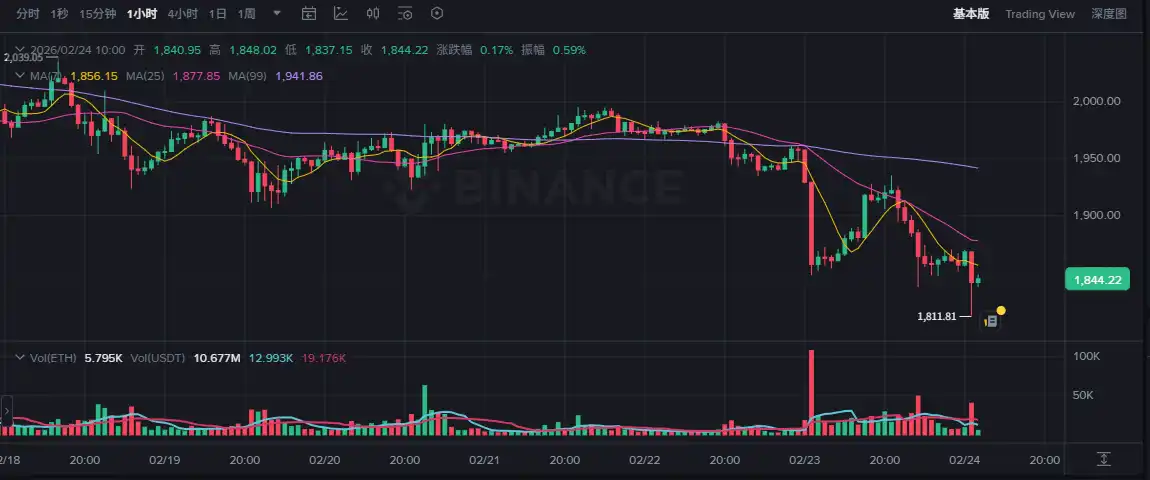
Looking back at the price movement in February 2026, ETH plummeted from above $2,360 to the $1,825 range in a short period, a drop of over 22.7%. Behind the surface of the price decline lies a comprehensive restructuring of the Ethereum network in terms of technical upgrades, organizational structure, and regulatory environment. For institutional investors and financial professionals, looking beyond short-term price fluctuations and understanding the transformation of Ethereum's underlying asset logic is the core issue at hand.

The most immediate pressure facing Ethereum currently comes from the continuous withdrawal of liquidity. This capital outflow is not a single event but a resonance of multiple sources of capital.

Net Redemptions in Spot ETFs: Risk aversion among institutional investors has significantly increased. For example, on January 29, 2026, U.S. spot Ethereum ETFs recorded a single-day net outflow of $155.7 million. Among them, Fidelity's FETH saw a net outflow of $59.2 million, BlackRock's ETHA had a net outflow of $54.9 million, and Grayscale's two funds also recorded outflows in the tens of millions of dollars. This indicates that traditional Wall Street capital is systematically reducing its exposure to Ethereum.

Concentrated Selling by Early Holders: On-chain data shows that whale accounts sold approximately 1.43 million ETH within just two weeks.

Founder's Sell-Off: This month, Ethereum co-founder Vitalik Buterin sold over 8,800 ETH, cashing out approximately $18.45 million. In traditional financial markets, intensive selling by core management is often seen as a major bearish signal, further exacerbating market panic.
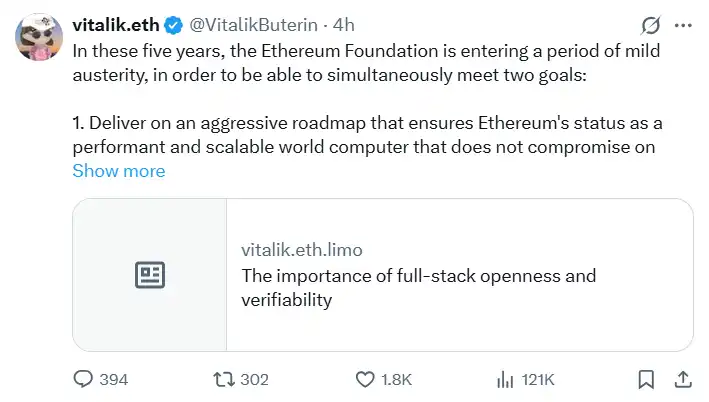
Facing the market's winter, the Ethereum Foundation (EF) has made a defensive shift in its financial strategy. Vitalik Buterin announced that the foundation will enter a five-year period of "moderate austerity."

From a corporate finance perspective, this is a classic cash flow management strategy. Its core objectives are twofold: first, to ensure the foundation can continue to fund the development of Ethereum's core underlying technology in the future, avoiding threats to its independence due to excessive resource consumption; second, to ensure that Ethereum's ambitious roadmap as a high-performance "world computer" is delivered on schedule.

To support this strategy, Vitalik himself proactively severed the funding dependence of some "special projects" on the foundation. He chose to extract 16,384 ETH and use decentralized staking yields to self-fund research and development for public goods such as open-source software, hardware, and privacy protection projects. This approach of internalizing peripheral R&D expenses and focusing on core business marks a move toward maturity and restraint in Ethereum's capital operations.

While the price is under pressure, Ethereum's technical fundamentals have shown remarkable resilience, even exhibiting a rare phenomenon of "price-volume divergence." Recently, the Ethereum network's TPS (transactions per second) reached a historic high of 75,862, far exceeding the previous peak of 58,786.
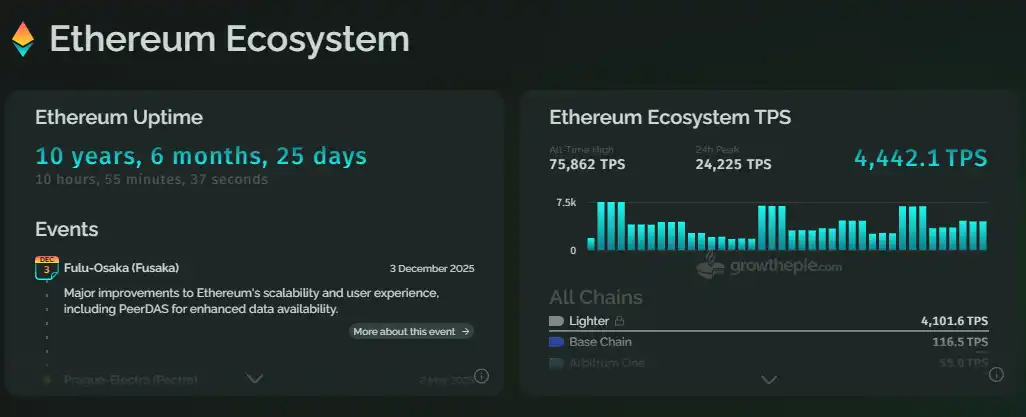
This is largely due to the Fusaka upgrade deployed last December. This upgrade introduced the PeerDAS mechanism, significantly expanding the data throughput of Layer 2 networks. However, with the explosion in data capacity, new systemic risks are emerging. Vitalik pointed out that because current block builders still need to download complete data, the network faces serious centralization risks.

To address this hidden danger, Ethereum plans to launch the Glamsterdam upgrade in 2026, which is essentially a bottom-up reform targeting internal oligopolies within the network.

ePBS Mechanism Reshapes Profit Distribution: The core of this upgrade is ePBS (in-protocol proposer-builder separation). It forcibly incorporates the block-building process into the protocol's底层, standardizing the bidding process and weakening the absolute dominance of the current few external builders over the market.

Preventing Rent-Seeking by Giants: For financial professionals, this means Ethereum is proactively intervening in its internal MEV (Maximal Extractable Value) market structure, breaking down the technical barriers of leading capital, and reconstructing the underlying logic of staking yields.

In addition to the internal structural pains, the Ethereum ecosystem also faces the impending regulatory hammer. The EU's MiCA (Markets in Crypto-Assets) regulation, set to take full effect on July 1, 2026, requires all crypto businesses operating within the EU to meet strict compliance standards.

The implementation of this regulation will directly impact the vast number of DeFi protocols, liquidity providers, and related derivative markets on the Ethereum chain that lack the backing of traditional corporate entities. The sharp rise in compliance costs and the early withdrawal of some non-compliant funds are the deep-seated macro reasons behind the recent sustained bleeding in the spot market.

Ethereum is in a period of divergence: on one side, there is the ruthless selling by short-term capital and the pre-pricing of strict regulations; on the other, there is the robust expansion of technical infrastructure and a self-driven revolution against internal monopolies. This is a typical "deleveraging" process, trading short-term pain for long-term systemic stability.


Связанные с этим вопросы

QWhat is the main reason for the recent sharp decline in Ethereum's price, according to the article?

AThe main reason is a dual pressure from capital outflows and shifting expectations, including massive net redemptions from spot ETFs, concentrated selling by early large holders, and sell-offs by founders, all contributing to a 22.7% drop.

QWhat strategic shift did Vitalik Buterin announce for the Ethereum Foundation in response to market conditions?

AVitalik Buterin announced that the Ethereum Foundation will enter a five-year 'mild austerity' phase to ensure sustainable funding for core technology development and maintain independence while focusing on Ethereum's ambitious roadmap.

QHow did the recent Fusaka upgrade impact Ethereum's network performance?

AThe Fusaka upgrade, deployed last December, introduced the PeerDAS mechanism, which significantly increased data throughput for Layer 2 networks, pushing Ethereum's TPS to a new high of 75,862.

QWhat is the purpose of the upcoming Glamsterdam upgrade for Ethereum?

AThe Glamsterdam upgrade aims to address centralization risks by implementing ePBS (in-protocol proposer-builder separation) to reform the block building process, reduce dominance by a few external builders, and restructure the MEV market to prevent oligopoly.

QWhat regulatory challenge is the Ethereum ecosystem facing in 2026, as mentioned in the article?

AThe Ethereum ecosystem is facing the EU's MiCA (Markets in Crypto-Assets) regulation, set to take full effect on July 1, 2026, which imposes strict compliance standards on crypto firms operating in the EU, potentially impacting DeFi protocols and liquidity providers.

Похожее

Gensyn AI: Don't Let AI Repeat the Mistakes of the Internet

In recent months, the rapid growth of the AI industry has attracted significant talent from the crypto sector. A persistent question among researchers intersecting both fields is whether blockchain can become a foundational part of AI infrastructure. While many previous AI and Crypto projects focused on application layers (like AI Agents, on-chain reasoning, data markets, and compute rentals), few achieved viable commercial models. Gensyn differentiates itself by targeting the most critical and expensive layer of AI: model training. Gensyn aims to organize globally distributed GPU resources into an open AI training network. Developers can submit training tasks, nodes provide computational power, and the network verifies results while distributing incentives. The core issue addressed is not decentralization for its own sake, but the increasing centralization of compute power among tech giants. In the era of large models, access to GPUs (like the H100) has become a decisive bottleneck, dictating the pace of AI development. Major AI companies are heavily dependent on large cloud providers for compute resources. Gensyn's approach is significant for several reasons: 1) It operates at the core infrastructure layer (model training), the most resource-intensive and technically demanding part of the AI value chain. 2) It proposes a more open, collaborative model for compute, potentially increasing resource utilization by dynamically pooling idle GPUs, similar to early cloud computing logic. 3) Its technical moat lies in solving complex challenges like verifying training results, ensuring node honesty, and maintaining reliability in a distributed environment—making it more of a deep-tech infrastructure company. 4) It targets a validated, high-growth market with genuine demand, rather than pursuing blockchain integration without purpose. Ultimately, the boundaries between Crypto and AI are blurring. AI requires global resource coordination, incentive mechanisms, and collaborative systems—areas where crypto-native solutions excel. Gensyn represents a step toward making advanced training capabilities more accessible and collaborative, moving beyond a niche controlled by a few giants. If successful, it could evolve into a fundamental piece of AI infrastructure, where the most enduring value in the AI era is often created.

marsbit8 ч. назад

Gensyn AI: Don't Let AI Repeat the Mistakes of the Internet

marsbit8 ч. назад

Why is China's AI Developing So Fast? The Answer Lies Inside the Labs

A US researcher's visit to China's top AI labs reveals distinct cultural and organizational factors driving China's rapid AI development. While talent, data, and compute are similar to the West, Chinese labs excel through a pragmatic, execution-focused culture: less emphasis on individual stardom and conceptual debate, and more on teamwork, engineering optimization, and mastering the full tech stack. A key advantage is the integration of young students and researchers who approach model-building with fresh perspectives and low ego, prioritizing collective progress over personal credit. This contrasts with the US culture of self-promotion and "star scientist" narratives. Chinese labs also exhibit a strong "build, don't buy" mentality, preferring to develop core capabilities—like data pipelines and environments—in-house rather than relying on external services. The ecosystem feels more collaborative than tribal, with mutual respect among labs. While government support exists, its scale is unclear, and technical decisions appear driven by labs, not state mandates. Chinese companies across sectors, from platforms to consumer tech, are building their own foundational models to control their tech destiny, reflecting a broader cultural drive for technological sovereignty. Demand for AI is emerging, with spending patterns potentially mirroring cloud infrastructure more than traditional SaaS. Despite challenges like a less mature data industry and GPU shortages, Chinese labs are propelled by vast talent, rapid iteration, and deep integration with the open-source community. The competition is evolving beyond a pure model race into a contest of organizational execution, developer ecosystems, and industrial pragmatism.

marsbit9 ч. назад

Why is China's AI Developing So Fast? The Answer Lies Inside the Labs

marsbit9 ч. назад

3 Years, 5 Times: The Rebirth of a Century-Old Glass Factory

Corning, a 175-year-old glass company, is experiencing a dramatic revival as a key player in AI infrastructure, driven by surging demand for high-performance optical fiber in data centers. AI data centers require vastly more fiber than traditional ones—5 to 10 times as much per rack—to handle high-speed data transmission between GPUs. This structural demand shift, coupled with supply constraints from the lengthy expansion cycle for fiber preforms, has created a significant supply-demand gap. Nvidia has invested in Corning, along with Lumentum and Coherent, in a $4.5 billion total commitment to secure the optical supply chain for AI. Corning's competitive edge lies in its expertise in producing ultra-low-loss, high-density, and bend-resistant specialty fiber, which is critical for 800G+ and future 1.6T data rates. Its deep involvement in co-packaged optics (CPO) with partners like Nvidia further solidifies its position. While not the largest fiber manufacturer globally, Corning's revenue from enterprise/data center clients now exceeds 40% of its optical communications sales, and it has secured multi-year supply agreements with major hyperscalers including Meta and Nvidia. Financially, Corning's optical communications revenue has surged, doubling from $1.3 billion in 2023 to over $3 billion in 2025. Its stock price has risen nearly 6-fold since late 2023. Key future catalysts include the rollout of Nvidia's CPO products and the scale of undisclosed customer agreements. However, risks include high current valuations and potential disruption from next-generation technologies like hollow-core fiber. The company's long-term bet on light over electricity, maintained even through the telecom bubble crash, is now being validated by the AI boom.

marsbit10 ч. назад

3 Years, 5 Times: The Rebirth of a Century-Old Glass Factory

marsbit10 ч. назад

Торговля

Спот
Фьючерсы
活动图片