Eric Trump Goes to War With Big Banks Over ‘Anti‑American’ Crypto Lobbying

bitcoinistОпубликовано 2026-03-05Обновлено 2026-03-05

Введение

Eric Trump has publicly criticized major U.S. banks, including JPMorgan Chase, Wells Fargo, and Bank of America, accusing them of pursuing an "anti-American" agenda by lobbying against crypto and stablecoins. He claims these institutions are trying to block Americans from earning higher yields on savings—often 4–5% in crypto platforms—to protect their low-interest monopoly and prevent deposit flight. According to Trump, banks are supporting bills like the Clarity Act to restrict yields and rewards on stablecoins, undermining competition and consumer freedom. He argues this contradicts American ideals and reflects the banking industry's panic over losing dominance in digital finance. The conflict centers on the GENIUS Act, which allowed stablecoins but banned interest payments, and the proposed Clarity Act, which aims to further limit yields.

Eric Trump lashed out against Big Banks for targeting Crypto and stablecoins, essentially not letting Americans make as much money as they could be.

An “Anti-American” Crypto Agenda

In a post on social network X on March 4, following his father Donald Trump’s message accusing banks of “undermining” the GENIUS Act, Eric Trump subsequently called out big banks like JPMorgan Chase, Wells Fargo and Bank of America.

He claims these banks are actively blocking Americans from “getting higher yields on their savings” and preventing “any rewards or perks from being given to customers,” arguing this is happening because they are “desperately targeting crypto/stablecoins, where platforms plan to offer 4–5% yields or rewards.” He goes as far as saying this stance betrays America’s freedom ideals:

The ABA and other lobbyists are spending millions trying to ban or restrict those yields via bills like the Clarity Act, crying “fairness” and using words like “stability”—when it’s really about protecting their low-rate monopoly and preventing deposit flight. his is anti-retail, anti-consumer, and straight-up anti-American.

The Greatest Hypocrites

In a different post from the same day, Eric Trump doubled down, accusing Big Banks of “doing everything they can to block the crypto industry” and branding them institutions that have “held a monopoly and screwed their customers for years.”

As Eric Trump sees it, this comes as a sort of tantrum, the last-ditch effort of a scared institution to keep control of Americans’ savings:

They are the greatest hypocrites and are in mass panic given they know they are losing the digital finance race!

The GENIUS Act vs. The Clarity Act

Both Donald and Eric Trump’s rants respond to a broader context: two flagship Trump-era bills are being weaponized against each other by the TradFi institutions.

The GENIUS Act, last year’s “big win” for payment stablecoins, legalized fully‐backed dollar tokens while explicitly banning issuers from paying interest on customer balances, a compromise that pushed yield into exchanges, fintech apps and DeFi protocols instead of killing it outright.

Now the banking lobby wants the CLARITY Act to finish the job: they are demanding a blanket prohibition on “yields, rewards or inducements” for stablecoin holders, closing the GENIUS loophole that still lets platforms compete with near‐zero bank accounts.

This is the fight the Trumps are now front running: an active opposition against those that are trying to make sure digital dollars can never pay ordinary savers more than the legacy system does.

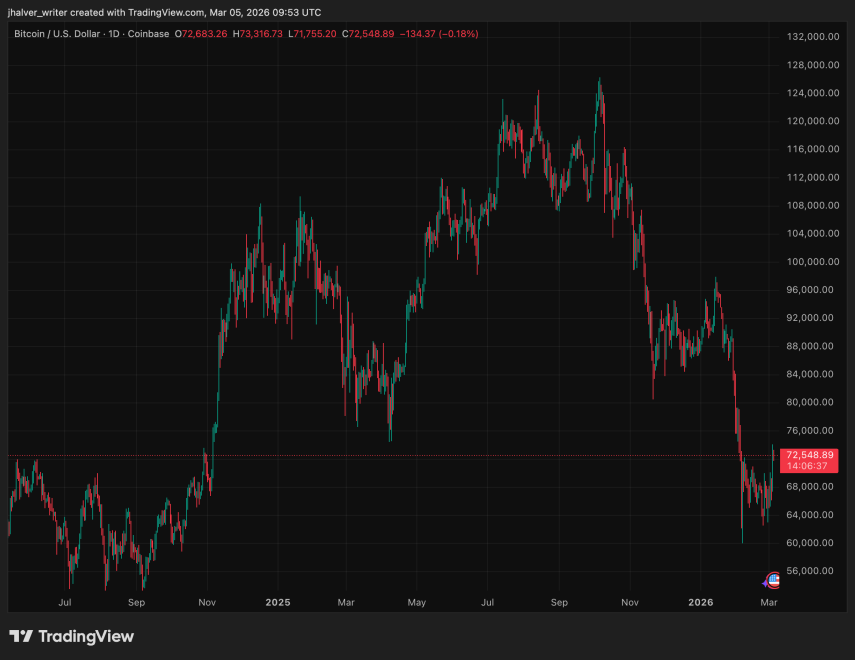
BTC’s price trends to the downside on the daily chart. Source: BTCUSD on Tradingview

Cover image from ChatGPT, BTCPUSD chart from Tradingview

Связанные с этим вопросы

QWhat did Eric Trump accuse big banks like JPMorgan Chase, Wells Fargo, and Bank of America of doing?

AEric Trump accused big banks of actively blocking Americans from getting higher yields on their savings and preventing rewards or perks from being given to customers, claiming they are desperately targeting crypto and stablecoins to protect their low-rate monopoly.

QWhich two acts are central to the conflict between the Trump family and big banks regarding crypto and stablecoins?

AThe GENIUS Act and the Clarity Act are central to the conflict, with the GENIUS Act legalizing fully-backed dollar tokens but banning interest on customer balances, while the Clarity Act seeks to prohibit yields, rewards, or inducements for stablecoin holders.

QWhy does Eric Trump label the actions of big banks and their lobbyists as 'anti-American'?

AHe labels them as 'anti-American' because he believes they are undermining America's freedom ideals by protecting their monopoly, preventing deposit flight, and restricting consumers from earning higher yields through crypto and stablecoins.

QWhat does Eric Trump claim is the real motivation behind the banking lobby's support for bills like the Clarity Act?

AHe claims the real motivation is to protect their low-rate monopoly and prevent deposit flight, rather than genuine concerns about fairness or stability.

QHow does Eric Trump describe the big banks' response to the rise of digital finance?

AHe describes it as a mass panic and tantrum, accusing them of being hypocrites who are desperately trying to block the crypto industry because they are losing the digital finance race.

Похожее

Popular Interaction Collection | Interstate Launches Points Event; Flip Early Waitlist Application (June 12)

**Interstate Launches Points Event, Flip Opens Early Waitlist Applications** *Originally published by Odaily Planet Daily, author Asher.* **Interstate**, an infrastructure platform integrating on-chain transactions for assets like Meme tokens, prediction markets, and xStocks, has launched a points event. Each trade on the platform now rewards users with points. The project has completed a $1.5 million seed round from investors including MH Ventures, Alchemy Ventures, and Marshland Capital. Users can visit the official website to connect their wallets and start earning points through trading tasks (note: the site may experience high traffic). **Flip**, an AI-powered financial assistant, has opened applications for its early waitlist. The platform allows users to manage finances via chat, helping with spending tracking, bill management, investment portfolio monitoring (including stocks and crypto), and more. Flip recently raised $1.4 million in a pre-seed round led by The House Fund and participated in a16z's Speedrun accelerator. Interested users can join the waitlist via the official website. **ArcNova**, an AI-native infrastructure platform for short-form video and entertainment, continues to offer tasks for earning points. Users can sign in daily, complete social and app tasks, and refer friends to accumulate points. The project announced a $15 million funding round in May, backed by Adaverse Ventures, Animoca Brands, and others. The task portal is accessible through the ArcNova website. These updates highlight ongoing opportunities for user engagement and potential rewards across emerging crypto and AI projects.

Odaily星球日报31 мин. назад

Popular Interaction Collection | Interstate Launches Points Event; Flip Early Waitlist Application (June 12)

Odaily星球日报31 мин. назад

MoneyGram: Why Did We Launch Our Own Stablecoin?

MoneyGram, a global leader in cross-border remittances for over 80 years, has launched its own stablecoin, MGUSD. The initiative aims to evolve from single-transaction services to becoming a more integral part of users' financial lives. By allowing customers to hold a stable US dollar balance within the MoneyGram app, MGUSD enables not only remittances but also everyday spending, currency exchange, cash access, and future financial services. Targeting the billions globally who face challenges like currency volatility or lack of bank accounts, MGUSD leverages Stellar blockchain technology with a self-custody wallet architecture. This gives users control over their assets while providing a secure, compliant experience through a trusted brand. The approach focuses on solving existing customer pain points within MoneyGram's established network, rather than competing for broad crypto market liquidity. A key advantage is MoneyGram's hybrid model, combining digital services with the world's largest physical network for crypto-to-cash conversions. The stablecoin also modernizes the company's internal infrastructure, streamlining treasury management and partner settlements, with annual forex volume via stablecoins already reaching $2 billion. The project was delivered in about a year, driven by a reorganization into agile, cross-functional teams that operate with startup-like speed while leveraging decades of institutional expertise. Partners include Stablecoin (issuance), Crossmint (wallet APIs), Fireblocks (enterprise treasury), m0 (smart contracts), and the Stellar network. MoneyGram emphasizes that enhancing direct consumer offerings strengthens its partner ecosystem. The future direction is clear: to provide users worldwide with stable value storage, better financial tools, and greater control over their funds through a trusted, existing network.

Foresight News1 ч. назад

MoneyGram: Why Did We Launch Our Own Stablecoin?

Foresight News1 ч. назад

Торговля

Спот
Фьючерсы
活动图片