Embodied Intelligence Breakthrough: Amap Fully Open-Sources Universal Robot Base Model ABot-M0

marsbitОпубликовано 2026-04-01Обновлено 2026-04-01

Введение

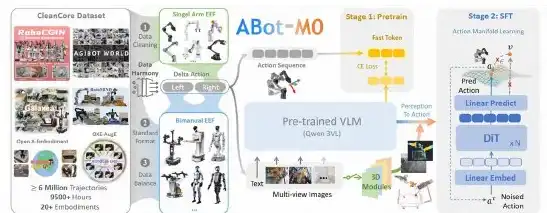
Embodied Intelligence Breakthrough: AutoNavi Open-Sources Universal Robot Base Model ABot-M0 AutoNavi has announced the full open-source release of ABot-M0, the world's first unified architecture-based embodied manipulation base model. This model is designed to enable "one general brain to adapt to multiple forms of robots," aiming to break down barriers between heterogeneous hardware and accelerate the adoption of embodied intelligence in industrial and household settings. ABot-M0 demonstrated exceptional performance in industry tests, achieving a task success rate of 80.5% on the Libero-Plus benchmark—a nearly 30% improvement over the previous benchmark, Pi0. It also set new state-of-the-art records on benchmarks like Libero and RoboCasa. The open-source release addresses long-standing challenges in the field, such as data isolation and deployment difficulties, by providing resources across three key dimensions: - **Data:** The UniACT dataset, the largest of its kind, with over 6 million real operation trajectories and full data pipeline tools. - **Algorithm:** The model architecture and training framework, featuring innovative components like Action Manifold Learning (AML) and a dual-stream perception architecture. - **Model:** End-to-end pre-trained models and a complete toolchain for out-of-the-box deployment, significantly lowering the barrier to adaptation. According to AutoNavi's ABot-M0 technical lead, this open-source initiative aims to build a bridge between ac...

The field of embodied intelligence has reached a milestone. Amap today officially announced the full open-source release of the world's first unified architecture-based robot operation base model ABot-M0. The core positioning of this model is to achieve "one universal brain adaptable to various forms of robots," aiming to break down barriers between heterogeneous hardware and accelerate the transition of embodied intelligence from the laboratory to industrial and home scenarios.

Core Technology and Performance

ABot-M0 has demonstrated outstanding performance in multiple industry authoritative benchmark tests. Data shows that the model achieved a task success rate of up to 80.5% on the Libero-Plus benchmark, a nearly 30% improvement over the previous industry benchmark solution Pi0. Furthermore, it set new SOTA (State-of-the-Art) records in tests such as Libero and RoboCasa.
Full Open-Source Across Three Dimensions

To address the long-standing pain points of "data silos" and "deployment difficulties" in the field of embodied intelligence, Amap's open-source release covers three key dimensions: underlying data, core algorithms, and pre-trained models:

  • Data Level: Open-sourced the currently largest universal robot dataset UniACT. This dataset integrates over 6 million real operation trajectories and provides a complete processing pipeline from heterogeneous data to standardized training data.

  • Algorithm Level: Simultaneously released the model architecture and training framework. Core highlights include Amap's innovative Action Manifold Learning (AML) algorithm and Dual-Stream Perception Architecture, endowing robots with exceptional spatial understanding and action execution capabilities.

  • Model Level: Provided end-to-end pre-trained models and a complete toolchain. Developers can achieve "out-of-the-box" usability without building a framework from scratch, significantly lowering the barrier to adapting to industrial collaborative or home service robots.

Industry Impact

Amap's ABot-M0 technical lead stated that true general embodied intelligence requires the collective refinement of global developers. The open-sourcing of ABot-M0 is not just a sharing of technology but also aims to build a bridge connecting academic research and industrial application, enabling every robot of different forms to possess a smart, reliable, and universal "brain".


Связанные с этим вопросы

QWhat is the name of the general-purpose robotic base model that AutoNavi has fully open-sourced?

AThe model is called ABot-M0.

QWhat is the core positioning or main goal of the ABot-M0 model?

AIts core positioning is to achieve 'one general-purpose brain adapted to various forms of robots', aiming to break down barriers between heterogeneous hardware.

QWhat is the name of the large-scale dataset that was open-sourced alongside the model, and how many real operation trajectories does it contain?

AThe dataset is called UniACT, and it integrates over 6 million real operation trajectories.

QOn which benchmark did ABot-M0 achieve a task success rate of 80.5%, and what was the performance improvement over the previous benchmark solution?

AIt achieved an 80.5% success rate on the Libero-Plus benchmark, which is a nearly 30% improvement over the previous benchmark solution, Pi0.

QName two core technical highlights of the algorithm that were open-sourced.

AThe two core technical highlights are the Action Manifold Learning (AML) algorithm and the Dual-Stream Perception architecture.

Похожее

From Madison Square Garden to Kalshi: Prediction Markets Break into the NBA Finals

From Madison Square Garden to Kalshi: Prediction Markets Break into the NBA Finals Prediction markets are playing a significant role in the 2026 NBA Finals, particularly around the New York Knicks' unexpected 2-0 series lead. Platforms like Kalshi and Polymarket have seen massive trading volumes, exceeding hundreds of millions of dollars on championship and related markets. Their influence extends beyond online trading. Kalshi's official partnership with Madison Square Garden has given it prominent physical branding at the arena. Furthermore, local businesses like The Jeffrey bar are using prediction market contracts to hedge the risk of game-result-based promotions, turning potential losses into manageable costs—a concept similar to the famous "Mattress Mack" strategy from traditional sports betting. These markets differentiate themselves by offering a wider, more entertainment-focused range of "event contracts" beyond typical game outcomes, such as predicting celebrity attendance. They also have broader accessibility across the U.S. compared to age- and location-restricted traditional sportsbooks. However, their rapid integration into sports raises regulatory and ethical questions. The NBA is cautiously engaging, discussing integrity frameworks with regulators like the CFTC. While the league permits minor investments like Giannis Antetokounmpo's stake in Kalshi, it advocates for strict rules to prevent insider trading. Many fans express concern on platforms like Reddit, fearing that the close ties between prediction markets, the league, and players could compromise the game's integrity. The NBA Finals has thus become a high-stakes testing ground, showcasing prediction markets' commercial potential while challenging traditional boundaries between financial trading, entertainment, and gambling.

marsbit1 ч. назад

From Madison Square Garden to Kalshi: Prediction Markets Break into the NBA Finals

marsbit1 ч. назад

Recursive Self-Improvement AI Gains Traction, Google Pours Cold Water, While DeepSeek and Others Approach the Fringes

The term "recursive self-improvement" (RSI), where AI improves itself autonomously, is gaining momentum in the AI industry. Startups like Recursive Superintelligence and projects such as Andrej Karpathy's Auto-Research aim to create systems where AI designs, implements, and validates its own research, moving toward superintelligence. While Google CEO Sundar Pichai cautions that such exponential acceleration is not yet a reality, progress is evident. For instance, Anthropic reported its Claude Code writes nearly 100% of the team's code, though it still lacks true self-direction. Analysts frame RSI development in stages: "adequacy" (systems functioning without humans), "parity" (matching human research quality), and "supremacy" (exceeding human-AI collaboration). Reaching parity could trigger rapid, unpredictable advancement due to AI's continuous operation. In China, companies like DeepSeek and Baidu incorporate self-optimization techniques without explicitly branding them as RSI, focusing on algorithmic efficiency and reinforcement learning. However, challenges remain, including "model collapse" from training on AI-generated data and the immense computational and open-collaboration requirements. Ultimately, RSI represents a trend of increasing automation in AI development, potentially reducing human oversight in the creation process itself.

marsbit1 ч. назад

Recursive Self-Improvement AI Gains Traction, Google Pours Cold Water, While DeepSeek and Others Approach the Fringes

marsbit1 ч. назад

Торговля

Спот
Фьючерсы
活动图片