Earnings Report, CLARITY Bill, and Warsh's Arrival: CRCL Faces Three Major Tests This Week

marsbitОпубликовано 2026-05-11Обновлено 2026-05-11

Введение

Circle (CRCL) faces three major tests this week that will significantly impact its stock price and valuation. First, on May 11, it will release its Q1 2026 earnings. Key metrics to watch are overall revenue and EPS, the proportion of revenue paid to distributors like Coinbase, and growth in non-interest income. The market also awaits Circle's stance on renegotiating its revenue-sharing contract with Coinbase, which expires in August. Second, on May 14, the U.S. Senate Banking Committee will vote on the CLARITY Act. This bill aims to establish a clear federal regulatory framework for digital assets. A recent compromise proposal would ban yield on static stablecoin reserves but allow rewards for active ones. Its passage, currently seen as likely by prediction markets, would be a major positive for the industry and Circle. Finally, on May 15, Kevin Warsh will succeed Jerome Powell as Federal Reserve Chair. Warsh's proposed policy of quantitative tightening combined with interest rate cuts could pose a short-term headwind for CRCL, as lower rates reduce Circle's primary revenue from USDC reserves. However, long-term prospects may improve as Warsh, a known crypto investor who opposes a Fed CBDC, is seen as potentially favorable to regulated private stablecoins like USDC.

Author|Azuma(@azuma_eth)

The Q1 earnings report on May 11th, the CLARITY bill's Senate hurdle on May 14th, and the Federal Reserve leadership change on May 15th... Circle (CRCL) is set to face three major tests this week. Each challenge will directly impact CRCL's price movement and may even redefine its valuation logic.

In the following, Odaily Planet Daily will analyze the progress and expectations of these three key events one by one and predict their potential impact on CRCL (Odaily Note: The following content does not constitute any investment advice).

Event One: 2026 Q1 Earnings Report

Tonight at 20:00, Circle will release its 2026 first-quarter earnings report before the US stock market opens, followed by an earnings conference call.

There are three main focal points for this earnings report.

  • The first is Circle's consolidated revenue and profit data for Q1 this year. Current market expectations for Circle's Q1 revenue are $715 million, with an expected earnings per share (EPS) of $0.178.
  • The second is the proportion of Circle's distribution costs (primarily to Coinbase) relative to its overall revenue. This represents Circle's dependence on distribution platforms like Coinbase. This ratio has shown a slight downward trend over the past few quarters and is expected to continue this trend in Q1.
  • The third is the growth status of non-interest income, meaning revenue from payments, enterprise, and on-chain businesses. This is the most important long-term data for Circle, indicating whether it can find a second major revenue stream beyond US Treasury interest.

Regarding the distribution contract with Coinbase, analysts are certain to ask about this during the earnings call, and Circle's response will be crucial. In August 2023, Circle signed a three-year contract with Coinbase, stipulating that Coinbase would receive all interest income generated by USDC on its platform, with interest from off-platform USDC split 50/50 between Coinbase and Circle.

This contract expires this August. However, last week the Coinbase CFO emphasized that the contract "renews every three years and never changes." If renewed under the original terms, it would certainly be unfavorable for Circle. Nevertheless, considering the current significant financial pressure on Coinbase and its strong reliance on Circle — all contracts are negotiated — this might be a favorable factor for Circle to seek amendment of the revenue-sharing terms.

  • Odaily Note: Refer to "Q1 Net Loss of $394.1 Million, Coinbase Has No Choice But to Hold Tight to Circle's Thigh".

Personally, I am cautiously optimistic about tonight's earnings report, expecting solid performance, but the focus lies more on Circle's stance regarding the August renewal.

Event Two: CLARITY Bill's Senate Hurdle

On May 14th, US local time, the US Senate Banking Committee will hold a vote hearing on the "Clarity for Digital Assets" bill (CLARITY Act). This will be a critical step for CLARITY to subsequently pass the Senate and become formal legislation.

The CLARITY Act aims to establish a regulatory framework for digital assets, clearly distinguish the classification of digital assets, and delineate the regulatory responsibilities of the US Securities and Exchange Commission (SEC) and the Commodity Futures Trading Commission (CFTC).

On July 17th last year, CLARITY passed the US House of Representatives with an overwhelming majority (vote count approximately 294–134) but encountered resistance when subsequently transferred to the Senate due to disagreements among various parties.

Controversies primarily centered around stablecoin yields, the regulatory approach to DeFi, and the ethics of the Trump family, especially the issue of stablecoin yields. Banking and crypto industries engaged in fierce debate, with Coinbase temporarily exiting negotiations, stalling the bill's progress (Recommended reading "Why Banks Insist on Banning Stablecoin Yields?").

The situation recently took a crucial turn. Senators Tom Tillis and Angela Alsbrooks have reached a compromise proposal, intending to ban yields on static stablecoin reserves but allowing rewards for actively used stablecoins.

Currently, on the prediction market Polymarket, the probability of CLARITY becoming law this year is as high as 76%, indicating relatively positive market sentiment regarding the bill's future progress.
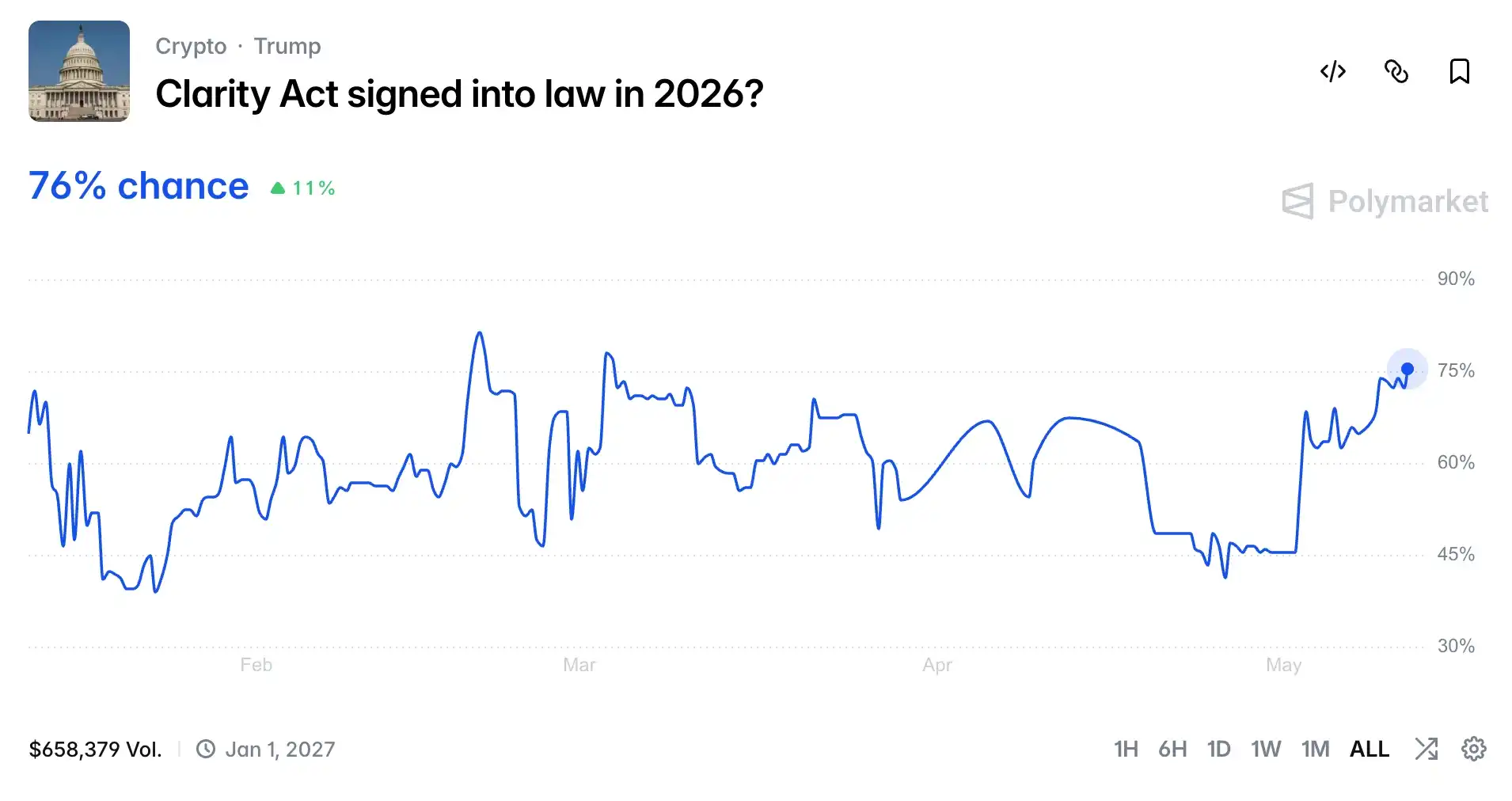
Once CLARITY becomes formal law, it will establish a clear, functional federal regulatory framework for the US digital asset market, addressing long-standing issues of regulatory ambiguity and inconsistent enforcement. This would be a significant positive for all industry participants, including Circle. My prediction on this is relatively optimistic.

Event Three: Federal Reserve Leadership Change

On May 15th, Jerome Powell's term as Federal Reserve Chairman officially ends (he will remain as a Board member until 2028), and his successor will be Kevin Warsh.

On April 29th, the US Senate Banking Committee voted to approve Warsh's nomination. Although it hasn't been confirmed by the full Senate vote yet, that is expected to happen in the coming days.

Unlike Powell, Warsh advocates for an unconventional combination of "balance sheet reduction + interest rate cuts," supporting inflation control through quantitative tightening (QT) while lowering interest rates to provide liquidity for the real economy. He believes QT targets the financial sector, while rate cuts benefit the industrial sector.

For Circle, which still relies primarily on US Treasury interest as its main income source, a market shift towards a rate-cutting cycle would be a direct bearish factor for CRCL. Simultaneously, QT could lead to tightened financial market liquidity in the short term, suppressing the stock market.

However, Warsh himself is a cryptocurrency holder. He is the first Federal Reserve Chair in history to have directly invested in the cryptocurrency field and places extreme importance on "the digital upgrade of US financial competitiveness." Warsh has also explicitly opposed the Fed issuing an official CBDC, arguing that its credit is deeply tied to national sovereignty; if the US dollar's credibility is damaged, the CBDC would also collapse. Therefore, he hopes to bring private stablecoins like USDC into the Federal Reserve's regulatory system, making them "shadow dollars."

Therefore, from a long-term perspective, Warsh taking office could potentially provide Circle with some policy tailwinds at the operational level, aiding its expansion.

So, regarding expectations, the short-term outlook may lean towards pessimism, but the long-term view could shift to neutral or optimistic.


Связанные с этим вопросы

QWhat are the three key events that Circle (CRCL) is facing this week according to the article?

AThe three key events are: 1) The Q1 2026 earnings report release on May 11. 2) The U.S. Senate Banking Committee hearing and vote on the CLARITY Act on May 14. 3) The transition of the Federal Reserve Chair from Powell to Kevin Warsh on May 15.

QWhat is the main concern regarding Circle's expiring contract with Coinbase?

AThe main concern is the terms of renewal. The current three-year contract, which gives Coinbase all interest from USDC on its platform and a 50% share of interest from off-platform USDC, expires in August 2026. The article suggests Circle may seek more favorable terms in the renewal, especially given Coinbase's current financial pressures.

QWhat is the significance of the CLARITY Act for the cryptocurrency industry, particularly for Circle?

AThe CLARITY Act aims to establish a clear federal regulatory framework for digital assets by distinguishing their classification and defining the regulatory roles of the SEC and CFTC. Its passage would be a major positive for industry participants like Circle by resolving long-standing regulatory ambiguity and inconsistent enforcement.

QAccording to the article, what is the potential market impact of Kevin Warsh's expected policy approach as the new Fed Chair?

AKevin Warsh's expected unconventional policy of 'shrinking the balance sheet (QT) + cutting interest rates' could create a short-term headwind for Circle. Rate cuts would directly reduce the interest income from its Treasury holdings (a primary revenue source), while QT could tighten financial market liquidity and pressure equity markets, including CRCL's stock price.

QWhat is the author's long-term view on Circle's prospects under a Kevin Warsh-led Federal Reserve?

AThe author holds a more optimistic long-term view. Despite potential short-term monetary policy headwinds, Kevin Warsh is described as a cryptocurrency holder who strongly supports the digital upgrade of U.S. financial competitiveness, opposes a Fed-issued CBDC, and favors bringing private stablecoins like USDC under the Fed's regulatory umbrella, which could provide favorable policy support for Circle's business expansion.

Похожее

Fei-Fei Li's Team Clarifies the Concept of 'World Models', Sora Merely a Renderer

"World Models" has become a widely used yet confusing term in AI. To address this, a team led by Fei-Fei Li and World Labs proposed a functional taxonomy based on the Partially Observable Markov Decision Process framework. This taxonomy categorizes systems called "world models" into three distinct projections: Renderers, Simulators, and Planners. Renderers, like OpenAI's Sora and other video generation models, focus on producing photorealistic visual outputs for human perception. They prioritize visual fidelity over physical accuracy. Simulators, such as NVIDIA Omniverse, aim to compute precise future environmental states for computational tasks like engineering analysis or digital twins. Planners, like Vision-Language-Action models, take in observations and goals to output executable actions for robots or agents. The article clarifies that most current "world models," including Sora, are primarily Renderers. They generate convincing visuals but lack the core ability to simulate state transitions based on actions, a key requirement for a true world model in classic reinforcement learning definitions. This conceptual confusion has practical implications, leading to potential misalignment in technology selection, investment, and public understanding of AI capabilities. Clear categorization is crucial. It helps enterprises avoid costly mistakes (e.g., using a renderer for robot training), allows investors to accurately assess markets, and enables researchers to build comparable benchmarks. While future systems may integrate these functions, recognizing current boundaries is essential for honest assessment and progress.

marsbit21 мин. назад

Fei-Fei Li's Team Clarifies the Concept of 'World Models', Sora Merely a Renderer

marsbit21 мин. назад

Bloomberg Uncovered: How Do China's Wealthy Circumvent the Annual $50,000 Limit to Transfer Assets?

**Summary: How Wealthy Chinese Circumvent $50,000 Annual Foreign Exchange Limits** Despite China's strict capital controls, including an annual $50,000 per person foreign exchange quota, an estimated $150 billion in funds still leaves the country annually via various gray and underground channels. This report outlines the evolution of China's "capital wall" and the methods used to bypass it. **The Evolving Capital Controls:** * **Foundation (1994):** The system of "current account convertibility with strict capital account controls" was established. * **Quota Set (2007):** The $50,000 individual annual forex purchase limit was formalized. * **Crackdown Begins (2015-2017):** Following market volatility, enforcement tightened. Banks were required to scrutinize transactions, and channels like using UnionPay cards for Hong Kong insurance premiums or buying overseas property were blocked. * **Digital & Legal Upgrades (2024-2026):** Enhanced algorithms now flag suspicious patterns (e.g., "smurfing"). The Common Reporting Standard (CRS) provides Chinese tax authorities with data on citizens' offshore accounts. Unlicensed cross-border brokers have been targeted. **Five Primary Methods for Moving Capital:** 1. **Underground Banking / "Hawala" (Duiqiao):** The largest-scale method. No money crosses borders. Clients pay RMB to a domestic account; an overseas associate deposits equivalent foreign currency into the client's offshore account. Risks include high fees, account freezes, and legal penalties. 2. **"Smurfing" or "Ant Moving":** Using multiple individuals' $50,000 quotas to pool funds for one offshore recipient. Increasingly detected by anti-money laundering algorithms. 3. **Trade Invoice Manipulation:** Businesses over-invoice imports or under-invoice exports via offshore shell companies, creating a pretext to transfer excess funds abroad under the guise of trade. 4. **Channel Migration:** After a crackdown on internet brokers, funds flow toward more compliant but costly channels like major banks' cross-border wealth management services or Qualified Domestic Institutional Investor (QDII) quotas. 5. **Structural Arrangements:** High-net-worth individuals use complex, high-cost legal structures involving offshore trusts, insurance, and investment migration programs to transfer asset ownership. **Regulatory Response: Focusing on People, Not Just Money** The current strategy extends oversight from enterprises to **individual residents**. Tools like CRS allow retroactive visibility into offshore assets. Cryptocurrencies, once seen as a potential loophole, are now actively monitored and prosecuted as an illegal channel. The underlying driver remains: with significant wealth concentrated among millions of affluent households seeking diversification amid domestic economic shifts, the incentive to move assets offshore persists despite regulatory barriers.

marsbit41 мин. назад

Bloomberg Uncovered: How Do China's Wealthy Circumvent the Annual $50,000 Limit to Transfer Assets?

marsbit41 мин. назад

Торговля

Спот
Фьючерсы

Популярные статьи

Как купить S

Добро пожаловать на HTX.com! Мы сделали приобретение Sonic (S) простым и удобным. Следуйте нашему пошаговому руководству и отправляйтесь в свое крипто-путешествие.Шаг 1: Создайте аккаунт на HTXИспользуйте свой адрес электронной почты или номер телефона, чтобы зарегистрироваться и бесплатно создать аккаунт на HTX. Пройдите удобную регистрацию и откройте для себя весь функционал.Создать аккаунтШаг 2: Перейдите в Купить криптовалюту и выберите свой способ оплатыКредитная/Дебетовая Карта: Используйте свою карту Visa или Mastercard для мгновенной покупки Sonic (S).Баланс: Используйте средства с баланса вашего аккаунта HTX для простой торговли.Третьи Лица: Мы добавили популярные способы оплаты, такие как Google Pay и Apple Pay, для повышения удобства.P2P: Торгуйте напрямую с другими пользователями на HTX.Внебиржевая Торговля (OTC): Мы предлагаем индивидуальные услуги и конкурентоспособные обменные курсы для трейдеров.Шаг 3: Хранение Sonic (S)После приобретения вами Sonic (S) храните их в своем аккаунте на HTX. В качестве альтернативы вы можете отправить их куда-либо с помощью перевода в блокчейне или использовать для торговли с другими криптовалютами.Шаг 4: Торговля Sonic (S)С легкостью торгуйте Sonic (S) на спотовом рынке HTX. Просто зайдите в свой аккаунт, выберите торговую пару, совершайте сделки и следите за ними в режиме реального времени. Мы предлагаем удобный интерфейс как для начинающих, так и для опытных трейдеров.

1.4k просмотров всегоОпубликовано 2025.01.15Обновлено 2026.06.02

Как купить S

Sonic: Обновления под руководством Андре Кронье – новая звезда Layer-1 на фоне спада рынка

Он решает проблемы масштабируемости, совместимости между блокчейнами и стимулов для разработчиков с помощью технологических инноваций.

2.3k просмотров всегоОпубликовано 2025.04.09Обновлено 2025.04.09

Sonic: Обновления под руководством Андре Кронье – новая звезда Layer-1 на фоне спада рынка

HTX Learn: Пройдите обучение по "Sonic" и разделите 1000 USDT

HTX Learn — ваш проводник в мир перспективных проектов, и мы запускаем специальное мероприятие "Учитесь и Зарабатывайте", посвящённое этим проектам. Наше новое направление .

1.8k просмотров всегоОпубликовано 2025.04.10Обновлено 2025.04.10

HTX Learn: Пройдите обучение по "Sonic" и разделите 1000 USDT

Обсуждения

Добро пожаловать в Сообщество HTX. Здесь вы сможете быть в курсе последних новостей о развитии платформы и получить доступ к профессиональной аналитической информации о рынке. Мнения пользователей о цене на S (S) представлены ниже.

活动图片