DWF Labs’ physical gold trade signals crypto capital’s move into commodities

cointelegraphОпубликовано 2025-12-23Обновлено 2025-12-23

Введение

DWF Labs, a cryptocurrency market maker, has expanded into physical commodities by settling its first gold transaction—a 25-kilogram gold bar—using traditional bullion infrastructure rather than blockchain. The company plans to scale this operation and trade additional commodities like silver, platinum, and cotton. This move contrasts with the broader crypto industry’s focus on tokenizing real-world assets and reflects a trend of crypto-native firms diversifying into traditional markets. The timing aligns with strong commodity performance, as gold prices hit record highs amid macroeconomic uncertainty, while crypto markets saw more muted gains. DWF Labs continues to invest in digital assets, including a $250 million Liquid Fund and a $75 million DeFi fund. Other firms like Coinbase are also expanding into legacy markets through tokenization and banking services.

DWF Labs, a cryptocurrency-focused market maker, has expanded into physical commodities after settling its first physical gold transaction, a rare move for a crypto-native company as precious metal prices continue to break record highs.

On Monday, managing partner Andrei Grachev said DWF Labs had “just settled our first gold trade,” describing it as a test tranche involving a single 25-kilogram gold bar. Grachev said the company plans to scale the operation, with ambitions to trade physical silver, platinum and cotton.

Notably, the transaction was completed using conventional bullion custody and settlement infrastructure, rather than blockchain-based rails.
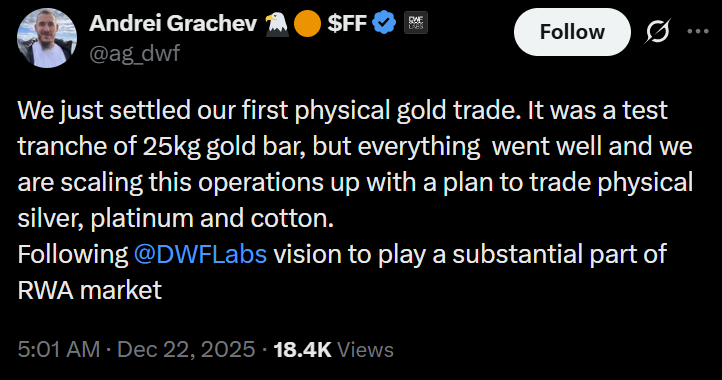
Source: Andrew Grachev

The move stands out at a time when many crypto-native companies are focused on tokenizing real-world assets. DWF Labs, by contrast, has engaged directly in the legacy commodities market in its gold transaction.

The timing reflects strong momentum in commodities markets this year. Gold and silver prices have outperformed much of the crypto sector, as investors seek hedges against macroeconomic uncertainty.

Gold futures recently reached new all-time highs above $4,500 per troy ounce, extending a year-long rally driven by central bank buying, geopolitical risk and expectations of eventual interest-rate cuts. By comparison, Bitcoin (BTC) and broader crypto markets have seen more muted price action over the same period.
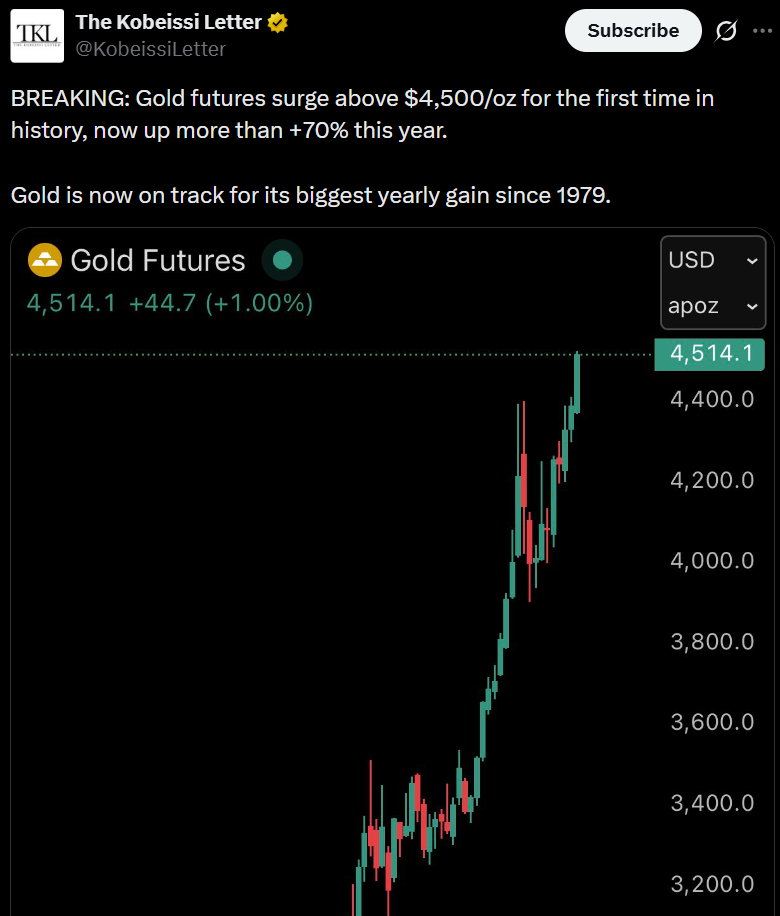
Source: The Kobeissi Letter

Beyond commodities, DWF Labs has expanded its footprint in digital assets. The company has launched multiple investment vehicles aimed at supporting crypto adoption, including a $250 million Liquid Fund focused on helping mid-cap blockchain projects scale, as well as a $75 million institutional DeFi fund.

Related: Tether Gold rides bullion boom as central banks, ETFs rush to accumulate

Is crypto blending into brick and mortar?

DWF Labs’ move into physical commodities appears to reflect a broader trend of crypto-native companies gradually extending into legacy markets to diversify revenue, reach new customers and broaden their operating scope beyond purely digital assets.

Other companies are pursuing parallel, though distinct, strategies. Coinbase, for instance, has outlined ambitions to become what it calls an “everything exchange,” with plans to let companies tokenize their shares for round-the-clock trading.

“In time, we believe everything will be tokenized, and bringing stocks to Coinbase is an important milestone toward enabling tokenized stocks,” Coinbase said in a blog post.

Deutsche Bank Research analysts said the move could “substantially widen [Coinbase’s] addressable market” across both retail and institutional clients, while helping to offset potential future pressure on retail crypto trading volumes, according to Bloomberg.

Several cryptocurrency companies have also sought entry into the traditional banking system through bank or trust charters, including stablecoin issuer Circle and digital asset custodian BitGo, which have pursued regulated banking or trust structures to expand their financial services offerings.

Related: Coinbase ‘cautiously optimistic’ on 2026 as crypto nears institutional inflection point

Связанные с этим вопросы

QWhat is the significance of DWF Labs settling its first physical gold transaction?

AIt marks a rare expansion for a crypto-native company into physical commodities, signaling a move to diversify beyond digital assets and into legacy markets like precious metals.

QHow did DWF Labs complete the gold transaction, and what infrastructure was used?

AThe transaction was completed using conventional bullion custody and settlement infrastructure, rather than blockchain-based rails.

QWhat are DWF Labs' future plans following this initial gold trade?

AThe company plans to scale its physical commodities operations and expand into trading physical silver, platinum, and cotton.

QHow have gold prices performed compared to cryptocurrencies like Bitcoin recently?

AGold futures reached all-time highs above $4,500 per troy ounce, outperforming Bitcoin and broader crypto markets, which saw more muted price action over the same period.

QWhat broader trend does DWF Labs' move into physical commodities reflect among crypto companies?

AIt reflects a trend of crypto-native companies expanding into traditional markets to diversify revenue, reach new customers, and broaden their operating scope beyond purely digital assets.

Похожее

The Value Distribution of Stablecoins

**Summary: The Value Distribution of Stablecoins** The article argues that stablecoins are evolving from mere trading tools into broader channels for dollar access. It divides the stablecoin ecosystem into four layers to analyze how value is distributed: 1. **Issuance Layer:** Mints stablecoins, holds reserve assets, and captures the spread between reserve yield and user costs (e.g., Tether, Circle). This layer currently earns the largest profit margin. 2. **Infrastructure Layer:** Connects stablecoins to the traditional financial system, handling fiat on/off-ramps, banking integration, compliance (KYC/AML), and asset management (e.g., Bridge, BVNK). This is the "unglamorous" but critical work, building the essential bridges between crypto and real-world finance. 3. **Acquiring/Distribution Layer:** Integrates stablecoins into merchant systems, manages payment flows, and provides enterprise financial software (e.g., Stripe, Coinbase). They act as the access point for businesses. 4. **Application Layer:** The end-users and businesses that ultimately use stablecoins for payments, settlements, or as a store of value. They benefit from convenience but have little pricing power. The core thesis is that while the issuance layer currently dominates profits, the often-overlooked **infrastructure layer holds significant long-term potential**. The real challenge and barrier to mass adoption is not the on-chain transfer of stablecoins (which is simple), but the complex "last mile" integration into existing business workflows, banking systems, and regulatory frameworks across different countries. Companies in this layer are currently in a "land grab" phase, investing heavily to build networks, secure bank partnerships, and establish compliance pathways. While their position is currently pressured by the profitable issuers above and distribution platforms below, the article suggests that if stablecoins become a default financial rail for businesses, the infrastructure providers who have done the hard work of integration will ultimately gain strong pricing power and become entrenched, essential players.

marsbit5 ч. назад

The Value Distribution of Stablecoins

marsbit5 ч. назад

The Value Distribution of Stablecoins

The Value Distribution of Stablecoins The article argues that stablecoins are evolving from a mere trading tool into a broad "dollar channel." It analyzes the industry's value chain through four layers: 1. **Issuance Layer (e.g., Tether, Circle):** The top layer that mints stablecoins, holds reserve assets, and captures the thickest interest rate spread. 2. **Infrastructure Layer (e.g., Bridge, BVNK):** Connects stablecoins to the traditional financial system, handling critical but complex "dirty work" like fiat on/off-ramps, banking integration, compliance (KYC/AML), and cross-border settlement. 3. **Acquiring/Distribution Layer (e.g., Stripe, Coinbase):** Embeds stablecoins into merchant systems, manages payment flows, and integrates with enterprise software. 4. **Application Layer:** End-users and businesses that ultimately use stablecoins for payments, settlement, or storing value. The author posits that while the issuance layer currently captures the most profit, the most overlooked and potentially critical layer is infrastructure. The core challenge for stablecoin adoption isn't the on-chain transfer (which is simple), but bridging the gap between blockchain and the real-world financial system. This involves solving practical problems for businesses: fiat conversion, reconciliation, tax handling, and user onboarding. Infrastructure companies are currently in a difficult "land-grab" phase—building networks, securing banking relationships, and achieving compliance country-by-country. They face pressure from both the profitable issuance layer above and distribution platforms below. However, the author suggests this layer is building a crucial moat. Once stablecoins become a default business rail, the infrastructure players who have done the hard work of integration may gain significant, durable value and pricing power.

链捕手5 ч. назад

The Value Distribution of Stablecoins

链捕手5 ч. назад

Торговля

Спот
Фьючерсы

Популярные статьи

Как купить S

Добро пожаловать на HTX.com! Мы сделали приобретение Sonic (S) простым и удобным. Следуйте нашему пошаговому руководству и отправляйтесь в свое крипто-путешествие.Шаг 1: Создайте аккаунт на HTXИспользуйте свой адрес электронной почты или номер телефона, чтобы зарегистрироваться и бесплатно создать аккаунт на HTX. Пройдите удобную регистрацию и откройте для себя весь функционал.Создать аккаунтШаг 2: Перейдите в Купить криптовалюту и выберите свой способ оплатыКредитная/Дебетовая Карта: Используйте свою карту Visa или Mastercard для мгновенной покупки Sonic (S).Баланс: Используйте средства с баланса вашего аккаунта HTX для простой торговли.Третьи Лица: Мы добавили популярные способы оплаты, такие как Google Pay и Apple Pay, для повышения удобства.P2P: Торгуйте напрямую с другими пользователями на HTX.Внебиржевая Торговля (OTC): Мы предлагаем индивидуальные услуги и конкурентоспособные обменные курсы для трейдеров.Шаг 3: Хранение Sonic (S)После приобретения вами Sonic (S) храните их в своем аккаунте на HTX. В качестве альтернативы вы можете отправить их куда-либо с помощью перевода в блокчейне или использовать для торговли с другими криптовалютами.Шаг 4: Торговля Sonic (S)С легкостью торгуйте Sonic (S) на спотовом рынке HTX. Просто зайдите в свой аккаунт, выберите торговую пару, совершайте сделки и следите за ними в режиме реального времени. Мы предлагаем удобный интерфейс как для начинающих, так и для опытных трейдеров.

1.5k просмотров всегоОпубликовано 2025.01.15Обновлено 2026.06.02

Как купить S

Sonic: Обновления под руководством Андре Кронье – новая звезда Layer-1 на фоне спада рынка

Он решает проблемы масштабируемости, совместимости между блокчейнами и стимулов для разработчиков с помощью технологических инноваций.

2.3k просмотров всегоОпубликовано 2025.04.09Обновлено 2025.04.09

Sonic: Обновления под руководством Андре Кронье – новая звезда Layer-1 на фоне спада рынка

HTX Learn: Пройдите обучение по "Sonic" и разделите 1000 USDT

HTX Learn — ваш проводник в мир перспективных проектов, и мы запускаем специальное мероприятие "Учитесь и Зарабатывайте", посвящённое этим проектам. Наше новое направление .

1.8k просмотров всегоОпубликовано 2025.04.10Обновлено 2025.04.10

HTX Learn: Пройдите обучение по "Sonic" и разделите 1000 USDT

Обсуждения

Добро пожаловать в Сообщество HTX. Здесь вы сможете быть в курсе последних новостей о развитии платформы и получить доступ к профессиональной аналитической информации о рынке. Мнения пользователей о цене на S (S) представлены ниже.

活动图片