Duan Yongping Makes First Investment in Crypto Company: Why Circle?

链捕手Опубликовано 2026-05-20Обновлено 2026-05-20

Введение

Duan Yongping, a renowned Chinese investor known as the "Chinese Buffett," has made his first investment in the cryptocurrency space through his family office, H&H International Investment LLC. According to a recent 13F filing, the firm acquired a position in stablecoin issuer Circle (CRCL), valued at approximately $19.08 million. While this amount represents only 0.2% of Duan's total portfolio, the move is symbolically significant. Historically cautious towards Web3 and crypto assets, Duan's investment philosophy aligns with traditional value investing principles—emphasizing understandable business models, strong moats, and stable cash flows. Most crypto projects have not met these criteria. Circle, however, stands apart. Its core business revolves around issuing the USDC stablecoin and generating interest income from its reserve assets, primarily U.S. Treasuries. This model resembles a money market fund or digital dollar bank, providing predictable revenue. Circle's Q1 2026 financials showed strong growth: revenue reached $694 million (up 20% year-on-year), with 94% from reserve interest, and adjusted EBITDA was $151 million (up 24%). USDC circulation grew 28% to $77 billion. Duan's investment signals a shift: stablecoin infrastructure like Circle's is becoming legible to traditional value investors. It represents a bridge between crypto and mainstream finance, underscored by Circle's recent $222 million pre-sale for its Arc layer-1 blockchain, backed by major firms like...

Circle Author: Hu Tao, ChainCatcher

H&H International Investment LLC, the family wealth management firm of renowned investor Duan Yongping, often referred to as the "Chinese Buffett," recently filed its Q1 13F holdings report with the U.S. SEC for the period ending March 31, 2026.

According to the report, the total market value of Duan Yongping's investment portfolio grew significantly from $17.49 billion last quarter to $20.004 billion. While continuing to hold heavy positions in Apple (AAPL), Berkshire Hathaway (BRK.B), and NVIDIA (NVDA), a new name has drawn the joint attention of both the crypto industry and value investors: stablecoin giant Circle (NYSE: CRCL).

Although the initial purchase amount of $19.08 million represents only 0.2% of Duan Yongping's vast portfolio, the signal it sends is highly symbolic. For a veteran value investor who has always invested only in businesses that are "understandable, have a moat, and generate good cash flow," the logic behind buying Circle is worth pondering.

From Exclusion to Acceptance

It is well known that Duan Yongping is one of China's most successful entrepreneur-investors and one of the very few Chinese investors who have truly practiced Buffett-style value investing long-term with great success.

However, Duan Yongping has long maintained a cautious attitude towards blockchain and Web3. Over the past few years, he has rarely publicly participated in the Web3 frenzy and has not frequently discussed concepts like NFTs, DeFi, or public blockchains as some tech investors have. He has also shown no significant interest in Bitcoin during its multiple boom-and-bust cycles.

This is actually not surprising. Duan Yongping's core investment framework is essentially closer to the Buffett system: it emphasizes long-term cash flow, understandability of the business model, brand and channel moats, and management quality. He particularly favors companies with strong consumer mindshare, high free cash flow, and long-term compounding ability, such as Apple, Kweichow Moutai, and Berkshire Hathaway.

However, most crypto projects in the past have found it difficult to meet these criteria.

Many Web3 projects have been highly dependent on token price movements, with fragile business models and unsustainable cash flows; the industry has long been accompanied by regulatory uncertainty, governance chaos, and cyclical bubbles. These characteristics are almost inherently at odds with the "certainty" emphasized by traditional value investors.

But Circle is an exception. Compared to many crypto projects that rely on "storytelling" or speculation to sustain valuations, Circle is more like a typical financial infrastructure company.

Why Circle?

Circle's core business is not "speculating on crypto," but issuing the stablecoin USDC and earning interest income through reserve assets like U.S. Treasuries. Its profit model is actually closer to that of a money market fund, a payment clearing platform, or even a "digital dollar bank."

This also means its revenue source is highly predictable. And Circle's latest Q1 2026 earnings report further reinforces this point.

The report shows that Circle's total Q1 revenue reached $694 million, a 20% year-on-year increase, with 94% coming from reserve interest income; adjusted EBITDA reached $151 million, a 24% year-on-year increase.

More crucially, its core business metrics are still expanding rapidly: USDC circulation reached $77 billion, up 28% year-on-year; USDC on-chain transaction volume reached $21.5 trillion, a staggering 263% year-on-year surge.

This means Circle has formed a relatively complete "stablecoin interest machine." Under the U.S. high-interest-rate cycle, the interest income generated from USDC reserves is growing rapidly, making Circle one of the few large companies in the crypto industry that truly has stable cash flow and can sustain profitability.
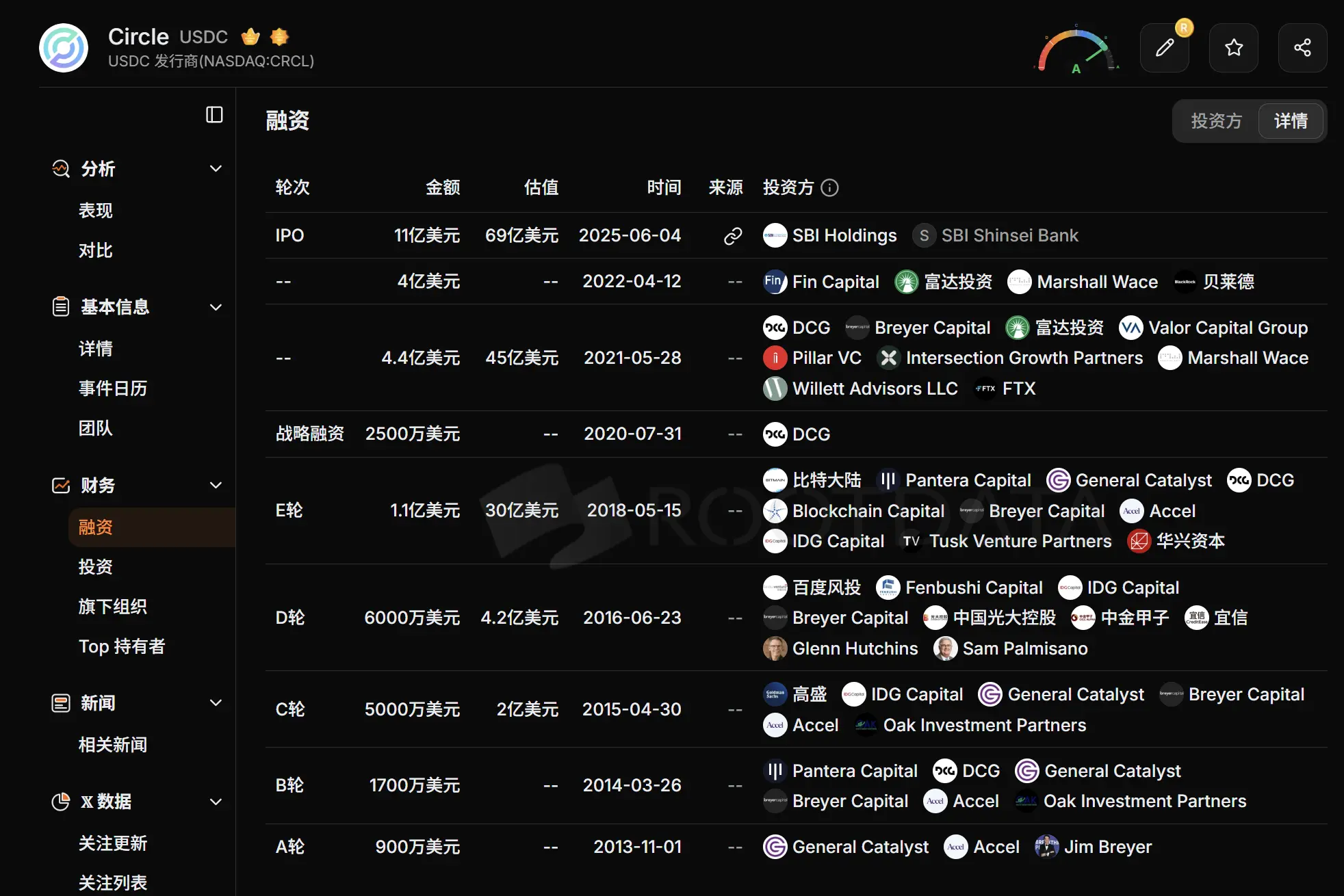
Circle's Financing History Source: RootData

For an investor like Duan Yongping who emphasizes the "essence of business," Circle has finally begun to take on a "understandable" form.

At the end of April, Circle also announced that its Layer 1 network, Arc, completed a token pre-sale financing round of $222 million, valuing it at $3 billion. a16z led a $75 million investment, with participation from more than ten institutions including BlackRock, Apollo Funds, Intercontinental Exchange (ICE), Standard Chartered Ventures, ARK Invest, and Bullish.

The expansion into the public chain network and the issuance of a native token have further opened the ceiling for Circle's business, and its stock price has risen accordingly. In May, Circle's stock price surged nearly 3 times from its yearly low ($50), briefly breaking through $140, and has since retreated slightly to around $111.

Traditional Finance is Increasingly Accepting Crypto Assets

Today, more and more crypto companies are attempting IPOs. From exchanges and stablecoin issuers to on-chain payment and custody infrastructure, many crypto enterprises are actively entering traditional capital markets, hoping to gain more stable financing channels, a broader institutional shareholder base, and stronger regulatory legitimacy.

At the same time, traditional financial giants are also entering the crypto space at an unprecedented pace. Whether it's BlackRock promoting Bitcoin ETFs, traditional banks exploring stablecoin settlement and on-chain asset custody, or payment institutions integrating with the USDC network, it essentially illustrates one thing:

The crypto industry is no longer just an independently existing "alternative market," but is beginning to integrate deeply with the global financial system.

In this process, stablecoin companies like Circle are becoming the bridge most easily understood and accepted by traditional capital.

The significance of Duan Yongping's purchase of Circle lies precisely here. It may not mean he is fully bullish on Web3, nor does it mean the value investing system is embracing all crypto assets. But at the very least, it shows that stablecoins and the on-chain dollar system have begun to enter the "circle of competence" of some traditional top-tier investors.

From a broader perspective, Circle is just one of the pioneers being "translated" by traditional mainstream capital from the crypto industry. As regulatory frameworks gradually become clearer, infrastructure matures, and profit models are continuously validated, more crypto-native enterprises like Circle will likely enter the view of traditional capital markets in the future.

Связанные с этим вопросы

QWhat is the significance of Duan Yongping's first investment in a crypto company, Circle, according to the article?

AThe article states that while the investment amount is small relative to his portfolio (0.2%), it is highly symbolic. It signifies that a traditional, Buffett-style value investor, who emphasizes investing in understandable businesses with strong moats and good cash flow, has found a crypto company (Circle) that fits his investment criteria. This reflects a potential bridge between traditional finance and the crypto sector.

QWhy did Duan Yongping historically avoid most crypto investments, and how is Circle an exception?

ADuan Yongping avoided most crypto investments because they often did not meet his value investing criteria: they lacked predictable long-term cash flows, had fragile business models dependent on token prices, and operated in a space with high regulatory uncertainty. Circle is an exception because its core business model, issuing the stablecoin USDC and earning interest from reserve assets, is more akin to a financial infrastructure company or a 'digital dollar bank' with predictable and profitable cash flows.

QWhat are the key financial metrics from Circle's latest quarterly report that likely made it attractive to a value investor?

ACircle's Q1 report showed total revenue of $694 million (up 20% YoY), with 94% coming from reserve interest income. Adjusted EBITDA was $151 million (up 24% YoY). Key operational metrics also grew: USDC circulation reached $77 billion (up 28% YoY) and USDC on-chain transaction volume surged to $21.5 trillion (up 263% YoY), demonstrating a scalable and profitable 'stablecoin interest machine'.

QHow does Circle's recent funding round for its Layer 1 network, Arc, relate to its business prospects and stock performance?

AIn late April, Circle announced a $222 million token pre-sale for its Layer 1 network Arc, valuing it at $3 billion, with backing from major firms like a16z, BlackRock, and Apollo. This expansion into a blockchain network and native token opens up new growth avenues for Circle, increasing its business ceiling. Subsequently, Circle's stock price rose significantly in May, nearly tripling from its yearly low to briefly surpass $140.

QWhat broader trend in the finance industry does Duan Yongping's investment in Circle represent?

AIt represents the increasing integration of the crypto industry with the traditional financial system. More crypto companies are seeking IPOs for legitimacy and funding, while traditional finance giants like BlackRock are entering the crypto space (e.g., via Bitcoin ETFs). In this context, stablecoin companies like Circle, which function as financial infrastructure, are becoming the most understandable and acceptable bridge for traditional capital, signaling a wider acceptance of certain crypto-native business models.

Похожее

U.S.-Iran Ceasefire: How Much of a Bitcoin Rally Can a Truce Agreement Support?

Headline: "U.S.-Iran Truce: How Much Can a Ceasefire Agreement Propel Bitcoin's Rebound?" On June 15th, Bitcoin rebounded to around $67,255, marking its first return to the $67,000 level since falling below $60,000 earlier in June. Ethereum and Solana also saw significant gains. The immediate driver for this market-wide recovery in crypto and global risk assets was the signing of a U.S.-Iran ceasefire memorandum, with a formal ceremony scheduled for June 19th. The agreement, which includes reopening the Strait of Hormuz, caused oil prices to plunge roughly 5%, easing inflation expectations and boosting prospects for Federal Reserve rate cuts. This macroeconomic shift fueled a rally in U.S. equities, with the Dow Jones hitting a record high. SpaceX's spectacular post-IPO performance further energized market sentiment. However, on-chain and derivatives data from Glassnode suggest this move is more indicative of a technical rebound from deeply oversold conditions rather than a confirmed trend reversal. The crypto market is undergoing noticeable capital rotation. While Bitcoin ETFs recently saw their worst outflows on record, the bleeding has slowed significantly. Meanwhile, new altcoin ETFs for assets like XRP and Solana are attracting substantial inflows, causing Bitcoin's market dominance to drop to 58%. Despite the rebound, the Crypto Fear & Greed Index remains in "Extreme Fear" territory at 22. The price quickly retreated after touching the $67,000 resistance level, indicating selling pressure persists. Analysis shows short-term speculative supply has been heavily washed out, with holder structure shifting toward a more long-term profile. While panic is subsiding and some on-chain metrics point to accumulation at lower prices, the market currently lacks the strong, sustained institutional buying needed to establish a new bullish trend.

Foresight News4 мин. назад

U.S.-Iran Ceasefire: How Much of a Bitcoin Rally Can a Truce Agreement Support?

Foresight News4 мин. назад

Copper, the Gold of 2026

Copper: The New Gold for 2026? Market focus has shifted from AI chips to underlying infrastructure, with copper emerging as a key narrative. Its role is evolving beyond "Dr. Copper"—a traditional indicator of economic cycles—due to structural demand growth from AI data centers (requiring massive electrical infrastructure), grid expansion, EVs, and re-industrialization. Estimates suggest data centers alone could require 300,000 tons of copper by 2050. The core bullish thesis is not just demand but a severe supply constraint. New copper mines take ~17 years to develop, while ore grades are declining and new discoveries are scarce, potentially leading to a 30% supply deficit by 2035. This supply rigidity, coupled with strategic importance, is giving copper a "gold-like" scarcity narrative. Major macro investors, including Stanley Druckenmiller, are allocating to copper as a hedge against dollar weakness and for its exposure to energy transition and geopolitics. Traders like Pierre Andurand have projected prices could reach $40,000/ton. Capital inflows are visible in surging futures trading volumes. Copper mining stocks act as leveraged plays on copper prices. Companies like Freeport-McMoRan (FCX) and Southern Copper (SCCO), as well as Chinese miners like CMOC, have seen significant volatility, offering high upside but also steep drawdowns, reflecting operational and geopolitical risks. While copper remains cyclical and won't fully replicate gold's monetary role, its long-term fundamentals have shifted. Its new scarcity premium, driven by a tightening supply structure and expanding electrical demand, suggests its "goldification" is just beginning.

marsbit11 мин. назад

Copper, the Gold of 2026

marsbit11 мин. назад

pump.fun's New Feature Brings 'Black Mirror' Into Reality

The article begins by recounting a dark fictional story from *Black Mirror* (Season 7, Episode 1 "Common People"), where a man is forced to perform humiliating tasks online to pay for his wife's life-sustaining medical subscription. It then draws a parallel to a new real-world feature on the crypto platform pump.fun called "Pump.fun Go," which allows users to post and complete paid bounty tasks. This feature gained mainstream attention, often negatively, through extreme examples. A prominent case involved a bounty of 40 SOL (~$2,600) offered to permanently tattoo "$bountywork" on one's forehead. An Indian man completed the task, stating the money "changed his life," and later earned significantly more from a related meme coin. Another bounty paid 200 SOL (~$14,000) for a "bounty.fun" forehead tattoo, with the participant simply stating, "We need the money." The article highlights how this system can amplify darkness, citing the dev behind $Bountywork who spent thousands on bounties for attention-grabbing stunts like eating bugs or drinking hot sauce for small sums. It compares this to past tragic live-streaming incidents where people harmed themselves for money, noting regulation cannot stop those in desperate need. However, it also points to positive, altruistic bounties that have emerged, such as organizing anti-work rallies in New York, performing random acts of kindness for strangers, organizing community food drives, or even helping an elderly person cross the street. The piece concludes by acknowledging the platform reflects both the dark and light sides of human nature when actions are given a price, hoping for more of the latter.

marsbit16 мин. назад

pump.fun's New Feature Brings 'Black Mirror' Into Reality

marsbit16 мин. назад

Торговля

Спот
Фьючерсы
活动图片