Double Zero slides 12% as momentum fades – Is the worst over for 2Z?

ambcryptoОпубликовано 2026-01-26Обновлено 2026-01-26

Введение

Double Zero (2Z) has declined over 12% amid a broader market downturn and significant long liquidations exceeding $719,000. Technical indicators remain bearish, with the MACD showing a death cross and the RSI trending downward around 46, suggesting potential further losses. A key demand zone lies between $0.114 and $0.118, which could serve as support. A rebound from this level toward $0.15 would represent a 28% gain, but current spot buying of around $874,400 appears insufficient to drive a strong recovery. Despite the bearish signals, derivatives traders maintain a slight long bias, with a Long-to-Short Ratio of 1.043 and a positive funding rate, indicating lingering bullish sentiment.

Double Zero has moved decisively lower following a major liquidity shift that triggered broad capitulation.

At press time, the altcoin was down over 12%, with rebound prospects appearing muted as momentum remains notably weak. While market participants continue to anticipate a reversal, the technical confluence needed to support such a move has yet to materialize.

Downtrend deepens as 2Z loses momentum

Double Zero’s [2Z] decline does not appear to be slowing at the time of publication. From a technical perspective, the chart showed an absence of immediate support levels—zones that typically act as buffers for price stabilization or rebounds.

However, the chart does reveal a lower ascending support that could serve as a potential pivot for price action.

This structure aligns with a demand zone between $0.114 and $0.118, an area that may provide the necessary footing for the price to stabilize or attempt a recovery.

A rebound from this zone toward the $0.15 level would represent a potential 28% upside, with additional gains possible if momentum improves.

That said, trader confidence remains fragile. Over the past 24 hours, long-positioned traders have incurred losses exceeding $719,700, compared to just $2,400 in losses recorded by short sellers.

Technical indicators tilt firmly bearish

Technical indicators continue to argue against aggressive accumulation at current levels. The Moving Average Convergence Divergence (MACD) remained firmly bearish after printing a classic “death cross.”

This pattern forms when the MACD line crosses below the signal line and is often associated with prolonged downside pressure. Historically, such setups have preceded sharper declines as selling momentum accelerates.

The Relative Strength Index (RSI) reinforces this bearish setup. At the time of publication, the RSI had slipped into the bearish zone between 30 and 50 and printed a reading of 46, with momentum still trending lower.

A sustained decline in the RSI typically reflects weakening market strength and raises the likelihood of continued downside price action.

If both indicators remain under pressure—particularly with the MACD firmly in negative territory—2Z could face deeper losses in the near term.

Spot demand lags as derivatives traders hold long bias

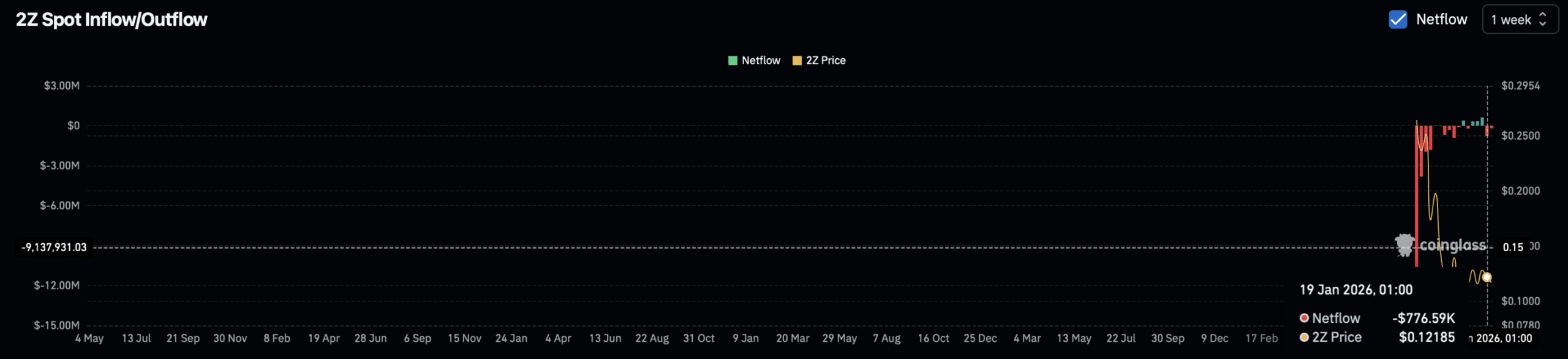
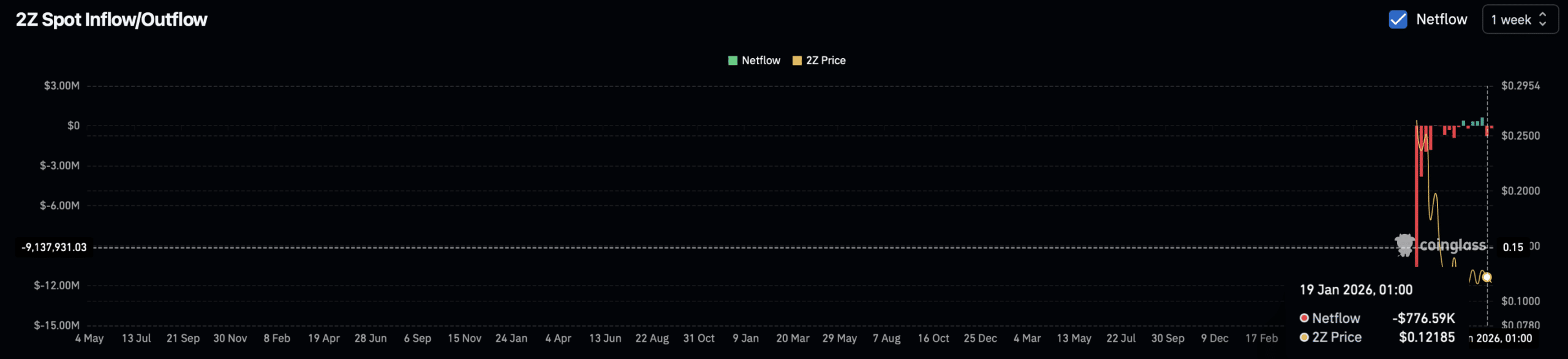
Spot market activity showed signs of accumulation, with buyers adding to positions over the past two weeks. However, the scale of these purchases remains modest.

According to CoinGlass Spot Netflow data, total spot purchases over this period amounted to approximately $874,400. While this inflow may help slow the pace of the decline, it remains insufficient to provide meaningful price support.

Meanwhile, sentiment in the 2Z perpetual market continued to hint at a potential rebound near the previously identified support zone.

The Long-to-Short Ratio, which tracks directional positioning—above 1 indicating long dominance and below 1 signaling short control—supports this view.
At press time, the ratio stood at 1.043. In addition, the Open Interest–Weighted Funding Rate printed a positive 0.0019%, suggesting that capital positioning remained tilted in favor of bullish traders.

This indicates that despite recent liquidation losses, trader conviction on the long side remains intact. Whether this positioning holds may prove pivotal in shaping 2Z’s next directional move.


Final Thoughts

  • 2Z may extend its decline until it finds a support level capable of cushioning further losses, even as a potential 28% rebound remains in view.
  • Indicators point to a short-term pullback, although spot traders and perpetual 2Z traders continue to maintain a bullish bias.


Связанные с этим вопросы

QWhat was the percentage decline in Double Zero (2Z) at the time of publication?

ADouble Zero was down over 12% at the time of publication.

QWhat is the potential upside percentage if 2Z rebounds from the demand zone to the $0.15 level?

AA rebound from the demand zone to the $0.15 level would represent a potential 28% upside.

QWhat key bearish technical pattern did the MACD indicator show?

AThe MACD indicator showed a classic 'death cross', which occurs when the MACD line crosses below the signal line.

QWhat does a Long-to-Short Ratio above 1 indicate for the 2Z perpetual market?

AA Long-to-Short Ratio above 1 indicates that long positions are dominant in the market.

QWhat was the total value of spot purchases over the two weeks leading up to the article?

ATotal spot purchases over the past two weeks amounted to approximately $874,400.

Похожее

Will the Next Crypto Bull Run Start with On-Chain Trading of SpaceX?

This article presents a scenario-based forecast for the crypto industry from 2026 to 2029, arguing that the next major cycle will be driven not by technological narratives but by legal access to real-world assets. The author predicts that by mid-2026, pre-IPO perpetual contracts for top private companies like SpaceX, OpenAI, and Anthropic on platforms like Hyperliquid will become the primary gateway for accessing quality assets, as most crypto-native tokens fail to capture real value. The much-hyped AI x Crypto intersection largely fails except for prediction markets, which thrive on betting on AI model supremacy. By 2027, public blockchain foundations are forced to choose between catering to retail speculation or building compliant infrastructure for institutions, with many opting for the latter. Growth in stablecoins and tokenized private credit/equity hits a "triple ceiling" due to regulatory and political uncertainty rather than market demand. The pivotal shift is forecast for 2028. A major liquidation event in pre-IPO perpetuals exposes the structural flaw of synthetic markets lacking a real underlying asset anchor. In response, regulatory changes finally allow the public solicitation of private securities resales to verified accredited investors. This creates a legitimate secondary market for real company equity, which then becomes the core asset class of the new bull market, relegating synthetic perps to a niche role. By 2029, the industry becomes "boring" but foundational. Tokens without claims on real cash flows or assets cease trading. Stablecoin growth is steady but politically capped. Crypto infrastructure fades from view as it gets absorbed into traditional finance backends. The article's central thesis is that the key bottleneck for crypto's next phase is legal and regulatory channels for real asset ownership, not technology.

marsbit1 ч. назад

Will the Next Crypto Bull Run Start with On-Chain Trading of SpaceX?

marsbit1 ч. назад

The Value Distribution of Stablecoins

**Summary: The Value Distribution of Stablecoins** The article argues that stablecoins are evolving from mere trading tools into broader channels for dollar access. It divides the stablecoin ecosystem into four layers to analyze how value is distributed: 1. **Issuance Layer:** Mints stablecoins, holds reserve assets, and captures the spread between reserve yield and user costs (e.g., Tether, Circle). This layer currently earns the largest profit margin. 2. **Infrastructure Layer:** Connects stablecoins to the traditional financial system, handling fiat on/off-ramps, banking integration, compliance (KYC/AML), and asset management (e.g., Bridge, BVNK). This is the "unglamorous" but critical work, building the essential bridges between crypto and real-world finance. 3. **Acquiring/Distribution Layer:** Integrates stablecoins into merchant systems, manages payment flows, and provides enterprise financial software (e.g., Stripe, Coinbase). They act as the access point for businesses. 4. **Application Layer:** The end-users and businesses that ultimately use stablecoins for payments, settlements, or as a store of value. They benefit from convenience but have little pricing power. The core thesis is that while the issuance layer currently dominates profits, the often-overlooked **infrastructure layer holds significant long-term potential**. The real challenge and barrier to mass adoption is not the on-chain transfer of stablecoins (which is simple), but the complex "last mile" integration into existing business workflows, banking systems, and regulatory frameworks across different countries. Companies in this layer are currently in a "land grab" phase, investing heavily to build networks, secure bank partnerships, and establish compliance pathways. While their position is currently pressured by the profitable issuers above and distribution platforms below, the article suggests that if stablecoins become a default financial rail for businesses, the infrastructure providers who have done the hard work of integration will ultimately gain strong pricing power and become entrenched, essential players.

marsbit7 ч. назад

The Value Distribution of Stablecoins

marsbit7 ч. назад

The Value Distribution of Stablecoins

The Value Distribution of Stablecoins The article argues that stablecoins are evolving from a mere trading tool into a broad "dollar channel." It analyzes the industry's value chain through four layers: 1. **Issuance Layer (e.g., Tether, Circle):** The top layer that mints stablecoins, holds reserve assets, and captures the thickest interest rate spread. 2. **Infrastructure Layer (e.g., Bridge, BVNK):** Connects stablecoins to the traditional financial system, handling critical but complex "dirty work" like fiat on/off-ramps, banking integration, compliance (KYC/AML), and cross-border settlement. 3. **Acquiring/Distribution Layer (e.g., Stripe, Coinbase):** Embeds stablecoins into merchant systems, manages payment flows, and integrates with enterprise software. 4. **Application Layer:** End-users and businesses that ultimately use stablecoins for payments, settlement, or storing value. The author posits that while the issuance layer currently captures the most profit, the most overlooked and potentially critical layer is infrastructure. The core challenge for stablecoin adoption isn't the on-chain transfer (which is simple), but bridging the gap between blockchain and the real-world financial system. This involves solving practical problems for businesses: fiat conversion, reconciliation, tax handling, and user onboarding. Infrastructure companies are currently in a difficult "land-grab" phase—building networks, securing banking relationships, and achieving compliance country-by-country. They face pressure from both the profitable issuance layer above and distribution platforms below. However, the author suggests this layer is building a crucial moat. Once stablecoins become a default business rail, the infrastructure players who have done the hard work of integration may gain significant, durable value and pricing power.

链捕手8 ч. назад

The Value Distribution of Stablecoins

链捕手8 ч. назад

Торговля

Спот
Фьючерсы
活动图片



