Dogecoin Price Just Entered A Critical Level, But Analyst Says It’s Not Time To Buy

bitcoinistОпубликовано 2026-06-04Обновлено 2026-06-04

Введение

Dogecoin has returned to a major long-term level on its monthly chart, entering what analyst Trader Tardigrade identifies as a critical resistance zone. Historically, this zone within a massive descending broadening channel has seen only two visits in the past decade—in 2017 and 2020—each followed by a strong rejection and deep correction. The coin has already dropped 8% after testing this area. Crucially, the analyst's chart is inverted; the "resistance" line is actually a bullish support line on a normal price chart. Past rejections from this line preceded major rallies. Therefore, the current price action near $0.0937 is viewed as a return to support, with potential for an upward bounce. A move above $0.10 could signal improving sentiment, while a break above $0.25 would confirm a bounce from support. The inverted chart structure even suggests room for significant upside toward double-digit targets.

Dogecoin has returned to a major long-term level on the monthly chart, setting up another important test for the meme coin after months of weak price action.

The setup was initially noted by crypto analyst Trader Tardigrade on X, who argued that DOGE is now sitting at a critical resistance zone where previous rallies have failed. Dogecoin has visited this price zone only twice in the past decade, and each visit ended the same way.

The Pattern That Has Defined DOGE Since 2015

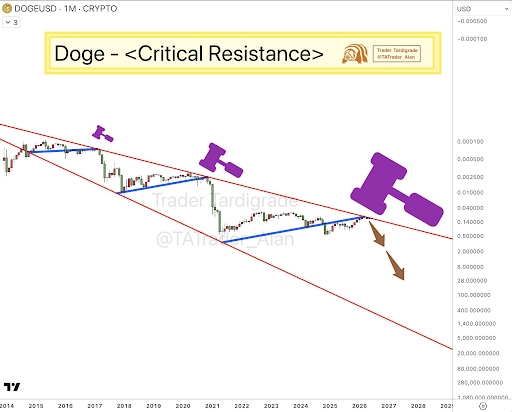
Trader Tardigrade’s long-term Dogecoin chart shows DOGE trading inside a massive descending broadening channel that has shaped price action for years. This channel has shaped Dogecoin’s price action for over a decade now, with two clearly defined red trendlines that widen progressively as time passes.

As shown in the chart below, Dogecoin previously rallied into the upper resistance of this channel in 2017 and in 2020, and both moves ended with strong rejections followed by deep corrections. Now, in 2026, Dogecoin has returned to that same overhead structure for a third time and looks like it is about to reject again. As noted by Trader Tardigrade, this is where we dump Dogecoin.

Source: Chart from Trader Tardigrade on X

Dogecoin has already dropped by 8% over the last three days, a decline that came shortly after DOGE tested that major resistance area, making the pattern a strong warning.

Real Message Behind The Inverted Chart

Trader Tardigrade’s chart presents DOGE/USD on the monthly timeframe, but the price scale is flipped. This means the lower the chart moves, the higher Dogecoin is actually moving in normal market price. Therefore, the red descending line labeled as critical resistance is not a bearish ceiling in the conventional sense, but a bullish line on an inverted chart, and a rejection from it sends the price directly into an upward movement in real terms.

In each of the two previous cases, the 2017 cycle and the 2021 cycle, a rejection from that inverted resistance was followed by a large move downward on the inverted chart, meaning a large rally upward on the normal DOGE chart.

Therefore, the current price action should be looked at as a return to support instead, and the analyst is expecting a bounce to higher price levels. Dogecoin is currently trading at $0.0937, which places it squarely within a support range between $0.09 and $0.10.

A move above $0.10 and into the $0.15 to $0.18 range would be the first indication that sentiment around DOGE is beginning to improve. However, the stronger signal would come from a break above $0.25, as that would make it clearer that DOGE is bouncing from the support structure.

Interestingly, the inverted chart’s structure leaves room for a move into double-digit price targets before Dogecoin reaches the next major trendline.

DOGE trading at $0.09 on the 1D chart | Source: DOGEUSDT on Tradingview.com

Связанные с этим вопросы

QWhat is the critical level that Dogecoin price has just entered, and how significant is it according to the article?

ADogecoin has returned to a major long-term resistance level on the monthly chart, which is a critical price zone it has only visited twice in the past decade. Both previous visits resulted in strong rejections followed by deep corrections, making this level highly significant and a crucial test for DOGE's current price action.

QWho is the analyst mentioned in the article, and what is their key observation about Dogecoin's current chart pattern?

AThe analyst mentioned is Trader Tardigrade on X. Their key observation is that Dogecoin is trading inside a massive descending broadening channel that has shaped its price action for years. DOGE is now testing the upper resistance of this channel for the third time, a zone where previous rallies in 2017 and 2021 failed.

QWhat is unusual about the chart presented by Trader Tardigrade, and how does it change the interpretation of the 'resistance' level?

AThe chart presents DOGE/USD on a monthly timeframe with an inverted price scale. This means the 'descending resistance' line is actually a bullish line on the inverted chart. A rejection from this line on the inverted chart signals a large upward movement for DOGE's actual price. Therefore, the critical level should be viewed as a support zone for a potential price bounce.

QBased on the inverted chart analysis, what price movement is expected for Dogecoin from its current level?

ABased on the inverted chart analysis, a rejection from the 'resistance' (which acts as support on the inverted chart) is expected to lead to a bounce to higher price levels. The analyst anticipates a move upward, with key levels to watch being a break above $0.10, then the $0.15 to $0.18 range, and a stronger signal coming from a break above $0.25.

QWhat is Dogecoin's current price and the key support range mentioned in the article?

ADogecoin is currently trading at $0.0937. The key support range mentioned is between $0.09 and $0.10.

Похожее

From Return to Resignation: Chen Hang's 437 Days at DingTalk

The 437-Day Return and Departure of Chen Hang at DingTalk This article chronicles the 437-day period from March 31, 2025, to June 11, 2026, when Chen Hang (also known as "No Move") returned as CEO of DingTalk, the enterprise communication platform he originally founded, only to later step down. Chen Hang, the creator of DingTalk in 2015, was brought back by Alibaba in 2025 after the company acquired his subsequent startup, HHO. His return was driven by Alibaba's renewed focus on AI and DingTalk's strategic role as its key to-B AI application. However, his aggressive management style, marked by strict work policies like mandatory clock-ins and extended hours, quickly caused internal friction and was criticized as being at odds with Alibaba's culture. Despite the internal turmoil, Chen Hang drove significant product launches. In August 2025, he unveiled "AI DingTalk 1.0," featuring new products like the AI-native entry point "DingTalk ONE." By March 2026, he announced "Wukong," touted as the world's first enterprise-grade AI-native work platform, representing a fundamental rebuild of DingTalk's architecture. The turning point came in early June 2026. A detailed internal post criticizing DingTalk's work culture went viral, followed by a public critique from a former executive. This prompted an unprecedented public rebuke from the Alibaba Partners Committee, which stated such management was not aligned with company values. One day later, on June 11, Alibaba announced Chen Hang's departure. He was succeeded by Chen Yusen, a 32-year-old technical expert known for founding cybersecurity firm Changting Technology. While Chen Hang's tenure laid the technical foundation for DingTalk's AI transformation with "Wukong," his leadership style ultimately led to his replacement as the company seeks a new direction under younger leadership.

marsbit6 мин. назад

From Return to Resignation: Chen Hang's 437 Days at DingTalk

marsbit6 мин. назад

The 2026 Landscape of Decentralized AI: Why Blockchain is the Inevitable 'Antidote' for AI?

Decentralized AI 2026 Landscape: Why Blockchain is AI's Essential "Antidote" Centralized AI faces structural bottlenecks—expensive compute, concentrated control, unverifiable outputs, and difficult data access—that cannot be solved by capital or code alone. Blockchain offers a path to make intelligence open, verifiable, and economically accessible. The decentralized AI stack comprises: * **Infrastructure:** The foundation with compute, verifiable inference, distributed training, data/storage, and privacy/verification layers. Projects like Akash, Render, and Filecoin provide cheaper, decentralized alternatives for raw resources. * **Middleware:** The coordination layer for agent discovery, identity, and commerce. Key players include Bittensor (a network of specialized AI subnets), Virtuals (an agent economy OS), and frameworks providing agent identity and tooling. * **Applications & Services:** Dominated by Agentic Finance (AI agents executing on-chain actions based on natural language) and Agentic Payments (machine-to-machine transactions using blockchain as a settlement layer). Projects like Giza, Infinit Labs, and x402 are enabling these use cases. Key trends for 2026-2027 show AI demand outgrowing infrastructure, compute becoming an asset class, and tokenomics emerging as a structural advantage for coordinating capital, compute, and data. While still early—with adoption uneven and revenue often trailing token incentives—projects like Bittensor, NEAR, and Venice demonstrate decentralized AI is evolving from a narrative into a new model for coordinating intelligence.

Foresight News26 мин. назад

The 2026 Landscape of Decentralized AI: Why Blockchain is the Inevitable 'Antidote' for AI?

Foresight News26 мин. назад

Торговля

Спот
Фьючерсы
活动图片