Delphi Digital: The Era of Tokenization Has Arrived

比推Опубликовано 2026-02-18Обновлено 2026-02-18

Введение

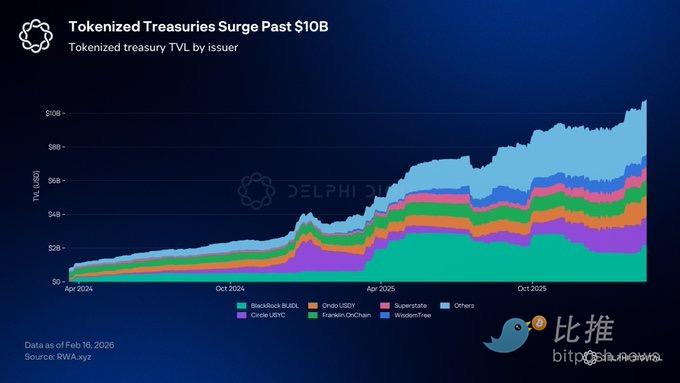
Tokenized U.S. Treasuries surpassed $10 billion in January 2024, led by institutions like BlackRock and Franklin Templeton. While government bonds are relatively straightforward to tokenize due to their standardized nature, equities present greater complexity because they involve shareholder rights such as voting and legal ownership. Two primary models exist: custodian-backed tokens (e.g., xStocks, Backed) offer price exposure but not direct ownership, while transfer agent-registered tokens (e.g., Superstate, Securitize) record holders directly on the shareholder registry, granting full rights. The latter enables functionalities like 24/7 trading, use as collateral in DeFi, cross-margin capabilities with crypto assets, and direct capital raises without traditional underwriters. However, challenges remain, including fragmented liquidity across blockchains, KYC/AML compliance friction, varying international regulations, and limited integration with traditional exchanges. While Nasdaq has applied to trade tokenized securities, broader market adoption depends on regulatory clarity and improved liquidity. The market is betting that the transfer agent model—which offers real ownership—will outperform custodian-based structures. Equities can now be settled instantly, traded around the clock, and used as collateral, but whether this becomes standard depends on regulatory and liquidity developments.

Source: Delphi Digital

Compiled and Edited: BitpushNews


In January, the scale of tokenized treasury bonds exceeded $10 billion, with BlackRock, Franklin Templeton, Ondo, and Circle leading the market. Government bonds were the first to be tokenized because they have standardized instruments and liquid markets, making the process relatively straightforward.

But the real challenge lies with stocks.

Stocks represent shareholders, who possess voting rights and legal rights that must be enforced. Tokenization projects have all hit the same wall: you can mint a token representing a stock, but you do not actually own the share.
Not all tokenized stocks operate in the same way. Tokens issued by platforms like xStocks, Backed, and similar are backed 1:1 by shares held by a custodian. Investors gain price exposure and can trade 24/7, but ownership remains with the custodian.

Custodian vs. Transfer Agent

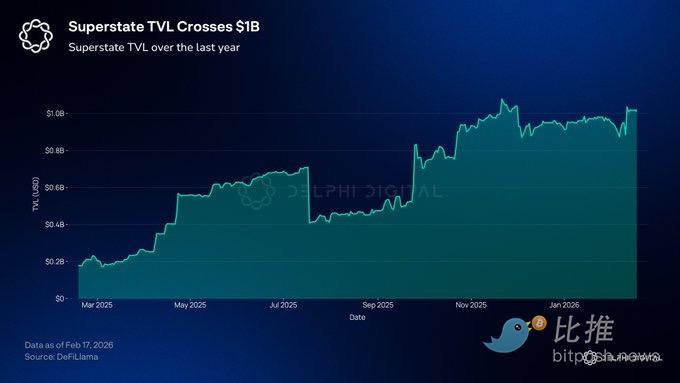
Superstate and Securitize are registered as transfer agents with the U.S. Securities and Exchange Commission (SEC), directly recording token holders on the company's shareholder registry. In September 2025, when Galaxy Digital was tokenized via Superstate's Opening Bell platform, GLXY token holders became genuine shareholders with voting rights and dividend entitlements. The blockchain was integrated with the shareholder registry.

Securitize has adopted a similar approach on the fund side. As the transfer agent behind BlackRock's BUIDL, they manage one of the largest tokenized treasury funds. They are also bringing institutional-grade private funds on-chain, lowering investment barriers and expanding access to alternative assets that were previously out of reach for most investors.

Recent guidance from SEC staff clarifies this distinction. Issuer-led tokenization through registered transfer agents creates ownership with full shareholder rights. Custodian-backed tokens may face different regulatory treatment and limitations compared to direct shareholder registration.
Genuine shareholder status enables functionalities that custodian-backed token structures cannot achieve.

Shareholders can trade 24/7 on supported trading platforms without waiting for the Toronto Stock Exchange to open. Shareholders of Forward Industries can pledge their equity as collateral on Kamino. Even if shares are deposited in lending pools, Superstate tracks beneficial ownership, ensuring dividends are distributed to the correct holders regardless of where the tokens are stored.

Backpack Exchange and Superstate have announced plans to enable cross-margining between tokenized stocks and crypto assets. Once live, traders can hold both tokenized stocks and SOL in the same account and use both as margin. Traditional brokers typically cannot offer this service because stocks and cryptocurrencies exist in completely separate custody and clearing systems.

This is unprecedented capital efficiency. Shareholders can obtain liquidity without selling, hedge across asset classes in a single account, and trade globally without settlement delays.

Raising Capital Without Underwriters

Superstate's direct issuance program allows publicly traded companies to reduce reliance on traditional underwriters for on-chain fundraising. Investors pay with stablecoins, shares are minted directly into their wallets, and companies receive funds instantly, with no cash settlement delays.

Traditional equity fundraising involves underwriters, roadshows, and settlement delays that can last weeks. Direct issuance compresses this into a single transaction, with the shareholder registry updated in real time.

The first issuances are expected later this year, likely from small-cap public companies that find traditional capital market infrastructure too costly relative to their trading size.

Missing Pieces

Liquidity remains fragmented. Tokenized stocks exist on multiple chains with no unified order book connecting them. Trading volumes are small compared to traditional markets, limiting the scale investors can move without impacting prices.

KYC requirements create friction with DeFi's permissionless architecture. Only whitelisted addresses can hold tokenized stocks, meaning they cannot be integrated into every lending protocol or liquidity pool. Issuers need to verify investors before they receive shares, and this verification must persist as tokens move between wallets.

Outside the U.S., regulatory frameworks vary significantly. SEC guidance applies to matters involving U.S. federal securities laws, but Europe, Asia, and other markets have their own rules, which may not align.

Traditional exchanges are watching closely. Nasdaq has filed an application with the SEC to trade tokenized securities. But until regulators and existing participants figure out how this fits into the existing market structure, actual exchange support for on-chain stocks remains pending.

Conclusion

Tokenized treasury bonds have proven that this mechanism can work at scale. Now, the stock space is catching up, achieving genuine compliance and true DeFi integration.

The market is betting that the transfer agent model, which records token holders as actual shareholders, will outperform indirect ownership structures that only provide price exposure.

Stocks can now be settled instantly, traded 24/7, and used as collateral in markets that never close. Whether this becomes the standard for how stocks operate or remains a niche play for crypto-native companies depends on whether liquidity and regulatory clarity can keep up with the infrastructure already in place.


Twitter:https://twitter.com/BitpushNewsCN

Bitpush TG Discussion:https://t.me/BitPushCommunity

Bitpush TG Subscription: https://t.me/bitpush

Original link:https://www.bitpush.news/articles/7612882

Трендовые криптовалюты

Связанные с этим вопросы

QWhat is the key difference between tokenized stocks issued by platforms like xStocks/Backed and those registered with the SEC as transfer agents like Superstate/Securitize?

APlatforms like xStocks and Backed issue tokens that are 1:1 backed by stocks held by a custodian, providing price exposure but not actual ownership. In contrast, SEC-registered transfer agents like Superstate and Securitize record token holders directly on the company's shareholder registry, granting them full shareholder rights including voting and dividends.

QWhat major milestone did tokenized treasury products achieve in January, and which companies are leading this market?

AIn January, the size of tokenized treasury products surpassed $10 billion. Companies such as BlackRock, Franklin Templeton, Ondo, and Circle are leading this market.

QWhat are some of the unique functionalities enabled by true shareholder status in tokenized stocks, according to the article?

ATrue shareholder status enables functionalities like 24/7 trading on supported platforms, the ability to use equity as collateral (e.g., on Kamino), receiving dividends regardless of where the token is held, and cross-margining between tokenized stocks and crypto assets in a single account for unprecedented capital efficiency.

QHow does Superstate's direct issuance plan aim to change the traditional capital raising process for public companies?

ASuperstate's direct issuance plan allows public companies to raise capital on-chain with reduced reliance on traditional underwriters. Investors pay with stablecoins, shares are minted directly to their wallets, the company receives funds instantly, and the shareholder registry is updated in real-time, compressing a process that traditionally takes weeks into a single transaction.

QWhat are the main challenges or missing pieces currently hindering the wider adoption of tokenized stocks?

AThe main challenges include fragmented liquidity across different blockchains without a central order book, smaller trading volumes limiting large-scale moves, friction between KYC requirements and DeFi's permissionless architecture, and varying regulatory frameworks outside the U.S. that are not necessarily aligned with the SEC's guidance.

Похожее

Паркер Льюис ответил, почему биткоин остаётся лучшими деньгами

Известный биткоин-аналитик Паркер Льюис раскритиковал стратегии публичных компаний, позиционирующих себя как криптовалютные казначейства. Он заявил, что продажа ими «цифрового кредита» в виде бессрочных привилегированных акций искажает суть биткоина, который не генерирует фиатный доход на алгоритмическом уровне. Льюис подчеркнул, что выплата дивидендов в этой модели часто зависит от притока новых инвесторов, что несёт высокие риски, наглядно демонстрируемые скромным размером рынка таких акций ($1 трлн) на фоне глобального кредитного рынка ($300 трлн). Эксперт также опроверг тезис о чрезмерной волатильности биткоина, объяснив её как естественное следствие массового принятия актива с жёстко ограниченным предложением. Он призвал инвесторов покупать биткоины напрямую, а не акции компаний вроде MicroStrategy, что математически безопаснее. Льюис указал на главную угрозу — инфляцию фиатных денег, проиллюстрировав её личным «Индексом рибая», показывающим рост цен на 12–13% годовых. В итоге, наиболее надёжной стратегией защиты сбережений он назвал прямое владение биткоином и контроль над приватными ключами, предостерегая от скрытых рисков погони за корпоративной доходностью через деривативы.

cryptonews.ru2 ч. назад

Паркер Льюис ответил, почему биткоин остаётся лучшими деньгами

cryptonews.ru2 ч. назад

Почему биткоин удерживает $64 000 после жесткой паузы ФРС

Федеральная резервная система США оставила ключевую ставку без изменений, но жесткая риторика и голосование (9 против 3) показали готовность к дальнейшему ужесточению, что ограничивает аппетит к рисковым активам. Несмотря на это, биткоин демонстрирует устойчивость, удерживаясь около уровня $64 000 после волатильной реакции на заявление ФРС. Ключевая поддержка находится в зоне $63 000–63 500, сопротивление — около $66 000. На рынке наблюдается ротация капитала: спотовые Bitcoin-ETF после серии оттоков показали чистый приток в $32,1 млн, тогда как фонды на Ethereum продолжили терять средства. Интерес институциональных инвесторов сместился в сторону биткоина как основного актива, хотя отдельные альткоины, такие как Solana, также привлекают капитал. Рыночная доля Ethereum снижается, несмотря на сильные фундаментальные показатели сети, включая растущую очередь на стейкинг. Законодательная инициатива CLARITY Act была отложена Сенатом США до осени, что снизило рыночные ожидания относительно её принятия в 2026 году. В последний день июля внимание инвесторов будет приковано к макроэкономической статистике из США. Устойчивость биткоина выше $63 000, закрепление Ethereum над $1 860 и продолжение притоков в ETF могут стать сигналами для формирования базы восстановления во второй половине года.

cryptonews.ru2 ч. назад

Почему биткоин удерживает $64 000 после жесткой паузы ФРС

cryptonews.ru2 ч. назад

Компания ARK Invest Кэти Вуд купила 109,129 акций Circle на $6,83 млн

Компания ARK Invest Кэти Вуд приобрела 109 129 акций компании Circle на сумму около 6,83 млн долларов США. Покупка была осуществлена через три ее биржевых фонда: ARK Innovation, ARK Next Generation Internet и ARK Fintech Innovation. Эта сделка произошла вскоре после того, как Circle получила лицензию на доверительное управление от Департамента финансовых услуг штата Нью-Йорк для своей дочерней компании Circle New York Trust. Генеральный директор Circle Джереми Аллер назвал получение лицензии долгосрочной целью компании. Однако, несмотря на это регулирующее одобрение, акции Circle (CRCL) 31 июля снизились на 2,54%, что, вероятно, указывает на сдержанную реакцию инвесторов на данную новость. Параллельно ARK Invest также совершила крупные покупки акций Tesla, SpaceX и Nvidia на общую сумму около 40,2 млн долларов, одновременно сократив свои доли в таких компаниях, как Shopify, Cloudflare и CrowdStrike.

cryptonews.ru2 ч. назад

Компания ARK Invest Кэти Вуд купила 109,129 акций Circle на $6,83 млн

cryptonews.ru2 ч. назад

Торговля

Спот

Популярные статьи

Как купить ERA

Добро пожаловать на HTX.com! Мы сделали приобретение Caldera (ERA) простым и удобным. Следуйте нашему пошаговому руководству и отправляйтесь в свое крипто-путешествие.Шаг 1: Создайте аккаунт на HTXИспользуйте свой адрес электронной почты или номер телефона, чтобы зарегистрироваться и бесплатно создать аккаунт на HTX. Пройдите удобную регистрацию и откройте для себя весь функционал.Создать аккаунтШаг 2: Перейдите в Купить криптовалюту и выберите свой способ оплатыКредитная/Дебетовая Карта: Используйте свою карту Visa или Mastercard для мгновенной покупки Caldera (ERA).Баланс: Используйте средства с баланса вашего аккаунта HTX для простой торговли.Третьи Лица: Мы добавили популярные способы оплаты, такие как Google Pay и Apple Pay, для повышения удобства.P2P: Торгуйте напрямую с другими пользователями на HTX.Внебиржевая Торговля (OTC): Мы предлагаем индивидуальные услуги и конкурентоспособные обменные курсы для трейдеров.Шаг 3: Хранение Caldera (ERA)После приобретения вами Caldera (ERA) храните их в своем аккаунте на HTX. В качестве альтернативы вы можете отправить их куда-либо с помощью перевода в блокчейне или использовать для торговли с другими криптовалютами.Шаг 4: Торговля Caldera (ERA)С легкостью торгуйте Caldera (ERA) на спотовом рынке HTX. Просто зайдите в свой аккаунт, выберите торговую пару, совершайте сделки и следите за ними в режиме реального времени. Мы предлагаем удобный интерфейс как для начинающих, так и для опытных трейдеров.

872 просмотров всегоОпубликовано 2025.07.17Обновлено 2026.06.02

Как купить ERA

Обсуждения

Добро пожаловать в Сообщество HTX. Здесь вы сможете быть в курсе последних новостей о развитии платформы и получить доступ к профессиональной аналитической информации о рынке. Мнения пользователей о цене на ERA (ERA) представлены ниже.

活动图片













