DAT: The Evolution of Digital Asset Treasuries as Strategic Assets for Crypto Enterprises

marsbitОпубликовано 2025-12-22Обновлено 2025-12-22

Введение

By the end of 2025, the Digital Asset Treasury (DAT) remains a significant corporate trend in the crypto industry, evolving from passive market participation to a strategic resource integrated into long-term enterprise planning. Companies are increasingly incorporating digital assets like Bitcoin and Ethereum into their balance sheets, shifting focus from mere accumulation to rational asset allocation, risk management, and strategic engagement with blockchain ecosystems. DAT strategies now emphasize diversification, cash flow stability, and participation in on-chain governance, staking, and lending, transforming digital assets into tools for operational resilience and ecosystem influence. Market structure is maturing, with indices like MSCI raising standards for transparency and governance, moving from asset-driven to capability-driven evaluations. Enterprises demonstrating robust risk controls, diversified portfolios, and synergistic business-ecosystem integration show greater resilience. The industry is experiencing differentiation: firms with clear strategic frameworks and sustainable practices are gaining competitive edges, while those reliant on single assets or market sentiment face constraints. Ultimately, DAT's value lies not in the volume of assets held but in the ability to embed them within a coherent strategy, sound governance, and active ecological participation, marking a shift from financial instruments to key strategic resources in corporate growth.

By the end of 2025, Digital Asset Treasuries (DAT) remain one of the most noteworthy corporate behaviors in the crypto industry. An increasing number of enterprises are choosing to incorporate digital assets into their balance sheets. This move is no longer merely a passive participation in market trends but an attempt to transform digital assets into long-term strategic resources. As market conditions and regulatory expectations gradually evolve, the DAT industry is undergoing structural optimization and capability screening. Its core value has shifted from单纯的 asset holding to a test of corporate strategic execution.

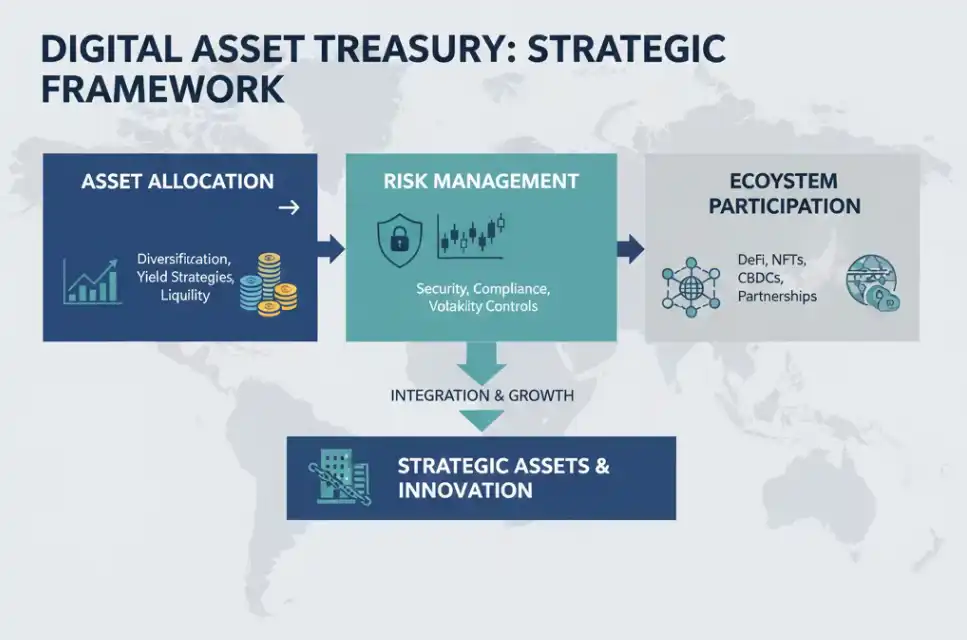
Typical DAT enterprises typically raise funds through stock financing, bond issuance, or private placements and allocate them to mainstream digital assets like Bitcoin and Ethereum. Compared to the early strategy of primarily "hoarding coins," companies now place greater emphasis on the rationality of asset allocation, risk control systems, and strategic linkages with the blockchain ecosystem. On one hand, digital assets provide enterprises with asset diversification and long-term value potential; on the other hand, companies must simultaneously establish cash flow management and risk constraint mechanisms to ensure operational sustainability. Furthermore, holding digital assets means enterprises can participate in on-chain governance, staking, and lending, thereby gaining deeper participation rights and influence at the ecosystem level. This change indicates that DAT has gradually become part of the corporate strategic management system, rather than just a book asset.
Market Structure and Corporate Performance

From recent industry performance, DAT enterprises are entering a clear phase of structural adjustment. Some companies are stabilizing market expectations and improving shareholder structure through share buybacks and asset portfolio optimization; others are gradually returning to more稳健 operational paths through strategic contraction or asset adjustments. At the same time, index agencies like MSCI are beginning to重新审视 the inclusion criteria for DAT-related companies, with significantly increased attention to corporate information disclosure, governance structure, and operational stability. This means the market is weakening its reliance on asset size and short-term price performance,转而 assessing enterprises' operational capabilities and risk management levels in complex environments.

It is worth noting that some companies with Ethereum-related assets as core allocations have shown relative resilience in recent market adjustments. This is not a reflection of a single asset's advantage but rather更多地反映了 the important role of asset diversification, business synergy, and governance capabilities in long-term corporate performance. Overall, changes in market structure are driving the DAT industry from "asset-driven" to "capability-driven."

Corporate Behavior and Strategic Choices

Starting from specific corporate behaviors, the strategic logic behind DAT can be understood more clearly.

At the asset level, enterprises no longer view digital assets as isolated investment targets but incorporate them into a long-term capital allocation framework to support future business expansion and ecosystem布局.

At the risk and stability level, companies balance market expectations and internal robustness through asset diversification, share buybacks, and operational structure improvements. The significance of such operations lies not in short-term market feedback but in securing greater strategic maneuvering space for the enterprise.

At the ecosystem level, holding digital assets enables enterprises to participate in on-chain governance and ecosystem building, transforming financial behavior into actual influence and voice. This shift from "asset management" to "ecosystem participation" is becoming an important path for DAT enterprises to build long-term competitiveness.

Overall, DAT has evolved from simple coin-holding behavior to a comprehensive practice integrating asset strategy, risk control, and ecosystem participation.

Industry Trends and Corporate Divergence

Observing from a longer cycle, the evaluation criteria of the DAT industry are undergoing substantive changes. Market focus is gradually shifting from asset size and short-term price fluctuations to corporate operational capabilities, cash flow stability, and governance transparency. This change directly promotes divergence among enterprises: those with clear asset strategies, diversified allocations, and robust governance structures are more likely to establish advantages in long-term competition; while those highly reliant on single assets or market sentiment see their strategic flexibility and sustainability significantly limited.

More importantly, some enterprises have already begun to transform digital assets into sustainable strategic resources through the combination of business synergy, ecosystem participation, and asset management. This path does not rely on a single market phase but is built on long-term capability building, constituting the core direction for the future development of the DAT industry.

Conclusion

The true value of DAT enterprises is not reflected in how many digital assets they hold, but in whether the enterprise can incorporate these assets into a clear strategic framework, establish a robust operational system and governance structure, and form sustained participation capabilities at the ecosystem level. By observing corporate behavior and industry structural changes, it can be seen that the DAT industry is moving towards a competitive stage centered on strategic capability and long-term execution.

Understanding DAT essentially means understanding how digital assets are transforming from a financial tool into a key resource within the corporate strategic system. This transformation not only reshapes how enterprises manage assets but also provides new judgment coordinates for investors and industry participants. In the future, enterprises that can form良性 synergy between asset strategy, risk management, and ecosystem participation are more likely to establish long-term, stable competitive advantages within the DAT system.

Похожее

Акции цикличные или роста? Отчет Coinbase за Q2 раскрывает "разногласия в оценке"

Криптобиржа Coinbase опубликовала отчет за второй квартал 2026 года. Выручка компании составила 1,22 млрд долларов, что на 19% меньше, чем годом ранее, и ниже рыночных ожиданий (1,29 млрд долларов). Основной источник доходов — комиссии от розничных транзакций с криптовалютами — сократился на 30% в годовом исчислении, достигнув уровня 2023 года. Чистый убыток составил 359 млн долларов, что является третьим кварталом убытков подряд. Несмотря на заявление Coinbase о рекордной доле рынка криптотрейдинга (10,3%), этот рост в основном обеспечен новыми продуктами, такими как деривативы, прогнозные рынки и токенизированные акции. Традиционный спотовый рынок для розничных клиентов продолжает сокращаться. В отчете также отмечаются положительные тенденции. Доходы от подписок и услуг, включая стабильные монеты, выросли и теперь почти равны доходам от транзакций. Компания делает ставку на диверсификацию: развивает платформу стабильных монет (лидер по хранению USDC), расширяет предложение деривативов после приобретения Deribit и укрепляет лидерство в области ончейн-агентской экономики через свою сеть Base и протокол x402. Таким образом, оценка Coinbase зависит от перспективы инвестора. Как циклическая акция, она страдает от медвежьего рынка. Как акция роста, она может быть недооценена благодаря потенциалу новых направлений, таких как агентская экономика, которую Coinbase оценивает как многотриллионный рынок к 2030 году.

Odaily星球日报5 мин. назад

Акции цикличные или роста? Отчет Coinbase за Q2 раскрывает "разногласия в оценке"

Odaily星球日报5 мин. назад

Утренний отчет с Уолл-Стрит: Microsoft развеяла опасения по поводу «AI cash burn», технологические акции совершили мощный отскок, ETF на память DRAM и индекс PHLX Semiconductor взлетели на 17% и 8%

Уолл-Стрит пережила мощный отскок после предыдущих распродаж. Ключевым фактором стал отчет Microsoft, который превзошел ожидания и развеял опасения по поводу затрат на ИИ. Акции Microsoft выросли на 15,51%, а капитализация компании увеличилась на рекордные 450 млрд долларов за день. Рост облачного сервиса Azure на 43% и оптимистичные прогнозы по денежным потокам восстановили доверие инвесторов к технологическому сектору. Индекс Nasdaq вырос на 2,78%, а индекс Philadelphia Semiconductor Index (SOX) взлетел на 8,19%. ETF Roundhill Memory, отслеживающий сектор памяти, подскочил почти на 17% на фоне ожиданий роста спроса на чипы для центров обработки данных ИИ. Однако широта рынка оставалась слабой: более 70% акций в S&P 500 закрылись в минусе, что указывает на концентрацию ралли в нескольких крупных технологических компаниях. Акции Meta упали на 7,95% из-за опасений по поводу больших капитальных затрат. На валютном рынке иена и вона значительно укрепились на фоне подозрений о валютных интервенциях Японии и Южной Кореи. Нефть слегка снизилась перед предстоящей встречей ОПЕК+, где ожидается решение о возможном увеличении добычи. Ближайшие события для наблюдения: срок выполнения правительством США рамок регулирования ИИ (1 августа), данные об экспорте Южной Кореи (1 августа) и встреча ОПЕК+ (2 августа).

marsbit10 мин. назад

Утренний отчет с Уолл-Стрит: Microsoft развеяла опасения по поводу «AI cash burn», технологические акции совершили мощный отскок, ETF на память DRAM и индекс PHLX Semiconductor взлетели на 17% и 8%

marsbit10 мин. назад

Исследование глобальной доли рынка: японские компании лидируют в области полупроводниковых материалов

Обзор доли рынка показывает, что японские компании сохраняют лидирующие позиции в секторе материалов для полупроводников. В 2025 году Shin-Etsu Chemical занимает первое место на рынке кремниевых подложек с долей 26,3%, а второй японский производитель, SUMCO, увеличивает свою долю. Три японские компании доминируют на рынке фоторезистов, занимая 60,5% доли. Однако в ключевых областях полупроводников, таких как память DRAM и NAND, а также GPU, лидерами являются южнокорейские (SK Hynix, Samsung) и американские (Micron) компании. Китайская компания CXMT удвоила свою долю на рынке DRAM. На фоне прогнозируемого резкого роста мирового рынка полупроводников японским производителям материалов для сохранения своих позиций необходимо осуществлять масштабные инвестиции, аналогичные инвестициям крупных производителей чипов. В автомобильной промышленности, являющейся опорой для Японии, наблюдается застой. Toyota сохранила первое место, но с незначительным ростом доли. Японские компании не входят в топ-5 на рынке электромобилей, где доминируют BYD и Tesla. В судостроении японская Imabari Shipbuilding поднялась на третье место в мире благодаря выполнению заказов на крупные контейнеровозы. Правительство Японии поставило цель удвоить объемы строительства к 2035 году, однако отрасль сталкивается с проблемой нехватки рабочей силы, а лидерами рынка остаются китайские и южнокорейские компании.

marsbit30 мин. назад

Исследование глобальной доли рынка: японские компании лидируют в области полупроводниковых материалов

marsbit30 мин. назад

25-летний вундеркинд OpenAI, который погубил глобальных инвесторов

Ведущий хедж-фонд Situational Awareness, управляемый 25-летним Леопольдом Ашенбреннером, бывшим сотрудником OpenAI, потерпел крах, потеряв миллиарды долларов. Фонд, достигший пика в $45 млрд и показавший доходность 439%, совершил ошибку, сделав чрезмерно leveraged-ставки на акции компаний, связанных с искусственным интеллектом, такие как SK Hynix и Micron. В июле 2026 года резкое падение цен на эти акции, вызванное в том числе массовыми продажами розничных инвесторов в Южной Корее, привело к маржин-коллам и принудительной ликвидации позиций. Ирония ситуации в том, что сразу после распродажи активов фонда по заниженным ценам (часть из них выкупила Citadel Кена Гриффина) эти же акции резко пошли вверх. История Ашенбреннера, автора популярного эссе об ИИ, и его фонда стала очередным примером на Уолл-стрит, когда верный долгосрочный прогноз терпит неудачу из-за неправильного выбора времени и чрезмерного использования кредитного плеча, что привело к огромным убыткам для него и последовавших за ним инвесторов.

marsbit54 мин. назад

25-летний вундеркинд OpenAI, который погубил глобальных инвесторов

marsbit54 мин. назад

STRC после деанкоринга: первая финансовая отчетность. Как Strategy намерена восстановить капитальное "колесо"?

Корпорация MicroStrategy опубликовала финансовый отчет за второй квартал 2026 года. Несмотря на рост выручки, компания зафиксировала чистый убыток в размере 8,22 млрд долларов США, в основном из-за нереализованных убытков от колебаний цены биткоина. В отчете основное внимание уделяется способности компании восстановить свою модель финансирования после дестабилизации своей ключевой приоритетной акции STRC, которая в настоящее время торгуется со скидкой к своей целевой номинальной стоимости. MicroStrategy продолжает придерживаться своей основной стратегии, увеличивая запасы биткоинов до 843 775 BTC. Однако подход к управлению капиталом изменился: от пассивного накопления к активному управлению, включая программу монетизации BTC для укрепления ликвидности. Главной задачей компании является восстановление стоимости STRC до номинала. Руководство исключило выпуск акций со скидкой и планирует использовать денежные резервы (3,75 млрд долларов США) и программу обратного выкупа акций на 10 млрд долларов для поддержки цены. Целевой срок восстановления — около 70 торговых дней. В будущем успех MicroStrategy зависит от двух ключевых факторов: краткосрочного восстановления STRC до номинальной стоимости и долгосрочного роста цены биткоина, который лежит в основе всей ее бизнес-модели.

marsbit1 ч. назад

STRC после деанкоринга: первая финансовая отчетность. Как Strategy намерена восстановить капитальное "колесо"?

marsbit1 ч. назад

Торговля

Спот
活动图片