Crypto traders alert! Why Trump’s weekend post could trigger liquidations on Monday

ambcryptoОпубликовано 2026-04-04Обновлено 2026-04-04

Введение

Crypto traders are on high alert as former President Trump's weekend social media post regarding a potential escalation with Iran could trigger significant market liquidations on Monday. The crypto market, already vulnerable, closed Q1 with a nearly 21% loss, extending a severe downturn. This decline has moved in lockstep with soaring oil prices, which surged nearly 70% in Q1 due to Middle East tensions. Trump's post, warning of a severe attack on Iran's infrastructure, adds a critical layer of uncertainty. With U.S. stock markets closed over the weekend, the full market reaction has been delayed. Analysts now anticipate a highly volatile session when markets reopen, with oil potentially surging toward $200 per barrel. This could spark a sharp sell-off in equities, which would severely impact the crypto market. Bitcoin's positioning index has already turned negative, indicating traders are betting on further downside. The market is trapped in a liquidity crunch, making it extremely sensitive to any catalyst. A major, liquidation-driven downturn is now likely as Monday's session begins.

Is the worst still yet to come for crypto?

From a technical standpoint, the market is officially rolling into Q2. However, to see where it’s headed, we need to check where it’s been. Q1 closed with the total crypto market cap down nearly 21%, extending losses from Q4 2025 when it fell by about 24%.

In just six months, crypto has technically lost over $1.5 trillion. Bitcoin [BTC] hasn’t been spared either, making up 60% of those outflows – A sign that it’s lagging compared to other volatile assets. Backing this, the XAU/BTC ratio closed Q1 up almost 40%, underlining BTC’s relative weakness versus gold.
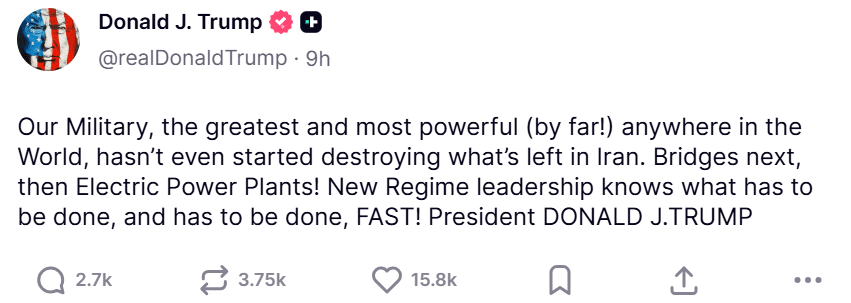
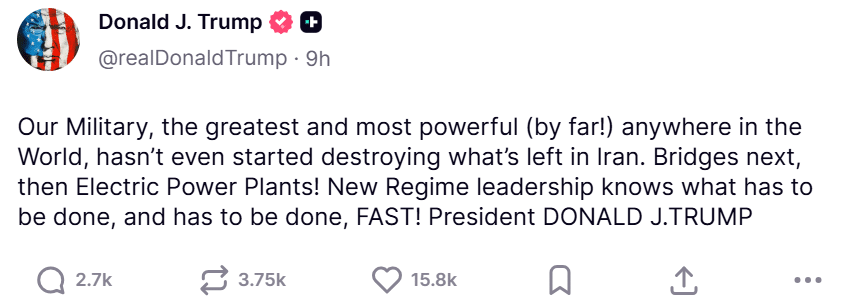
Source: TruthSocial

In short, despite recent optimism around Bitcoin’s “relative” resilience, Q1 revealed crypto was still the weakest performer across asset classes. Against this backdrop, a recent post by U.S President Donald Trump couldn’t have come at a more critical time.

In it, President Trump sounded a warning about a potentially severe attack on Iran’s infrastructure, putting ceasefire expectations on hold. However, more than the content, it’s the “timing” of the post that’s sparked a full-blown market frenzy. Notably, the U.S stock market will remain closed over the weekend, which means the post has temporarily prevented a liquidation cascade.

The real momentum shift, however, is in oil prices. Even before the post, oil had been rattling global markets. Now, the added geopolitical risk layers in more uncertainty. Traders and investors are likely to react as soon as the market reopens, making Monday a highly volatile session for equities. The spotlight, however, falls on crypto – Is a massive bloodbath looming?

Crypto locked in a liquidity trap as weekend market risk spikes

The crypto market’s nearly 21% drop in Q1 has moved almost in lockstep with oil prices.

Notably, this trend is set to shape Monday’s market, especially with equities likely to react. Take the NASDAQ (NDX), for example – It closed Q1 down nearly 6%, marking its worst quarterly performance since Q1 2025.

Here, the culprit is the ongoing Middle East conflict, which has created a massive oil supply squeeze. The Strait of Hormuz, responsible for roughly 20% of global oil exports, remains under serious threat. The impact is clear – Oil closed Q1 up nearly 70%, sending ripples across risk assets, including crypto.
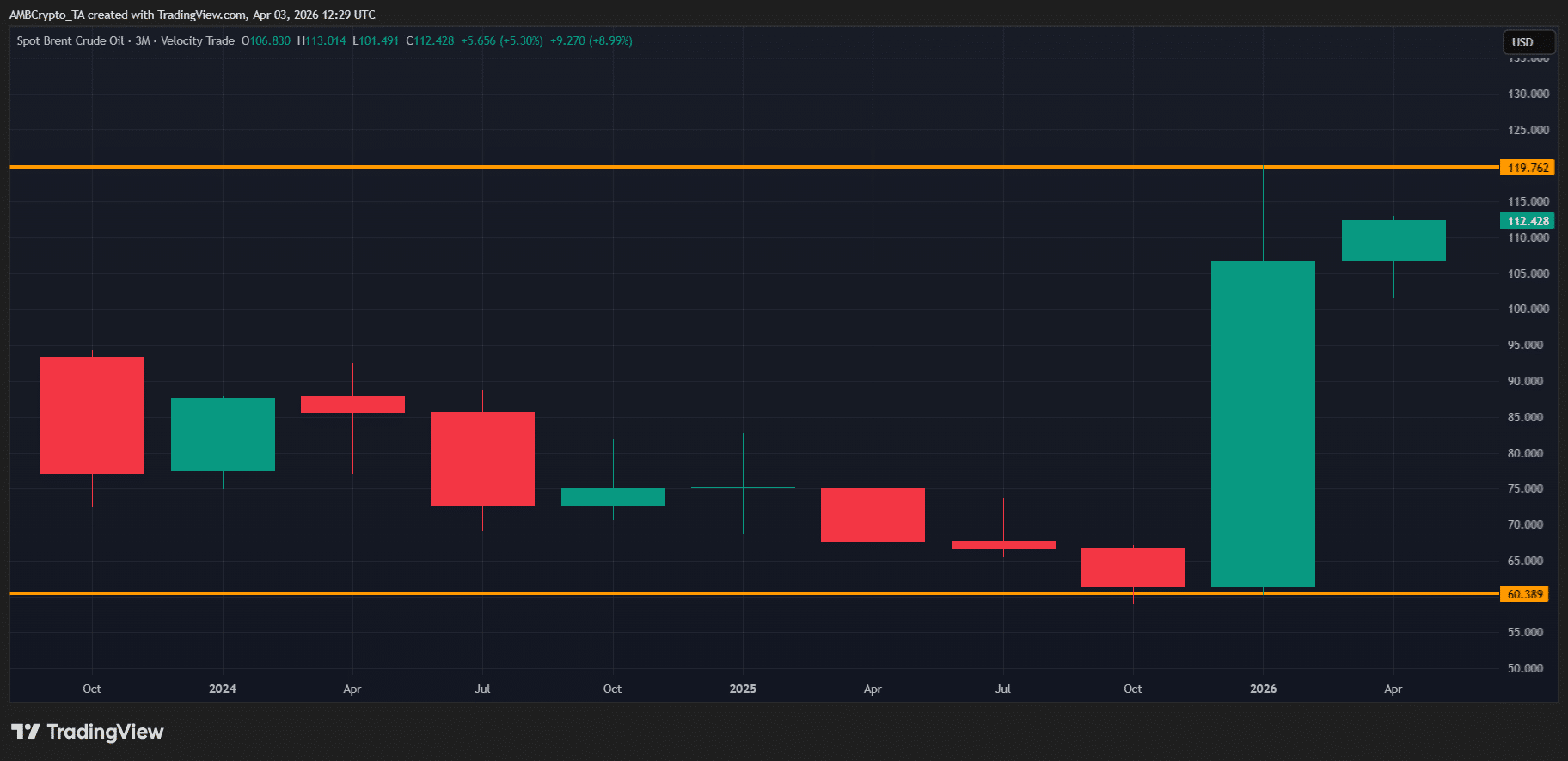
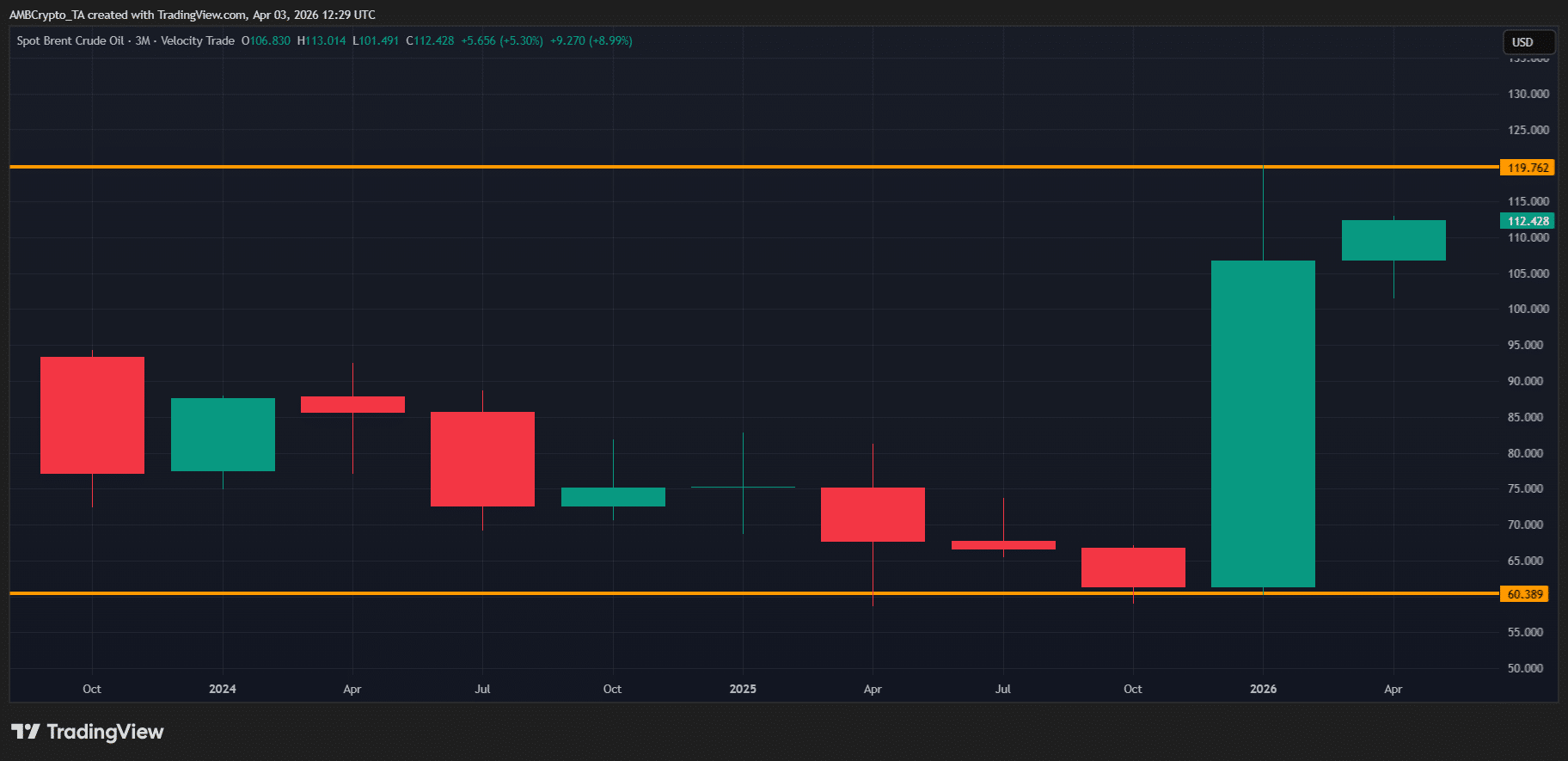
Source: TradingView (BRENT/USD)

According to AMBCrypto, that’s where President Trump’s recent post comes into play. With the escalation now official, analysts are expecting oil prices to surge towards $200 per barrel. In this context, Monday’s market reaction could be critical, with the odds of a sharp sell-off looking high.

Meanwhile, Bitcoin’s positioning index flipped negative, signaling that shorts are returning. This isn’t random. Instead, it’s a strategic move by traders, positioning for a potential downside in crypto once Monday’s session kicks off. With crypto heavily locked in a liquidity trap, even a small move could trigger sharp price swings, making the market extra sensitive to any catalyst.

Against this backdrop, President Trump’s post is now a key bearish trigger. Once Monday’s session begins, equities are set to react, putting crypto at high risk of a liquidation-driven bloodbath.


Final Summary

  • Q1 losses, negative positioning, and a liquidity trap are setting the stage for sharp downside moves.
  • President Trump’s post and surging oil prices could trigger a major market reaction on Monday.

Связанные с этим вопросы

QWhat was the overall performance of the crypto market in Q1, and how does it compare to Q4 2025?

AThe total crypto market cap was down nearly 21% in Q1, which extended the losses from Q4 2025 when it fell by about 24%.

QAccording to the article, what is the significance of the XAU/BTC ratio closing Q1 up almost 40%?

AThe XAU/BTC ratio's significant increase underlines Bitcoin's relative weakness as an asset compared to gold.

QWhy is the timing of President Trump's post considered so critical for the markets?

AThe timing is critical because the U.S. stock market was closed over the weekend, temporarily preventing an immediate liquidation cascade. The post is expected to trigger a major market reaction when trading resumes on Monday.

QWhat key factor, besides Trump's post, is identified as a major driver of risk asset performance and a threat to crypto?

ASurging oil prices, driven by the ongoing Middle East conflict and a potential supply squeeze from the Strait of Hormuz, are a major driver putting pressure on risk assets like crypto.

QWhat does the shift in Bitcoin's positioning index to negative signal, according to the analysis?

AThe shift to a negative positioning index signals that traders are opening short positions, strategically preparing for a potential downside move in the crypto market once Monday's trading session begins.

Похожее

Arthur Hayes' New Article: It's 'No-Trade Zone' Time

Arthur Hayes argues that the current market is in a "no-trade zone," a period of high uncertainty created by two converging forces: the deflationary shock from AI and the inflationary shock from geopolitics. AI agents are rapidly displacing knowledge workers, eroding their incomes and creditworthiness, which will eventually trigger a deflationary financial crisis in consumer credit-dependent Western economies. Simultaneously, the war in the Middle East, particularly the potential disruption to shipping through the Strait of Hormuz, threatens global energy supplies and could force nations to abandon the dollar system. Hayes outlines three main scenarios: 1) A return to normalcy, where the deflationary AI shock remains the primary concern; 2) The "Tehran Toll Booth," where Iran controls the Strait and demands payment in gold or yuan, accelerating the end of dollar hegemony; and 3) "Empire Strikes Back," where the US destroys Iran's capabilities but risks a catastrophic regional war that sends commodity prices soaring. In all but the most extreme scenarios, Hayes posits that the key driver for Bitcoin's price will be the *quantity* of money, not its price (interest rates). He expects that governments, forced to fund wars and stockpile resources, will have to print money, expanding the money supply. This would be bullish for fixed-supply assets like Bitcoin, even if it occurs alongside rising rates. However, he cautions that until this liquidity is explicitly unleashed (e.g., when bond market volatility spikes), the risk/reward for new long positions is poor. His current strategy is to wait for a clear signal of monetary expansion before deploying capital, preferring to hold gold and select crypto assets in the meantime.

marsbit33 мин. назад

Arthur Hayes' New Article: It's 'No-Trade Zone' Time

marsbit33 мин. назад

a16z Founder: In the Agent Era, What Truly Matters Has Changed

Marc Andreessen, co-founder of a16z, argues that the current AI boom is not an overnight success but the culmination of 80 years of research, now delivering practical results. He emphasizes that this era is defined by the convergence of four key capabilities: large language models (LLMs), reasoning, coding, and agents capable of recursive self-improvement. Andreessen describes the agent architecture—combining an LLM with a shell, file system, markdown, and cron/loop—as a fundamental shift beyond chatbots. This structure leverages existing software components, allowing agents to maintain state, introspect, and extend their own functionality. He predicts a move away from traditional GUI and browser-based interactions toward an "agent-first" world where software is primarily operated by bots, not humans, with people simply stating their goals. He draws parallels to the 2000 internet bubble but notes key differences: current AI infrastructure investments are led by cash-rich giants and quickly monetized. He highlights that scaling constraints involve not just GPUs but the entire chip ecosystem. Open source and edge inference are crucial for democratizing knowledge and enabling low-latency, cost-effective applications on local hardware. Finally, Andreessen identifies significant non-technical challenges: potential short-term cybersecurity crises, the need for "proof of human" identity solutions, financial infrastructure for agents, and institutional resistance from sectors like education and healthcare. He cautions that societal adoption will be slower than technological change.

marsbit43 мин. назад

a16z Founder: In the Agent Era, What Truly Matters Has Changed

marsbit43 мин. назад

Торговля

Спот
Фьючерсы
活动图片