Crypto May Be Loud Online, But Only 4% Of Voters Care: Poll

bitcoinistОпубликовано 2026-05-14Обновлено 2026-05-14

Введение

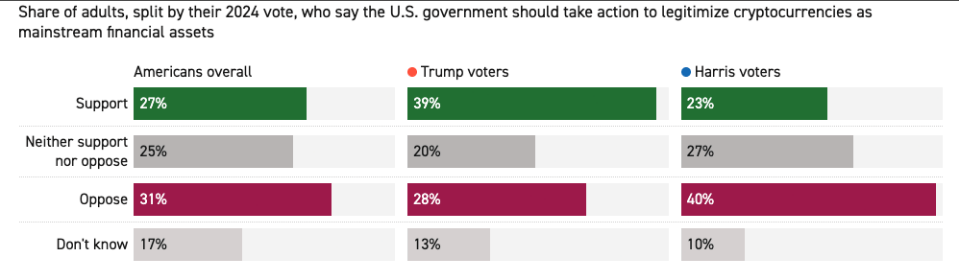
A Politico survey reveals a stark disconnect between crypto industry lobbying and U.S. voter priorities. While crypto groups have spent over $130 million on the 2024 elections, only 4% of voters say a candidate's position on crypto would influence their vote. Affordable housing, consumer fraud protection, and lower bank fees rank as far more important issues for voters. The poll also shows public ambivalence toward digital assets. Only 27% support government efforts to make crypto mainstream, while 31% oppose it. Over half of respondents have never traded crypto and don't plan to. Among those who have traded, 7% say a candidate's stance would sway their vote. Furthermore, 45% view crypto investing as a risk not worth taking. Despite low voter interest, Congress is advancing crypto regulation. The Senate Banking Committee is set to vote on a regulatory framework bill, a version of which already passed the House in June.

A separate poll released Friday by HarrisX found that 47% of registered voters said they would consider crossing party lines to support a candidate who backed crypto regulation legislation — a figure that stands in sharp contrast to new data showing crypto barely moves the needle for most Americans when they head to the polls.

The Lobbying Machine Behind The Legislation

The Politico survey, conducted by polling firm Public First and covering 2,035 US adults, found that only 4% of respondents would factor a candidate’s position on crypto into their voting decision.

Source: Politico

Affordable housing topped the list of issues voters want Congress to address, followed by consumer fraud protection and lower bank fees. Crypto regulation came in last.

That gap between voter priorities and industry muscle is hard to ignore. Crypto lobbies spent more than $130 million during the 2024 elections — more than any other industry — and have already committed $320 million to shape the upcoming November midterms, according to data compiled by researcher Molly White.

Survey results on public opinion regarding whether the US government should formally adopt crypto as a mainstream financial asset. Source: Politico.

In Illinois alone, crypto-aligned PACs have spent over $5.5 million opposing specific congressional candidates this year.

BTCUSD currently trading at $79,593. Chart: TradingView

Republican Representative Dusty Johnson acknowledged the disconnect. Most voters don’t think about digital assets, he told Politico, but those who do feel strongly about it. He described it as a high-intensity issue that is slowly growing in public awareness, even if the numbers remain small.

A Public Still Divided On Digital Assets

The survey also captured a broader wariness toward crypto among ordinary Americans. Only 27% said they support or strongly support the US government taking steps to make crypto a mainstream financial asset.

A slightly larger share — 31% — said they oppose or strongly oppose such a move. More than half of respondents said they had never traded crypto and had no plans to do so.

Image: Pexels

Among the 19% who had actually traded crypto, 7% said a candidate’s stance on the issue would influence their vote. The poll also found that 45% of respondents considered crypto investing a risk not worth taking, even with the promise of high returns. Only 25% disagreed.

Senate Moving On Crypto Regulation This Week

Meanwhile, Congress is pushing ahead. The Senate Banking Committee is set to vote on whether to advance a long-awaited bill that would establish a regulatory framework for the crypto industry.

A version of the bill — known as the Clarity Act — already cleared the House in June. Reports indicate the White House has been involved in negotiations between crypto interests and banking lobbies to shape the final version.

Featured image from Unsplash, chart from TradingView

Связанные с этим вопросы

QAccording to the poll, what percentage of voters would factor a candidate's position on crypto into their voting decision?

AAccording to the Politico survey, only 4% of respondents would factor a candidate's position on crypto into their voting decision.

QWhat issue topped the list of voter priorities that they want Congress to address, as revealed in the article?

AAffordable housing topped the list of issues voters want Congress to address, according to the survey.

QHow much money did crypto lobbies spend during the 2024 elections, and how does this compare to other industries according to the data cited?

ACrypto lobbies spent more than $130 million during the 2024 elections, which was more than any other industry.

QWhat percentage of survey respondents support the US government taking steps to make crypto a mainstream financial asset?

AOnly 27% of survey respondents said they support or strongly support the US government taking steps to make crypto a mainstream financial asset.

QWhat legislative action is the Senate Banking Committee set to take regarding crypto, as mentioned in the article?

AThe Senate Banking Committee is set to vote on whether to advance a long-awaited bill, known as the Clarity Act, which would establish a regulatory framework for the crypto industry.

Похожее

It Took Me a Year to See the Bitter Truth About Agent Payments

After a year building infrastructure for the Agent economy, engaging with major players like Stripe, Visa, and Coinbase, the author shares a sobering analysis of the current state of Agent payments. The core finding is a stark lack of genuine, immediate demand across most envisioned use cases. The article breaks down four key market segments: 1. **Agent-to-Merchant (Consumer Shopping):** For most product categories (e.g., clothing, electronics), conversational AI shopping is a step backwards from visual e-commerce interfaces. While agents excel at understanding needs, they can't replace side-by-side product comparison. Real merchant interest is defensive "Agent Engine Optimization," not driven by current customer demand. Potential exists for high-frequency, low-decision purchases (like food delivery) or navigating complex store UIs, but these require massive B2C distribution channels dominated by giants like Amazon. 2. **Agent-to-API (Developer Services):** Developers already have subscriptions and billing relationships for APIs (compute, data). Prepaid balances solve micro-payment issues for low transaction volumes. A deeper structural problem is that major SaaS vendors' business models rely on enterprise contracts, resisting granular pay-per-call pricing. While protocols like MPP and x402 serve the long tail of niche services, this market is small and developers are historically low-willingness-to-pay. 3. **Agent-to-Agent:** This remains largely theoretical with minimal transaction volume. While it represents a long-term bet on a fundamentally new transaction infrastructure (sub-second, micro-penny to million-dollar, multi-party settlements), it does not constitute a present market. 4. **Agent-to-Finance:** This is the only category with existing, paying demand. Integrating AI into financial workflows (trading, portfolio management) is a natural evolution and enables new capabilities like autonomous rebalancing. However, competition favors established, regulated institutions. The "real problem" is not moving money between agents, but the broader challenge of **coordination**—orchestrating work between agents and humans, verifying outcomes, and settling results. Payment is just one component of settlement, which is itself part of coordination. Companies that solve the coordination layer will subsume payment, not the other way around. While well-funded incumbents build defensively for a long-term future, startups must find where the market is today—which, for the author's team, lies outside these four categories in an area of real, growing, and underserved activity.

marsbit3 мин. назад

It Took Me a Year to See the Bitter Truth About Agent Payments

marsbit3 мин. назад

It Took Me a Year to See the Hard Truth About Agent Payments

**Title: It Took Me a Year to See the Hard Truth About Agent Payments** Over the past year, I've worked on infrastructure for the Agent economy, engaging with major players like Stripe, Visa, Coinbase, and numerous startups. The findings reveal a stark reality: genuine, widespread demand for Agent-based payments does not yet exist. **Key Observations:** * **Agent-to-Merchant (Shopping):** The user experience for AI shopping often falls short, especially for visual product discovery. While AI excels at understanding needs, conversational interfaces can't yet replace browsing and comparing multiple products visually. Current merchant interest is largely defensive ("Agent Engine Optimization") for a future that hasn't arrived. High-frequency, low-friction purchases (like food delivery) are potential fits, but lack open APIs and face high AI inference costs. Simpler, more affordable, or cross-language interactions for complex UIs are a niche opportunity but require massive consumer distribution to scale. * **Agent-to-API (Developer Tools):** Developer payment needs for APIs (computing, data, models) are already met through subscriptions and prepaid credits. The core challenge is not payment friction but supplier economics: most large SaaS providers prefer enterprise contracts over micropayments for API calls. Protocols like MPP and x402 suit the long-tail of smaller services but cater to a developer market historically reluctant to pay for these tools. Major infrastructure needs at the top of the stack are already being addressed. * **Agent-to-Agent (Machine Commerce):** This is a long-term vision with almost no current transaction volume. While a future with high-speed, high-frequency, multi-party machine-to-machine transactions would require novel infrastructure, it remains theoretical. The market is not here yet. * **Agent-to-Finance:** This is the only category with clear, present demand. Financial professionals and DeFi users already pay for tools, and AI augmentation is a natural evolution. Autonomous AI agents can enable entirely new financial strategies. However, competition is fierce from established, regulated incumbents who can more easily layer AI onto their existing products. **The Core Insight:** Companies, especially giants with long time horizons, are building defensively for a potential future of mass machine commerce. For them, early investment is a low-cost hedge. For startups, the current market reality is different. The primary challenge isn't just moving money between agents (payments). The larger, unsolved problem is **orchestration** – coordinating work between agents and humans, verifying outcomes, and then settling. Payment is just a part of settlement, which is just a part of orchestration. Companies that solve the orchestration problem will subsume payments, not the other way around. After a year of building, we see the real, growing, and underserved market opportunity lies in this broader domain of orchestration.

链捕手26 мин. назад

It Took Me a Year to See the Hard Truth About Agent Payments

链捕手26 мин. назад

Claude Opus 4.8 Finds a $4.5 Billion Bug: The AI Era is Mass-Producing Hackers

A researcher discovered a critical "infinite mint" vulnerability in the Zcash cryptocurrency's Orchard protocol using Claude Opus 4.8, leading to a swift fix but also a 50% market drop, erasing billions in value. This incident highlights a new era where powerful, accessible AI models are dramatically lowering the barrier to finding software vulnerabilities. Previously, the security community feared specialized models like Claude Mythos Preview, capable of finding decades-old zero-day exploits. The Zcash case, however, involved a publicly available, general-purpose model. This shift makes advanced security auditing—and attack capabilities—accessible to far more people, not just experts. The mass democratization of vulnerability discovery brings a dual challenge: a flood of low-quality, AI-generated false reports that overwhelm maintainers, and the real, rapid uncovering of deep, dangerous bugs. Open-source projects, often understaffed and unfunded, are particularly vulnerable to this "attention DDoS." The article cites examples like curl shutting down its bug bounty program due to the unsustainable workload. Our perceived digital safety has often been luck, relying on the high cost and effort required to find deeply hidden flaws in complex systems, as seen with historical vulnerabilities like Heartbleed or Baron Samedit. AI changes this cost structure, effectively "mass-producing flashlights" to illuminate every corner of our codebase. While large companies operate extensive security chains involving external white-hat hackers and massive defensive operations, the global cybersecurity workforce faces a severe shortage, especially of experienced personnel capable of analyzing complex threats and coordinating fixes. The core dilemma emerges: AI makes *finding* bugs cheap and scalable, but *fixing* them remains a slow, expensive, and human-intensive process. The article concludes that AI won't destroy the internet but acts as a bright light, revealing that our digital existence is not inherently secure but is precariously maintained by ongoing human effort. The true cost in the AI era may not be discovery, but whether there will be enough people left willing and able to do the hard work of repair.

marsbit59 мин. назад

Claude Opus 4.8 Finds a $4.5 Billion Bug: The AI Era is Mass-Producing Hackers

marsbit59 мин. назад

Codex Goal Mode Usage Guide: How to Make AI Continuously Pursue a Specific Objective

"Codex Goal Mode: How to Make AI Work Continuously Toward a Specific Goal" OpenAI's Codex "goal mode" (/goal) transforms the AI from a reactive code assistant into a proactive execution agent capable of working autonomously for hours or even days to achieve a defined objective. To maximize its effectiveness, follow these key principles: 1. **Define Clear, Verifiable Exit Criteria:** The goal prompt should be a concise, measurable success condition, not a lengthy specification. Use quantifiable metrics like "reduce build time by 30%" or "achieve 100% test parity." 2. **Provide Initial Guidance and Tools:** Direct Codex toward likely problem areas and specify available tools (e.g., browsers, testing environments) to prevent it from exploring unproductive paths. 3. **Enable Progress Measurement:** Equip Codex with ways to track advancement, such as creating comparison tools for visual tasks or evaluation sets, ensuring it can gauge its own progress. 4. **Use a Realistic Execution Environment:** For tasks like performance optimization, provide access to environments that closely mimic production (e.g., similar configs, databases) to yield valid results. 5. **Be Cautious with Visual Goals:** Avoid vague "pixel-perfect" instructions. Instead, supplement visual references with functional checklists or design system specifications to prevent Codex from obsessing over minor details. 6. **Implement Progress Tracking:** For long-running tasks, have Codex commit code to draft PRs, update progress documents, or send Slack updates to maintain visibility into its work. 7. **Review and Consolidate Results:** Once the goal is met, instruct Codex to review its work, clean up ineffective experimental code, and reflect on what strategies succeeded or failed. Ultimately, using goal mode shifts the developer's role from writing prompts to managing a persistent engineering agent—defining objectives, establishing metrics, configuring environments, and conducting final reviews.

marsbit2 ч. назад

Codex Goal Mode Usage Guide: How to Make AI Continuously Pursue a Specific Objective

marsbit2 ч. назад

Торговля

Спот
Фьючерсы

Популярные статьи

Как купить 4

Добро пожаловать на HTX.com! Мы сделали приобретение 4 (4) простым и удобным. Следуйте нашему пошаговому руководству и отправляйтесь в свое крипто-путешествие.Шаг 1: Создайте аккаунт на HTXИспользуйте свой адрес электронной почты или номер телефона, чтобы зарегистрироваться и бесплатно создать аккаунт на HTX. Пройдите удобную регистрацию и откройте для себя весь функционал.Создать аккаунтШаг 2: Перейдите в Купить криптовалюту и выберите свой способ оплатыКредитная/Дебетовая Карта: Используйте свою карту Visa или Mastercard для мгновенной покупки 4 (4).Баланс: Используйте средства с баланса вашего аккаунта HTX для простой торговли.Третьи Лица: Мы добавили популярные способы оплаты, такие как Google Pay и Apple Pay, для повышения удобства.P2P: Торгуйте напрямую с другими пользователями на HTX.Внебиржевая Торговля (OTC): Мы предлагаем индивидуальные услуги и конкурентоспособные обменные курсы для трейдеров.Шаг 3: Хранение 4 (4)После приобретения вами 4 (4) храните их в своем аккаунте на HTX. В качестве альтернативы вы можете отправить их куда-либо с помощью перевода в блокчейне или использовать для торговли с другими криптовалютами.Шаг 4: Торговля 4 (4)С легкостью торгуйте 4 (4) на спотовом рынке HTX. Просто зайдите в свой аккаунт, выберите торговую пару, совершайте сделки и следите за ними в режиме реального времени. Мы предлагаем удобный интерфейс как для начинающих, так и для опытных трейдеров.

647 просмотров всегоОпубликовано 2025.10.20Обновлено 2026.06.02

Как купить 4

Неделя обучения по популярным токенам 4: В 2025 году экосистема TRON переживает взрывной рост, TRON укрепляет позиции лидера по переводу стейблкоинов

В 2025 году экосистема TRON быстро развивается, уделяя особое внимание взаимодействию, безопасности и практическому внедрению.

2.1k просмотров всегоОпубликовано 2025.12.30Обновлено 2025.12.30

Неделя обучения по популярным токенам 4: В 2025 году экосистема TRON переживает взрывной рост, TRON укрепляет позиции лидера по переводу стейблкоинов

Обсуждения

Добро пожаловать в Сообщество HTX. Здесь вы сможете быть в курсе последних новостей о развитии платформы и получить доступ к профессиональной аналитической информации о рынке. Мнения пользователей о цене на 4 (4) представлены ниже.

活动图片