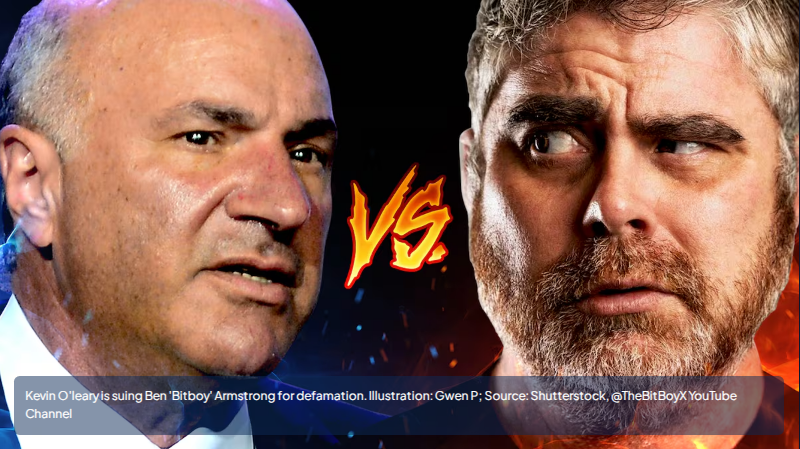
Crypto Courtroom Drama: Kevin O’Leary Wins Nearly $3M Against YouTuber ‘Bitboy’

bitcoinistОпубликовано 2026-02-16Обновлено 2026-02-16

Введение

Kevin O'Leary, known as "Mr. Wonderful" from Shark Tank, has been awarded a $2.8 million default judgment by a US federal court against YouTuber Ben "BitBoy" Armstrong. The ruling stems from a defamation lawsuit after Armstrong failed to respond to allegations that he made false social media posts accusing O'Leary of involvement in a fatal 2019 boating incident. The damages include $78,000 for reputational harm, $750,000 for emotional distress, and $2 million in punitive damages. The case is unrelated to crypto, but highlights legal risks for influencers spreading unverified claims.

Businessman and TV personality Kevin O’Leary, known as “Mr. Wonderful” from Shark Tank, has won a $2.8 million judgment after a US federal court entered default against popular YouTuber Ben “BitBoy” Armstrong.

The ruling comes after Armstrong failed to respond to a defamation lawsuit related to false claims he made on social media, which accused O’Leary of involvement in a 2019 boating accident that resulted in fatalities.

Those claims were never proven in court, and reporters have noted the legal action focused on restoring reputation and seeking damages for harm caused by the statements.

Court Enters Default Judgment

The court award totals roughly $2.8 million in combined damages. That figure breaks down into about $78,000 for reputational injury, $750,000 for emotional distress, and $2,000,000 in punitive damages meant to punish the conduct.

Judge Beth Bloom presided over the matter in the US District Court for the Southern District of Florida, which handled filings and issued the judgment. The ruling came after procedural steps that allow a plaintiff to obtain judgment when a defendant fails to respond.

Allegations And Timeline

Reports say the posts at the center of the case appeared in March of last year. They accused the businessman of being connected to lethal conduct and alleged a cover-up. O’Leary has never been charged in relation to that incident, and later court records showed related parties were cleared at trial.

Total crypto market cap currently at $2.33 trillion. Chart: TradingView

The defamation suit alleged the statements crossed the line from opinion into false factual claims that damaged reputation and caused distress. Because Armstrong did not appear or meaningfully answer the complaint, the court treated the claims as conceded for purposes of final judgment.

Crypto Connection And Implications

Armstrong is a well-known personality in the world of cryptocurrency, operating the popular site BitBoy Crypto. His messages reach thousands of cryptocurrency fans and investors, which helped to spread the false claims.

Although the case itself is not related to cryptocurrency, it shows the legal danger that cryptocurrency influencers may face when posting unverified or defamatory information online. This decision may make other personalities in the cryptocurrency world more careful about what they post online.

Featured image from Getty Images, chart from TradingView

Связанные с этим вопросы

QWhat was the total amount of the default judgment awarded to Kevin O'Leary against Ben Armstrong?

AThe total default judgment awarded to Kevin O'Leary was approximately $2.8 million.

QWhat were the three categories of damages included in the court's award and what were their amounts?

AThe damages were broken down into $78,000 for reputational injury, $750,000 for emotional distress, and $2,000,000 in punitive damages.

QWhy did the US federal court enter a default judgment in this case?

AThe court entered a default judgment because Ben Armstrong failed to respond to the defamation lawsuit.

QWhat was the nature of the false claims that Ben Armstrong made about Kevin O'Leary?

AArmstrong made false claims on social media accusing Kevin O'Leary of involvement in and a cover-up of a fatal 2019 boating accident.

QWhat potential impact does this case have on other cryptocurrency influencers, according to the article?

AThe article suggests the ruling may make other cryptocurrency influencers more careful about posting unverified or defamatory information online due to the legal dangers it highlights.

Похожее

3 People with 100 AI Programmers, Burning Through $1.3 Million a Month! OpenAI: I'll Foot the Bill

In a striking demonstration of AI-powered development, Peter Steinberger (creator of OpenClaw) shared that his three-person team spent $1.3 million in one month to run approximately 100 AI agents (primarily Codex instances). OpenAI covered the cost. The expenditure consumed 6.03 trillion tokens across 7.6 million requests. Steinberger argues that, with "fast mode" disabled, the cost falls below that of a single engineer while providing significantly greater output. This "cloud programmer army" handles core but tedious software engineering tasks: reviewing pull requests, finding security vulnerabilities, deduplicating issues, fixing bugs, monitoring benchmarks, and even generating PRs after meetings. This shifts AI's role from merely writing code to maintaining the entire collaborative fabric of a project. Steinberger's tool, CodexBar (a macOS menu bar app), tracks usage and costs across various AI coding services, highlighting how token consumption is becoming a key metric—a new "means of production." The experiment poses a profound question: if token cost ceases to be a barrier, how will software development transform? As model prices fall, the capability for small teams to leverage large numbers of AI agents could become commonplace, fundamentally altering the scale and speed of development. The future, Steinberger suggests, is arriving rapidly.

marsbit1 ч. назад

3 People with 100 AI Programmers, Burning Through $1.3 Million a Month! OpenAI: I'll Foot the Bill

marsbit1 ч. назад

In the AI Era, How to Onboard Without Starting from Scratch

In the AI era, onboarding new employees often resembles a botched relay race baton handoff, where the organization maintains speed while the newcomer starts from zero. The author, after joining Ramp, argues the core problem is a lack of accessible, shared organizational "context"—the collective knowledge from meetings, documents, Slack discussions, and decisions. Instead of relying on slow, manual onboarding or isolated AI tools, the solution is building a continuously updated "company brain." This system acts as a central, AI-native knowledge base that absorbs all company signals. The author describes building a prototype using an Obsidian vault powered by Claude, fed by automated meeting transcripts and notes, and topped with reusable agent "skills." The current enterprise AI approach, deploying specific workflow agents, is likened to the "chatbot era"—useful but disconnected. The real gap is the absence of a shared brain that all agents and employees can access from day one. The future lies in making context layer infrastructure the priority: write context first, then install tools; record every meeting; build the wiki before the dashboard. When new hires, AI agents, and even customers can immediately access this living company brain, the costly "ramp-up" period becomes obsolete. True organizational speed is achieved when maximum velocity and seamless context transfer happen simultaneously.

marsbit1 ч. назад

In the AI Era, How to Onboard Without Starting from Scratch

marsbit1 ч. назад

Торговля

Спот
Фьючерсы
活动图片