Cracks Behind the S&P High: Financial Sector Down 6% Year-to-Date, $2 Trillion Private Credit Undercurrents Spreading

marsbitОпубликовано 2026-05-08Обновлено 2026-05-08

Введение

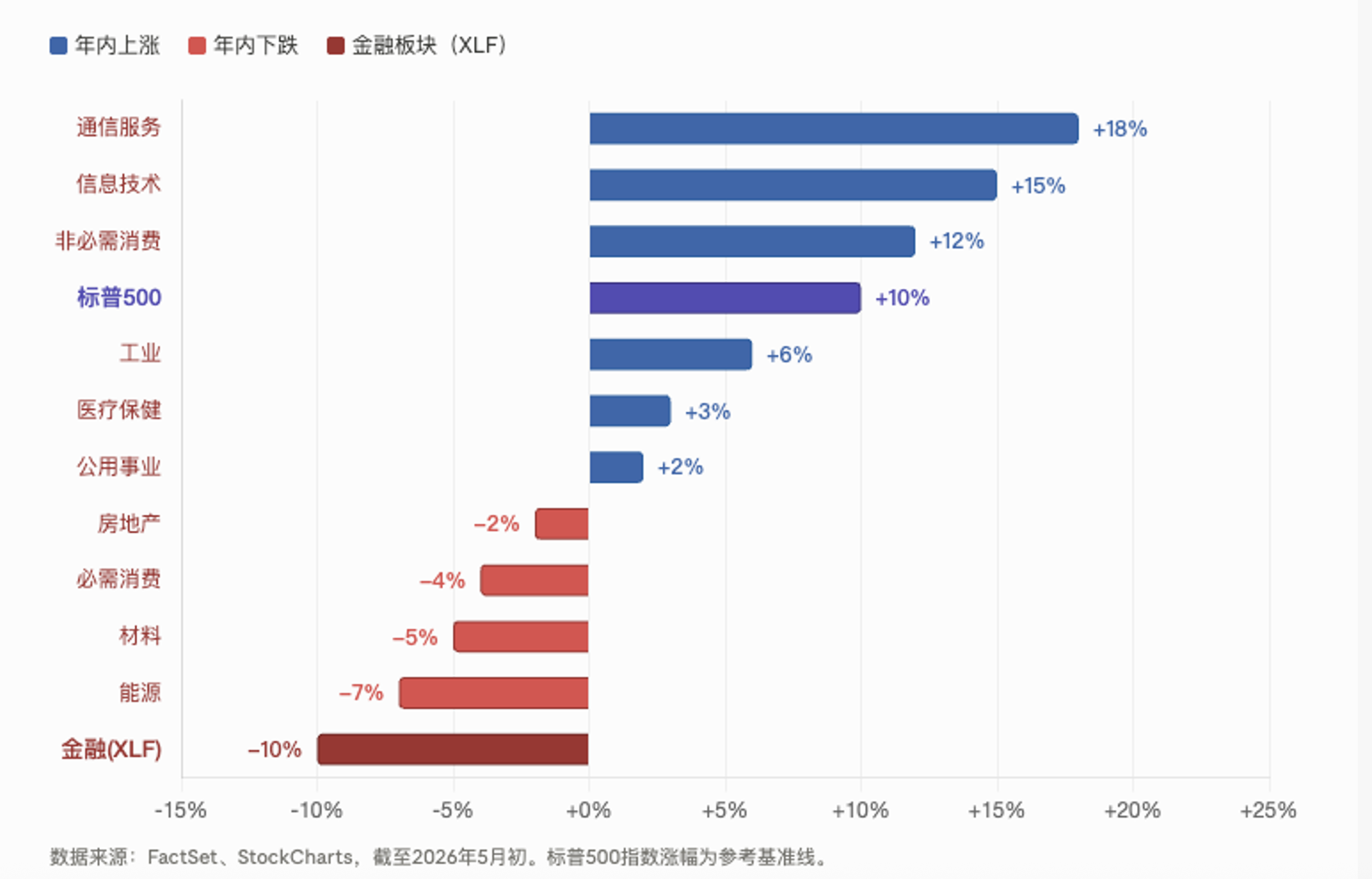
Amidst the S&P 500 hitting record highs with strong Q1 earnings, the financial sector (XLF ETF) is the worst performer, down over 6% year-to-date. Its relative weakness versus the broader market is at a historic low, surpassing levels seen during the 2008 and 2020 crises. This divergence points to growing stress in the $2 trillion private credit market. Despite robust bank earnings, investor concern focuses on hidden balance sheet risks. The private credit market, which ballooned post-2008, is showing cracks. The Financial Stability Board (FSB) recently warned of its systemic risks, high leverage, and reliance on risky payment-in-kind loans. Concurrently, major funds are facing significant redemptions; Blackstone's flagship BCRED fund saw $3.7bn in withdrawal requests, a record high. Technical indicators for the financial sector are bearish, with XLF trading below its 200-day moving average. Historical data suggests a high probability of a near-term market pullback when such conditions coincide with a market high. Initial "Trump re-election" optimism for the sector has faded due to unmet expectations for rate cuts and emerging private credit woes. Analysts warn the interconnected risks from private credit could spread wider than anticipated, advising investor caution over adding new exposure to the current market.

Author: Claude, Deep Tide TechFlow

Deep Tide Guide: While the S&P 500 hits consecutive record highs with Q1 profit growth reaching 27.1%, the financial sector has fallen over 6% year-to-date, becoming the worst performer among the 11 sectors. The relative performance of XLF versus the broad market has fallen to its lowest level since 1998, weaker than during the financial crisis and the COVID-19 pandemic. The driving force behind this is the accelerated exposure of cracks in the $2 trillion private credit market. Blackstone's flagship fund faced a $3.7 billion redemption wave, and the FSB just issued a systemic risk warning two days ago.

The S&P 500 index closed April at a record high of 7209 points, with Q1 profit growth of 27.1%, the highest since Q4 2021, and 84% of its components exceeding expectations. On the surface, US stocks have never looked healthier.

But the financial sector is sending a completely different signal. The XLF ETF tracking the sector has fallen more than 6% year-to-date, making it the worst-performing sector among all 11 S&P 500 industries. The severity of this divergence has surpassed levels seen during the 2008 financial crisis and the 2020 COVID-19 shock. According to FactSet and MarketWatch data, the relative performance of XLF versus the S&P 500 has fallen to its historical low since its inception in 1998.

Scott Brown, founder of Brown Technical Insights, stated bluntly: The US stock market cannot do without the support of the financial sector; currently, financial stocks aren't even participating in the rally.

Bank Profits Hit New Highs, Sector Hits New Lows

This round of weakness in the financial sector is particularly counterintuitive.

According to FactSet data on May 1, the S&P 500's Q1 profit growth reached 27.1%, the highest since Q4 2021, with the financial sector's revenue growth also ranking among the top four. Major banks like JPMorgan Chase, Bank of America, and Wells Fargo all reported strong quarterly results in April.

But the market is not trading on current quarter income statements; it's trading on the invisible risk exposures on the balance sheets.

The root of the problem points to private credit. This market, with a size of approximately $1.5 to $2 trillion, expanded rapidly into the void left by banks scaling back lending after the 2008 financial crisis. It is now deeply intertwined with banks, insurance companies, and asset management institutions. Once credit deterioration occurs, the transmission chain is far longer than what appears on the surface.

$2 Trillion Private Credit: From "Cockroaches" to Systemic Warning

JPMorgan Chase CEO Jamie Dimon previously likened emerging problems in the private credit field to "cockroaches," suggesting that if you see one, there are likely more behind it. This metaphor is increasingly being supported by data.

On May 6, the Financial Stability Board (FSB) issued a stern private credit risk report, warning that the market's complexity, high leverage, and deep interconnections with the banking system could amplify stress under adverse scenarios, posing risks to broader financial stability. The FSB specifically noted that private credit's high leverage is concentrated in technology, healthcare, and services, and it has never been tested by a prolonged economic downturn.

The report also highlighted an ominous signal: a growing number of private credit borrowers are starting to rely on payment-in-kind loans (i.e., paying off old debt with new debt rather than cash), which is often seen as a sign of deteriorating credit conditions.

Two days earlier, Bank of England Deputy Governor Sarah Breeden publicly expressed concerns about private credit asset quality, valuation discipline, and liquidity issues. The European Central Bank also issued similar warnings recently. Barclays disclosed its private credit exposure at $20 billion, and Deutsche Bank at around $30 billion.

Blackstone's Flagship Fund Faces $3.7 Billion in Redemptions, Clear Signal of Retail Investor Retreat

Beyond macro-level warnings, turbulence on the capital side is more direct.

According to a Reuters report on March 3, Blackstone's $82 billion flagship private credit fund BCRED faced $3.7 billion in redemption requests in Q1, accounting for 7.9% of the fund's assets, a record high since the fund's inception. JPMorgan analysts characterized this as the first net outflow in BCRED's history, calling it a "significant expression of a sharp deterioration in investor sentiment toward direct lending." Blackstone was forced to raise the regular 5% redemption cap to 7% and injected $400 million from the company and its executives to fulfill all redemption requests.

The day after the news was announced, Blackstone's stock price plummeted up to 8% to a two-year low.

The situation for another private credit giant, Blue Owl Capital, is even more dire. Its flagship fund OCIC saw redemption requests as high as 21.9% in Q1, but the company only met a pro-rata 5% cap, meaning about three-quarters of the redemption requests were rejected. Its tech-focused fund OTIC had redemption requests as high as 17% in the previous quarter.

The assessment from investment bank RA Stanger is quite impactful; it believes alternative assets are entering a "sharp turn" phase, with capital flowing out of private credit. It estimates BDC (Business Development Company) capital formation will decrease by about 40% year-on-year in 2026.

According to a PitchBook survey of about 100 credit institutions, 35% of respondents believe negative perception of the private credit sector is the biggest headwind for the industry, with market sentiment significantly worse than six months ago. Morgan Stanley predicts private credit default rates will rise to 8%, with about 20% of loans directed to software companies. The prospects for this portion of assets are particularly concerning under the impact of AI.

Technical Signals: 90% Historical Probability Points to Correction

Returning to the technicals of the financial sector itself, the signals are also not optimistic.

Scott Brown points out that XLF not only continued to fall while the S&P 500 was making new highs but also consistently traded below its 200-day moving average. Historical data shows that in the 32 previous instances where the S&P 500 made a new high while XLF was simultaneously below its 200-day moving average, the S&P 500 fell 29 times one month later, with an average decline of 3.3%. The win rate six months later is closer to fifty-fifty, but the maximum decline in the downside range was as high as 41.5%, indicating an asymmetrically larger tail risk.

Among all 11 SPDR sector ETFs for the S&P 500, XLF is currently the only sector where both the price and the 50-day moving average are below the 200-day moving average, showing weakness in both short-term and long-term trends.

Historically, the financial sector has twice provided early warnings before the market peaked. In April 1999, XLF's relative performance versus the S&P 500 began to weaken, about 11 months before the S&P 500's final peak. In February 2007, XLF again issued an early warning signal, leading the market top by about 8 months.

Year-start "Trump Dividend" Expectations Completely Unfulfilled

The financial sector started the year with high hopes. The market widely expected a second Trump term to bring lower interest rates and looser regulation, creating a favorable environment for banks, insurance companies, and asset management institutions.

According to an Investing.com report in early April, the opposite happened. Over a year into Trump's second term, the financial sector became the worst-performing sector in the S&P 500. Hopes for interest rate cuts were dashed, private credit landmines surfaced, and Middle East conflicts pushed up oil prices and inflation expectations, with multiple headwinds converging.

Melissa Brown, Global Head of Investment Decision Research at SimCorp, points out that the financial system is highly interconnected, and the associated risks in the private credit field could spread more widely than currently anticipated.

Scott Brown's advice is prudence over aggression; judging the top in the current market is not easy, but investors might consider gradually reducing holdings rather than continuing to chase gains, and certainly should not inject new funds into the market.

Связанные с этим вопросы

QWhat is the key reason behind the poor performance of the financial sector (XLF ETF) despite strong overall market and banking profit growth?

AThe key reason is growing concern over the approximately $2 trillion private credit market, where cracks are emerging, such as rising defaults, increased use of risky payment-in-kind loans, and investor redemptions from major funds like Blackstone's BCRED. This systemic risk threatens banks and financial institutions deeply interconnected with this market.

QWhat specific data point highlights the extreme divergence between the financial sector and the broader S&P 500 index?

AThe relative performance of the XLF ETF (tracking the financial sector) compared to the S&P 500 has fallen to its lowest level since its inception in 1998. This divergence is more severe than during both the 2008 financial crisis and the 2020 Covid-19 market shock.

QWhat was a significant real-world consequence of the stress in the private credit market mentioned in the article?

ABlackstone's flagship $82 billion private credit fund, BCRED, faced a record $3.7 billion in redemption requests in Q1. To meet these demands, Blackstone had to raise its redemption limit from 5% to 7% and inject $400 million from the company and its executives.

QAccording to the technical analysis by Scott Brown, what is the historical probability of a market correction when a specific technical condition occurs with the XLF ETF?

AHistorically, in the 32 instances where the S&P 500 hit a new high while the XLF was trading below its 200-day moving average, the S&P 500 declined 29 times (over 90% probability) one month later, with an average drop of 3.3%.

QWhat major regulatory body recently issued a warning about private credit, and what were its primary concerns?

AThe Financial Stability Board (FSB) issued a stern warning. Its primary concerns were the market's complexity, high leverage, deep interconnections with the banking system, concentration in sectors like tech and healthcare, and the increasing reliance on payment-in-kind loans, which could amplify stress and pose systemic risks during an economic downturn.

Похожее

Warsh's First Day in Office, Markets Deliver a 'Wake-up Call': Rate Hike Expected This Year

On his first day in office, newly inaugurated Federal Reserve Chairman Warsh received a stark market warning, with expectations now fully pricing in a 25-basis-point interest rate hike this year. The shift was triggered by hawkish remarks from Fed Governor Waller, who stated that inflation is now the key policy "driver" and that the odds of a hike or cut are evenly split. This sent short-term Treasury yields higher. Waller signaled a significant pivot in his stance, citing disappointing inflation and labor data. He suggested removing "easing bias" language from Fed statements and did not rule out future rate increases if inflation fails to recede, though he noted immediate action isn't warranted without signs of unanchored inflation expectations. Chairman Warsh faces immediate pressure at his first FOMC meeting in June. With the preferred inflation gauge at a three-year high, analysts warn that failing to hike could be interpreted as an implicit easing of policy. The geopolitical situation in the Middle East is adding to existing price pressures. The market's expectation for a hike contrasts sharply with earlier forecasts for multiple cuts. While long-term Treasury yields have been contained by lower energy prices recently, analysts note they remain under structural upward pressure. Warsh's swearing-in at the White House highlights political scrutiny over Fed independence. However, the market has made it clear that inflation is the most urgent challenge, leaving the new chairman little time to settle in.

marsbit4 ч. назад

Warsh's First Day in Office, Markets Deliver a 'Wake-up Call': Rate Hike Expected This Year

marsbit4 ч. назад

Has Microsoft Lost Its Way in the AI Race, and Can Copilot Bring It Back on Track?

Microsoft, once seen as an early AI frontrunner due to its investment in OpenAI, is navigating a strategic shift amid increased competition. Its initial reliance on OpenAI’s GPT models has been complicated by OpenAI’s growing ambitions as a direct competitor, rapid advancements from rivals like Claude and Gemini, and the disruptive rise of AI agents, which challenge its traditional SaaS business model. These factors contributed to stock declines and slower-than-expected adoption of its flagship Copilot products. In response, CEO Satya Nadella has taken a hands-on role in product development, signaling the urgency of change. Microsoft is pivoting from a model-centric strategy to a "model-agnostic" enterprise platform approach. It aims to become the foundational layer connecting various AI models—from OpenAI, Anthropic, or its own new "Superintelligence" team—with enterprise workflows, data, security, and cloud services. Recent organizational changes merged consumer and enterprise Copilot teams to accelerate innovation, exemplified by new products like Copilot Tasks and Copilot Cowork. However, this transformation comes at a high cost. Microsoft faces massive capital expenditures, potentially reaching ~$190 billion by 2026, to support AI infrastructure. While its platform strategy shows early signs of traction with growing Azure AI revenue, it must balance startup-like agility with the reliability expected by enterprise clients. The core challenge is no longer being the sole AI winner but defending its position as the essential enterprise software entry point amidst rapid technological commoditization and the shift towards always-on AI agents.

marsbit5 ч. назад

Has Microsoft Lost Its Way in the AI Race, and Can Copilot Bring It Back on Track?

marsbit5 ч. назад

Why Haven't Forex Stablecoins Taken Off?

Why FX Stablecoins Never Took Off: A Path Forward via Synthetic FX Despite the explosive growth of stablecoin-powered digital banking, which has seen ~$6B in VC investment and a 24x surge in crypto card spending in under a year, a major limitation persists: these banks are essentially dollar-only accounts. This leaves 95-99% of global accounts, which are denominated in non-USD currencies, underserved. Attempts to create native foreign currency (FX) stablecoins (like EURC) have largely failed, with total FX stablecoin TVL at ~$600M compared to $400B for USD stablecoins—a 700x gap. These FX tokens face critical challenges: fragile pegs due to low liquidity, limited exchange/FinTech acceptance, poor on/off-ramps, complex regional compliance, and a chicken-and-egg adoption problem. The article argues that the solution lies not in competing with entrenched USD stablecoin networks (USDT/USDC), but in adopting a synthetic FX model inspired by traditional finance. Specifically, it advocates for Mark-to-Market Non-Deliverable Forwards (NDFs)—cash-settled FX derivatives that allow users to maintain underlying USD stablecoin holdings while having their account balance and P&L denominated in a foreign currency. This approach offers key advantages: strong oracle-based pegs, retention of deep USD stablecoin liquidity and yield, superior on/off-ramps, scalability to any currency with a reliable feed, and capital efficiency. It mirrors how modern institutional FX markets operate. Primary use cases for on-chain NDFs include: 1. **Digital Banks/Wallets:** Enabling multi-currency accounts for international users without leaving the USD stablecoin ecosystem, boosting deposits and retention. 2. **FX Carry Trade Vaults:** Offering access to sovereign interest rate differentials (e.g., earning yield on BRL) in a more stable and scalable format than crypto-native products like Ethena. 3. **Global Enterprise Payments:** Allowing merchants to receive payments in local currency equivalents while settling in USD stablecoins, similar to services offered by Stripe for fiat. The conclusion is that synthetic FX, not native FX stablecoins, is the viable path to integrating foreign exchange into the growing stablecoin digital banking landscape, potentially unlocking the next phase of institutional DeFi and multi-trillion-dollar global adoption.

链捕手5 ч. назад

Why Haven't Forex Stablecoins Taken Off?

链捕手5 ч. назад

Торговля

Спот
Фьючерсы

Популярные статьи

Как купить S

Добро пожаловать на HTX.com! Мы сделали приобретение Sonic (S) простым и удобным. Следуйте нашему пошаговому руководству и отправляйтесь в свое крипто-путешествие.Шаг 1: Создайте аккаунт на HTXИспользуйте свой адрес электронной почты или номер телефона, чтобы зарегистрироваться и бесплатно создать аккаунт на HTX. Пройдите удобную регистрацию и откройте для себя весь функционал.Создать аккаунтШаг 2: Перейдите в Купить криптовалюту и выберите свой способ оплатыКредитная/Дебетовая Карта: Используйте свою карту Visa или Mastercard для мгновенной покупки Sonic (S).Баланс: Используйте средства с баланса вашего аккаунта HTX для простой торговли.Третьи Лица: Мы добавили популярные способы оплаты, такие как Google Pay и Apple Pay, для повышения удобства.P2P: Торгуйте напрямую с другими пользователями на HTX.Внебиржевая Торговля (OTC): Мы предлагаем индивидуальные услуги и конкурентоспособные обменные курсы для трейдеров.Шаг 3: Хранение Sonic (S)После приобретения вами Sonic (S) храните их в своем аккаунте на HTX. В качестве альтернативы вы можете отправить их куда-либо с помощью перевода в блокчейне или использовать для торговли с другими криптовалютами.Шаг 4: Торговля Sonic (S)С легкостью торгуйте Sonic (S) на спотовом рынке HTX. Просто зайдите в свой аккаунт, выберите торговую пару, совершайте сделки и следите за ними в режиме реального времени. Мы предлагаем удобный интерфейс как для начинающих, так и для опытных трейдеров.

1.3k просмотров всегоОпубликовано 2025.01.15Обновлено 2025.03.21

Как купить S

Sonic: Обновления под руководством Андре Кронье – новая звезда Layer-1 на фоне спада рынка

Он решает проблемы масштабируемости, совместимости между блокчейнами и стимулов для разработчиков с помощью технологических инноваций.

2.2k просмотров всегоОпубликовано 2025.04.09Обновлено 2025.04.09

Sonic: Обновления под руководством Андре Кронье – новая звезда Layer-1 на фоне спада рынка

HTX Learn: Пройдите обучение по "Sonic" и разделите 1000 USDT

HTX Learn — ваш проводник в мир перспективных проектов, и мы запускаем специальное мероприятие "Учитесь и Зарабатывайте", посвящённое этим проектам. Наше новое направление .

1.8k просмотров всегоОпубликовано 2025.04.10Обновлено 2025.04.10

HTX Learn: Пройдите обучение по "Sonic" и разделите 1000 USDT

Обсуждения

Добро пожаловать в Сообщество HTX. Здесь вы сможете быть в курсе последних новостей о развитии платформы и получить доступ к профессиональной аналитической информации о рынке. Мнения пользователей о цене на S (S) представлены ниже.

活动图片