Coinbase Launches Crypto-Backed USDC Loans For UK Users In Latest Expansion

bitcoinistОпубликовано 2026-04-21Обновлено 2026-04-21

Введение

Coinbase has expanded its crypto-backed USDC lending service to UK residents, allowing them to use Bitcoin (BTC), Ethereum (ETH), and Coinbase Wrapped Staked Ether (cbETH) as collateral. Powered by the on-chain protocol Morpho on the Base network, the service enables users to borrow up to $5 million in USDC without selling their crypto holdings. Collateral is locked in a smart contract until the loan is repaid, with liquidation triggered if the loan-to-value ratio exceeds a threshold. This follows the service’s successful US launch, where originations surpassed $2.17 billion. The move is part of Coinbase’s broader expansion in the UK, including savings accounts and DEX trading, and aligns with its efforts to integrate crypto into traditional finance, such as recently offering crypto-backed mortgages.

Building on its US success, crypto exchange Coinbase has rolled out crypto-backed USDC loans for UK residents, using Bitcoin (BTC) and Ethereum (ETH) as collateral. This expands the exchange’s growing suite of financial services in the region.

Crypto-Backed Loans Cross The Pond

On Monday, Coinbase, the largest crypto exchange in the US, announced that it has expanded its Borrow product to UK residents, unlocking more liquidity for users without having to sell their crypto holdings.

UK customers can now instantly borrow USDC using their Bitcoin, Ethereum, and Coinbase Wrapped Staked Ether (cbETH) as collateral, powered by Morpho, an on-chain protocol on the Base network.

Notably, Coinbase users will be able to borrow up to $5 million in USDC for Bitcoin-backed loans, depending on the amount of BTC pledged as collateral, the announcement explained.

The crypto exchange stated that collateral will be locked in a Morpho smart contract until the loan is fully repaid, and there is no fixed repayment schedule. However, it will be liquidated to repay the loan if the loan-to-value ratio exceeds a certain threshold, and Morpho will charge a liquidation penalty fee.

According to the Monday announcement, the launch expands access to the exchange’s crypto-backed lending service, which has seen multi-billion-dollar demand since launch in the US last year.

Providing access to crypto-backed loans in the UK is the first step in Coinbase’s ongoing efforts to expand following the launch of this offering in the US in January 2025. Initial interest in the service in the US has been substantial with total loan originations through Coinbase on Morpho growing to over $2.17B USDC as of April 14, 2026. Coinbase plans to continue expanding access to crypto-backed loans in more countries in the near future.

It also marks another step in Coinbase’s efforts to build a broader lineup of financial products in the country, following its successful registration as a crypto service provider by the Financial Conduct Authority (FCA) in February 2025. The exchange also launched savings accounts in the UK and DEX trading in November 2025 and April 2026, respectively.

Coinbase Expansion Continues

Coinbase’s latest launch also follows the company’s recent push to expand crypto-backed lending in traditional finance use cases. As reported by Bitcoinist, the exchange and Better Home & Finance launched a joint mortgage product for prospective home buyers to use their crypto holdings as collateral to fund their down payments on a Fannie Mae‐backed loan.

Per the announcement, the product aims to create a “direct pathway from digital wealth to homeownership” by allowing users to pledge Bitcoin and USDC held in a Coinbase account to secure a separate loan for their down payment.

Earlier this month, the exchange also achieved a crucial milestone in the US after receiving key approval that may unlock a broader market for the company. On April 2, Coinbase secured conditional approval from the Office of the Comptroller of the Currency (OCC), the main banking regulator, to charter Coinbase National Trust Company.

Although the company will not become a commercial bank and will not take retail deposits or engage in fractional reserve banking, the exchange noted the conditional approval marked a major step toward becoming a federally regulated crypto custodian, as it will allow Coinbase to “build the next chapter of finance,” boosted by the regulatory confidence.
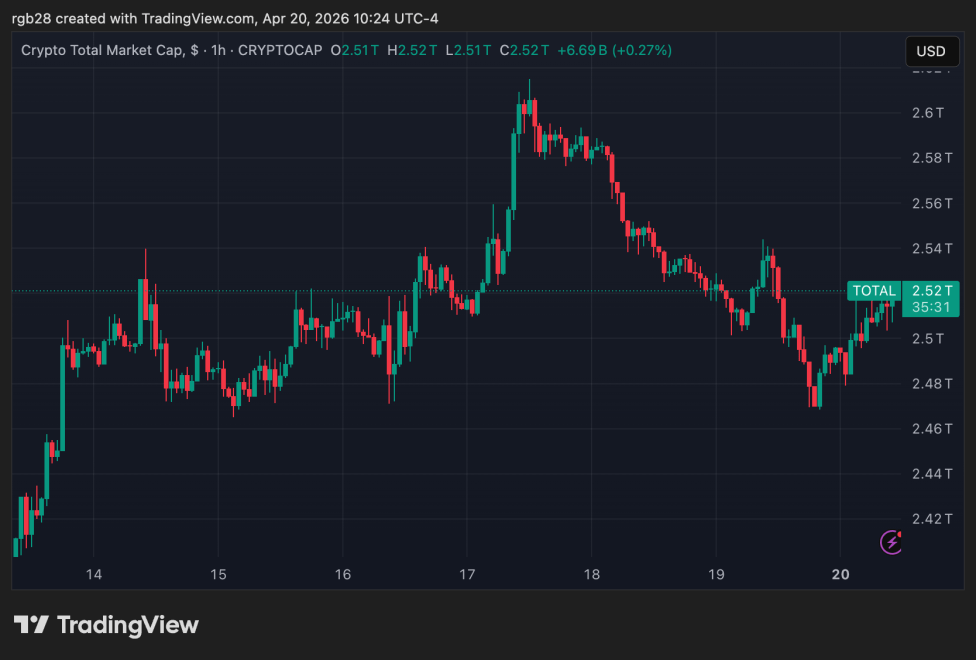
The total crypto market capitalization is at $2.52 trillion in the one-week chart. Source: TOTAL on TradingView


Связанные с этим вопросы

QWhat new service has Coinbase launched for UK users and which cryptocurrencies can be used as collateral?

ACoinbase has launched crypto-backed USDC loans for UK users, allowing them to use Bitcoin (BTC), Ethereum (ETH), and Coinbase Wrapped Staked Ether (cbETH) as collateral.

QWhat is the maximum loan amount a user can borrow for a Bitcoin-backed loan and what determines this amount?

AUsers can borrow up to $5 million in USDC for a Bitcoin-backed loan, with the specific amount depending on the value of the BTC pledged as collateral.

QWhich on-chain protocol powers this new lending service and what happens to the collateral if the loan-to-value ratio is exceeded?

AThe service is powered by the Morpho protocol on the Base network. If the loan-to-value ratio exceeds a certain threshold, the collateral will be liquidated to repay the loan, and a liquidation penalty fee will be charged.

QWhat was the total value of loan originations through Coinbase on Morpho in the US as of April 14, 2026?

AThe total loan originations through Coinbase on Morpho in the US grew to over $2.17 billion USDC as of April 14, 2026.

QWhat recent regulatory approval did Coinbase receive in the article mentions as a crucial milestone for its expansion?

ACoinbase received conditional approval from the Office of the Comptroller of the Currency (OCC) to charter Coinbase National Trust Company, a major step toward becoming a federally regulated crypto custodian.

Похожее

War Trade Unwinding | TradeXYZ Weekend Observations

Weekend markets saw a clear return of risk appetite. Major indices rose broadly, with significant gains in tech and precious metals, while energy sectors fell sharply on the "end of war" narrative. On June 14, oil prices initially rose on reports Iran had not yet finalized a memorandum of understanding. Later, YNET reported Trump might immediately lift the maritime blockade on Iran and the Strait of Hormuz. At 21:30, Trump confirmed on Truth Terminal that a deal with Iran was done, authorizing an immediate end to the US blockade and toll-free opening of the Strait. Iran's deputy foreign minister simultaneously announced an immediate and permanent halt to military actions on multiple fronts. Oil prices had already fallen to weekend boundaries, pre-pricing the news. The S&P 500 subsequently touched 7530. Markets will likely remain in a waiting period until the formal peace deal signing on June 19. At the moment of the deal announcement, gold jumped from ~4,221 to a high of 4,337, and silver from ~67.85 to 70.83, before stabilizing at higher levels. Individual stocks and ETFs like NBIS, RKLB, and LITE performed strongly. NBIS, added to the Nasdaq index, saw a target price increase due to strong AI cloud growth. RKLB, also added to the index, benefited from positive SpaceX valuation sentiment. LITE received a $1,130 target from JPMorgan. SPCX rose quickly after Musk tweeted SpaceX could potentially reach ~$1 trillion in revenue by 2030. In summary, the market shock from the multi-month war is beginning to dissipate. Israel's actions remain the key variable before the June 19 signing. Upcoming events like Fed Chair Warsh's debut and BoJ rate hike expectations will also significantly impact markets this week.

marsbit9 мин. назад

War Trade Unwinding | TradeXYZ Weekend Observations

marsbit9 мин. назад

Will the Next Crypto Bull Run Start with On-Chain Trading of SpaceX?

This article presents a scenario-based forecast for the crypto industry from 2026 to 2029, arguing that the next major cycle will be driven not by technological narratives but by legal access to real-world assets. The author predicts that by mid-2026, pre-IPO perpetual contracts for top private companies like SpaceX, OpenAI, and Anthropic on platforms like Hyperliquid will become the primary gateway for accessing quality assets, as most crypto-native tokens fail to capture real value. The much-hyped AI x Crypto intersection largely fails except for prediction markets, which thrive on betting on AI model supremacy. By 2027, public blockchain foundations are forced to choose between catering to retail speculation or building compliant infrastructure for institutions, with many opting for the latter. Growth in stablecoins and tokenized private credit/equity hits a "triple ceiling" due to regulatory and political uncertainty rather than market demand. The pivotal shift is forecast for 2028. A major liquidation event in pre-IPO perpetuals exposes the structural flaw of synthetic markets lacking a real underlying asset anchor. In response, regulatory changes finally allow the public solicitation of private securities resales to verified accredited investors. This creates a legitimate secondary market for real company equity, which then becomes the core asset class of the new bull market, relegating synthetic perps to a niche role. By 2029, the industry becomes "boring" but foundational. Tokens without claims on real cash flows or assets cease trading. Stablecoin growth is steady but politically capped. Crypto infrastructure fades from view as it gets absorbed into traditional finance backends. The article's central thesis is that the key bottleneck for crypto's next phase is legal and regulatory channels for real asset ownership, not technology.

marsbit1 ч. назад

Will the Next Crypto Bull Run Start with On-Chain Trading of SpaceX?

marsbit1 ч. назад

The Value Distribution of Stablecoins

**Summary: The Value Distribution of Stablecoins** The article argues that stablecoins are evolving from mere trading tools into broader channels for dollar access. It divides the stablecoin ecosystem into four layers to analyze how value is distributed: 1. **Issuance Layer:** Mints stablecoins, holds reserve assets, and captures the spread between reserve yield and user costs (e.g., Tether, Circle). This layer currently earns the largest profit margin. 2. **Infrastructure Layer:** Connects stablecoins to the traditional financial system, handling fiat on/off-ramps, banking integration, compliance (KYC/AML), and asset management (e.g., Bridge, BVNK). This is the "unglamorous" but critical work, building the essential bridges between crypto and real-world finance. 3. **Acquiring/Distribution Layer:** Integrates stablecoins into merchant systems, manages payment flows, and provides enterprise financial software (e.g., Stripe, Coinbase). They act as the access point for businesses. 4. **Application Layer:** The end-users and businesses that ultimately use stablecoins for payments, settlements, or as a store of value. They benefit from convenience but have little pricing power. The core thesis is that while the issuance layer currently dominates profits, the often-overlooked **infrastructure layer holds significant long-term potential**. The real challenge and barrier to mass adoption is not the on-chain transfer of stablecoins (which is simple), but the complex "last mile" integration into existing business workflows, banking systems, and regulatory frameworks across different countries. Companies in this layer are currently in a "land grab" phase, investing heavily to build networks, secure bank partnerships, and establish compliance pathways. While their position is currently pressured by the profitable issuers above and distribution platforms below, the article suggests that if stablecoins become a default financial rail for businesses, the infrastructure providers who have done the hard work of integration will ultimately gain strong pricing power and become entrenched, essential players.

marsbit8 ч. назад

The Value Distribution of Stablecoins

marsbit8 ч. назад

The Value Distribution of Stablecoins

The Value Distribution of Stablecoins The article argues that stablecoins are evolving from a mere trading tool into a broad "dollar channel." It analyzes the industry's value chain through four layers: 1. **Issuance Layer (e.g., Tether, Circle):** The top layer that mints stablecoins, holds reserve assets, and captures the thickest interest rate spread. 2. **Infrastructure Layer (e.g., Bridge, BVNK):** Connects stablecoins to the traditional financial system, handling critical but complex "dirty work" like fiat on/off-ramps, banking integration, compliance (KYC/AML), and cross-border settlement. 3. **Acquiring/Distribution Layer (e.g., Stripe, Coinbase):** Embeds stablecoins into merchant systems, manages payment flows, and integrates with enterprise software. 4. **Application Layer:** End-users and businesses that ultimately use stablecoins for payments, settlement, or storing value. The author posits that while the issuance layer currently captures the most profit, the most overlooked and potentially critical layer is infrastructure. The core challenge for stablecoin adoption isn't the on-chain transfer (which is simple), but bridging the gap between blockchain and the real-world financial system. This involves solving practical problems for businesses: fiat conversion, reconciliation, tax handling, and user onboarding. Infrastructure companies are currently in a difficult "land-grab" phase—building networks, securing banking relationships, and achieving compliance country-by-country. They face pressure from both the profitable issuance layer above and distribution platforms below. However, the author suggests this layer is building a crucial moat. Once stablecoins become a default business rail, the infrastructure players who have done the hard work of integration may gain significant, durable value and pricing power.

链捕手8 ч. назад

The Value Distribution of Stablecoins

链捕手8 ч. назад

Торговля

Спот
Фьючерсы
活动图片