Coinbase Hit With Nevada Lawsuit Over Illegal Betting Claims

bitcoinistОпубликовано 2026-02-05Обновлено 2026-02-05

Введение

Coinbase faces a civil lawsuit from the Nevada Gaming Control Board for offering event contracts that regulators claim constitute unlicensed sports betting. The state seeks a temporary restraining order and injunction to halt these operations, arguing they violate Nevada gaming laws. Coinbase contends that such contracts fall under federal CFTC jurisdiction, not state oversight, and has sued multiple states in response. The legal conflict highlights ongoing tension between state and federal regulators regarding prediction markets, as the CFTC considers new rules clarification. Similar enforcement actions are occurring in other states.

Coinbase is facing a civil enforcement action in Nevada after state gaming regulators said the company offered event contracts that look like wagers to local users.

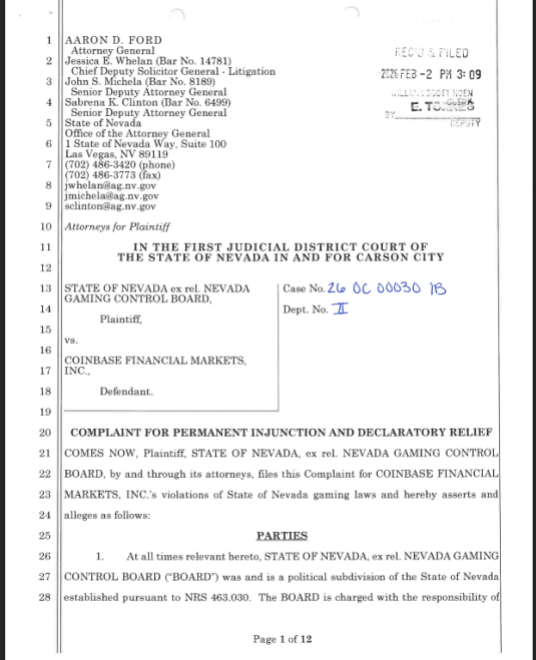
Based on reports, the Nevada Gaming Control Board filed suit in state court asking a judge to stop Coinbase from offering these contracts inside Nevada and to grant a temporary restraining order and preliminary injunction.

Nevada Files Civil Enforcement Action

The complaint says Coinbase’s event contracts operate like unlicensed sports betting under Nevada law, and that the exchange did not hold the required state gaming license to offer them.

Source: Nevada Gaming Control Board

The filing seeks immediate court steps to halt the products while the state pursues its claims. Reports note the move follows similar actions against other prediction platforms and comes as the legal fight over where these products belong—state gaming law or federal derivatives law—intensifies.

Background On Prediction Markets And Coinbase’s Response

Prediction markets have grown quickly. Coinbase rolled out a prediction market product that lets customers take positions on the outcomes of sports and other real-world events, working with established market operators.

BTCUSD currently trading at $76,059. Chart: TradingView

Coinbase has pushed back by suing multiple states in federal court, arguing that event contracts are regulated by the federal Commodity Futures Trading Commission and not by individual state gaming regulators. Those federal suits targeted Connecticut, Illinois, and Michigan, among others.

Federal Regulator Signals New Rules

Reports say the CFTC’s chair has signaled a shift toward clearer federal rules for event contracts and suggested the agency may issue new guidance that affects ongoing state cases.

That announcement could change the legal balance, since a stronger federal stance would bolster exchanges that claim CFTC jurisdiction over these products. Still, state claims press on, and courts will have to sort out who has the power to regulate.

Nevada’s Push Comes As Other States Act

Nevada’s action is not isolated. A Nevada state court recently granted a temporary restraining order that barred another major prediction platform from offering event contracts in the state for a short period while the matter moved toward a hearing.

Regulators in several states have issued cease-and-desist letters or sued operators they say are offering unlicensed wagering.

Featured image from Shutterstock, chart from TradingView

Связанные с этим вопросы

QWhat is the main reason Nevada is taking legal action against Coinbase?

ANevada is taking legal action because state gaming regulators claim Coinbase offered event contracts that operate like unlicensed sports betting without holding the required state gaming license.

QWhat specific legal measures did the Nevada Gaming Control Board request from the court?

AThe Nevada Gaming Control Board filed a suit asking the court to stop Coinbase from offering these contracts in Nevada and to grant a temporary restraining order and preliminary injunction.

QHow has Coinbase responded to similar regulatory challenges from other states?

ACoinbase has pushed back by suing multiple states, including Connecticut, Illinois, and Michigan, in federal court, arguing that event contracts are regulated by the federal CFTC and not by state gaming regulators.

QWhat potential shift in the regulatory landscape is mentioned regarding the CFTC?

AThe CFTC's chair has signaled a shift toward clearer federal rules for event contracts and suggested the agency may issue new guidance, which could bolster exchanges' claim of CFTC jurisdiction.

QIs Nevada's action an isolated case, or are other states taking similar steps?

ANevada's action is not isolated; regulators in several states have issued cease-and-desist letters or sued operators they allege are offering unlicensed wagering.

Похожее

Raising Interest Rates Is Not a Tech Killer, EPS Is: A Strategy for Discarding the Weak and Retaining the Strong After the AI Theme's Sharp Decline

**Summary: Rising Interest Rates Are Not the Killer of Tech; EPS Is: The "Keep the Strong, Ditch the Weak" Strategy After the AI Theme Plunge** The author argues that the sharp sell-off in tech and AI-related stocks, triggered by a strong US jobs report that heightened Fed rate hike fears, represents a "pullback to pick up passengers" rather than a "car crash." The true end of a tech bull market is not determined by an extra 25 basis point hike, but by industry overcapacity and the disproval of earnings per share (EPS) expectations. Historical analysis shows that during past rate hike cycles, the Nasdaq-100 often outperformed, provided EPS growth remained strong. The current phase is seen as a shift from a "broad narrative-driven rally" to a "focused verification stage" for AI. The investment strategy should be to "keep the strong, ditch the weak." * **Retain exposure** to high-conviction AI infrastructure leaders with clear order visibility, stable margins, strong cash flow, and upward EPS revisions (e.g., AI servers, advanced packaging, optical modules, key cloud suppliers). * **Reduce exposure** to high-beta, narrative-driven stocks with unclear profit paths (e.g., some quantum computing, space, or speculative chip stocks), especially on rebounds. Valuation concerns should focus on whether earnings can catch up to high multiples, not on high P/E alone. Crowded positioning signals a concentration into quality assets, not necessarily a market top. The upcoming Q2 earnings season will be a key validation point. The core principle is to hold stocks with proven EPS, while using macro events (CPI data, central bank meetings) to manage timing and risk.

marsbit1 ч. назад

Raising Interest Rates Is Not a Tech Killer, EPS Is: A Strategy for Discarding the Weak and Retaining the Strong After the AI Theme's Sharp Decline

marsbit1 ч. назад

Торговля

Спот
Фьючерсы
活动图片