Coinbase borrows Kalshi’s playbook, sues three states over prediction markets

cointelegraphОпубликовано 2025-12-19Обновлено 2025-12-19

Введение

Coinbase has filed lawsuits against regulators in Connecticut, Illinois, and Michigan, seeking federal court rulings that prediction markets operated under CFTC oversight fall under the Commodity Exchange Act and are not subject to individual state gambling laws. The exchange argues that allowing states to independently classify these markets as illegal gambling would undermine federal regulatory authority and create inconsistent national standards. Coinbase’s chief legal officer, Paul Grewal, emphasized that prediction markets function as neutral trading platforms—unlike traditional sportsbooks—and should be treated as regulated financial instruments. The legal move mirrors strategies used by prediction market operator Kalshi, which has faced mixed outcomes in similar state-level challenges. The cases may ultimately determine whether prediction markets are considered CFTC-regulated derivatives or gambling products subject to state prohibitions.

Coinbase is taking three US states to court in a bid to lock in federal protection for its planned prediction markets, opening a new front in the battle over whether event contracts are finance or gambling.​

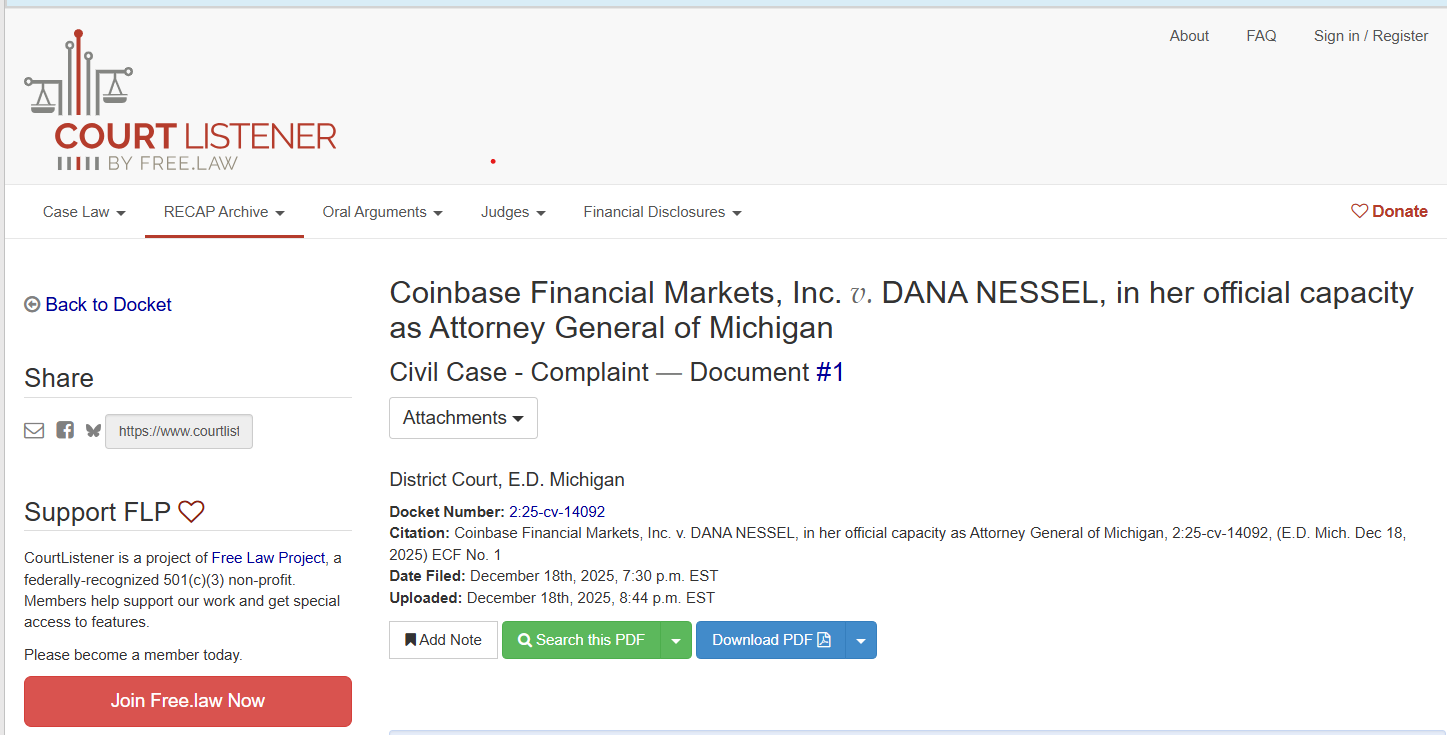
The exchange has sued regulators in Connecticut, Illinois, and Michigan, asking federal judges to declare that prediction markets listed on a US Commodity Futures Trading Commission (CFTC)-regulated platform fall under the Commodity Exchange Act (CEA) and the CFTC’s exclusive jurisdiction, not 50 separate state gambling codes.

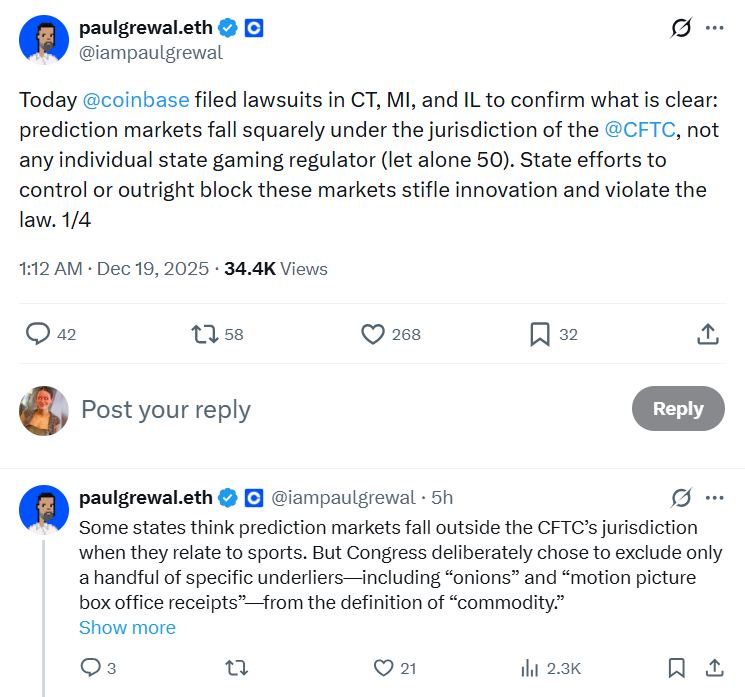
In a Friday X post, chief legal officer Paul Grewal said Coinbase filed the cases “to confirm what is clear: prediction markets fall squarely under the jurisdiction of the @CFTC, not any individual state gaming regulator (let alone 50).”​

Source: Paul Grewal

Related: Coinbase appoints former UK minister George Osborne to chair advisory council

Coinbase’s federalism challenge to state gambling laws

Coinbase frames the dispute as both a legal and structural question. Court filings argue that if each state can independently decide whether federally supervised prediction markets are illegal gambling, the most restrictive regime would effectively become the national standard, “turning our system of federalism upside down.”

The company also leans hard on the way Congress defined “commodity” in the CEA, noting that lawmakers chose to carve out only a handful of specific underliers, notably onions and “motion‐picture box‐office receipts,” rather than sports or politics.​

Coinbase filing against Michigan. Source: Court Listener

Grewal draws a clear line between Coinbase’s planned markets and traditional sportsbooks. Casinos and bookmakers, he argues, profit from customer losses and set odds to maximize their winnings. Prediction markets, on the other hand, are neutral matching engines that pair buyers and sellers and are indifferent to price.

Treating both as the same thing, Coinbase says, would not only misread the statute but also smother a federally regulated product that is supposed to live inside the derivatives framework, with CFTC surveillance and position limits.​

Related: Coinbase adds stock trading, prediction markets in ‘everything app’ push

Kalshi’s mixed record shows what’s at stake for prediction markets

Kalshi, which already operates as a CFTC‐designated contract market for event contracts, has been testing that theory in court for almost a year. It has sued or been sued in at least six states over whether its sports and event markets are CFTC‐regulated derivatives or unlicensed gambling.

Outcomes so far are mixed. In Nevada and Maryland, judges have held that Kalshi is subject to state gaming oversight despite its CFTC status, while in New Jersey and, more recently, Connecticut, federal courts have granted the company temporary protection from enforcement while they weigh broader injunctions. Massachusetts, meanwhile, has sued to block Kalshi’s sports products, with an injunction decision not expected until early 2026.​

With Coinbase now effectively adopting Kalshi’s pre‐emption playbook, the combined docket could force federal courts to answer the core question both firms have been circling. Are US prediction markets going to be treated as regulated financial instruments under the CEA, or as gambling products that live or die under state law?

Связанные с этим вопросы

QWhat is the main legal action Coinbase is taking and against which states?

ACoinbase is suing regulators in Connecticut, Illinois, and Michigan to seek federal declaration that its prediction markets are under CFTC jurisdiction, not state gambling laws.

QHow does Coinbase differentiate its prediction markets from traditional sports betting?

ACoinbase argues that prediction markets are neutral matching engines for buyers and sellers, indifferent to price, unlike sportsbooks which profit from customer losses and set odds to maximize their own winnings.

QWhat precedent has been set by Kalshi's legal battles in various states?

AKalshi has had mixed outcomes: courts in Nevada and Maryland ruled it is subject to state gaming oversight, while courts in New Jersey and Connecticut granted temporary protection from enforcement. Massachusetts is suing to block its sports products.

QWhat is the core legal question that Coinbase's lawsuit aims to resolve?

AThe core question is whether US prediction markets should be treated as regulated financial instruments under the Commodity Exchange Act (CEA) and CFTC jurisdiction, or as gambling products subject to individual state laws.

QWhat structural argument does Coinbase make regarding state vs. federal regulation?

ACoinbase argues that allowing each state to independently decide the legality of federally supervised prediction markets would let the most restrictive state regime become the de facto national standard, undermining the principle of federalism.

Похожее

The AI Agent Era Accelerates Its Arrival: Questflow Defines a New Paradigm of Financial Intelligence with On-Chain AI Brokerage

The AI Agent era is accelerating, with the CB Insights AI 100 list highlighting global investment confidence. The focus has shifted from whether AI works to its speed of deployment and ability to manage complex workflows, with autonomous AI Agents driving this transformation. At the forefront is Questflow, a Singapore-based startup redefining financial intelligence through its on-chain AI brokerage. Unlike tools that merely provide data dashboards, Questflow deploys AI Agents that proactively scan markets, form judgments, and execute trades via a conversational interface—operating 24/7 without requiring manual confirmation for each decision. This embodies the new AI paradigm of agents capable of executing multi-step workflows autonomously. Questflow's mission is to democratize institutional-grade trading intelligence. Historically reserved for the ultra-wealthy, this capability is now accessible starting from just $1 through Questflow's "AI Clone + Copy Trade" model. The platform charges only a 1% execution fee, aligning its incentives directly with users and eliminating traditional management or performance fees. The timing is opportune, aligning with key trends identified by CB Insights: the scalable deployment of AI Agents, accelerated AI adoption in financial services, and the maturation of on-chain infrastructure. With robust liquidity on platforms like Hyperliquid and Polymarket, alongside advancements in AI reasoning and non-custodial wallet security, Questflow is positioned to merge the roles of broker, fund, and exchange into a single, accessible platform for millions.

链捕手19 мин. назад

The AI Agent Era Accelerates Its Arrival: Questflow Defines a New Paradigm of Financial Intelligence with On-Chain AI Brokerage

链捕手19 мин. назад

Why Pricing Social Interactions is Doomed to Fail?

Titled "Why Putting a Price on Social Interaction Is Doomed to Fail," this article critiques attempts to monetize social networks directly through SocialFi models, arguing their inevitable failure stems from a fundamental misunderstanding of media dynamics. Using Marshall McLuhan's theory of "hot" and "cold" media, the author posits that social networks are inherently "cold" media. Their value isn't contained in individual posts but is co-created through user participation, interpretation, and fragmented, ongoing interaction (e.g., replies, shares). This ambiguity and need for user involvement are core to their function. The article asserts that SocialFi projects like Friend.tech failed because introducing real-time, tradable financial pricing (a definitive "hot" signal) into this "cold" environment doesn't add a layer—it replaces the medium's essence. The unambiguous price signal overshadows and nullifies the nuanced, participatory social signal. Users become traders, not participants, and when speculative profits vanish, the underlying social ecosystem—never genuinely cultivated—collapses entirely. This principle extends beyond crypto. The author argues platforms like Twitter have gradually "heated up" through metrics (likes, retweets counts, algorithmically defined value), shifting users from participants to performers and eroding organic engagement. The solution isn't to abandon capital but to manage its entry point. Successful models like Substack, Patreon, or Bandcamp allow capital to "condense" at specific, isolated nodes (e.g., subscriptions, one-time payments) without permeating and "heating" every social interaction. They preserve the core "cold," participatory medium while enabling monetization at designated boundaries. The NFT boom and bust serves as a stark parallel: the ancient "cold" medium of collecting (valued for story, community, gradual accumulation) was rapidly destroyed by platforms that introduced real-time floor prices, rarity scores, and trading dashboards, transforming collectors into speculators and vaporizing cultural value when prices fell. The core lesson: "Liquidity equals heat." Injecting high liquidity and definitive pricing into a "cold" participatory medium doesn't optimize it; it fundamentally alters and destroys its value-creating mechanism. The future lies not in pricing every social gesture but in finding precise, non-invasive points for capital to condense without overheating the entire ecosystem.

marsbit27 мин. назад

Why Pricing Social Interactions is Doomed to Fail?

marsbit27 мин. назад

Jensen Huang's CMU Speech: In the AI Era, Don't Just Watch, Build

Jensen Huang, CEO of NVIDIA and a first-generation immigrant, delivered the commencement address to Carnegie Mellon University's class of 2026. He shared his personal journey from a humble background to founding NVIDIA, emphasizing resilience, learning from failure, and the responsibility that comes with leadership. Huang framed the present moment as the dawn of the AI revolution, a shift he believes is more profound than previous computing waves. He described AI as fundamentally resetting computing—moving from human-written software to machines that understand, reason, and use tools. This will create a new industry for generating intelligence and transform every sector. While acknowledging AI's potential to automate tasks and displace some jobs, Huang distinguished between the *tasks* of a job and its core *purpose*. He argued AI will augment human capability, not replace humans. The real risk, he stated, is not AI itself, but people being left behind by those who effectively use AI. He presented AI as a generational opportunity for massive infrastructure investment—in chip factories, data centers, energy grids, and advanced manufacturing—that could re-industrialize nations like the U.S. and bridge the digital divide by making computing and intelligent tools accessible to all. Huang called for a balanced approach: advancing AI safely and responsibly, establishing prudent policies, ensuring broad access, and encouraging universal participation. He urged the graduates not to fear the future but to engage with optimism and ambition, reminding them of CMU's motto, "My heart is in the work." His core message was clear: this is their moment to actively build and shape the AI-powered future, not merely observe it.

marsbit1 ч. назад

Jensen Huang's CMU Speech: In the AI Era, Don't Just Watch, Build

marsbit1 ч. назад

Торговля

Спот
Фьючерсы

Популярные статьи

Как купить S

Добро пожаловать на HTX.com! Мы сделали приобретение Sonic (S) простым и удобным. Следуйте нашему пошаговому руководству и отправляйтесь в свое крипто-путешествие.Шаг 1: Создайте аккаунт на HTXИспользуйте свой адрес электронной почты или номер телефона, чтобы зарегистрироваться и бесплатно создать аккаунт на HTX. Пройдите удобную регистрацию и откройте для себя весь функционал.Создать аккаунтШаг 2: Перейдите в Купить криптовалюту и выберите свой способ оплатыКредитная/Дебетовая Карта: Используйте свою карту Visa или Mastercard для мгновенной покупки Sonic (S).Баланс: Используйте средства с баланса вашего аккаунта HTX для простой торговли.Третьи Лица: Мы добавили популярные способы оплаты, такие как Google Pay и Apple Pay, для повышения удобства.P2P: Торгуйте напрямую с другими пользователями на HTX.Внебиржевая Торговля (OTC): Мы предлагаем индивидуальные услуги и конкурентоспособные обменные курсы для трейдеров.Шаг 3: Хранение Sonic (S)После приобретения вами Sonic (S) храните их в своем аккаунте на HTX. В качестве альтернативы вы можете отправить их куда-либо с помощью перевода в блокчейне или использовать для торговли с другими криптовалютами.Шаг 4: Торговля Sonic (S)С легкостью торгуйте Sonic (S) на спотовом рынке HTX. Просто зайдите в свой аккаунт, выберите торговую пару, совершайте сделки и следите за ними в режиме реального времени. Мы предлагаем удобный интерфейс как для начинающих, так и для опытных трейдеров.

1.3k просмотров всегоОпубликовано 2025.01.15Обновлено 2025.03.21

Как купить S

Sonic: Обновления под руководством Андре Кронье – новая звезда Layer-1 на фоне спада рынка

Он решает проблемы масштабируемости, совместимости между блокчейнами и стимулов для разработчиков с помощью технологических инноваций.

2.2k просмотров всегоОпубликовано 2025.04.09Обновлено 2025.04.09

Sonic: Обновления под руководством Андре Кронье – новая звезда Layer-1 на фоне спада рынка

HTX Learn: Пройдите обучение по "Sonic" и разделите 1000 USDT

HTX Learn — ваш проводник в мир перспективных проектов, и мы запускаем специальное мероприятие "Учитесь и Зарабатывайте", посвящённое этим проектам. Наше новое направление .

1.8k просмотров всегоОпубликовано 2025.04.10Обновлено 2025.04.10

HTX Learn: Пройдите обучение по "Sonic" и разделите 1000 USDT

Обсуждения

Добро пожаловать в Сообщество HTX. Здесь вы сможете быть в курсе последних новостей о развитии платформы и получить доступ к профессиональной аналитической информации о рынке. Мнения пользователей о цене на S (S) представлены ниже.

活动图片