Circle stock drops nearly 20% as stablecoin yield restrictions spark concern

ambcryptoОпубликовано 2026-03-24Обновлено 2026-03-24

Введение

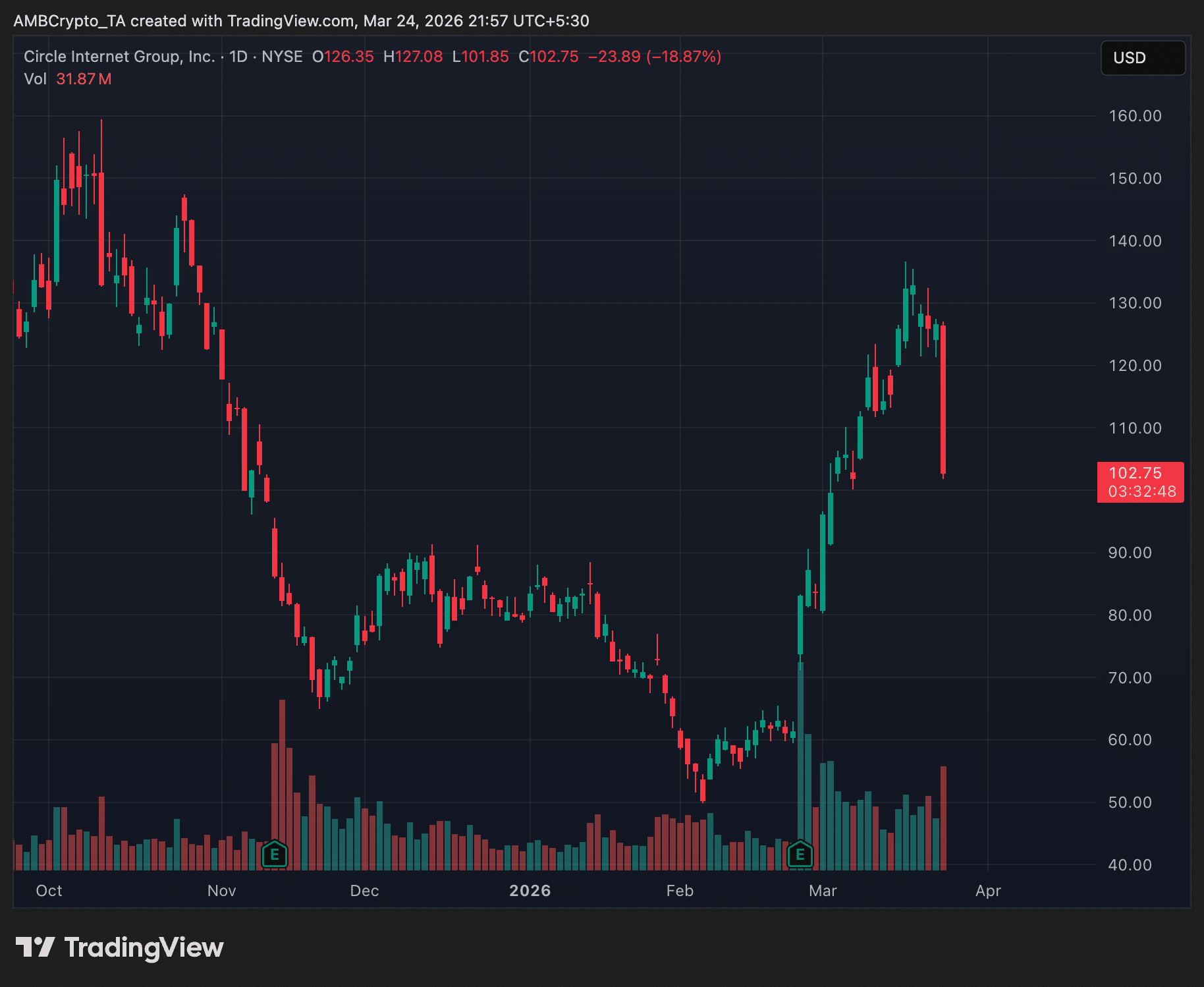
Shares of Circle Internet Group (CRCL) fell nearly 19% on March 24, dropping from an intraday high of around $127 to approximately $102. The sharp decline followed a strong rally earlier in March and was accompanied by high trading volume, indicating a shift in investor sentiment. The sell-off appears linked to emerging regulatory concerns, particularly a draft legislative proposal that could prohibit platforms from offering yield or interest-like rewards for holding stablecoins. This restriction, which targets both direct and indirect incentives, may impact Circle’s USDC stablecoin growth and user engagement. The proposal would still permit activity-based rewards but could reduce stablecoins' competitiveness against traditional financial products. The move underscores the sensitivity of crypto equities to regulatory developments.

Shares of Circle Internet Group [CRCL] fell sharply on 24 March, dropping nearly 19% in a single session as markets reacted to emerging concerns around potential restrictions on stablecoin yield and rewards.

The stock declined from an intraday high of around $127 to approximately $102, marking one of its steepest single-day losses in recent weeks. The move comes after a strong rally earlier in March, when CRCL climbed from below $60 to above $130.

Sharp reversal follows March rally

CRCL’s latest decline stands in contrast to its recent momentum, with the stock having more than doubled earlier this month before reversing course.
Source: TradingView

The sell-off was accompanied by a spike in trading volume, suggesting strong conviction behind the move rather than routine market fluctuations.

The abrupt reversal suggests a potential shift in sentiment, with investors reacting quickly to new developments in the stablecoin sector.

While no official trigger has been confirmed, the timing of the decline coincides with growing regulatory scrutiny around stablecoins.

Draft proposal targets stablecoin yield

According to a report from Eleanor Terrett, new legislative language under discussion could significantly limit how stablecoin issuers and platforms offer rewards to users.

The proposal would prohibit platforms from offering yield “directly or indirectly” for holding a stablecoin, or in any way that resembles a bank deposit. The restriction would apply broadly across exchanges, brokers, and affiliated services.

It would also ban any mechanism deemed “economically or functionally equivalent” to interest.

At the same time, the draft would allow activity-based rewards tied to user behavior, such as loyalty or promotional programs, provided they are not interpreted as interest-like incentives.

The proposal is expected to undergo further review, including feedback from banking representatives.

Implications for Circle and stablecoin issuers

For Circle, which issues the USDC stablecoin, yield restrictions could have direct implications for growth and user incentives.

Stablecoin yield and reward programs have become a key mechanism for attracting and retaining users across exchanges and platforms.

Limiting these features could reduce stablecoins’ competitiveness relative to traditional financial products and narrow revenue opportunities tied to user balances.

The uncertainty surrounding how regulators may interpret “economic equivalence” adds another layer of risk, particularly for business models that rely on flexible reward structures.


Final Summary

  • Circle’s sharp decline highlights how sensitive crypto-linked equities are to emerging regulatory risks, particularly around stablecoin incentives.
  • Growing scrutiny and industry moves toward transparency suggest a structural shift in how stablecoin issuers operate going forward.


Связанные с этим вопросы

QWhat caused Circle's stock (CRCL) to drop nearly 20% on March 24?

AThe sharp decline was triggered by emerging concerns and a draft legislative proposal that could restrict stablecoin issuers and platforms from offering yield or interest-like rewards to users.

QWhat was the price range of CRCL's intraday movement during the sell-off?

AThe stock dropped from an intraday high of around $127 to approximately $102.

QWhat specific activity does the new legislative proposal aim to prohibit regarding stablecoins?

AThe proposal aims to prohibit platforms from offering yield 'directly or indirectly' for holding a stablecoin, or any mechanism deemed 'economically or functionally equivalent' to interest or a bank deposit.

QHow might the proposed restrictions impact Circle and other issuers?

AThe restrictions could reduce stablecoins' competitiveness compared to traditional financial products, narrow revenue opportunities from user balances, and create uncertainty for business models relying on reward structures.

QWhat type of rewards would still be allowed under the draft proposal?

AActivity-based rewards tied to user behavior, such as loyalty or promotional programs, are allowed provided they are not interpreted as interest-like incentives.

Похожее

За $100 000 в месяц: Truth Social продает доступ к постам Трампа инвестиционным фирмам

Корпорация Trump Media and Technology Group (TMTG) запустила платный сервис Truth API, предоставляющий институциональным инвесторам и фирмам, занимающимся высокочастотной торговлей, мгновенный доступ к постам самых влиятельных аккаунтов в Truth Social, включая аккаунт экс-президента Дональда Трампа. Стоимость подписки, по данным источников, может достигать $100 000 в месяц. Компания позиционирует это как стратегию по извлечению прибыли из собственных активов. Инициатива вызвала критику со стороны ряда сенаторов-демократов и республиканцев, которые обвинили TMTG в продаже привилегированного доступа к постам президента и потребовали проверки со стороны SEC. В ответ компания заявила о скоординированной кампании по нанесению вреда её бизнесу. Анализ отмечает, что подобный сервис создает архитектуру риска, аналогичную случаям, когда торговые алгоритмы в прошлом вызывали обвал рынков, реагируя на фейковые сообщения в соцсетях. Отсутствие встроенного механизма верификации постов в реальном времени делает платформу потенциальной целью для манипуляций.

cryptonews.ru2 ч. назад

За $100 000 в месяц: Truth Social продает доступ к постам Трампа инвестиционным фирмам

cryptonews.ru2 ч. назад

Дивиденды по привилегированным акциям STRC остаются на уровне 12% несмотря на цену ниже номинала

Хотя привилегированные акции STRC компании Strategy завершили июль значительно ниже номинальной стоимости в $100, инвесторам сообщили, что дивиденд за август останется на уровне 12% и не будет увеличен. Акции закрылись 2 августа на уровне $89.46. Генеральный директор Фонг Ле подтвердил, что корпоративная цель — достичь торговли акциями в диапазоне $99-$100, но не уточнил сроки. В июле компания сообщила о чистом убытке в $8.22 млрд за второй квартал, в основном из-за нереализованных потерь на хранении биткоина. Для обеспечения выплат по привилегированным акциям Strategy создала денежный резерв в $3.75 млрд, которого хватит более чем на два года. Компания также выкупила часть своих привилегированных акций со скидкой и намерена продолжать покупки, пока они торгуются ниже номинала.

cointelegraph3 ч. назад

Дивиденды по привилегированным акциям STRC остаются на уровне 12% несмотря на цену ниже номинала

cointelegraph3 ч. назад

Вывод биткоинов продолжается: 8 лет хранения в холодном кошельке Coldcard закончились нулем

Аппаратный кошелек Coldcard оказался уязвимым, что привело к масштабному выводу средств. По данным Galaxy Research на 2 августа 2026 года, похищено уже более 1367 BTC (около $88.6 млн) с 4585 адресов. Проблема связана не с прошивкой, а с seed-фразами, сгенерированными на уязвимых устройствах в определенный период (Mk2/Mk3 с прошивкой 4.0.1–4.1.9; Mk4/Mk5 до версии 5.6.0; Q до версии 1.5.0Q). Причина — ошибка в интеграции библиотеки libNgU, из-за которой устройство перестало использовать аппаратный генератор случайных чисел, перейдя на предсказуемый программный. Обновление прошивки не меняет существующую seed-фразу, поэтому владельцам необходимо сгенерировать новую на исправленной версии и перевести активы. Статья приводит трагичный пример 39-летнего инвестора, который за 8 лет накопил 2 BTC тяжелым трудом, храня их в Coldcard как защиту от гиперинфляции в своей стране, но потерял все за минуты из-за этой уязвимости. Этот случай показывает, что даже стратегия холодного хранения не является абсолютно надежной, особенно когда уязвимость кроется в самом генераторе случайных чисел внутри изолированного устройства.

cryptonews.ru3 ч. назад

Вывод биткоинов продолжается: 8 лет хранения в холодном кошельке Coldcard закончились нулем

cryptonews.ru3 ч. назад

Торговля

Спот
活动图片