Circle Acquires Axelar Team but Excludes Token, How Should Token Holders Respond to Value Stripping?

比推Опубликовано 2025-12-16Обновлено 2025-12-16

Введение

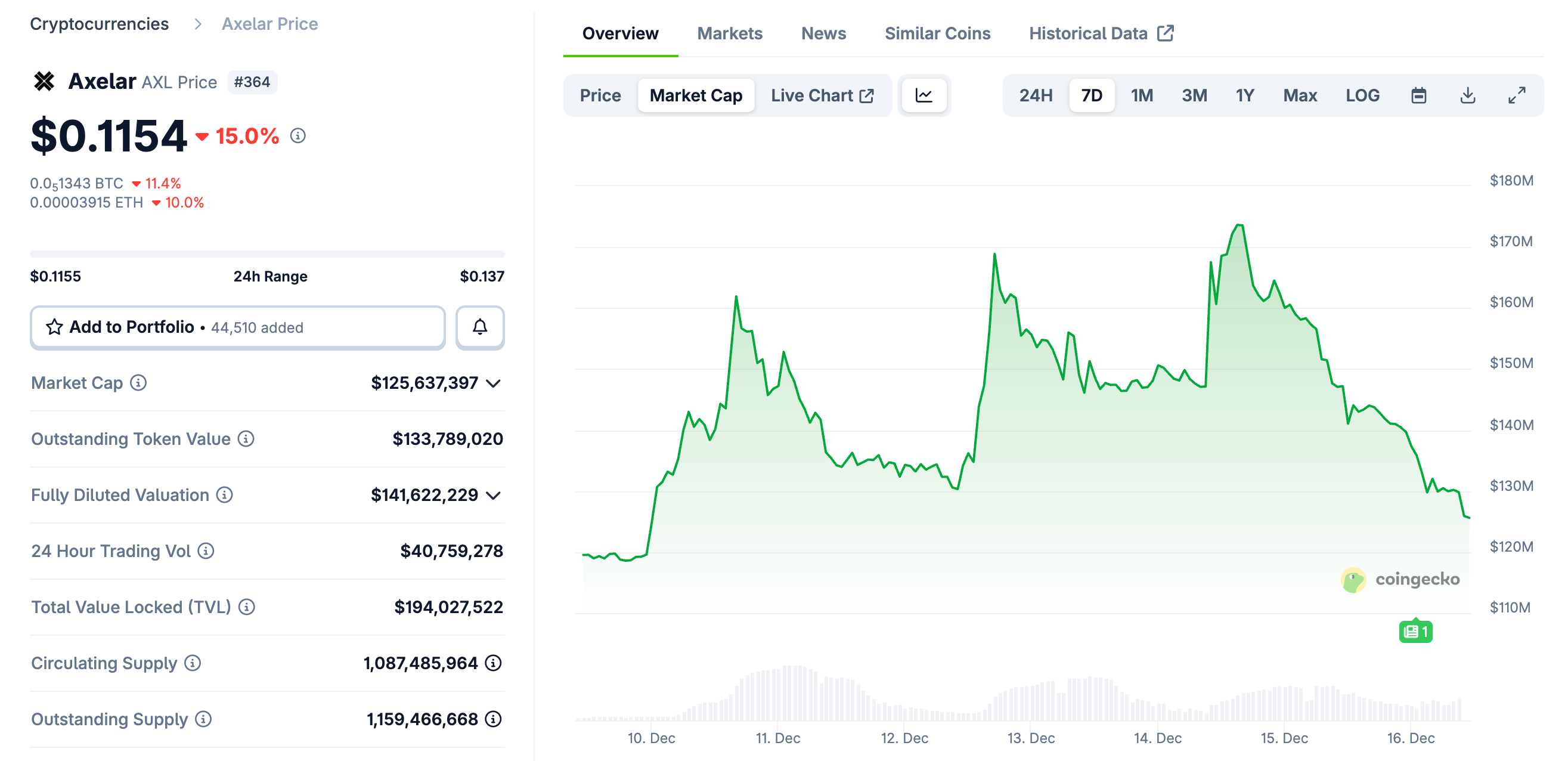
Circle, the stablecoin giant, has announced the acquisition of the core team and technology behind Axelar Network's initial team, Interop Labs, to advance its cross-chain infrastructure strategy. However, the acquisition explicitly excludes the Axelar Network project itself, its foundation, and the AXL token, which will continue to operate independently under community governance. This has led to a sharp 15% drop in AXL's price. The move has sparked significant controversy, highlighting the ongoing debate over "equity vs. token" interests in the crypto industry. Critics, including VCs and industry figures, argue that the acquisition effectively abandons token holders who supported the project, calling it a "rug pull" and morally questionable. They emphasize that while the team and intellectual property were monetized, token investors were left with depreciating assets. Supporters, however, view it as a standard market practice, noting that tokens sit at the bottom of the capital structure in traditional finance, behind debt and equity. They argue that Circle’s decision reflects rational business logic, where acquirers prioritize valuable assets like talent and IP without obligation to token holders. The core issue revolves around the ambiguous legal and economic nature of tokens—often treated as "quasi-equity" during bullish phases but stripped of rights in events like acquisitions. The incident underscores the need for clearer definitions and structures for tokens to prot...

Author: Azuma

Original Title: Circle's Acquisition of Axelar Sparks Controversy: Giant Wants the People, Not the Coin


In the early hours of December 16th, stablecoin giant Circle officially announced it had signed an agreement to acquire the core talent and technology of Interop Labs, the initial development team behind the cross-chain protocol Axelar Network. This move aims to advance Circle's cross-chain infrastructure strategy and help achieve seamless, scalable interoperability for core Circle products like Arc and CCTP.

This seemed like another classic case of an industry giant acquiring a quality team, appearing to be a win-win situation. However, the crucial point is that Circle explicitly stated in its acquisition announcement that the deal only involves the Interop Labs team and its proprietary intellectual property. The Axelar Network, the Axelar Foundation, and the AXL token will continue to operate independently under community governance, with another contributing team, Common Prefix, taking over Interop Labs' original related activities.

In simple terms, Circle took the original development team of Axelar Network but explicitly discarded the Axelar Network project itself and its AXL token.

Affected by this sudden news, AXL plummeted sharply. As of around 10:00 AM today, it was temporarily quoted at $0.115, a 24-hour drop of 15%.

Simultaneously, the unique "acquire the team, discard the token" nature of the acquisition and the衍生出的 "equity vs. token" issue have sparked extensive discussion within the community. Supporters and opponents of this acquisition model are locked in debate, each holding their own views.

Opposing Viewpoint: A disguised RUG, Circle is out of line, only token holders are getting hurt......

The core strength of the opposition consists of some VCs, which is understandable — "I invested real money in the project's token equity, holding a bunch of tokens. Now you've taken the key developers away, what use do I have for these tokens?"

Moonrock Capital founder Simon Dedic commented on this: "Another acquisition, another RUG. Circle acquiring Axelar but explicitly excluding the Foundation and the AXL token is practically criminal. Even if it doesn't break the law, it violates ethics. If you are a founder wanting to issue a token: either treat it like equity, or please get lost."

The Block co-founder and 6MV founder Mike Dudas commented: "For everyone thinking this is a token vs. equity issue, I can tell you clearly, this is entirely Circle causing trouble. Rumors suggest that Circle's VP of Corporate Development once told an Axelar co-founder 'I don't care about your investors,' and 'bought' the CEO and IP out from under the investors' noses without paying them any consideration, even though this IP and team were crucial for Arc's launch."

Lombard Finance founder posted AXL's price chart and predicted: "Axelar's core team was bought by Circle, AXL might be worthless now. It's been over three years since the token issuance, the team's equity has long been fully vested. But this outcome feels very uncomfortable: the team and/or investors sell tokens for profit, while token holders can only pin their hopes on a distant dream."

ChainLink community figurehead Zach Rynes stated: "This again exposes the token vs. equity利益冲突 problem plaguing the crypto industry. The development team behind the protocol gets successfully acquired, while the token holders who funded this team get nothing. The so-called continued independent operation under community governance is no different than the development team abandoning its users for better prospects. If we want to attract real capital, this is the primary issue the industry urgently needs to solve."

SOAR Ecosystem Lead Nicholas Wenzel said: "Axelar token is heading to zero, thanks for playing everyone. Another acquisition where token holders get nothing and equity holders make a fortune."

Supporting Viewpoint: Normal market behavior, tokens are naturally at the bottom of the capital structure

If the opposition focuses more on the unfair treatment of token holders, the supporters focus more on the rules of financing and mergers and acquisitions.

Arca Chief Investment Officer Jeff Dorman believes Circle's approach is not problematic and wrote a long explanation about the capital structure of corporate financing and the天然劣势 position tokens occupy.

Companies raise capital through different tiers of the capital structure, and these tiers have a clear order of priority—some tiers are naturally senior to others: Secured Debt > Unsecured Senior Debt > Subordinated Debt > Preferred Stock > Common Stock > Tokens.

History is filled with examples where gains for one type of investor came at the expense of another.

  • In bankruptcies, creditors win at the expense of equity investors;

  • In Leveraged Buyouts (LBOs), equity holders often profit at the expense of creditors;

  • In take-unders, creditors are usually prioritized over equity holders;

  • In strategic acquisitions, usually both creditors and equity holders benefit (but not always);

  • And tokens are often at the very bottom of the capital structure......

This doesn't mean tokens have no value, nor does it mean tokens necessarily need some kind of "protection mechanism," but the market needs to recognize the reality: when someone acquires a company whose value isn't high to begin with, and the token issued by that company is also nearly worthless, token holders won't magically receive a "magical dividend." In such cases, gains for equity often come at the expense of losses for the token.

Electric Capital co-founder Avichal Garg also commented: "This is normal. If all future value is created by the team, no company will want to pay returns to investors."

Core Contradiction: What exactly is a Token?

Surrounding the "acquire the team, discard the token" acquisition storm involving Axelar and Circle, both sides of the debate seem to have their points.

The anger of the opposition is real: Token holders bore the risk during the project's most difficult times, when it most needed liquidity and narrative support, yet were completely excluded at the critical juncture of value realization. From the result, the core team and intellectual property achieved value monetization, while the token was left in the vacuum narrative of "community governance." The market voted most directly with the price, which is indeed deeply frustrating for all who believed in the token's value.

The judgment of the supporters is also reasonable in a practical sense: From a strict capital structure perspective, tokens are neither debt nor equity and naturally lack priority in the context of M&A and liquidation. Circle did not violate existing commercial rules; it just冷静地 chose the assets most valuable to itself.

The true core of the contradiction is not whether Circle acted morally, but rather a question the industry has long刻意回避: What exactly is a token in the legal and economic structure?

When prospects are bright, tokens are默认为 "quasi-equity," imbued with the imagination of claiming future success; but in practical scenarios like acquisitions, bankruptcies, and liquidations, they are quickly reduced to their original form of "rights-less certificates." This narrative equity-ization coupled with structural subordination is the root cause of recurring conflicts.

The Axelar acquisition might not be the last similar controversy, but hopefully it can serve as an opportunity for the industry to further contemplate the positioning and meaning of tokens — tokens do not naturally possess rights; only institutionalized, structured rights are acknowledged at critical moments. The specific form of implementation still requires all practitioners to explore and practice together.


Twitter:https://twitter.com/BitpushNewsCN

Bitpush TG Discussion Group:https://t.me/BitPushCommunity

Bitpush TG Subscription: https://t.me/bitpush

Original link:https://www.bitpush.news/articles/7596158

Связанные с этим вопросы

QWhat was the main controversy surrounding Circle's acquisition of Axelar's development team?

AThe main controversy was that Circle acquired the core team and intellectual property of Axelar's developer, Interop Labs, but explicitly excluded the Axelar Network, its foundation, and the AXL token from the deal, leaving token holders with no direct benefits.

QHow did the AXL token price react to the news of the acquisition?

AThe AXL token price dropped significantly, falling to around $0.115 with a 24-hour decline of 15% following the announcement.

QWhat argument did opponents of the acquisition make regarding token holders?

AOpponents argued that the acquisition was unfair to token holders, who took on early risk and provided liquidity, but were excluded from the value realization, effectively leaving them with a token that might become worthless.

QHow did supporters of the acquisition justify Circle's decision?

ASupporters justified it by explaining that tokens are at the bottom of the capital structure in traditional finance, and acquisitions often prioritize equity and debt over tokens, making Circle's move a normal market behavior without legal or ethical breaches.

QWhat core issue does this acquisition highlight about tokens in the crypto industry?

AIt highlights the unresolved ambiguity around what tokens represent legally and economically—often treated as 'quasi-equity' during good times but stripped of rights in events like acquisitions, exposing their weak structural positioning.

Похожее

The Shutdown of Claude Mythos Revealed the True Cost of Renting AI to Me

The sudden shutdown of Claude Mythos this week starkly highlights a critical, often overlooked risk for founders: when your core capability relies entirely on someone else's platform, your fate is not in your own hands. The key question becomes: who truly owns the intelligence your product depends on? For years, the debate around open-source models focused on cost. Now, the evidence is clear: fine-tuned open-source models can achieve frontier-level quality for specific, mission-critical tasks at a fraction of the cost. However, the deeper issue is control. Relying on a third-party API is like renting; it works until the landlord changes the rules, raises the rent, or asks you to leave—as Mythos experienced. The lesson is not to stop using frontier models—they are incredible infrastructure. The goal is ownership. Ownership means starting with a powerful open-source model and shaping it around what makes your company unique: your data, workflows, domain expertise, and definition of "good." Over time, the model becomes less generic and more reflective of your business, creating durable value. The optimistic conclusion is that AI's future doesn't hinge on one superior model. There is no single frontier. The frontier includes proprietary models, models fine-tuned on company-specific knowledge, specialized models for narrow problems, and intelligent routers orchestrating model ensembles. The most interesting development is not models getting smarter, but intelligence becoming increasingly customizable. The winning companies will be those that transform intelligence into a unique, owned asset. Looking ahead, the vision is not one model dominating all, but many teams owning the part of the frontier that matters most to them.

marsbit29 мин. назад

The Shutdown of Claude Mythos Revealed the True Cost of Renting AI to Me

marsbit29 мин. назад

Tiger Research: U.S. Strategic Bitcoin Reserve - Should the Market Be Happy or Disappointed?

Tiger Research analyzes the evolution of U.S. legislative efforts regarding a strategic Bitcoin reserve, concluding the market impact is limited in the short term but potentially positive long-term. The core event was a March 2025 executive order by former President Trump, which designated confiscated Bitcoin as a strategic reserve and promised not to sell existing holdings (approx. 190k BTC). As it contained no mandate to purchase new Bitcoin, the market reacted negatively, with prices dropping 5.7%. Legislative history shows a significant retreat from initial ambitions. The 2024 "BITCOIN Act" proposed mandatory purchases of 1 million BTC over five years. Reintroduced in 2025, it stalled due to high fiscal costs, concerns over dollar hegemony, and opposition from the Treasury Secretary. The current frontrunner, the 2026 "American Retirement and Monetary Advancement (ARMA) Act," is a compromise. It lacks any purchase requirement, instead focusing on consolidating existing government-held Bitcoin and legally prohibiting its sale for at least 20 years. While ARMA has higher passage odds due to bipartisan support and no purchase mandate, its immediate market effect is neutral. It eliminates potential government selling pressure but creates no new demand. The long-term significance is that formally establishing Bitcoin as a national reserve asset in law could later reignite debates on mandatory purchases. Therefore, the path to a government buyer is longer than initially priced by the market, but the directional narrative remains intact.

marsbit31 мин. назад

Tiger Research: U.S. Strategic Bitcoin Reserve - Should the Market Be Happy or Disappointed?

marsbit31 мин. назад

US Stock Market Trend (June 16): SpaceX Rises 42% in Two Days, New Fed Chairman Takes Office Today

**U.S. Stocks Trend (June 16): SpaceX Soars 42% in Two Days, New Fed Chair Takes Office Today** Markets surged on Monday following former President Trump's social media announcement of a completed U.S.-Iran deal to reopen the Strait of Hormuz, pending a June 19 signing. The news triggered a broad risk-on rally: oil prices crashed, tech stocks soared, bond yields fell, and defensive sectors lagged. **Market Performance:** The Nasdaq jumped 3.07%, led by semiconductor stocks like Micron (+9.2%). The S&P 500 gained 1.65%, and the Dow rose 0.92% to a record high. However, the Russell 2000 small-cap index underperformed (+0.72%). SpaceX continued its hot streak, rising another 5% pre-market after disclosures of large buys by an Australian billionaire and Cathie Wood's ARK. Boeing also rallied on the transportation optimism. Conversely, energy stocks like Chevron fell over 3% on the oil price plunge, with other defensive sectors also selling off. The day's action showed a clear rotation of funds from energy/defensive plays into AI and tech narratives. **Macro & Outlook:** The VIX fear index fell 8.37%. Treasury yields declined, and WTI crude dropped over 5%. Attention now shifts to a packed schedule: the Bank of Japan is widely expected to hike rates to 1.0% on Tuesday. The Fed's June meeting concludes Wednesday, marking new Chair Wash's debut. While rates are expected to hold, his tone on stubborn inflation and the "dot plot" will be crucial for gauging the 2024 rate path. The formal Iran deal signing is set for Friday. **Trend Perspective:** While the peace deal is a genuine positive, Monday's explosive rally may have gotten ahead of itself, pricing in a swift resolution to inflation concerns. The shortened trading week faces a triple test: BoJ tightening, the Fed's policy stance, and deal implementation details. Tech and semiconductors, which led the surge, remain vulnerable to any disappointment from these key events. The real price discovery begins with the central banks' communications this week.

marsbit52 мин. назад

US Stock Market Trend (June 16): SpaceX Rises 42% in Two Days, New Fed Chairman Takes Office Today

marsbit52 мин. назад

Торговля

Спот
Фьючерсы

Популярные статьи

Как купить S

Добро пожаловать на HTX.com! Мы сделали приобретение Sonic (S) простым и удобным. Следуйте нашему пошаговому руководству и отправляйтесь в свое крипто-путешествие.Шаг 1: Создайте аккаунт на HTXИспользуйте свой адрес электронной почты или номер телефона, чтобы зарегистрироваться и бесплатно создать аккаунт на HTX. Пройдите удобную регистрацию и откройте для себя весь функционал.Создать аккаунтШаг 2: Перейдите в Купить криптовалюту и выберите свой способ оплатыКредитная/Дебетовая Карта: Используйте свою карту Visa или Mastercard для мгновенной покупки Sonic (S).Баланс: Используйте средства с баланса вашего аккаунта HTX для простой торговли.Третьи Лица: Мы добавили популярные способы оплаты, такие как Google Pay и Apple Pay, для повышения удобства.P2P: Торгуйте напрямую с другими пользователями на HTX.Внебиржевая Торговля (OTC): Мы предлагаем индивидуальные услуги и конкурентоспособные обменные курсы для трейдеров.Шаг 3: Хранение Sonic (S)После приобретения вами Sonic (S) храните их в своем аккаунте на HTX. В качестве альтернативы вы можете отправить их куда-либо с помощью перевода в блокчейне или использовать для торговли с другими криптовалютами.Шаг 4: Торговля Sonic (S)С легкостью торгуйте Sonic (S) на спотовом рынке HTX. Просто зайдите в свой аккаунт, выберите торговую пару, совершайте сделки и следите за ними в режиме реального времени. Мы предлагаем удобный интерфейс как для начинающих, так и для опытных трейдеров.

1.5k просмотров всегоОпубликовано 2025.01.15Обновлено 2026.06.02

Как купить S

Sonic: Обновления под руководством Андре Кронье – новая звезда Layer-1 на фоне спада рынка

Он решает проблемы масштабируемости, совместимости между блокчейнами и стимулов для разработчиков с помощью технологических инноваций.

2.3k просмотров всегоОпубликовано 2025.04.09Обновлено 2025.04.09

Sonic: Обновления под руководством Андре Кронье – новая звезда Layer-1 на фоне спада рынка

HTX Learn: Пройдите обучение по "Sonic" и разделите 1000 USDT

HTX Learn — ваш проводник в мир перспективных проектов, и мы запускаем специальное мероприятие "Учитесь и Зарабатывайте", посвящённое этим проектам. Наше новое направление .

1.8k просмотров всегоОпубликовано 2025.04.10Обновлено 2025.04.10

HTX Learn: Пройдите обучение по "Sonic" и разделите 1000 USDT

Обсуждения

Добро пожаловать в Сообщество HTX. Здесь вы сможете быть в курсе последних новостей о развитии платформы и получить доступ к профессиональной аналитической информации о рынке. Мнения пользователей о цене на S (S) представлены ниже.

活动图片