Chinese Young Man's AI Short Goes Viral Abroad! Hollywood Director Searches Online: Wants to Hire Him

marsbitОпубликовано 2026-05-14Обновлено 2026-05-14

Введение

A young Chinese creator, Mx-Shell, an amateur filmmaker from Yunnan with no formal film training, has gone viral internationally with his AI-generated short film "Zombie Scavenger." Created independently in about 10 days using the Chinese AI video tool Seedance 2.0 at a minimal cost, the film features a robot cowboy in a post-apocalyptic world. Its unique atomic-punk style and cinematic quality caught the attention of Hollywood. The film initially gained little traction on Chinese platform Bilibili. However, after PJ Ace, founder of LA-based AI studio Genre.ai, shared it on X (formerly Twitter), praising it as "one of the best short films I've seen in recent years," it quickly garnered millions of views overseas. PJ Ace then publicly sought to hire the unknown director, sparking a cross-platform search. The creator, who doesn't speak English, was unaware of the overseas buzz until Chinese internet users relayed the message. Connection was eventually made via a QQ email address shared in Bilibili comments, and Mx-Shell received a job offer from the Hollywood director. The article highlights this as a case of "talent export." It argues that while China's competitive AI tool market lowers technical barriers, true success still relies on individual creativity, aesthetic judgment, and narrative skill—qualities Mx-Shell demonstrated. His story exemplifies how AI tools can empower previously unseen creators with compelling ideas to reach a global audience, even if initial recogni...

Author: David, Shenchao TechFlow

Hollywood is searching the internet for a Chinese person. But the person being sought didn't even leave a usable contact method.

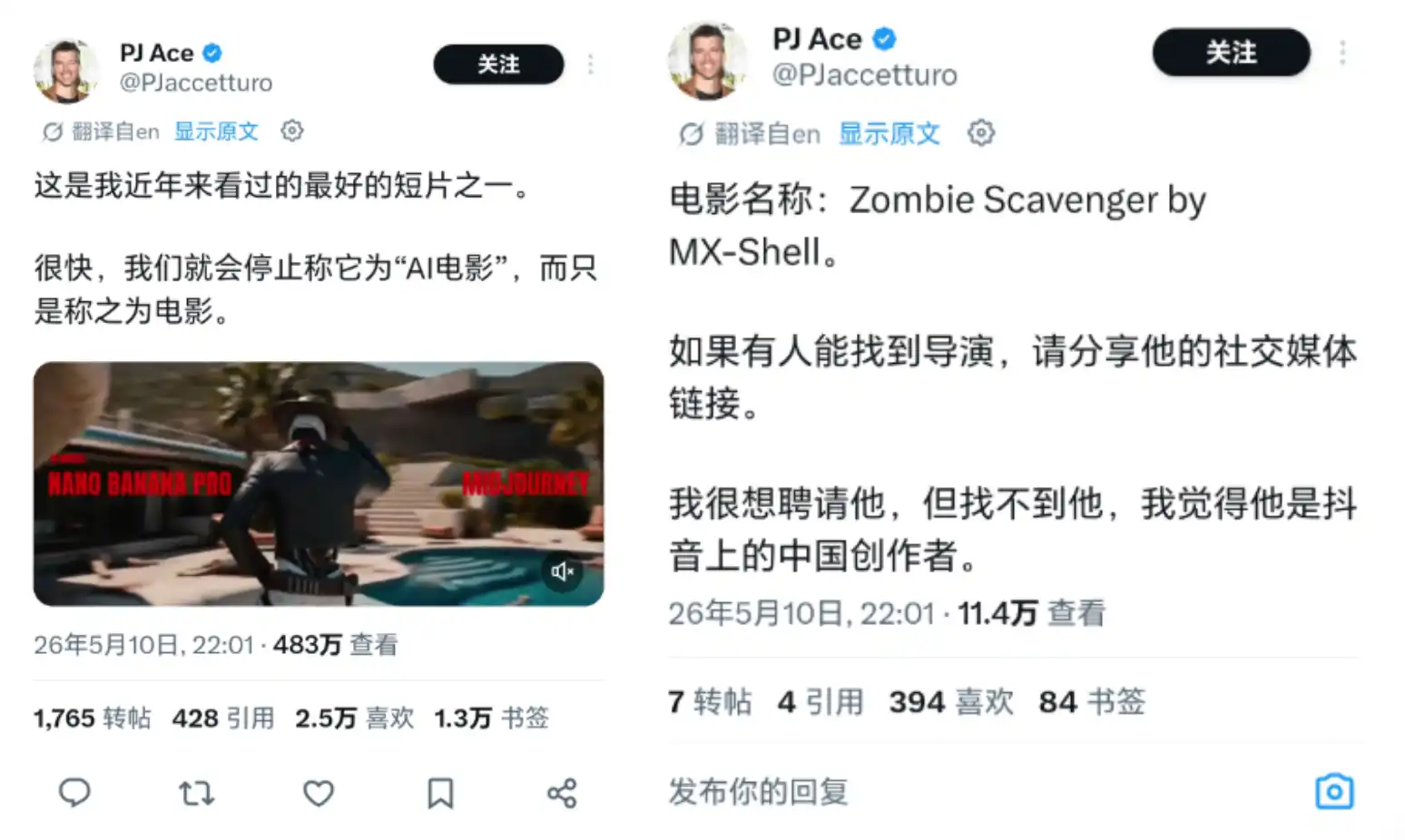
On the evening of May 10th, PJ Ace, founder of the Los Angeles AI film studio Genre.ai, reposted an AI short film called "The Scavenger" on X. PJ Ace is probably one of the most influential figures in the AI video circle, with his own content garnering over 300 million views across platforms.

His evaluation of this short film was extremely high, "This is one of the best short films I've seen in recent years."

The concept of the short is roughly this: a robot cowboy rides an ostrich through a post-apocalyptic wasteland, battles zombies, and has a romance with a plastic mannequin. Besides the sufficiently cyberpunk and fantastical theme, the visuals and music also have a distinct blockbuster quality.

(Viewers who haven't seen it can click here to experience it.)

A few hours after PJ's post went up, the view count reached 5 million.

He immediately followed up with a missing person post: "I would love to hire the director of this short, but I can't find him. I think he's a Chinese creator on Douyin."

A person holding Hollywood content production resources, posting on Twitter like a lost and found notice to find a Chinese person? The author feels this scene itself is more surreal than the short film...

His reasoning was that, before AI, something of this quality would have cost at least $500,000 and six months to produce, yet this author achieved this level using only his own creative effort. The replies to the post quickly turned into a search party, with people searching for the author ID MX-Shell, and others tracing clues to Bilibili.

A massive cross-platform search from Hollywood to Bilibili's comment section had begun.

However, on the same day PJ Ace was anxiously posting missing person notices on Twitter, this short film hadn't made much of a splash on Bilibili or Douyin yet, lying quietly in the information feeds.

A short film made by a Chinese person using Chinese AI tools had to first become popular across the Pacific, before being noticed back home. The process of this large-scale cross-platform search returning to China itself became a case of reimported goods.

Making a Hobby Visible

The person PJ Ace was looking for had labeled himself with five words on Bilibili: amateur hobbyist.

The author, Mx-Shell, commented claiming to be a vocational school graduate from Yunnan, having never attended university or worked for any film company. The "non-professional amateur hobbyist" written in his Bilibili bio seems like genuine humility.

It is reported that "The Scavenger" was made by him using ByteDance's AI video tool Seedance 2.0. Alone, without a team or investment, he independently completed it from conception to final product, even creating the background music himself.

The production cycle was about 10 days, with Token costs roughly equivalent to about 3,000 RMB.

Then comes what the author finds the most fascinating part of the whole story.

PJ Ace's missing person post was seen by millions on X, but Mx-Shell himself couldn't see it at all, unaware that a Hollywood director across the Pacific was looking for him.

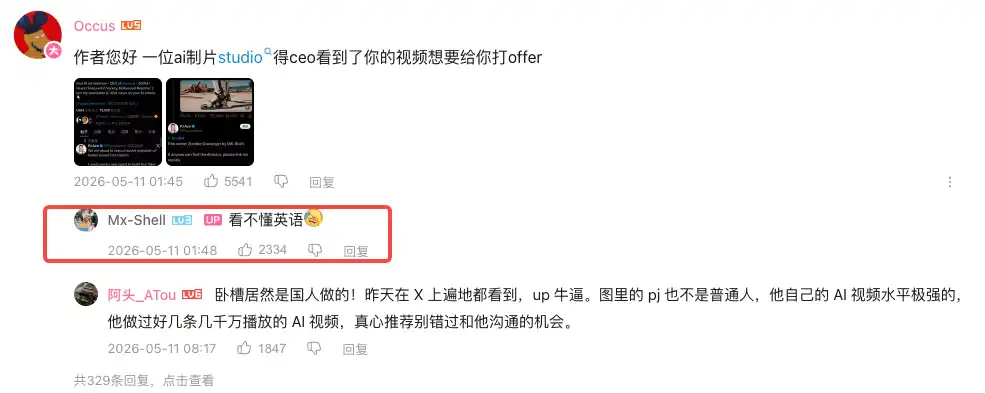
When the news eventually made its way back to China, the comments section under the video exploded, but Mx-Shell himself didn't understand English, lacked channels to connect with overseas media, and even posted his QQ email address, asking netizens to forward it to the other side.

Hollywood was looking for him in English on Twitter, he was looking for Hollywood with a QQ email address in the Bilibili comments section. With the help of netizens, this cross-platform conversation had a happy ending.

Currently, PJ has already sent him an email via the address. In the letter, PJ Ace said he runs a film studio in Los Angeles, the short film garnered over 4 million views on the day it was shared, and then asked, "Would you be interested in becoming a Hollywood director?"

An amateur hobbyist receiving an olive branch extended by Hollywood—perhaps this is also a kind of wonderful, serendipitous discovery of talent in the AI era.

Talent Going Global, Reimported Goods

Back to why this short film was quiet on Bilibili initially but exploded when posted on X.

On Bilibili, a short film labeled "Contains AI-Generated Content" has to compete for the same information feed as professional animations from million-follower UP owners, game live streams, and popular fan creations. Mx-Shell had only a few thousand followers at the time, no recommendation spots—a grain of sand falling into the desert.

X is a completely different world. The overseas AI creator community has grown its own ecosystem over the past two years, with top bloggers, evaluation consensus, and mature dissemination networks.

PJ Ace is a core node in this ecosystem. What he saw in "The Scavenger" was the work itself; AI was just the tool. The fan base amplified the spread, exploding this piece of content in a matter of hours.

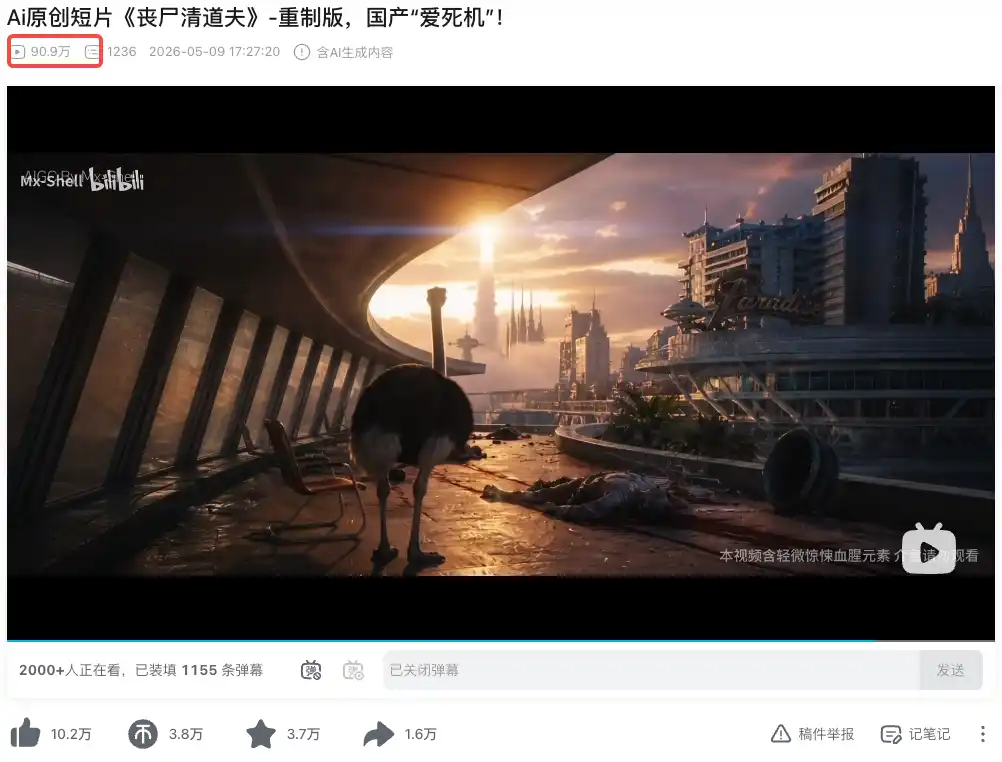
The later reimported data also illustrates this point. Domestic viewers recognized its merit too, with over 900,000 plays and 100,000 likes on Bilibili. In the AI era, content is never the primary problem; the problem is whether it gets delivered to the right people.

This reminds the author of a similar phenomenon: Token export.

Chinese large language models sell computing power globally via APIs. The electricity never leaves China's power grid, but value is delivered cross-border through Tokens. Mx-Shell's story is the creative version of the same logic. Talent and aesthetics never left his computer, but the work also achieved cross-border delivery through a short film. Seedance is ByteDance's, the computing power is from Chinese data centers, the creator is from Yunnan, but the first large-scale audience to see this film was across the Pacific.

If Token export is power export, "The Scavenger" is talent export.

Why did this path start from China? Probably because China simultaneously has two things. The world's most fiercely competitive AI video tool market—ByteDance, Alibaba, Kuaishou trampling over each other to drive generation costs to the floor. Mx-Shell's use of Seedance 2.0 was relatively low-cost in terms of spending.

And a large number of creative people who previously had no outlet—people with taste and ideas, lacking only a handy tool.

The former gave the latter a key. Once the door opened, the global market was outside.

AI is a Good Shovel, But You Have to Dig Yourself

The story isn't over yet.

After Mx-Shell connected with PJ Ace, he posted a lengthy article responding to the external attention. Thirteen points, each one substantial. The author feels this text itself is worth a closer look.

He said the style of "The Scavenger" is called atompunk, a form of retro sci-fi. Creative inspiration came from Pixar's "WALL-E," and it was made to the standard of the popular Netflix series "Love, Death & Robots."

One of the creative intentions was to show overseas audiences the current level of domestic AI production.

Shot control relied on text prompts, the prompts were basically crafted manually. Post-production was done by one person. Even the background music was original. Looking at these details together, one realizes Mx-Shell is far from just being "lucky to encounter AI tools."

He has visual aesthetics, being a photographer by background. He has auditory aesthetics, being an independent musician. He has a sense for narrative, setting a high bar for himself with the "Love, Death & Robots" standard.

AI tools gave him production capacity, but the taste and judgment were his own.

So the author feels the saying "AI allows everyone to make movies" is only half right. AI indeed pushes production barriers to the floor, but computing power can be bought, taste cannot.

Anyone can use Seedance 2.0. Why was it Mx-Shell who made something that prompted a Hollywood missing person post? The tools are equal, but the people using them are vastly different.

This leads to another interesting angle.

ByteDance's investment in Seedance 2.0 is unknown to the outside world, but so far, the best advertisement for this tool might be what a Yunnan vocational school graduate created.

ByteDance's marketing department couldn't have planned such a story because the story's persuasiveness lies precisely in it being spontaneous, organic, and unplanned.

The strongest proof for a platform product is always users creating things that exceed the platform's expectations. Taobao's early benchmark stories were rural women earning millions selling local specialties. YouTube's benchmark was bedroom teenagers making shows better than TV. Seedance 2.0's benchmark story is more creators like Mx-Shell.

According to DataEye data, the overseas AI short drama and comic drama market size is expected to reach $650 million in 2026, a sixfold year-on-year increase. Currently, two paths are running in this market:

One is the industrialization route. Domestic teams produce AI short dramas in bulk—zombies, werewolves, underdog revenge stories—packaged into genre shells familiar to Western audiences, monetizing through TikTok ad campaigns. Reports say several works have already achieved tens of millions of views. This path competes on capital, team, and production capacity, somewhat like the short video factories of the past.

The other is the path Mx-Shell took. One person, one computer, not relying on ad campaigns or scale; the content itself is the transmission force. Token costs a few thousand, cycle less than two weeks, exchanged not for platform revenue share, but for Hollywood actively reaching out.

Both paths can work, but the author finds the second path more noteworthy.

Because the barrier for the first path is money—if you have money, you can do it, not much related to the individual creator. The barrier for the second path is the person—the taste, the judgment of content. These things AI can't give you, and money can't buy them either.

He won't be the last person to walk this path.

China has a large number of creators with taste, ideas, and a desire to express. Previously, what blocked them was equipment, funds, teams, academic qualifications. Now, these barriers are being dismantled one by one by AI tools. The remaining problem is only one: how to be seen.

Mx-Shell's answer was a QQ email address and a group of enthusiastic netizens. The next person might have other methods.

But before the domestic ecosystem for AI creation truly matures, this detour of reimported goods will probably have to continue for a while longer.

Связанные с этим вопросы

QWho is PJ Ace, and why did he start searching for a Chinese creator online?

APJ Ace is the founder of the Los Angeles-based AI film studio Genre.ai. He is a prominent figure in the AI video community with content that has garnered over 300 million views. He searched for the Chinese creator online after being deeply impressed by the AI-generated short film 'Zombie Scavenger,' which he called one of the best shorts he had seen in years. He wanted to hire its director for his studio.

QWhat is the title and basic plot of the AI-generated short film that sparked this international search?

AThe AI-generated short film is titled 'Zombie Scavenger.' Its plot involves a robot cowboy riding an ostrich through a post-apocalyptic wasteland, battling zombies, and having a romantic encounter with a plastic mannequin. The film is noted for its cyberpunk and fantastical themes, as well as its high-quality visuals and music.

QWho is Mx-Shell, the creator of 'Zombie Scavenger,' and what are some key details about his background and the film's production?

AMx-Shell is a self-described amateur enthusiast from Yunnan, China, with a background as a secondary technical school graduate, no university degree, and no prior experience in film companies. He created 'Zombie Scavenger' independently using ByteDance's AI video tool Seedance 2.0. The entire process, from conception to final edit, including composing the original background score, took him about 10 days and cost approximately 3,000 RMB in token expenses.

QWhy did the short film gain massive attention overseas on platform X before becoming popular domestically on Bilibili?

AThe film initially went unnoticed on Bilibili, a platform saturated with content from established creators. However, on platform X, it entered a well-established AI creator ecosystem with influential figures like PJ Ace. When PJ Ace shared and praised the film, his large following and the platform's effective content dissemination network caused it to go viral rapidly, reaching millions of views within hours. The attention later flowed back to Bilibili, where it also gained significant traction.

QWhat broader implications does the article suggest about AI tools and creative opportunities for individuals like Mx-Shell?

AThe article suggests that AI tools like Seedance 2.0 drastically lower the technical and financial barriers to high-quality content creation, such as filmmaking. This empowers individuals with creativity, aesthetic sense, and storytelling ability—qualities that AI cannot provide—to produce compelling work and reach a global audience. It highlights a potential path for talented creators who previously lacked resources or formal training, enabling 'talent export' where creative value is delivered internationally through digital作品, similar to the concept of 'Token出海' (Token export).

Похожее

BIS Latest Research: The Future of Stablecoins and the Global Monetary Landscape

BIS Working Paper No. 170, released in May 2026, analyzes the impact of stablecoins on the global monetary system. The market has grown exponentially since 2014, with over 300 active stablecoins exceeding $300 billion in market capitalization. It is highly concentrated, dominated by USD-linked stablecoins (98% by market cap, mainly USDT and USDC), which function as new forms of private offshore dollar claims on blockchain. Currently, stablecoin use remains largely within crypto ecosystems for trading and DeFi collateral. Real-economy adoption, such as in cross-border payments, is nascent but growing in emerging markets and developing economies (EMDEs) facing high inflation and volatile currencies, where they facilitate capital flight and "digital dollarization." The paper assesses impacts using the Cohen-Kennen framework. For private-sector functions, stablecoins most directly affect value storage (as a dollar-denominated safe haven in EMDEs) and the medium of exchange (enhancing cross-border payment efficiency, further entrenching dollar use). Impacts on the unit of account and official-sector functions are currently limited but could indirectly constrain monetary policy autonomy and capital controls. The report outlines three potential future scenarios: 1) **Niche adoption**, where stablecoins remain crypto-centric with minimal systemic impact; 2) **Digital dollarization**, a high-risk scenario where USD stablecoins become de facto standards in EMDEs, eroding monetary sovereignty; and 3) **Local currency stablecoin integration**, an ideal but challenging scenario where regulated domestic stablecoins linked to CBDCs enhance efficiency without foreign currency substitution. Key policy recommendations emphasize global coordination: establishing uniform regulatory standards (e.g., for reserves and disclosure), strengthening cross-border supervisory cooperation, enhancing domestic defenses in EMDEs (via macroeconomic stability, improved payment systems, and CBDCs), and combating illicit activities. The paper concludes that stablecoins are a structural force reinforcing dollar dominance in the near term, posing significant risks to EMDEs' financial stability and policy autonomy. Their long-term trajectory depends on regulatory responses, adoption patterns, and the co-evolution with public digital currencies.

marsbit10 мин. назад

BIS Latest Research: The Future of Stablecoins and the Global Monetary Landscape

marsbit10 мин. назад

BIS Latest Research: Stablecoins and the Future of the Global Monetary Landscape

The Bank for International Settlements (BIS) Working Paper No. 170 analyzes the rise of stablecoins and their impact on the global monetary system. Stablecoins, privately issued digital tokens pegged to fiat currencies, have grown exponentially since 2014, with a market dominated by USD-pegged variants like USDT and USDC. Their core function remains within the crypto ecosystem, though use in cross-border payments and as a store of value in high-inflation emerging markets is increasing. The report identifies stablecoins as a new form of offshore dollar claims, extending dollar liquidity via blockchain. Their stability depends entirely on reserve quality and market arbitrage, lacking traditional banking safeguards. In the short term, stablecoins reinforce the US dollar's dominance, posing risks to monetary sovereignty in emerging market and developing economies (EMDEs) by facilitating "digital dollarization," which can undermine local currency deposits, capital controls, and monetary policy effectiveness. The BIS outlines three potential future scenarios: 1) Niche adoption within crypto (baseline), 2) Widespread "digital dollarization" in EMDEs (high-risk), and 3) Integration of domestic currency stablecoins (ideal but challenging). Effective global regulatory coordination is crucial to manage risks like reserve transparency, cross-border spillovers, and illicit activities. The report concludes that stablecoins represent a structural force reshaping international monetary hierarchies, presenting both opportunities for payment efficiency and significant risks to financial stability and autonomy, necessitating robust policy responses.

链捕手15 мин. назад

BIS Latest Research: Stablecoins and the Future of the Global Monetary Landscape

链捕手15 мин. назад

Solo Company Craze: Some Earn Millions Annually, Others See Incomes Shrink by 90%

The Rise of the "One-Person Company" (OPC): AI Fuels a Solo Entrepreneurship Wave The concept of the "One-Person Company" (OPC)—where an individual leverages AI tools to start and run a business—is gaining significant traction, hailed by some as ushering in a "golden age" for solo entrepreneurship. While success stories abound, the reality is a mixed picture of high earnings and significant struggles. The article profiles several OPC founders across different industries: * A game developer created 6 bullet-chat (danmaku) games in a year using an AI-powered workflow, earning approximately 1 million RMB. AI handled around 70% of art and 99% of coding tasks, slashing development cycles from months to about 15 days per game. * A materials researcher in Japan, using AI for tasks from translation to legal advice, earns roughly triple the salary of a local white-collar worker. * A biotech entrepreneur uses AI Agents to automate 80% of repetitive work like data analysis, doubling their previous income while gaining time freedom. * Conversely, a former tech executive turned cross-border e-commerce founder in Latin America reports a 90% drop in income compared to their previous corporate job, cautioning against blindly following the trend. Key insights from these cases include: AI dramatically lowers barriers to entry and operational costs, but does not guarantee success. It excels at automating repetitive tasks but cannot replace core human skills like creativity, project management, judgment, and client acquisition. Industry experience and existing client/resources remain critical advantages. The model suits self-starters with specific expertise but poses challenges in areas like sales, compliance, and scaling. Ultimately, while AI empowers solo ventures, entrepreneurship's inherent risks and demands persist.

marsbit21 мин. назад

Solo Company Craze: Some Earn Millions Annually, Others See Incomes Shrink by 90%

marsbit21 мин. назад

Goldman Sachs Research Report Analysis: Chip Shortage to Persist Until 2028, Maintain Buy Recommendations

Goldman Sachs Research Report Summary: Memory Shortage Until 2028, Maintain Buy Recommendations Goldman Sachs' latest Asia-Pacific equities report, "The 720," forecasts a sustained memory chip upcycle extending into 2028, driven by strong AI server demand visibility, limited supply growth, and binding long-term agreements. The firm believes the market significantly underestimates the cycle's duration, as evidenced by low P/E ratios for memory stocks. Key sector calls include raising 12-month price targets for Samsung Electronics and SK Hynix, and upgrading Kioxia from Hold to Buy, citing higher and more sustainable peak profits over the next 2-3 years. The report also highlights the broader AI hardware supply chain benefiting from hyperscaler capex acceleration. Recommendations include: * MediaTek (Buy) for its data center/ASIC pivot. * Eoptolink (Buy) on 1.6T optical module ramp-up. * Biren (Buy) for its AI chip migration. * Huaqin (Buy, newly covered) for its shift from consumer electronics ODM to AI data centers. * Lenovo (Buy) on the AI PC refresh cycle. Other notable mentions include China property developers (under an optimistic scenario), BYD for its affordable city NOA strategy, and select Japanese semiconductor equipment makers. A macro theme notes the divergence between AI-boom beneficiaries (e.g., Korea, Taiwan) and energy-importing economies facing inflationary pressure. The report concludes with standard disclaimers, noting that price targets are forward-looking estimates and that sell-side research has an inherent bullish bias. The core investment thesis hinges on the longevity of the memory upcycle and the AI-driven capex wave.

marsbit55 мин. назад

Goldman Sachs Research Report Analysis: Chip Shortage to Persist Until 2028, Maintain Buy Recommendations

marsbit55 мин. назад

Торговля

Спот
Фьючерсы

Популярные статьи

Как купить S

Добро пожаловать на HTX.com! Мы сделали приобретение Sonic (S) простым и удобным. Следуйте нашему пошаговому руководству и отправляйтесь в свое крипто-путешествие.Шаг 1: Создайте аккаунт на HTXИспользуйте свой адрес электронной почты или номер телефона, чтобы зарегистрироваться и бесплатно создать аккаунт на HTX. Пройдите удобную регистрацию и откройте для себя весь функционал.Создать аккаунтШаг 2: Перейдите в Купить криптовалюту и выберите свой способ оплатыКредитная/Дебетовая Карта: Используйте свою карту Visa или Mastercard для мгновенной покупки Sonic (S).Баланс: Используйте средства с баланса вашего аккаунта HTX для простой торговли.Третьи Лица: Мы добавили популярные способы оплаты, такие как Google Pay и Apple Pay, для повышения удобства.P2P: Торгуйте напрямую с другими пользователями на HTX.Внебиржевая Торговля (OTC): Мы предлагаем индивидуальные услуги и конкурентоспособные обменные курсы для трейдеров.Шаг 3: Хранение Sonic (S)После приобретения вами Sonic (S) храните их в своем аккаунте на HTX. В качестве альтернативы вы можете отправить их куда-либо с помощью перевода в блокчейне или использовать для торговли с другими криптовалютами.Шаг 4: Торговля Sonic (S)С легкостью торгуйте Sonic (S) на спотовом рынке HTX. Просто зайдите в свой аккаунт, выберите торговую пару, совершайте сделки и следите за ними в режиме реального времени. Мы предлагаем удобный интерфейс как для начинающих, так и для опытных трейдеров.

1.4k просмотров всегоОпубликовано 2025.01.15Обновлено 2025.03.21

Как купить S

Sonic: Обновления под руководством Андре Кронье – новая звезда Layer-1 на фоне спада рынка

Он решает проблемы масштабируемости, совместимости между блокчейнами и стимулов для разработчиков с помощью технологических инноваций.

2.3k просмотров всегоОпубликовано 2025.04.09Обновлено 2025.04.09

Sonic: Обновления под руководством Андре Кронье – новая звезда Layer-1 на фоне спада рынка

HTX Learn: Пройдите обучение по "Sonic" и разделите 1000 USDT

HTX Learn — ваш проводник в мир перспективных проектов, и мы запускаем специальное мероприятие "Учитесь и Зарабатывайте", посвящённое этим проектам. Наше новое направление .

1.8k просмотров всегоОпубликовано 2025.04.10Обновлено 2025.04.10

HTX Learn: Пройдите обучение по "Sonic" и разделите 1000 USDT

Обсуждения

Добро пожаловать в Сообщество HTX. Здесь вы сможете быть в курсе последних новостей о развитии платформы и получить доступ к профессиональной аналитической информации о рынке. Мнения пользователей о цене на S (S) представлены ниже.

活动图片