China's Version of 'Tech Burning Man' Debuts in Shanghai, muShanghai Creates a Global Geek 'Pop-up City'

marsbitОпубликовано 2026-05-11Обновлено 2026-05-11

Введение

From May 10 to June 6, 2026, the inaugural muShanghai "Pop-up City" experiment, dubbed China's version of a "tech Burning Man," launched in Shanghai. Co-organized by the international open-source community The Mu and the Hongqiao Alibaba Center, this 28-day event aimed to build a global "parallel city" for geeks, attracting over 800 participants from more than 50 countries, including former OpenAI engineers and startup founders. The program featured four themed weeks: AI Week, Biotech Week, Robotics Week, and Culture Week, hosting nearly 100 sessions like ClawCon 2026. Activities ranged from discussions on AI safety and consumer apps to robot battles and cyberpunk culture, culminating in large outdoor "Innovator Marketplaces." A core principle was "Build in Public," encouraging open sharing of projects and progress. Hongqiao Alibaba Center served as the co-host and primary venue, positioning itself as a first-stop hub for international talent in China. The event marks a significant step for The Mu community, which has previously organized similar pop-up cities in Argentina and San Francisco, in bringing its model of immersive, collaborative innovation to China. It aims to be a key window for global科创 (scientific and technological innovation) exchange.

From May 10 to June 6, 2026, the "Pop-up City" experiment hosted by muShanghai kicked off in Shanghai. The experiment was initiated by the international open-source community The Mu and co-hosted by Hongqiao Alibaba Center. Whether you are a code-writing geek, a research-driven academic achiever, or an aspiring disruptor looking to make a big impact, you will find your place here. The organizers hope to co-build a "parallel city" belonging to global geeks with participants.

This 28-day experiment will gather developers, researchers, and entrepreneurs from over fifty countries worldwide to jointly explore new possibilities for human-technology collaboration in the AI era.
Global Tech Innovation Forces Resonate Together in Shanghai

"When my foreign friend first came to China, he said, 'China is different from what I imagined. You must host a The Mu event here, to let the world see the real China,'" recalled Sun, the initiator of muShanghai.

Since its launch, this experiment has attracted over 2000 applications globally, with more than 800 people passing the muShanghai review. They are evenly distributed across over fifty countries, including the United States, Argentina, Canada, Japan, France, South Africa, the United Kingdom, and China. The lineup of participants is impressive, ranging from former OpenAI engineers and founders of startups that have raised tens of millions in funding, to core contributors of OpenClaw like Vincent Koc and Dave Morin. Top technical talent from around the world will collide and collaborate across disciplines here.

"Domestic talents go global, and international talents come to China—letting the world see China ultimately means letting the world see you," Sun stated. "We've built the stage, now it's your turn to co-create."

Four Thematic Weeks Build an Immersive Innovation Ecosystem
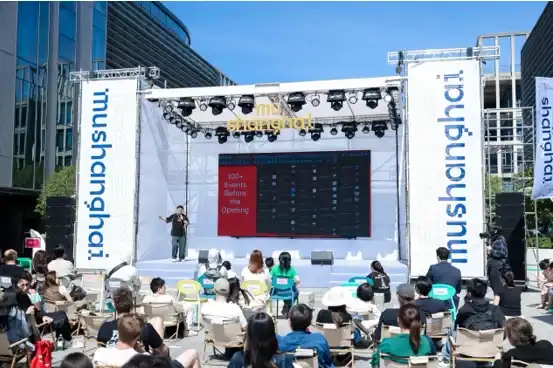
This 28-day "Tech Burning Man" will revolve around four thematic weeks, hosting nearly 100 events cumulatively. As a grand opening, ClawCon 2026 Shanghai will gather core global contributors of OpenClaw to deeply discuss AI development trends and open-source ecosystem building.

  • AI Week (May 11-15): Big Model Day will invite guests from kimi, Zhipu AI, Ant Bailing, StepFun, and others to share hardcore insights; the AI Safety session convenes global safety researchers and cryptographers; the Consumer App session invites teams behind multimodal large models like MiniMax and ZPilot, along with other Chinese AI consumer product teams, to deconstruct product iteration logic on-site.
  • Biotech Week (May 18-22): Topics progress layer by layer, from using technology to combat aging, to equipping labs with AI brains and robotic arms, to rewriting the underlying code of the material world. There's even a month-long longevity experiment led by a Yale PhD, where researchers will use themselves as subjects to explore the boundaries of life sciences.
  • Robotics Week (May 25-29): Robot combat competitions, cyber fashion shows, hardware supply chain pop-ups, and other events will take turns, offering a visually striking tech feast showcasing cutting-edge achievements in robotics.
  • Culture Week (June 1-6): Stepping beyond a purely technological perspective, it explores future social forms, cyberpunk culture, independent game creation, and other topics, allowing technology and humanities to collide and integrate here.

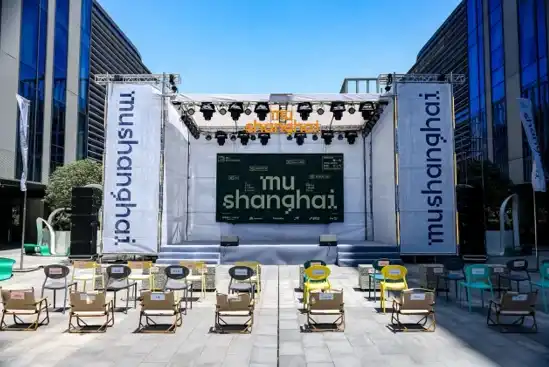
Notably, every Friday during the first three weeks, a large outdoor "Innovator's Market" will be held, and in the final week, there will be exhibitions related to technology and humanities. All participants can bring their own projects for on-site display, testing, and exchange, promoting rapid implementation of ideas and facilitating efficient collaboration. muShanghai will implement a Build in Public content mechanism throughout. We have designed a complete set of methods to encourage everyone to publicly share their projects, processes, problems, progress, and interim results, continuing iteration based on real feedback.

Hongqiao Alibaba Center Empowers "The First Stop for Starting a Business in China"
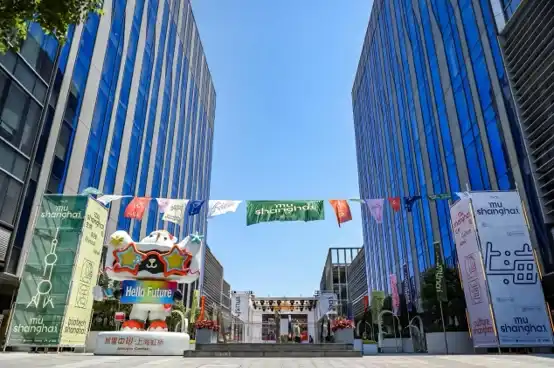
This one-month event is expected to reach over 100,000 people. As the co-organizer, Hongqiao Alibaba Center positions itself as an international innovation community and an ecological development hub. Relying on its five-dimensional one-stop capabilities in space, commerce, culture, ecosystem, and government services, it provides solid support for overseas talents to land and develop.

The "Tech Burning Man" initiator, The Mu, is the first international entrepreneur community to settle in Hongqiao Alibaba Center and is also one of the first international open-source partner communities of the HongCheng OPC community. The park director stated that HongCheng OPC is committed to providing one-stop services for global entrepreneurs coming to China. Collaborating with The Mu this time is a key layout for Hongqiao Alibaba Center in building an international tech innovation ecosystem.

This event is not only a frontier tech gathering but also an important window for China's tech innovation ecosystem to integrate with the world.

The Mu: An Open-Source Community That "Builds Cities from Scratch" Globally

Behind muShanghai is The Mu community, which has been successfully implemented in places like Argentina and San Francisco.

In Argentina, the Crecimiento project gathered 2,500 developers, incubated over 1,200 projects, with total funding exceeding $20 million. In San Francisco, The Mu helped transform the 16-story Frontier Tower into a tech innovation landmark, hosting OpenClaw's first offline developer gathering. It was also the sole startup community at the 2025 Osaka World Expo.

From preparation to project establishment, the muShanghai team overcame multiple challenges over seven months, including compliance filings for foreign events and rebuilding resource networks. On the opening day, attendees included Kong Fuan, Party Secretary and Executive Deputy Director of the Shanghai Hongqiao International Central Business District Administrative Committee; Lou Yongqi, President of Shanghai University of Engineering Science; Ke Xiaolin and Wang Ximei, Deputy District Heads of Minhang District, among others. The muShanghai core creative team and domestic and international co-creation partners introduced the thematic content and exciting activities for the upcoming four weeks.

AI may be changing the world, but it cannot replace the infinite possibilities that arise when we meet and collide.

About The Mu

The Mu is a global community organization that promotes open-source collaboration and innovation. It is committed to providing immersive co-creation spaces for developers, researchers, and entrepreneurs through the "Pop-up City" model, facilitating cross-cultural, interdisciplinary knowledge sharing and technological breakthroughs.

About Hongqiao Alibaba Center

Located in the core area of the Hongqiao International Open Hub, Hongqiao Alibaba Center is an important industrial office carrier for Alibaba Group in Shanghai. It is dedicated to creating a benchmark for space services targeting global tech talent, providing first-stop support for international developers, entrepreneurs, and companies coming to China. It offers not just office space, but an ecosystem-based development solution for international talent.


Связанные с этим вопросы

QWhat is muShanghai and what event is it organizing in Shanghai in 2026?

AmuShanghai is organizing a 28-day 'Pop-up City' experiment in Shanghai from May 10 to June 6, 2026. It aims to create a 'parallel city' for global geeks, co-hosted by the international open-source community The Mu and the Hongqiao Alibaba Center.

QWhat are the four theme weeks of the muShanghai 'Pop-up City' event and their main focuses?

AThe four theme weeks are: 1) AI Week (May 11-15): Focusing on large models, AI safety, and consumer applications. 2) Biotech Week (May 18-22): Exploring longevity, AI/robotics in labs, and foundational science. 3) Robotics Week (May 25-29): Featuring robot combat, cyber fashion shows, and hardware supply chain events. 4) Culture Week (June 1-6): Discussing future society, cyberpunk culture, and independent game creation.

QWho is The Mu community and what role does it play in the muShanghai event?

AThe Mu is an international open-source community that drives collaboration and innovation globally. It is the organizer behind the muShanghai 'Pop-up City' event. The community has previously run successful projects in Argentina and San Francisco and aims to provide an immersive co-creation space for developers, researchers, and entrepreneurs.

QWhat is the significance of the Hongqiao Alibaba Center's involvement as a co-host?

AAs a co-host, the Hongqiao Alibaba Center provides a strategic 'first stop in China' for overseas talent and entrepreneurs. It offers comprehensive support in space, business, culture, ecosystem, and government services, positioning itself as an international innovation hub and a key part of building a global tech and innovation ecosystem in Shanghai.

QWhat does 'Build in Public' refer to in the context of the muShanghai event?

A'Build in Public' is a core content mechanism for the muShanghai event. It refers to a designed set of practices that encourages participants to openly share their projects, processes, problems, progress, and interim results throughout the event. The goal is to foster iteration and improvement through real-time feedback and collaboration within the community.

Похожее

The Era of Bitcoin Dominating Crypto Is Over

The era of Bitcoin's dominance over the entire crypto market is ending. The crypto economy is now bifurcating into two distinct camps: endogenous assets and exogenous assets. Endogenous assets, like Bitcoin and many traditional cryptocurrencies, derive their value primarily from the broader crypto market's price movements. Their fortunes rise and fall with the market cycle. Exogenous assets, however, are increasingly decoupled from crypto market volatility. These projects, while technically part of the crypto space, have business models and value drivers that operate independently. Examples include Venice, which monetizes private AI inference services; Figure, a fintech firm using blockchain to streamline home equity loans; and stablecoin-related companies like BVNK and Bridge, which see growth unrelated to crypto bull or bear markets. This shift is fundamental. Past narratives of a "blockchain over Bitcoin" focus failed because they lacked sustainable, quantifiable demand and revenue streams that could translate to token value. The current cycle is different: exogenous projects generate real revenue from paying users, and investors are beginning to evaluate them based on fundamentals rather than mere market narrative. While endogenous assets will remain relevant—akin to gold and gold mining stocks in a portfolio—their performance drivers are now distinct from those of exogenous assets. Consequently, analyzing exogenous assets requires a traditional, fundamentals-based approach: examining user bases, unit economics, and competitive moats, much like a fintech investor would. Bitcoin's price is no longer the primary reference point. Promising exogenous sectors include on-chain exchanges/brokerages, AI/crypto fusion, tokenization of real-world assets, new digital banks, lending platforms, payment channels, non-financial crypto-consumer products, and the agent economy. Currently, investing in company equity is often the most direct way to gain exposure, though token mechanisms are evolving. The core trend is clear: the crypto market's drivers are diversifying from a single factor to multiple factors. Industry analysis must now focus on deep business fundamentals, not just interpreting Bitcoin's price charts.

marsbit11 мин. назад

The Era of Bitcoin Dominating Crypto Is Over

marsbit11 мин. назад

Claude Bill Skyrockets by 5 Billion, Surges 60-Fold Overnight—Can Your Token Budget Keep Up?

An enterprise reportedly ran up a staggering $500 million bill on Anthropic's Claude AI in just one month due to a simple oversight: failing to set usage limits for employee accounts. This incident highlights a growing trend of runaway AI costs. Other examples include a Google Cloud user hit with an unexpected $18,000 bill from API key abuse, and an OpenAI internal experiment that consumed 603 billion tokens, costing $1.3 million in 30 days. Major AI providers like OpenAI and GitHub are shifting from flat monthly fees to granular, usage-based pricing (per input/output/cached token), causing shock for some users whose costs skyrocketed by orders of magnitude. The root causes extend beyond pricing. The rise of autonomous AI agents executing long, complex tasks has drastically increased token consumption. Furthermore, misaligned incentives, like internal "leaderboards" ranking employees by AI usage, can encourage wasteful "tokenmaxxing"—using powerful models for trivial tasks just to inflate metrics. This has sparked a new industry focused on cost optimization. Solutions include providing AI with better context (reducing redundant searches) and intelligent model routing (matching tasks to the most cost-effective model). Research indicates token consumption for agentic tasks can vary wildly (up to 30x for the same job) without guaranteeing better results, and models often underestimate their own costs. As AI expenses begin to rival or even surpass human labor costs for some teams, companies are being forced to move from indiscriminate usage to meticulous "token accounting." The future belongs to those who can maximize the value of every token spent.

marsbit41 мин. назад

Claude Bill Skyrockets by 5 Billion, Surges 60-Fold Overnight—Can Your Token Budget Keep Up?

marsbit41 мин. назад

24/7 Unstoppable Derivatives Wave: Cryptocurrency Is Forcing Traditional Finance to 'Change Time Zones'

The article discusses how the 24/7 nature of the cryptocurrency market is compelling traditional finance to adapt its operating hours and infrastructure. The key catalyst is the CME Group's planned launch of nearly round-the-clock trading for regulated crypto derivatives, a move driven by strong institutional demand for continuous risk management. This shift highlights a fundamental change: derivatives, not spot trading, now dominate crypto market activity and price discovery. However, integrating continuous trading into traditional finance reveals structural tensions. While execution times can be extended, settlement, clearing, and regulatory reporting largely remain bound to traditional business-day cycles. This creates a lag where weekend price movements can impact risk exposures before traditional control systems are fully active. Furthermore, the article explores new challenges arising from this always-on environment. The inherent transparency of public blockchains, while ensuring auditable settlement, also exposes sensitive corporate information like treasury flows to competitors in real-time. This has elevated privacy from a feature to a core requirement for institutional adoption. The next phase hinges on building systems that balance this necessary privacy with regulatory accountability and compliance. In conclusion, the move towards 24/7 trading signifies more than crypto becoming institutionalized. It represents traditional finance beginning to adopt the temporal structure of crypto-native markets. The future will be defined by how successfully traditional risk, identity, privacy, and settlement frameworks can operate at the continuous speed cryptocurrency markets demand.

marsbit1 ч. назад

24/7 Unstoppable Derivatives Wave: Cryptocurrency Is Forcing Traditional Finance to 'Change Time Zones'

marsbit1 ч. назад

Торговля

Спот
Фьючерсы
活动图片