China's Export Controls to Japan Create Bottleneck; 'White-Haired Stock God' Serenity Claims South Korea's Foosung to Become a 'Big Winner'

marsbitОпубликовано 2026-06-15Обновлено 2026-06-15

Введение

China's export controls on tungsten have triggered a supply crisis in the AI memory chip sector. Japan, accounting for 25% of global WF6 (tungsten hexafluoride) production, faces imminent shutdowns due to shortages of tungsten precursor from China. This forces major Korean chipmakers like Samsung and SK Hynix to urgently seek alternatives. Korean suppliers SK Specialty and Foosung are moving to fill the gap. SK Specialty has signed a long-term contract to supply Samsung with 150 tons of WF6 monthly. Foosung has begun certification with China's CSSC Specialty Gases to start large-scale WF6 imports by August. Market analysts, including social media figure "White-Haired Stock God" Serenity, have labeled Foosung a potential "big winner," with its stock rising significantly. The crisis has led to drastic price increases, with 2026 WF6 contract prices set to rise 70-90%. Japanese suppliers warn their key inventories could be depleted by mid-2026. However, the opportunity for Korean firms hinges on continued access to Chinese tungsten powder—a geopolitical choice rather than a permanent technological advantage. The situation highlights the fragility of the concentrated WF6 supply chain and the strategic risks for downstream chip manufacturers.

Author: Ada, Deep Tide TechFlow

The ripple effects of China's tungsten export controls to Japan have now reached the upstream AI memory chip sector.

Japan's 25% share of global WF6 (tungsten hexafluoride) production capacity has entered a countdown to shutdown, forcing Samsung and SK Hynix to urgently seek alternative supplies overnight. South Korea's SK Specialty signed a long-term contract with Samsung for a monthly supply of 150 tons, while Foosung initiated certification with China's CSSC Specialty Gases, aiming for large-scale imports starting August; 2026 WF6 contract prices have been locked in for increases of 70% to 90%. Japanese suppliers warn that key inventories could be depleted by mid-2026. On social platform X, the 'White-Haired Stock God' Serenity singled out Foosung as a 'big winner,' but the inherent risks in this substitution game are equally clear—Korean manufacturers themselves rely on imports for the tungsten powder needed to produce the gas.

Japan's two main WF6 suppliers, Kanto Denka Kogyo and Central Glass, have notified South Korean clients like Samsung, SK Hynix, and DB HiTek that they cannot guarantee supply after May or June. This is a major blow to the downstream memory chip sector following China's implementation of export controls on tungsten-related items in February 2025.

Chain Reaction from China's APT Export Controls, Japan's WF6 Capacity Feels Pressure First

As early as February 2025, China's Ministry of Commerce and the General Administration of Customs jointly announced the inclusion of tungsten-related items into the dual-use items export control list. The impact of this move is now being fully realized over a year later. According to industry analysis firm CTOL Digital, since the controls took effect, Japan's imports of APT (Ammonium Paratungstate, a precursor to tungsten powder) from China on key trade routes plummeted by up to 70%, a figure that directly chokes the supply chain for Japanese WF6 producers.

The pressure arrived faster than the industry anticipated. According to a report on April 3 by South Korean semiconductor media The Elec, citing multiple industry sources, Kanto Denka and Central Glass have begun notifying South Korean chipmakers like Samsung and DB HiTek of potential imminent supply disruptions. One informed source stated, 'Supply can be maintained with existing tungsten inventories in May and June, but the outlook for the second half is unclear.' Japanese producers have suggested their South Korean clients turn to domestic alternatives, SK Specialty and Foosung.

Japan holds about 25% of the global WF6 supply. This means that a production cut by Japanese firms would instantly remove a quarter of the world's tungsten film precursor. According to information agency SunSirs, Samsung and SK Hynix sourced approximately 80% of their WF6 from Japan in the past, placing them squarely on the front lines of the crisis. Among them, Samsung's exposure is significantly higher than SK Hynix's, as the latter's supply portfolio is more diversified, including SK Specialty, Foosung, and China's Peric Special Gases.

SK Specialty Signs 150-ton Monthly Long-Term Supply Deal with Samsung, Korean Leaders Ramp Up Production

In the face of the crisis, South Korean companies demonstrated exceptional execution speed. According to SunSirs, SK Specialty has signed a long-term supply agreement with Samsung for a monthly volume of 150 tons. This scale is unusual under normal circumstances, as WF6 is a high-purity specialty gas, not a bulk commodity that can be easily scaled up.

SK Specialty is South Korea's largest WF6 supplier and benefits from natural group synergy with downstream clients. It belongs to the SK Group, closely tied to SK Hynix within the same group; now, by adding Samsung to its long-term contract list, it essentially secures positions with both of South Korea's top memory manufacturers.

Time is the scarcest resource in this scramble for orders. WF6 is a highly corrosive, hazardous gas requiring purity levels of 5N to 6N (99.999% to 99.9999%). The certification process for new suppliers typically takes 12 to 18 months, covering process testing, yield verification, equipment adaptation, and more. However, according to The Elec, some foundries are 'shortening or skipping parts of the process' for one reason only: urgency.

Foosung Initiates Certification with CSSC Specialty Gases, Targets Large-Scale Imports Starting August

Foosung (Korean code 093370) is taking another route. This South Korean fluorochemical company, with a market cap of about $1.2 billion, is one of SK Hynix's three existing WF6 suppliers, alongside SK Specialty and China's Peric. Beyond WF6, it is also South Korea's sole producer of anhydrous hydrogen fluoride (HF), the country's second-largest WF6 manufacturer, and the sole producer of battery electrolyte salt LiPF6. Its Ulsan plant integrates three fluorochemical production lines, representing highly concentrated technological assets.

According to industry information cited by SunSirs and futunn among other media, Foosung has initiated the certification process with China Shipbuilding Industry Group's CSSC Specialty Gases, aiming to begin large-scale WF6 imports from August. The hidden implication of this move is worth unpacking: Japan halts WF6 production due to tungsten powder shortages, while South Korea's Foosung turns to importing finished WF6 from China. The same tungsten supply chain is segmented by China's export controls into parts that 'restrict Japan' and 'allow South Korea.'

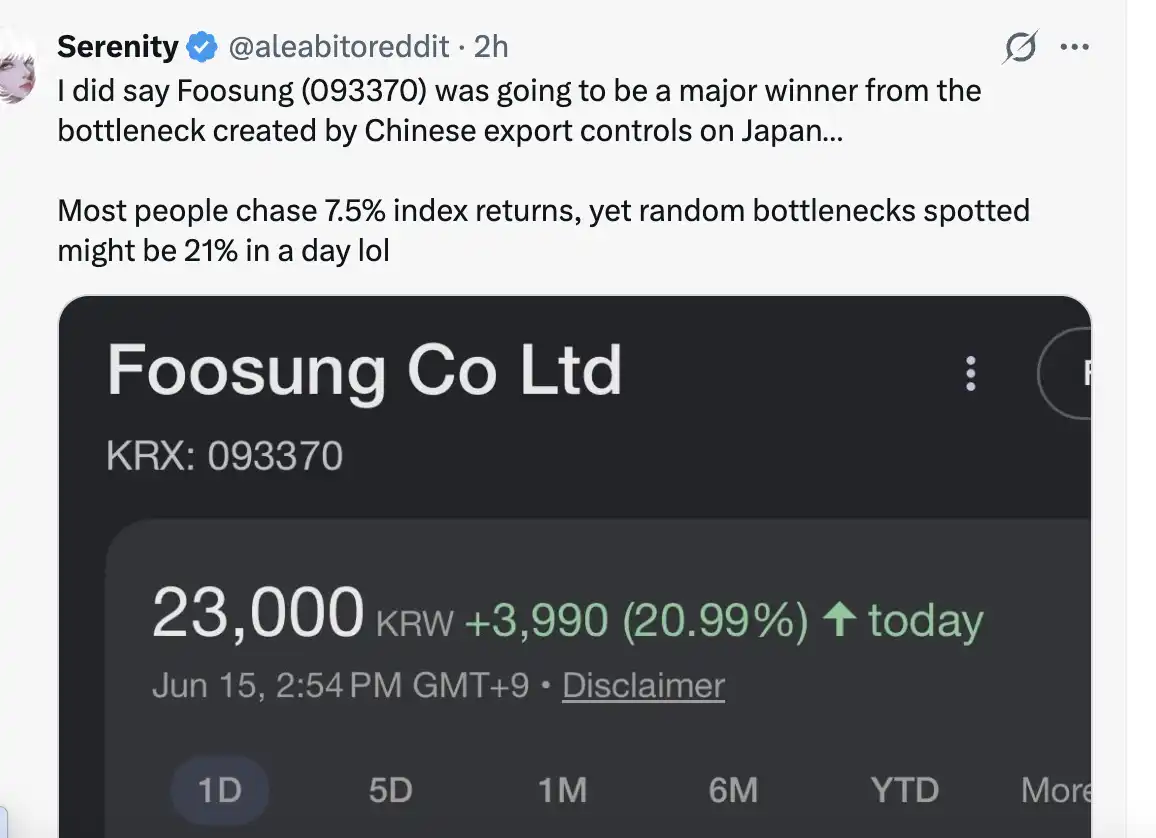
The 'White-Haired Stock God' Serenity on platform X has noted this thread. He posted on June 13, naming Foosung: 'Foosung looks like it will become a huge beneficiary soon. Basically, China's export controls on Japan have caused Japan's WF6 supply chain to collapse, and the 25% of global supply needed by SK Hynix, Samsung, TSMC will have to find alternatives elsewhere.'

The secondary market has already reacted to this logic. According to CTOL Digital, Foosung's stock price has risen approximately 196% over the past 12 months, despite its TTM EPS still being negative.

2026 WF6 Contract Prices to Rise 70% to 90%; Japanese Suppliers Warn of Mid-2026 Inventory Depletion

Price signals at the contract level have already emerged. According to CTOL Digital, South Korea's SK Specialty, Foosung, and Japan's Kanto Denka have formally notified Samsung, SK Hynix, DB HiTek, and Magnachip that 2026 WF6 contract prices will increase by 70% to 90%. This is a collective pricing action within an oligopolistic market, leaving downstream buyers with few alternative options.

An even more cautionary signal comes from the supply side. Also per CTOL Digital, Japanese suppliers have warned that key inventories could be depleted by mid-2026. This implies that even South Korean clients with signed long-term contracts face uncertainty regarding physical deliveries.

The irreplaceability of WF6 is being repriced by the market. Chipmakers cannot simply swap gas cylinders between different suppliers; any deviation in impurities could scrap millions of dollars worth of wafer inventories. This is the fundamental reason for the stringent 12 to 18-month certification process for new suppliers and the underlying logic that sustains the oligopolistic structure.

The stock price reaction is already ahead. According to CTOL Digital, Japan's Kanto Denka's stock price has risen about 374% over the past year, with its market capitalization soaring to 240.3 billion yen and a TTM P/E ratio exceeding 63 times. Foosung's gain in the same period is about 196%, and despite its negative TTM EPS, the market has granted it a significant premium. These valuations reflect not a short-term, event-driven spike but a structural market revaluation of the WF6 oligopoly.

South Korea's Substitution Window Supported by Geopolitics, Not Determined by Technical Barriers

The South Korean companies poised to benefit from Japan's supply disruption are not entirely self-sufficient either. SK Specialty and Foosung, as domestic South Korean WF6 producers, also rely on imported tungsten powder for gas production. The difference so far is that they are being treated differently from their Japanese counterparts. SunSrs states: 'China's export controls have so far primarily targeted Japan. South Korea can still continue importing tungsten powder. This is a geopolitical choice, not a natural outcome of market forces.'

The Chinese domestic supply side is rapidly rising. According to futunn citing industry data, CSSC Specialty Gases will reach a WF6 production capacity of 2,000 tons/year by the end of 2025, with purity reaching 6N levels, and its products have already entered the supply chains of global chipmakers. SunSrs data further indicates that the localization rate of China's fluorine-containing specialty gases has significantly increased to 50% over the past two years.

This reality adds a clear footnote to Foosung's 'winner' narrative. The current window of opportunity is premised on the assumption that 'China continues to allow tungsten powder exports to South Korea,' not locked in by irreplaceable technical barriers. Decision-makers at Samsung and SK Hynix may already be asking themselves the question posed by SunSirs: 'If Japan can be shut down due to raw material shortages, what could prevent South Korea from facing the same fate tomorrow?'

Связанные с этим вопросы

QWhat is WF6 and why is its supply disruption significant for the AI and semiconductor industries?

AWF6 (tungsten hexafluoride) is a high-purity, corrosive specialty gas used as a precursor for tungsten thin films in semiconductor manufacturing, particularly for DRAM and AI memory chips. Its supply disruption is significant because Japan, which accounts for approximately 25% of global WF6 capacity, is facing production shutdowns due to China's export controls on tungsten feedstocks. This directly threatens the supply chains for major memory chipmakers like Samsung and SK Hynix, which heavily rely on Japanese suppliers, potentially causing production bottlenecks and price surges.

QHow are South Korean companies like SK Specialty and Foosung responding to the potential shortage of WF6 from Japan?

ASouth Korean companies are responding by rapidly securing alternative supplies and expanding their roles. SK Specialty has signed a long-term contract with Samsung to supply 150 tons of WF6 per month. Foosung, an existing supplier to SK Hynix, has initiated the qualification process with China's CSSC Specialty Gases to begin large-scale imports of finished WF6 by August 2025. These moves aim to fill the supply gap left by Japanese producers.

QWho is Serenity and what investment thesis did he present regarding Foosung in relation to the supply chain disruption?

ASerenity, a prominent stock commentator known as the 'White-Haired Stock God' on social media platform X, identified South Korean company Foosung as a major potential beneficiary of the supply chain crisis. His thesis is that China's export controls, which crippled Japan's WF6 supply chain, will force major chipmakers (Samsung, SK Hynix, TSMC) to find new sources for the 25% of global WF6 previously supplied by Japan, positioning Foosung to gain significant market share and revenue.

QWhat are the reported projected changes in WF6 contract prices for 2026, and what is driving this increase?

AMajor WF6 suppliers, including SK Specialty, Foosung, and Japan's Kanto Denka, have reportedly notified their customers that contract prices for 2026 will increase by 70% to 90%. This dramatic price hike is driven by the impending supply shortage and the resulting seller's market. With Japanese production shutting down and new supply sources taking time to qualify, the remaining suppliers hold significant pricing power in an oligopolistic market where WF6 is difficult to substitute.

QWhat underlying risk does the article highlight for South Korean companies like Foosung, despite their potential short-term gains?

AThe article highlights that the opportunity for South Korean companies is not based on unassailable technical superiority but on a geopolitical concession. While South Korea can still import tungsten powder from China, Japan cannot. Both SK Specialty and Foosung themselves depend on imported tungsten powder to produce WF6. Therefore, their 'winning' position is contingent on China's continued willingness to supply tungsten to South Korea, making their advantage potentially fragile and subject to future policy shifts by China.

Похожее

The World Cup is Here: The Battle for Entry into Prediction Markets Has Begun

The 2026 FIFA World Cup has begun, and alongside the on-field competition, a new off-field battleground is emerging: prediction markets. These blockchain-based platforms, which convert crowd wisdom into tradable probabilities, are gaining significant traction. However, their complexity—involving wallets, gas fees, and smart contracts—has historically limited participation to crypto-native users. Centralized exchanges (CEXs), like Gate, are tackling this adoption barrier. By integrating with leading prediction market protocol Polymarket, Gate simplifies the user experience. Users can participate directly with their exchange account and USDT, bypassing complex Web3 steps. Gate offers a streamlined "Prediction Mode" for casual users and a professional "Trading Mode" with advanced tools. Key features include two-way trading (allowing users to buy or sell positions before event resolution), support for diverse markets (sports, crypto, macroeconomics), and a suite of information tools like a "Smart Money" leaderboard, wallet tracking, and AI-powered insights. For the World Cup, Gate launched a dedicated hub aggregating schedules, standings, and relevant markets. This allows fans to seamlessly follow games and trade on outcomes, transforming passive viewing into active participation where they can monetize their predictions and trade on shifting consensus throughout a match. The article argues that prediction markets have proven their value in event forecasting. The next challenge is mass adoption. The competition is shifting from building effective protocols to creating accessible user entry points. By lowering technical barriers and building a complete ecosystem for information and trading, platforms like Gate aim to transition prediction markets from a niche crypto tool to a mainstream platform for expressing and trading on collective intelligence.

Odaily星球日报6 мин. назад

The World Cup is Here: The Battle for Entry into Prediction Markets Has Begun

Odaily星球日报6 мин. назад

Spain Held to a Draw by Cape Verde, Jucom Prediction Market Witnesses Historic Upset

In a major upset at the 2026 FIFA World Cup, tournament favorites Spain were held to a surprising 0-0 draw by debutants Cape Verde in their Group H opener on June 16, Beijing time. Despite dominating possession (74%) and recording 27 shots with an expected goals figure of 2.16, Spain failed to break down a resilient Cape Verde defense, with their 40-year-old goalkeeper Vozinha making 7 saves to earn Man of the Match. Pre-match predictions on the Jucom prediction market had heavily favored Spain, assigning them a 92% win probability. The actual result, a goalless draw, triggered significant volatility across related prediction markets. This outcome forces a market-wide reassessment of several key probabilities, including Spain's likelihood of winning the group and the tournament itself, while Cape Verde's previously near-zero chance of advancing is now being re-evaluated. The event highlights both the efficiency and the inherent limitations of prediction markets. While prices aggregate known information, football's low-scoring, high-variance nature means unquantifiable in-game factors can lead to unlikely results. The core value of such markets lies not in perfect foresight but in their ability to dynamically reflect how new information is incorporated into collective expectations. Platforms like Jucom, which track outcomes from single matches to the final champion, provide a real-time lens into how global consensus evolves with each game.

链捕手9 мин. назад

Spain Held to a Draw by Cape Verde, Jucom Prediction Market Witnesses Historic Upset

链捕手9 мин. назад

Standard Chartered Bank Places a 40x 'Bet', Calls for UNI to Rise to $100

Standard Chartered Bank’s digital asset research head, Geoff Kendrick, initiated coverage on Uniswap with a highly bullish long-term price target of $100 for its UNI token by 2030—a roughly 40-fold increase from its ~$2.60 trading price at the time of the report. The bank’s thesis hinges on the exponential growth of tokenized real-world assets (RWA), projected to surge from ~$340 billion to $4 trillion by 2028. It expects the share of these assets deployed in DeFi to rise from 3.5% to 30%, driving total DeFi TVL to around $2.7 trillion. As the leading decentralized exchange (DEX), Uniswap is positioned to capture a significant portion of this liquidity influx. A key catalyst is Uniswap’s “fee switch,” activated in late 2024, which directs a portion of protocol fees to UNI token buybacks and burns. This transforms UNI from a pure governance token into a yield-generating, deflationary asset, narrowing its valuation gap with centralized exchanges like Coinbase. The report draws an analogy: Coinbase operates like Netflix (centralized, high-cost), while Uniswap functions like YouTube (open, user-generated, network-effect driven). Despite its dominant market share and recent institutional adoption—such as BlackRock’s BUIDL fund and Fidelity’s stablecoin using Uniswap for liquidity—the path faces challenges. Competition from Solana-based DEXs and aggregators threatens user mindshare, while regulatory delays or setbacks in RWA adoption could slow the projected growth. Furthermore, UNI remains down over 92% from its 2021 peak, reflecting persistent market skepticism. Ultimately, Standard Chartered’s report signals a shift in traditional finance’s perception of DeFi, valuing network effects and cash flow potential. However, realizing the $100 target depends on Uniswap successfully navigating intense competition, regulatory hurdles, and the multi-year timeline for massive tokenized asset adoption.

marsbit34 мин. назад

Standard Chartered Bank Places a 40x 'Bet', Calls for UNI to Rise to $100

marsbit34 мин. назад

Торговля

Спот
Фьючерсы

Популярные статьи

Как купить S

Добро пожаловать на HTX.com! Мы сделали приобретение Sonic (S) простым и удобным. Следуйте нашему пошаговому руководству и отправляйтесь в свое крипто-путешествие.Шаг 1: Создайте аккаунт на HTXИспользуйте свой адрес электронной почты или номер телефона, чтобы зарегистрироваться и бесплатно создать аккаунт на HTX. Пройдите удобную регистрацию и откройте для себя весь функционал.Создать аккаунтШаг 2: Перейдите в Купить криптовалюту и выберите свой способ оплатыКредитная/Дебетовая Карта: Используйте свою карту Visa или Mastercard для мгновенной покупки Sonic (S).Баланс: Используйте средства с баланса вашего аккаунта HTX для простой торговли.Третьи Лица: Мы добавили популярные способы оплаты, такие как Google Pay и Apple Pay, для повышения удобства.P2P: Торгуйте напрямую с другими пользователями на HTX.Внебиржевая Торговля (OTC): Мы предлагаем индивидуальные услуги и конкурентоспособные обменные курсы для трейдеров.Шаг 3: Хранение Sonic (S)После приобретения вами Sonic (S) храните их в своем аккаунте на HTX. В качестве альтернативы вы можете отправить их куда-либо с помощью перевода в блокчейне или использовать для торговли с другими криптовалютами.Шаг 4: Торговля Sonic (S)С легкостью торгуйте Sonic (S) на спотовом рынке HTX. Просто зайдите в свой аккаунт, выберите торговую пару, совершайте сделки и следите за ними в режиме реального времени. Мы предлагаем удобный интерфейс как для начинающих, так и для опытных трейдеров.

1.5k просмотров всегоОпубликовано 2025.01.15Обновлено 2026.06.02

Как купить S

Sonic: Обновления под руководством Андре Кронье – новая звезда Layer-1 на фоне спада рынка

Он решает проблемы масштабируемости, совместимости между блокчейнами и стимулов для разработчиков с помощью технологических инноваций.

2.3k просмотров всегоОпубликовано 2025.04.09Обновлено 2025.04.09

Sonic: Обновления под руководством Андре Кронье – новая звезда Layer-1 на фоне спада рынка

HTX Learn: Пройдите обучение по "Sonic" и разделите 1000 USDT

HTX Learn — ваш проводник в мир перспективных проектов, и мы запускаем специальное мероприятие "Учитесь и Зарабатывайте", посвящённое этим проектам. Наше новое направление .

1.8k просмотров всегоОпубликовано 2025.04.10Обновлено 2025.04.10

HTX Learn: Пройдите обучение по "Sonic" и разделите 1000 USDT

Обсуждения

Добро пожаловать в Сообщество HTX. Здесь вы сможете быть в курсе последних новостей о развитии платформы и получить доступ к профессиональной аналитической информации о рынке. Мнения пользователей о цене на S (S) представлены ниже.

活动图片