Chainlink Founder Sergey Nazarov Identifies 3 Trends That Will Define the Cryptosphere as Hyper Token Soars

bitcoinistОпубликовано 2026-02-10Обновлено 2026-02-10

Введение

Chainlink co-founder Sergey Nazarov identifies three key trends shaping the crypto industry: real-world asset (RWA) tokenization, cross-chain interoperability, and high-performance infrastructure. These shifts signal a move from speculation to practical, institutional-grade applications. Bitcoin Hyper ($HYPER) emerges as a solution addressing Bitcoin’s scalability and utility limitations. By integrating the Solana Virtual Machine (SVM) as a Bitcoin Layer 2, it enables high-speed, low-cost smart contracts while leveraging Bitcoin’s security. The project has raised over $31.3M in its presale, with significant whale activity, indicating strong institutional interest. Bitcoin Hyper aims to unlock Bitcoin’s dormant capital through DeFi applications, staking rewards, and a decentralized bridge for seamless BTC transfers. This aligns with Nazarov’s vision of a verifiable, interconnected financial ecosystem.

Trusted Editorial content, reviewed by leading industry experts and seasoned editors. Ad Disclosure

Quick Facts:

  • ➡️ Chainlink’s Sergey Nazarov identifies RWA tokenization, cross-chain interoperability, and high-performance infrastructure as the three pillars of the next crypto cycle.
  • ➡️ Bitcoin Hyper addresses the liquidity gap by bringing the Solana Virtual Machine (SVM) to Bitcoin, enabling high-speed smart contracts on the world’s most secure chain.
  • ➡️ Institutional interest in Bitcoin Layer 2s is rising, evidenced by over $31M raised in the Bitcoin Hyper presale and verified whale accumulation.
  • ➡️ Whales join the race with over $1M raised across three transactions-only; FOMO is real.

The crypto market is undergoing a structural transformation that extends far beyond daily price tickers.

In recent keynotes, Chainlink co-founder Sergey Nazarov outlined three critical trends signaling the industry’s shift from speculative experimentation to critical global infrastructure.

It’s a bold claim, but his analysis suggests the next bull cycle won’t be defined by hype, it’ll be defined by the collision of traditional finance (TradFi) and decentralized protocols.

First, Nazarov points to the inevitability of Real-World Assets (RWAs) migrating on-chain. Major institutions aren’t just testing the waters anymore; they’re actively building tokenization platforms. This isn’t just about efficiency, it’s about creating a ‘verifiable web’ where asset ownership is mathematically guaranteed rather than legally promised.

Then there’s the collapse of cross-chain friction. The future isn’t a winner-take-all single chain, but an interconnected ecosystem where liquidity flows seamlessly between networks via protocols like CCIP.

The third trend is perhaps the most immediate: the demand for high-performance infrastructure capable of handling ‘internet-scale’ transactions. As DeFi matures, users are rejecting high latency and exorbitant gas fees.

This sentiment shift is driving capital away from legacy Layer 1s that refuse to scale and toward specialized execution layers. That’s exactly where new solutions are emerging to unlock the dormant capital on the world’s largest blockchain: Bitcoin Hyper ($HYPER).

$HYPER is available here.

Bitcoin Hyper Integrates SVM To Solve The Liquidity Fragmentation Crisis

While Nazarov emphasizes cross-chain standards, a glaring inefficiency remains: Bitcoin holds over 50% of the industry’s market cap but lacks the native programmability to participate in this new ‘verifiable web.’

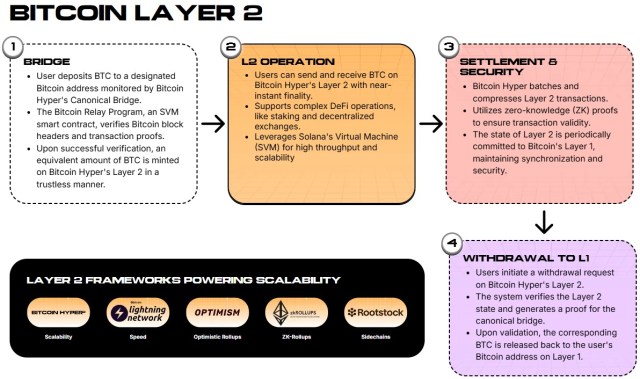
Enter Bitcoin Hyper ($HYPER). By integrating the Solana Virtual Machine (SVM) directly as a Bitcoin Layer 2, the project introduces high-speed, low-cost transaction execution to the Bitcoin network.

The architecture here is distinct. Rather than relying on slow settlement times, Bitcoin Hyper utilizes a modular setup: Bitcoin L1 handles final settlement and security, while the SVM L2 handles real-time execution.

The result? A network capable of sub-second finality and negligible fees, outperforming even Solana in specific latency benchmarks. For developers, this means the ability to build high-performance DeFi applications using Rust, finally bridging the gap between Bitcoin’s liquidity and modern smart contract utility.

Smart money seems to be watching this setup. On-chain data from Etherscan indicates that two whale wallets accumulated $1M+ in recent transactions, with the largest single purchase of $500K occurring on Jan 15, 2026.

This accumulation suggests traders are betting on Layer 2s that can unlock Bitcoin’s yield-bearing potential without compromising its security.

Read more about $HYPER here.

Presale Momentum Accelerates As Capital Rotates Into Bitcoin Layer 2s

The narrative shift toward infrastructure that Nazarov predicts is already reflecting in capital flows. Investors are hunting for protocols offering immediate utility rather than vague roadmap promises.

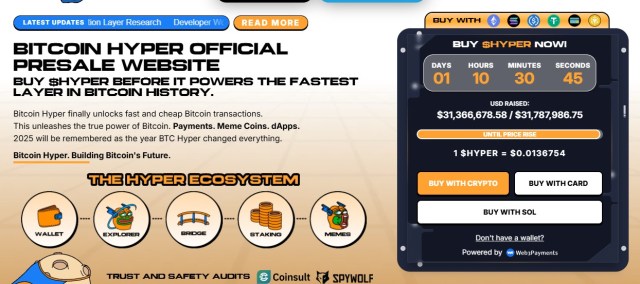
Bitcoin Hyper ($HYPER) has tapped into this demand, raising over $31.3M in its ongoing presale. With tokens currently priced at $0.0136754, the project is drawing liquidity from traders hedging against Ethereum’s congestion and Solana’s occasional instability.

Plus, the economic model is driving interest. Bitcoin Hyper introduces a high-yield staking protocol available immediately after the Token Generation Event (TGE). Unlike traditional mining (which requires hardware), $HYPER staking rewards community participation and governance with a short 7-day vesting period for presale stakers.

It’s a setup designed for both exposure to a high-growth infrastructure token and yield generation on a Bitcoin-native layer.

The project’s Decentralized Canonical Bridge aligns with the industry’s push for interoperability. By allowing trustless transfers of $BTC into the L2 ecosystem, it enables Bitcoin to be used as collateral in lending and derivatives markets previously accessible only to $ETH or $SOL holders.

As the market moves toward the ‘verifiable web’ Nazarov describes, protocols that make Bitcoin actually usable could be positioned to capture significant value.

Buy $HYPER here.

This article is for informational purposes only and does not constitute financial advice. Cryptocurrencies are high-risk assets with significant volatility. The presale data and technical claims regarding Bitcoin Hyper are based on information provided by the project team. Always perform your own due diligence before investing.

Editorial Process for bitcoinist is centered on delivering thoroughly researched, accurate, and unbiased content. We uphold strict sourcing standards, and each page undergoes diligent review by our team of top technology experts and seasoned editors. This process ensures the integrity, relevance, and value of our content for our readers.

patrubogdan

Follow

Full Profile

Related Posts

Russian Lawmaker Predicts Bitcoin Collapse While Smart Money Rotates into Layer 2 Utility

Solana’s Low Fees Create Strong Competition for Base, BNB, and Polygon and Fuel SUBBD Token

Bitcoin Demand Plunges Per CryptoQuant, Yet Maxi Doge Endures

Crypto Markets Catch A Breather As Outflows Begin To Slow: Analysts

SUBBD Token’s Massive Projected Impact on the Content Creation Market in 2026

Government Shutdown Fears Trigger 2% Crypto Dip, But Bitcoin Hyper Remains Unshaken

Связанные с этим вопросы

QWhat are the three critical trends identified by Chainlink's Sergey Nazarov that will define the next crypto cycle?

AThe three trends are Real-World Assets (RWA) tokenization, cross-chain interoperability, and high-performance infrastructure capable of handling internet-scale transactions.

QHow does Bitcoin Hyper ($HYPER) address the liquidity fragmentation problem on the Bitcoin network?

ABitcoin Hyper integrates the Solana Virtual Machine (SVM) as a Bitcoin Layer 2, enabling high-speed smart contracts and low-cost transactions while using Bitcoin L1 for final settlement and security.

QWhat evidence suggests institutional interest in Bitcoin Hyper's presale?

AThe project raised over $31.3 million in its presale, with on-chain data showing whale transactions including a single purchase of $500,000 on January 15, 2026.

QWhat technical advantage does Bitcoin Hyper claim over other networks?

AIt claims sub-second finality and negligible fees, outperforming even Solana in specific latency benchmarks, while maintaining Bitcoin's security through its modular architecture.

QHow does Bitcoin Hyper's staking model differ from traditional Bitcoin mining?

AIt offers a high-yield staking protocol with immediate vesting after Token Generation Event (TGE), requiring no hardware and featuring a 7-day vesting period for presale participants, unlike hardware-dependent mining.

Похожее

From Survival to Accelerated Growth: The Journey of Zcash's Three-Year Rise as Told by the Founder of ZODL

**From Survival to Accelerated Growth: Zcash Founder Details the 3-Year Rise** Three years ago, Zcash (ZEC) was a struggling pioneer in privacy technology, with a price near $30, low shielded supply (11%), and a community mired in governance disputes. Today, ZEC trades around $600, with over 31% of its supply (~$3B) in user-controlled shielded pools. This transformation resulted from breaking key constraints. First, **governance shackles were removed**. The old model guaranteed funding to two entities (ECC and ZF) regardless of performance, creating a monopoly. In 2024, ECC rejected further direct funding, forcing a change. The NU6 upgrade ended direct funding, allocating 8% to community grants and 12% to a protocol-controlled treasury for retroactive rewards, expiring in 2028 unless renewed by overwhelming consensus. The entities also relinquished their trademark-based veto power, freeing community governance. Second, the **product focus shifted** from pure cryptography to user growth. Previously, engineering excelled at privacy tech but failed to attract users. In early 2024, the team (later ZODL) pivoted to building products users wanted, like the Zodl wallet (default privacy, hardware support, cross-asset swaps). This drove shielded supply to grow over 400% in ZEC terms, with 86.5% of recent transactions being shielded, representing real user adoption. Third, the **narrative evolved** from the limiting "privacy coin" label to "unstoppable private money." This clarified Zcash's value proposition: a Bitcoin-like monetary policy with verifiable private payments via advanced cryptography. This structural narrative—protocol (Zcash), asset (ZEC), gateway (Zodl)—enabled broader exchange listings, institutional interest, and ETF filings. Finally, **organizational constraints were broken**. In early 2026, the ECC team left its non-profit structure after disputes over control, forming Zcash Open Development Lab (ZODL). ZODL raised $25M from top VCs (Paradigm, a16z, etc.), gaining the capital and agility of a startup to scale consumer products. Current metrics show strong momentum: social discussion volume for ZEC surged 15,245% in a year, with 81% positive sentiment. The focus is now on enhancing user experience (Zodl wallet), scalability (Tachyon project targeting Visa-level throughput with 25-second blocks), and post-quantum security (quantum-recoverable wallets coming soon). Zcash is positioned to become faster, more usable, scalable, and quantum-resistant.

marsbit5 мин. назад

From Survival to Accelerated Growth: The Journey of Zcash's Three-Year Rise as Told by the Founder of ZODL

marsbit5 мин. назад

Five Counterparty Risk Architectures: A Settlement-Layer Methodology for Classifying TradFi Models in Crypto Exchanges

**Summary:** This companion piece reframes the five TradFi-on-crypto exchange architectures, previously classified by "architectural fingerprint," through the lens of counterparty risk. The core question is: whose balance sheet bears the loss first in a stress scenario, and has it historically done so? Each of the five models corresponds to a distinct risk holder with its own documented failure modes. * **Model 1 (Stablecoin-Settled CEX Perpetuals):** Risk is held by the stablecoin issuer (e.g., reserve composition, bank connectivity) and the CEX's own book. History includes Tether's banking disconnections (2017) and reserve misrepresentations (CFTC 2021 Order). * **Model 2 (CFD Brokers):** Risk resides on the broker's balance sheet (B-book model). Regulatory differences (e.g., ESMA's mandatory negative balance protection vs. Mauritius FSC's lack thereof) define loss allocation rules, as seen in the 2015 SNB event (Alpari UK insolvency). * **Model 3 (Off-Chain Custody & Transfer Agent Chain):** Risk lies with the off-chain custodian/platform. User asset recovery depends on Terms of Use and corporate structure, exemplified by the Celsius bankruptcy ruling (2023) where Earn Account assets were deemed property of the estate. * **Model 4 (DEX Perpetual Protocols):** No single balance sheet bears risk. Loss absorption relies on a protocol's insurance fund and Auto-Deleveraging (ADL) mechanism, as demonstrated in the GMX V1 (2022) and dYdX v3 YFI (2023) incidents. * **Model 5 (Regulated CCP - DCM-DCO-FCM):** The most institutionalized model concentrates risk in the Central Counterparty (CCP). However, history shows CCPs can employ non-standard tools under extreme stress, such as mass trade cancellation (LME Nickel, 2022) or enabling negative price settlements (CME WTI, 2020). The report argues that regulatory choices and counterparty risk structures are co-extensive, not in an upstream-downstream relationship. It concludes with five separate observation checklists (not predictions) for monitoring the structural vulnerabilities of each risk model.

marsbit22 мин. назад

Five Counterparty Risk Architectures: A Settlement-Layer Methodology for Classifying TradFi Models in Crypto Exchanges

marsbit22 мин. назад

Торговля

Спот
Фьючерсы

Популярные статьи

Как купить LINK

Добро пожаловать на HTX.com! Мы сделали приобретение ChainLink (LINK) простым и удобным. Следуйте нашему пошаговому руководству и отправляйтесь в свое крипто-путешествие.Шаг 1: Создайте аккаунт на HTXИспользуйте свой адрес электронной почты или номер телефона, чтобы зарегистрироваться и бесплатно создать аккаунт на HTX. Пройдите удобную регистрацию и откройте для себя весь функционал.Создать аккаунтШаг 2: Перейдите в Купить криптовалюту и выберите свой способ оплатыКредитная/Дебетовая Карта: Используйте свою карту Visa или Mastercard для мгновенной покупки ChainLink (LINK).Баланс: Используйте средства с баланса вашего аккаунта HTX для простой торговли.Третьи Лица: Мы добавили популярные способы оплаты, такие как Google Pay и Apple Pay, для повышения удобства.P2P: Торгуйте напрямую с другими пользователями на HTX.Внебиржевая Торговля (OTC): Мы предлагаем индивидуальные услуги и конкурентоспособные обменные курсы для трейдеров.Шаг 3: Хранение ChainLink (LINK)После приобретения вами ChainLink (LINK) храните их в своем аккаунте на HTX. В качестве альтернативы вы можете отправить их куда-либо с помощью перевода в блокчейне или использовать для торговли с другими криптовалютами.Шаг 4: Торговля ChainLink (LINK)С легкостью торгуйте ChainLink (LINK) на спотовом рынке HTX. Просто зайдите в свой аккаунт, выберите торговую пару, совершайте сделки и следите за ними в режиме реального времени. Мы предлагаем удобный интерфейс как для начинающих, так и для опытных трейдеров.

1.6k просмотров всегоОпубликовано 2024.03.29Обновлено 2025.03.21

Как купить LINK

Обсуждения

Добро пожаловать в Сообщество HTX. Здесь вы сможете быть в курсе последних новостей о развитии платформы и получить доступ к профессиональной аналитической информации о рынке. Мнения пользователей о цене на LINK (LINK) представлены ниже.

活动图片