CFTC warns on prediction market insider trading as volumes hit $75B in Q1

ambcryptoОпубликовано 2026-04-01Обновлено 2026-04-01

Введение

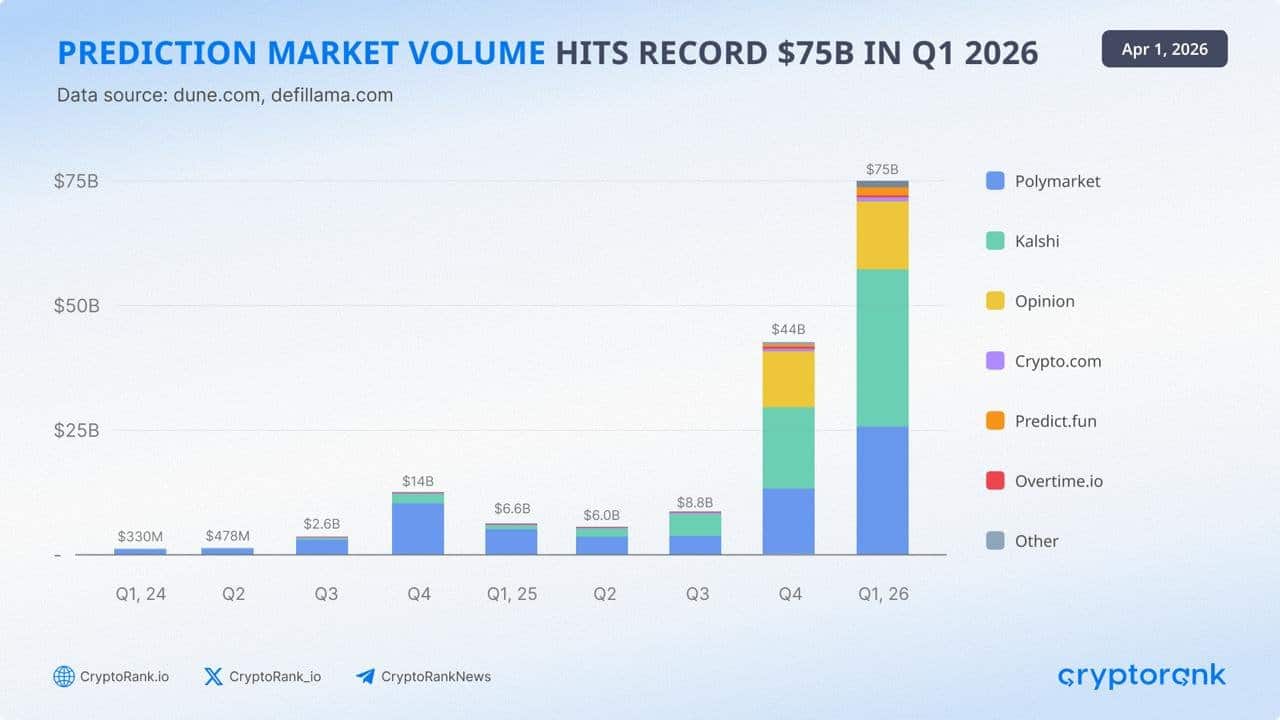
The U.S. Commodity Futures Trading Commission (CFTC) has warned that insider trading laws apply to prediction markets, countering the belief that such activity operates in a regulatory gray area. A senior official stated the CFTC will aggressively pursue cases involving misuse of material non-public information, emphasizing that prediction market contracts fall under existing anti-fraud provisions. The regulator also highlighted exchanges' responsibilities to maintain surveillance systems and avoid listing easily manipulated contracts. This comes as prediction market trading volume surged to $75 billion in Q1 2026, up dramatically from $330 million in Q1 2024, driven by event-based trading on political, economic, and sports outcomes. The CFTC outlined enforcement priorities including insider trading, market manipulation, and retail fraud, while also introducing a new cooperation framework for self-reporting firms.

The U.S. derivatives regulator is sharpening its stance on prediction markets just as the sector sees explosive growth.

In remarks delivered on 31 March, a senior official at the Commodity Futures Trading Commission said insider trading laws do apply to prediction markets, pushing back against a growing narrative that such activity exists in a regulatory gray area.

The agency signaled that it will “aggressively detect, investigate, and prosecute” insider trading involving the misuse of material non-public information.

Insider trading rules extend to event contracts

The CFTC’s enforcement division emphasized that prediction market contracts fall under existing anti-fraud provisions of U.S. commodities law.

That includes trading based on misappropriated information obtained through a breach of duty, a framework commonly known as the “misappropriation theory.”

The remarks directly challenge a widely circulated belief across social media and parts of the crypto industry that insider trading is either permissible or inevitable in prediction markets.

Instead, the agency made clear that such conduct can constitute fraud under the Commodity Exchange Act, particularly when confidential information is used improperly.

Exchanges face growing compliance pressure

The warning was not limited to individual traders.

The CFTC also highlighted the role of exchanges, noting that platforms must maintain surveillance systems, enforce fair trading practices, and avoid listing contracts susceptible to manipulation.

The regulator highlighted risks in certain event-based contracts, including those tied to individual actions or outcomes, where access to non-public information could distort pricing.

Record growth brings regulatory focus

The renewed scrutiny comes as prediction markets scale rapidly.

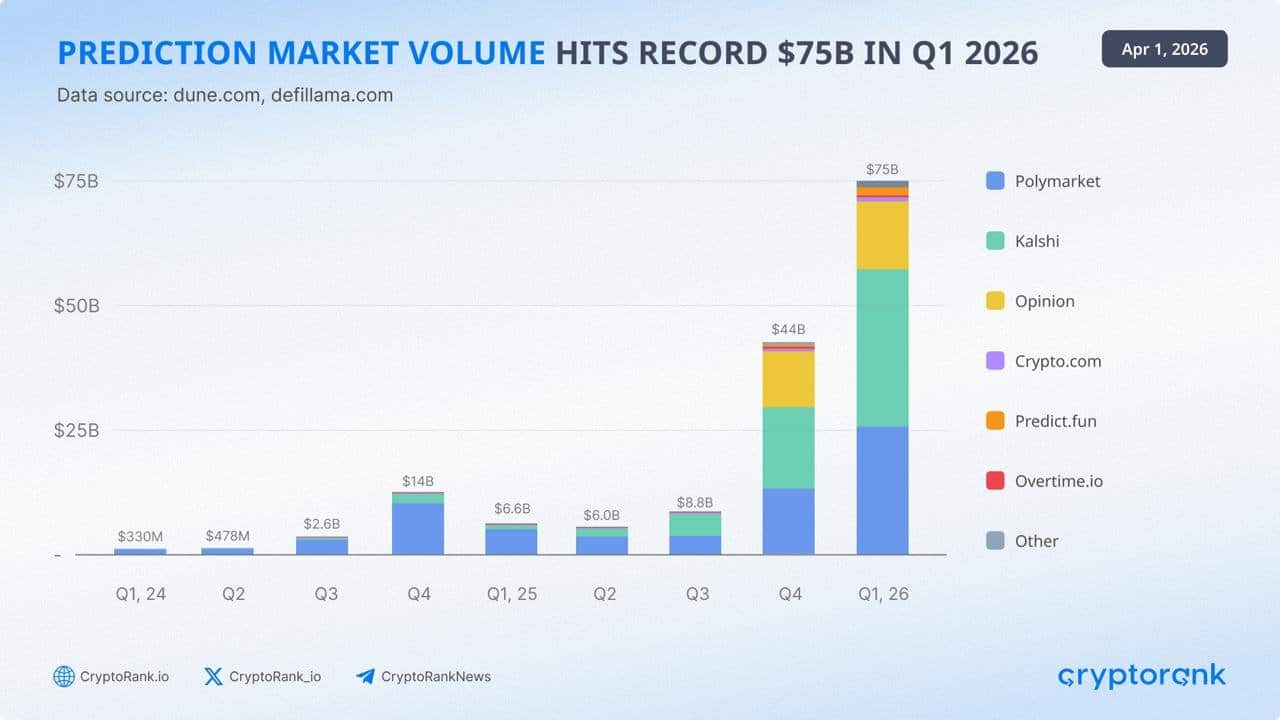
Data from CryptoRank and DeFiLlama shows total trading volume across platforms such as Polymarket and Kalshi reached $75 billion in Q1 2026, up sharply from just $330 million in Q1 2024.

Source: CryptoRank

The growth reflects increasing demand for event-based trading across political outcomes, macroeconomic indicators, and sports markets.

But with that expansion has come rising concern over market integrity, particularly around insider information and potential manipulation.

A shift in enforcement approach

The CFTC also outlined a broader shift in its enforcement approach.

While signaling an end to so-called “regulation by enforcement,” the agency identified five core priorities: insider trading, market manipulation, disruptive trading practices, retail fraud, and willful violations of AML and KYC rules.

At the same time, it plans to introduce a new cooperation framework that could offer declinations for firms that self-report, fully cooperate, and remediate misconduct.


Final Summary

  • Prediction markets have grown rapidly to $75 billion in quarterly volume, drawing increased regulatory scrutiny over insider-trading risks.
  • The CFTC has made clear that insider trading laws apply to these markets, signaling more active enforcement as the sector grows.

Связанные с этим вопросы

QWhat is the CFTC's stance on insider trading in prediction markets according to the article?

AThe CFTC has made clear that insider trading laws apply to prediction markets, and it will 'aggressively detect, investigate, and prosecute' such activity, particularly the misuse of material non-public information.

QWhat was the total trading volume for prediction markets in Q1 2026, and how does it compare to Q1 2024?

AThe total trading volume across prediction market platforms reached $75 billion in Q1 2026, which is a sharp increase from just $330 million in Q1 2024.

QBesides individual traders, who else did the CFTC warn about compliance in its remarks?

AThe CFTC also warned exchanges, highlighting that platforms must maintain surveillance systems, enforce fair trading practices, and avoid listing contracts that are susceptible to manipulation.

QWhat legal framework did the CFTC's enforcement division say prediction market contracts fall under?

AThe CFTC's enforcement division emphasized that prediction market contracts fall under the existing anti-fraud provisions of U.S. commodities law.

QWhat are the five core enforcement priorities the CFTC identified?

AThe five core enforcement priorities identified by the CFTC are: insider trading, market manipulation, disruptive trading practices, retail fraud, and willful violations of AML and KYC rules.

Похожее

The AI Agent Era Accelerates Its Arrival: Questflow Defines a New Paradigm of Financial Intelligence with On-Chain AI Brokerage

The AI Agent era is accelerating, with the CB Insights AI 100 list highlighting global investment confidence. The focus has shifted from whether AI works to its speed of deployment and ability to manage complex workflows, with autonomous AI Agents driving this transformation. At the forefront is Questflow, a Singapore-based startup redefining financial intelligence through its on-chain AI brokerage. Unlike tools that merely provide data dashboards, Questflow deploys AI Agents that proactively scan markets, form judgments, and execute trades via a conversational interface—operating 24/7 without requiring manual confirmation for each decision. This embodies the new AI paradigm of agents capable of executing multi-step workflows autonomously. Questflow's mission is to democratize institutional-grade trading intelligence. Historically reserved for the ultra-wealthy, this capability is now accessible starting from just $1 through Questflow's "AI Clone + Copy Trade" model. The platform charges only a 1% execution fee, aligning its incentives directly with users and eliminating traditional management or performance fees. The timing is opportune, aligning with key trends identified by CB Insights: the scalable deployment of AI Agents, accelerated AI adoption in financial services, and the maturation of on-chain infrastructure. With robust liquidity on platforms like Hyperliquid and Polymarket, alongside advancements in AI reasoning and non-custodial wallet security, Questflow is positioned to merge the roles of broker, fund, and exchange into a single, accessible platform for millions.

链捕手37 мин. назад

The AI Agent Era Accelerates Its Arrival: Questflow Defines a New Paradigm of Financial Intelligence with On-Chain AI Brokerage

链捕手37 мин. назад

Why Pricing Social Interactions is Doomed to Fail?

Titled "Why Putting a Price on Social Interaction Is Doomed to Fail," this article critiques attempts to monetize social networks directly through SocialFi models, arguing their inevitable failure stems from a fundamental misunderstanding of media dynamics. Using Marshall McLuhan's theory of "hot" and "cold" media, the author posits that social networks are inherently "cold" media. Their value isn't contained in individual posts but is co-created through user participation, interpretation, and fragmented, ongoing interaction (e.g., replies, shares). This ambiguity and need for user involvement are core to their function. The article asserts that SocialFi projects like Friend.tech failed because introducing real-time, tradable financial pricing (a definitive "hot" signal) into this "cold" environment doesn't add a layer—it replaces the medium's essence. The unambiguous price signal overshadows and nullifies the nuanced, participatory social signal. Users become traders, not participants, and when speculative profits vanish, the underlying social ecosystem—never genuinely cultivated—collapses entirely. This principle extends beyond crypto. The author argues platforms like Twitter have gradually "heated up" through metrics (likes, retweets counts, algorithmically defined value), shifting users from participants to performers and eroding organic engagement. The solution isn't to abandon capital but to manage its entry point. Successful models like Substack, Patreon, or Bandcamp allow capital to "condense" at specific, isolated nodes (e.g., subscriptions, one-time payments) without permeating and "heating" every social interaction. They preserve the core "cold," participatory medium while enabling monetization at designated boundaries. The NFT boom and bust serves as a stark parallel: the ancient "cold" medium of collecting (valued for story, community, gradual accumulation) was rapidly destroyed by platforms that introduced real-time floor prices, rarity scores, and trading dashboards, transforming collectors into speculators and vaporizing cultural value when prices fell. The core lesson: "Liquidity equals heat." Injecting high liquidity and definitive pricing into a "cold" participatory medium doesn't optimize it; it fundamentally alters and destroys its value-creating mechanism. The future lies not in pricing every social gesture but in finding precise, non-invasive points for capital to condense without overheating the entire ecosystem.

marsbit45 мин. назад

Why Pricing Social Interactions is Doomed to Fail?

marsbit45 мин. назад

Торговля

Спот
Фьючерсы
活动图片