CFTC unveils Innovation Task Force to tackle crypto’s regulatory confusion

ambcryptoОпубликовано 2026-03-25Обновлено 2026-03-25

Введение

The U.S. Commodity Futures Trading Commission (CFTC) has launched an Innovation Task Force aimed at addressing regulatory uncertainty in areas including cryptocurrency, AI, and prediction markets. Chaired by Michael S. Selig, the initiative seeks to create clear guidelines to foster responsible innovation and ensure U.S. market competitiveness. The move signals a shift from ambiguous, enforcement-heavy regulation toward a more structured and collaborative approach between agencies like the CFTC and SEC. While the crypto industry largely welcomes the clarity, some critics caution it may distract from pending legislation like the CLARITY Act. The development also reflects a broader change in U.S. crypto policy, transitioning from the Biden administration’s enforcement-focused strategy to a more growth-oriented framework under Trump.

For years, the U.S. derivatives market operated under ambiguity, where companies waited for guidance but often faced lawsuits instead of clear rules.

Now, that seems to be changing. On the 24th of March, CFTC Chairman Michael S. Selig launched an Innovation Task Force to create clear guidelines, especially for areas like crypto, AI systems, and prediction markets. The purpose of these rules is to facilitate businesses’ establishment and operations in the United States.

CFTC Chief’s new crypto taskforce

Remarking on the same, Chairman Selig added,

By establishing a clear regulatory framework for innovators building on the new frontier of finance, we can foster responsible innovation at home and ensure American market participants are not left on the sidelines.

Regulators are shifting toward a more customized and flexible approach rather than enforcing uniform rules for all situations. The way this task force is set up shows that U.S. regulators may finally start working together instead of competing.

By appointing Michael J. Passalacqua, the CFTC shows this is a key priority, not a side project. Additionally, coordination with the SEC will further help fix past confusion caused by conflicting rules.

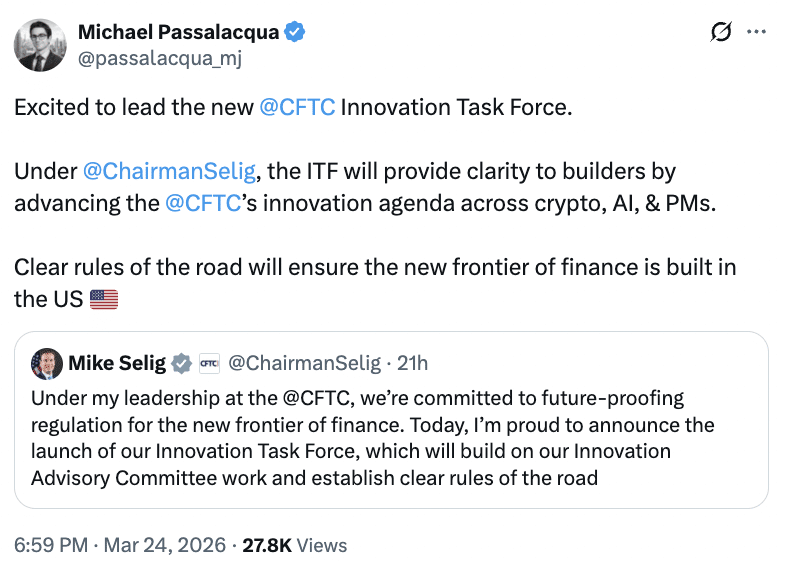
Expressing excitement, Passalacqua took X and noted,
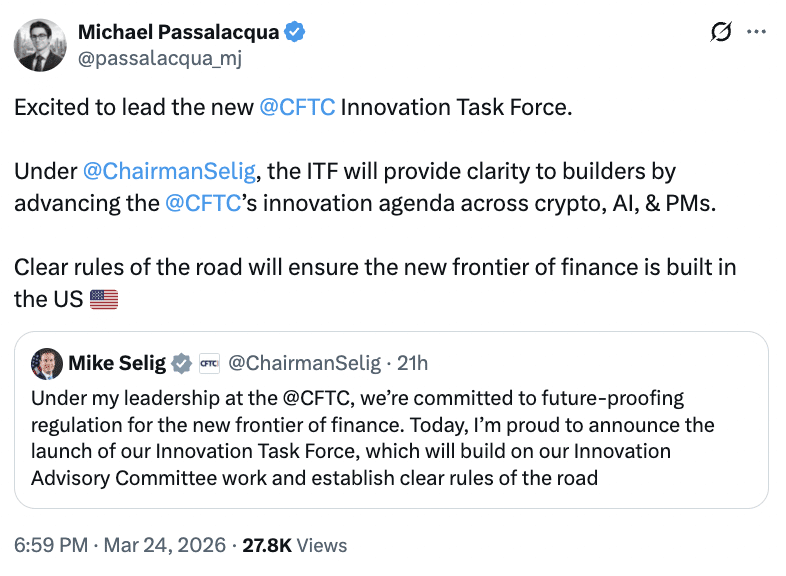
Source: Michael Passalacqua/X

Mixed community reactions

As expected, the crypto industry also sees this as a step toward clearer guidance and easier entry for institutional players. For instance, an X user noted,
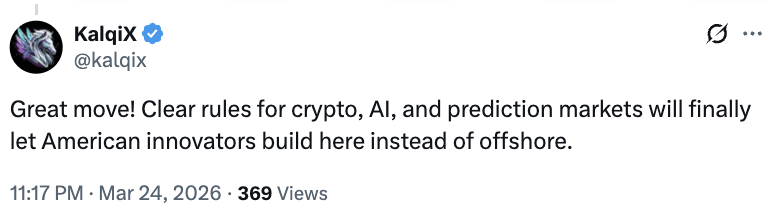
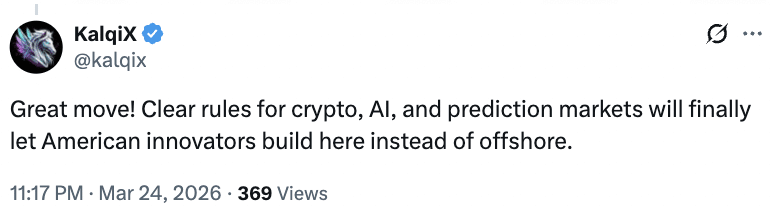
Source: X

However, not everyone shares the same spirit. Some have questioned this move, noting that it may be a distraction from the passage of the CLARITY Act.
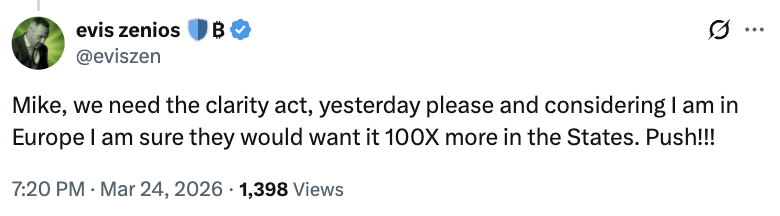
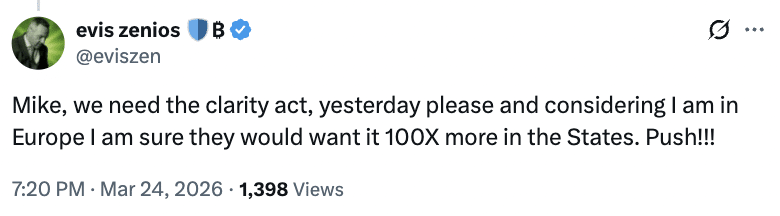
Source: X

That said, these developments also reflect a clear shift in how the U.S. approaches crypto across administrations.

Biden vs. the Trump administration

Under former U.S. President Joe Biden, the strategy was largely enforcement-driven, with the SEC under Gary Gensler relying on lawsuits and strict oversight.

In contrast, under Donald Trump, the administration is taking a more growth-focused path. With leaders like Michael Selig and Paul Atkins, the emphasis is on creating clear, structured rules and encouraging institutional participation.

More developments

Meanwhile, on the 20th of March, the SEC sent proposals to the White House, one on financial transparency and another focused on clearly classifying digital assets.

Together with the CFTC’s new task force, this move could finally move the industry past the long debate over whether crypto is a security or a commodity. If approved, it would give institutions the clarity they need and signal a more stable, well-defined U.S. crypto market.


Final Summary

  • The U.S. is shifting from unclear, enforcement-heavy regulation to a more structured and transparent approach.
  • Better coordination between the CFTC and SEC could reduce past confusion and regulatory overlap.

Связанные с этим вопросы

QWhat is the main purpose of the CFTC's newly launched Innovation Task Force?

AThe main purpose of the CFTC's Innovation Task Force is to create clear regulatory guidelines, especially for areas like crypto, AI systems, and prediction markets, to facilitate businesses' establishment and operations in the United States and foster responsible innovation.

QHow does the appointment of Michael J. Passalacqua signal the importance of this task force?

AThe appointment of Michael J. Passalacqua shows that this initiative is a key priority for the CFTC, not just a side project, indicating a serious commitment to addressing regulatory challenges in emerging technologies.

QWhat contrasting regulatory approaches are highlighted between the Biden and Trump administrations regarding crypto?

AUnder President Biden, the strategy was largely enforcement-driven with lawsuits and strict oversight by the SEC. In contrast, the Trump administration is taking a more growth-focused path, emphasizing clear, structured rules and encouraging institutional participation.

QWhat recent action did the SEC take that could complement the CFTC's new task force?

AOn March 20th, the SEC sent proposals to the White House, one on financial transparency and another focused on clearly classifying digital assets, which could help move the industry past the debate over whether crypto is a security or a commodity.

QWhat was a common criticism or concern from the crypto community regarding the new task force?

ASome in the crypto community questioned the move, noting that it might be a distraction from the passage of the CLARITY Act, expressing skepticism about its immediate impact.

Похожее

Institutional Adoption of Prediction Markets Stuck at the Third Stage

Prediction markets are transitioning from niche platforms focused on elections and sports to mainstream financial tools, as highlighted at Kalshi Research's inaugural conference. While sports still dominate trading volume (around 80%), non-sports categories like macroeconomics, politics, and entertainment are growing faster, signaling a shift from entertainment-based trading to information and risk management tools. Institutions, including Wall Street firms, are increasingly using prediction markets for data reference (Stage 1 adoption), with some progressing to system integration (Stage 2). However, full-scale trading (Stage 3) is limited due to the lack of margin trading, requiring full collateral for positions—a barrier for leverage-dependent entities. Kalshi is working with regulators to introduce margin mechanisms. Key insights from participants like Goldman Sachs and CNBC emphasize the value of real-time pricing for events (e.g., Fed decisions, tariffs), providing benchmarks previously unavailable. The path to maturity mirrors historical financial instruments like options, with expectations that prediction markets will become institutional staples within five years. Political leaders, including Trump and Schumer, now cite Kalshi odds, underscoring its growing influence. The platform rewards domain expertise over traditional finance backgrounds, attracting diverse participants from fields like music and poker. Ultimately, prediction markets are evolving into critical infrastructure for pricing uncertainty.

marsbit33 мин. назад

Institutional Adoption of Prediction Markets Stuck at the Third Stage

marsbit33 мин. назад

The First Year of Computing Power Inflation: The Cheaper DeepSeek Gets, the Harder It Is to Stop This Round of Price Hikes

The year 2026 marks the beginning of "computing power inflation." While AI inference costs have dropped by over 80% in 18 months globally, China's three major cloud providers—Alibaba Cloud, Baidu AI Cloud, and Tencent Cloud—simultaneously announced price hikes of 20–30%. This reflects a deeper structural shift driven by Jevons Paradox: as unit costs fall (e.g., via models like DeepSeek-R1), demand explodes, especially with the rise of reasoning models and AI agents that consume 10–50x more tokens per task. Although DeepSeek open-sourced its model weights, it did not release its inference optimization stack, leaving a significant engineering efficiency gap between cloud providers and smaller players. The big three are leveraging this advantage to reposition: Alibaba focuses on high-margin premium clients, Baidu filters out low-value users, and Tencent capitalizes on ecosystem lock-in. Meanwhile, ByteDance’s Volcano Engine adopts a more moderate pricing strategy to capture displaced customers. Unexpectedly, the price surge is pushing large enterprises toward self-built computing solutions once their cloud bills exceed a certain threshold. While cloud providers aim to boost profitability, they risk driving away innovative startups and accelerating competition from GPU leasing and domestic hardware providers like Huawei. The涨价 trend is expected to persist for 2–3 years, fueled by rising token consumption from reasoning models, AI agent adoption, and NVIDIA export restrictions. The inflection point depends on whether domestic chips can match NVIDIA’s efficiency, likely around 2027–2028. Until then, cloud providers will maintain pricing power, and the key for AI companies is to optimize token usage—the real moat in this era.

marsbit1 ч. назад

The First Year of Computing Power Inflation: The Cheaper DeepSeek Gets, the Harder It Is to Stop This Round of Price Hikes

marsbit1 ч. назад

Торговля

Спот
Фьючерсы

Популярные статьи

Как купить S

Добро пожаловать на HTX.com! Мы сделали приобретение Sonic (S) простым и удобным. Следуйте нашему пошаговому руководству и отправляйтесь в свое крипто-путешествие.Шаг 1: Создайте аккаунт на HTXИспользуйте свой адрес электронной почты или номер телефона, чтобы зарегистрироваться и бесплатно создать аккаунт на HTX. Пройдите удобную регистрацию и откройте для себя весь функционал.Создать аккаунтШаг 2: Перейдите в Купить криптовалюту и выберите свой способ оплатыКредитная/Дебетовая Карта: Используйте свою карту Visa или Mastercard для мгновенной покупки Sonic (S).Баланс: Используйте средства с баланса вашего аккаунта HTX для простой торговли.Третьи Лица: Мы добавили популярные способы оплаты, такие как Google Pay и Apple Pay, для повышения удобства.P2P: Торгуйте напрямую с другими пользователями на HTX.Внебиржевая Торговля (OTC): Мы предлагаем индивидуальные услуги и конкурентоспособные обменные курсы для трейдеров.Шаг 3: Хранение Sonic (S)После приобретения вами Sonic (S) храните их в своем аккаунте на HTX. В качестве альтернативы вы можете отправить их куда-либо с помощью перевода в блокчейне или использовать для торговли с другими криптовалютами.Шаг 4: Торговля Sonic (S)С легкостью торгуйте Sonic (S) на спотовом рынке HTX. Просто зайдите в свой аккаунт, выберите торговую пару, совершайте сделки и следите за ними в режиме реального времени. Мы предлагаем удобный интерфейс как для начинающих, так и для опытных трейдеров.

1.1k просмотров всегоОпубликовано 2025.01.15Обновлено 2025.03.21

Как купить S

Sonic: Обновления под руководством Андре Кронье – новая звезда Layer-1 на фоне спада рынка

Он решает проблемы масштабируемости, совместимости между блокчейнами и стимулов для разработчиков с помощью технологических инноваций.

2.2k просмотров всегоОпубликовано 2025.04.09Обновлено 2025.04.09

Sonic: Обновления под руководством Андре Кронье – новая звезда Layer-1 на фоне спада рынка

HTX Learn: Пройдите обучение по "Sonic" и разделите 1000 USDT

HTX Learn — ваш проводник в мир перспективных проектов, и мы запускаем специальное мероприятие "Учитесь и Зарабатывайте", посвящённое этим проектам. Наше новое направление .

1.7k просмотров всегоОпубликовано 2025.04.10Обновлено 2025.04.10

HTX Learn: Пройдите обучение по "Sonic" и разделите 1000 USDT

Обсуждения

Добро пожаловать в Сообщество HTX. Здесь вы сможете быть в курсе последних новостей о развитии платформы и получить доступ к профессиональной аналитической информации о рынке. Мнения пользователей о цене на S (S) представлены ниже.

活动图片